Aggrastat 0.25 mg/ml concentrate for solution for infusion
Spain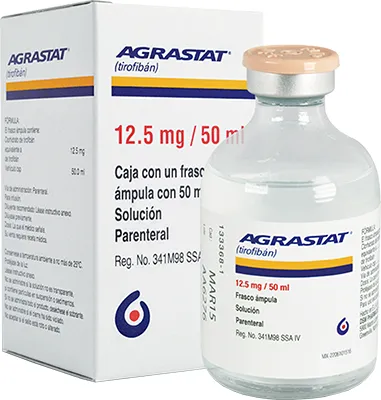
Table of Contents
Patient Information Leaflet
Introduction
Package leaflet: Information for the patient
AGRASTAT 0.25 mg/ml concentrate for solution for infusion
(tirofiban)
Read the entire leaflet carefully before you start using this medicine, as it contains important information for you.
- Keep this leaflet, as you may need to read it again.
- If you have any questions, ask your doctor or pharmacist.
- This medicine has been prescribed for you only, and you should not give it to others, even if they have the same symptoms as you, because it may harm them.
- If you experience any adverse effects, consult your doctor or pharmacist, even if they are adverse effects not listed in this leaflet. See section 4.
Leaflet contents:
- What AGRASTAT is and what it is used for
- What you need to know before using AGRASTAT
- How to use AGRASTAT
- Possible side effects
- How to store AGRASTAT
- Contents of the pack and other information
1. What AGRASTAT is and what it is used for
AGRASTAT is used to help improve blood flow to the heart and to prevent chest pain and heart attacks. It works by preventing platelet aggregation, which are blood cells that form blood clots.
This medicine may also be used in patients whose blood vessels are widened with a balloon (percutaneous coronary intervention or PCI). This procedure involves the placement of a small tube (stent) to improve blood flow to the heart.
AGRASTAT is intended to be used with aspirin and unfractionated heparin.
2. What you need to know before using AGRASTAT
Do not use AGRASTAT:
- If you are allergic (hypersensitive) to tirofiban or to any of the other components of AGRASTAT (listed in section 6.).
- If you have internal bleeding or a history of internal bleeding within the last 30 days.
- If you have a history of intracranial hemorrhage, a brain tumor, or abnormal blood vessels in the brain.
- If you have severe uncontrolled high blood pressure (malignant hypertension).
- If you have low platelet count (thrombocytopenia) or blood coagulation disorders.
- If you developed thrombocytopenia while being treated with AGRASTAT or another medicine in the same therapeutic group.
- If you have had a stroke within the last 30 days or any history of hemorrhagic stroke.
- If you have had a major trauma or major surgery within the last six weeks.
- If you have severe liver failure.
Your doctor will review your medical history to determine whether you are at increased risk of experiencing side effects associated with the use of this medicine.
Warnings and precautions
Talk to your doctor before using AGRASTAT if you have or have had:
- Any medical condition.
- Any allergies.
- Cardiopulmonary resuscitation, biopsy, or lithotripsy within the last 2 weeks.
- Severe trauma or major surgery within the last 3 months.
- A stomach or intestinal (duodenal) ulcer within the last 3 months.
- Recent bleeding disorder (within the last year), such as gastrointestinal bleeding or blood in urine or stools.
- Recent spinal intervention.
- History or symptoms of aortic rupture (aortic dissection).
- Uncontrolled high blood pressure.
- Inflammation of the membrane lining the heart (pericarditis).
- Inflammation of the blood vessels (active vasculitis).
- Blood vessel problems in the back of the eye (retina).
- Problems with medications that help prevent or dissolve blood clots.
- Kidney problems.
- Insertion of a special intravenous catheter below the collarbone within the last 24 hours.
- Heart failure.
- Low blood pressure due to heart failure (cardiogenic shock).
- Liver disorder.
- Low blood count or anemia.
Use of AGRASTAT with other medicines
In general, AGRASTAT can be used with other medicines. Please inform your doctor if you are taking, have recently taken, or might take any other medicines, including over-the-counter medicines, as they may affect the action of these medicines. It is very important that you tell your doctor if you are taking medicines that prevent blood clotting, such as warfarin.
Use of AGRASTAT with food, drinks, and alcohol
Food and drinks do not affect this medicine.
Pregnancy, breastfeeding, and fertility
If you are pregnant or breastfeeding, think you might be pregnant, or plan to become pregnant, consult your doctor before using this medicine.
Driving and using machines
Due to your medical condition, you will not be able to drive or operate machinery while using AGRASTAT.
AGRASTAT contains sodium
This medicine contains approximately 189 mg of sodium per 50 ml vial, which should be taken into consideration when treating patients on sodium-restricted diets.
3. How to use AGRASTAT
AGRASTAT must be prescribed by qualified physicians experienced in the management of acute coronary syndromes.
AGRASTAT is administered intravenously. Your doctor will determine the appropriate dose based on your condition and body weight.
Use in children
Use in children is not recommended.
If you use more AGRASTAT than you should
Your AGRASTAT dose will be carefully monitored and supervised by your doctor and pharmacist.
The most commonly reported adverse effect due to overdose is bleeding. If you experience bleeding, you must inform your doctor immediately.
In case of overdose or accidental ingestion, contact your doctor or pharmacist immediately or call the Toxicology Information Service at telephone number: 91 562 04 20, indicating the medication and the amount ingested.
If you forget to use AGRASTAT
Your doctor will decide when AGRASTAT should be administered.
If you stop using AGRASTAT
Your doctor will determine when treatment should be discontinued. However, if you wish to stop treatment earlier, you should discuss alternative options with your doctor.
If you have any further questions about the use of this medicine, ask your doctor or pharmacist.
4. Possible adverse effects
Like all medicines, this medicine can cause adverse effects, although not everyone gets them.
The most common adverse effect with AGRASTAT is bleeding, which can occur anywhere in your body. This adverse effect can be serious and, rarely, may be fatal.
If you experience adverse effects, you may require medical attention. While you are receiving AGRASTAT, if you develop any of the following symptoms, you must contact your doctor immediately:
- Signs of intracranial bleeding such as headache, sensory deficits (visual or hearing), difficulty speaking, numbness, or problems with movement or balance.
- Signs of internal bleeding such as coughing up blood or presence of blood in urine or stools.
- Signs of serious allergic reactions such as difficulty breathing or dizziness.
Listed below are adverse effects that have occurred in patients treated with AGRASTAT. These adverse effects are classified in decreasing order of frequency.
Very common adverse effects (may affect more than 1 in 10 people):
Bleeding after surgery
Bleeding under the skin at the injection site, or in the muscle causing swelling
Small red spots on the skin (petechiae)
Occult blood in urine or stools
Dizziness
Headache
Common adverse effects (may affect up to 1 in 10 people):
Blood in urine
Coughing up blood
Nosebleeds
Bleeding from gums and mouth
Bleeding at puncture site
Reduction in blood count (decrease in hematocrit and hemoglobin)
Decrease in platelet count below 90,000/mm³
Fever
Uncommon adverse effects (may affect up to 1 in 100 people):
Bleeding in stomach or intestine
Vomiting blood
Decrease in platelet count below 50,000/mm³
Adverse effects of unknown frequency (cannot be estimated from the available data):
Intracranial bleeding
Spinal hematoma
Retroperitoneal bleeding
Accumulation of blood around the heart (cardiac tamponade)
Pulmonary hemorrhage
Acute and severe decrease in platelet count below 20,000/mm³
Severe allergic reactions with chest tightness, urticaria, including reactions that may cause difficulty breathing and dizziness.
Reporting of adverse effects
If you experience any type of adverse effect, talk to your doctor or pharmacist, even if it is a possible adverse effect not listed in this leaflet. You can also report them directly via the Spanish Pharmacovigilance System for Human Medicines: www.notificaRAM.com. By reporting adverse effects, you can help provide more information on the safety of this medicine.
5. Storage of AGRASTAT
Your doctor or pharmacist will know how to store and dispose of this medicine.
Keep this medicine out of the sight and reach of children.
Do not use this medicine after the expiry date stated on the bag after EXP. The expiry date is the last day of the month indicated.
Do not freeze.
Do not use AGRASTAT if visible particles are present or if the solution is discolored before use.
Medicines must not be disposed of via wastewater or household waste. Dispose of containers and unused medicines at the SIGRE collection point at your pharmacy. In case of doubt, ask your pharmacist how to dispose of containers and medicines you no longer need. This will help protect the environment.
6. Contents of the container and other information
Composition of AGRASTAT
The active substance is tirofiban hydrochloride monohydrate.
1 ml contains 281 micrograms of tirofiban hydrochloride monohydrate, equivalent to 250 micrograms of tirofiban.
The other components are: Sodium chloride, sodium citrate dihydrate, anhydrous citric acid, water for injection, hydrochloric acid and/or sodium hydroxide (for pH adjustment).
Appearance of AGRASTAT and contents of the container
AGRASTAT is a clear, colourless, concentrated solution supplied in 50 ml Type I glass vials.
Marketing Authorisation Holder and Manufacturer
Marketing Authorisation Holder
Advanz Pharma Limited
Unit 17, Northwood House,
Northwood Crescent,
Dublin 9,
D09 V504,
Ireland
Manufacturer
Orion Corporation, Orion Pharma Espoo site
Orionintie 1, FI 00220, Espoo, Finland
Or
Tjoapack Netherlands B.V.
Nieuwe Donk 9, Etten-Leur, 4879 AC,
The Netherlands
Local representative:
Advanz Pharma Spain S.L.U.
Paseo de la Castellana 135,
7th floor, 28046 Madrid (Spain)
Tel: +34 900 834 889
[email protected]
Date of the most recent review of this summary: October 2013
Other sources of information
Detailed information on this medicinal product is available on the European Medicines Agency website: http://www.ema.europa.eu/.
This information is intended for healthcare professionals only:
This product is intended exclusively for hospital use and must be administered by physicians experienced in the treatment of acute coronary syndromes.
AGRASTAT concentrate must be diluted before use.
AGRASTAT must be administered with unfractionated heparin and oral antiplatelet therapy, including acetylsalicylic acid (ASA).
Dosage and method of administration
In patients treated with an early invasive strategy for non-ST-segment elevation acute coronary syndrome (NSTE-ACS) who are not scheduled to undergo angiography within at least 4 hours and up to 48 hours after diagnosis, AGRASTAT is administered intravenously at an initial infusion rate of 0.4 micrograms/kg/min for 30 minutes. At the end of the initial infusion, AGRASTAT should be continued at a maintenance infusion rate of 0.1 micrograms/kg/min. AGRASTAT should be administered with unfractionated heparin (typically an intravenous bolus of 50–60 units (U)/kg administered simultaneously with the initiation of AGRASTAT therapy, followed by approximately 1,000 (U) per hour, adjusted according to activated partial thromboplastin time (aPTT), which should be approximately twice the normal value) and oral antiplatelet therapy, including but not limited to ASA, unless contraindicated.
In patients with NSTE-ACS undergoing scheduled percutaneous coronary intervention (PCI) within the first 4 hours after diagnosis, or in patients with acute myocardial infarction undergoing scheduled primary PCI, AGRASTAT should be administered using an initial bolus of 25 micrograms/kg given over a 3-minute period, followed by continuous infusion at a rate of 0.15 micrograms/kg/min for 12–24 hours, and up to 48 hours. AGRASTAT should be administered with unfractionated heparin (as indicated above) and oral antiplatelet therapy, including but not limited to acetylsalicylic acid (ASA), unless contraindicated.
No dose adjustment is required for elderly patients.
Patients with severe renal impairment
In patients with severe renal impairment (creatinine clearance <30 ml/min), the dose of AGRASTAT should be reduced by 50%.
Paediatric population
The safety and efficacy of AGRASTAT in children have not been established.
No data are available.
Initiation and duration of AGRASTAT treatment
In patients treated with an early invasive strategy for non-ST-segment elevation acute coronary syndrome (NSTE-ACS) who are not scheduled to undergo angiography within at least 4 hours and up to 48 hours after diagnosis, the AGRASTAT dosing regimen should be initiated after diagnosis at a loading rate of 0.4 micrograms/kg/min. The recommended duration of maintenance infusion should be at least 48 hours. Infusion of AGRASTAT and unfractionated heparin should continue during coronary angiography and should be maintained for at least 12 hours and no more than 24 hours after angioplasty/atherectomy. Once the patient is clinically stable and no further coronary intervention is planned by the physician, the infusion should be discontinued. Total duration of treatment should not exceed 108 hours.
If a patient diagnosed with NSTE-ACS is treated with an invasive strategy and undergoes angiography within 4 hours of diagnosis, the bolus dosing regimen of AGRASTAT (25 micrograms/kg) should be initiated at the beginning of PCI, followed by continuous infusion for 12 to 24 hours and up to 48 hours.
In patients with acute myocardial infarction undergoing scheduled primary PCI, the bolus infusion regimen should be initiated as soon as possible after diagnosis.
Concomitant therapy (unfractionated heparin, oral antiplatelet therapy including ASA)
Unfractionated heparin therapy is initiated with an intravenous bolus of 50–60 U/kg, followed by a maintenance infusion of 1,000 units per hour. Heparin dosage should be titrated to maintain an activated partial thromboplastin time (aPTT) of approximately twice the normal value.
Unless contraindicated, all patients should receive oral antiplatelet agents, including but not limited to ASA, prior to initiation of AGRASTAT therapy. This medication should be continued for at least the duration of AGRASTAT infusion.
Most studies investigating AGRASTAT administration as an adjunct to PCI have used ASA in combination with clopidogrel as oral antiplatelet therapy. The efficacy of AGRASTAT in combination with prasugrel or ticagrelor has not been established in randomised, controlled trials.
If angioplasty (PCI) is required, heparin should be discontinued after PCI, and catheters should be removed once coagulation has returned to normal, for example, when activated coagulation time (ACT) is less than 180 seconds (typically 2–6 hours after discontinuation of heparin).
Incompatibilities
Cases of incompatibility with diazepam have been reported. Therefore, AGRASTAT and diazepam must not be administered through the same intravenous line.
No incompatibilities have been found between AGRASTAT and the following intravenous formulations: atropine sulfate, dobutamine, dopamine, epinephrine hydrochloride, furosemide, heparin, lidocaine, midazolam hydrochloride, morphine sulfate, nitroglycerin, potassium chloride, propranolol hydrochloride, and injectable famotidine.
Instructions for use:
AGRASTAT Concentrate must be diluted before use:
-
Withdraw 50 ml from a 250 ml container of 0.9% sterile saline or 5% glucose in water, and replace it with 50 ml of AGRASTAT (from a 50 ml puncture vial) to achieve a concentration of 50 micrograms/ml. Mix well before use.
-
Use according to the dosing table.
The following table is provided as a guide for dose adjustment based on body weight.
Patient weight (kg) |
0.4 micrograms/kg/min Loading dose regimen Most patients |
0.4 micrograms/kg/min Loading dose regimen Severe renal impairment |
25 micrograms/kg Bolus dose regimen Most patients |
25 micrograms/kg Bolus dose regimen Severe renal impairment |
||||
30-minute loading infusion rate (ml/h) |
Maintenance infusion rate (ml/h) |
30-minute loading infusion rate (ml/h) |
Maintenance infusion rate (ml/h) |
Bolus (ml) |
Maintenance infusion rate (ml/h) |
Bolus (ml) |
Maintenance infusion rate (ml/h) |
|
30–37 |
16 |
4 |
8 |
2 |
17 |
6 |
8 |
3 |
38–45 |
20 |
5 |
10 |
3 |
21 |
7 |
10 |
4 |
46–54 |
24 |
6 |
12 |
3 |
25 |
9 |
13 |
5 |
55–62 |
28 |
7 |
14 |
4 |
29 |
11 |
15 |
5 |
63–70 |
32 |
8 |
16 |
4 |
33 |
12 |
17 |
6 |
71–79 |
36 |
9 |
18 |
5 |
38 |
14 |
19 |
7 |
80–87 |
40 |
10 |
20 |
5 |
42 |
15 |
21 |
8 |
88–95 |
44 |
11 |
22 |
6 |
46 |
16 |
23 |
8 |
96–104 |
48 |
12 |
24 |
6 |
50 |
18 |
25 |
9 |
105–112 |
52 |
13 |
26 |
7 |
54 |
20 |
27 |
10 |
113–120 |
56 |
14 |
28 |
7 |
58 |
21 |
29 |
10 |
121–128 |
60 |
15 |
30 |
8 |
62 |
22 |
31 |
11 |
129–137 |
64 |
16 |
32 |
8 |
67 |
24 |
33 |
12 |
138–145 |
68 |
17 |
34 |
9 |
71 |
25 |
35 |
13 |
146–153 |
72 |
18 |
36 |
9 |
75 |
27 |
37 |
13 |
AGRASTAT Concentrate must first be diluted as indicated in Instructions for use
- Whenever solution and container permit, parenteral medicinal products should be inspected visually for particulate matter and discoloration prior to administration.
- AGRASTAT must be administered only by intravenous route and may be administered with unfractionated heparin through the same infusion line.
- It is recommended to administer AGRASTAT using a calibrated infusion set with sterile equipment.
- Care must be taken not to prolong the infusion of the loading dose and to avoid calculation errors in infusion rates for the maintenance dose based on patient weight.
Special storage precautions
Do not use AGRASTAT after the expiry date stated on the label and outer packaging. The expiry date refers to the last day of the month indicated.
Do not freeze. Keep the container in the outer carton to protect it from light.
After dilution, the product should be used immediately. If not used immediately, storage conditions must not exceed 24 hours at 2–8°C.
Nature and contents of the product and pack
AGRASTAT is a clear, colourless concentrated solution supplied in 50 ml Type I glass vials.
Special precautions for disposal and other handling
Disposal of unused medicine and of all materials that have come into contact with it must be carried out in accordance with local regulations.
"Detailed and up-to-date information on this medicinal product is available on the website of the Spanish Agency for Medicines and Health Products (AEMPS) at http://www.aemps.gob.es/"