Afstyla 500 IU powder and solvent for solution for injection
Spain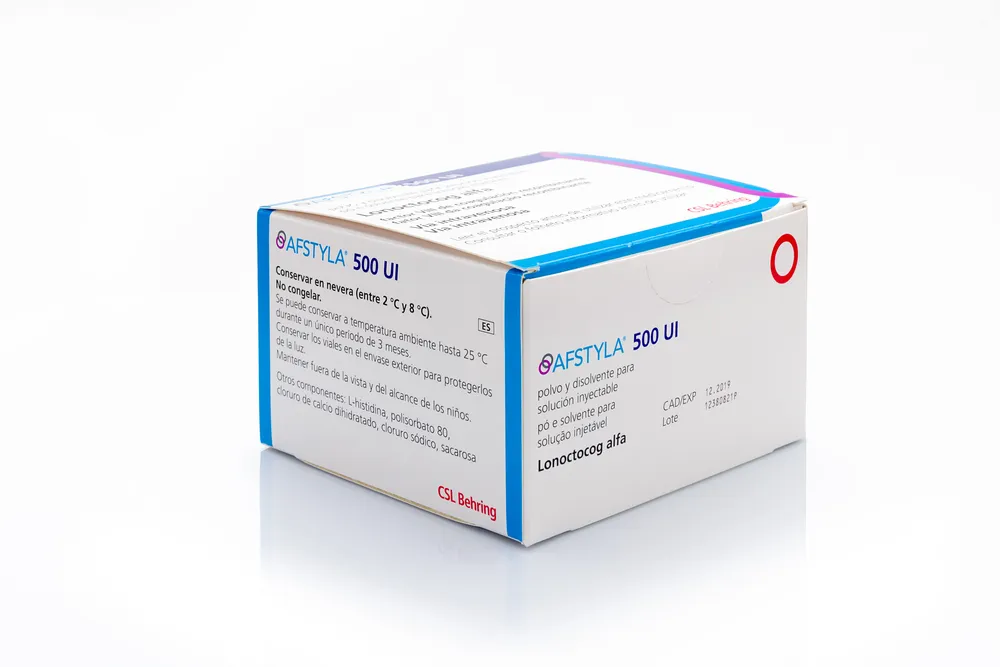
Table of Contents
Package Leaflet: Information for the User
Introduction
Package Leaflet: Information for the User
AFSTYLA 250 IU, powder and solvent for solution for injection
AFSTYLA 500 IU, powder and solvent for solution for injection
AFSTYLA 1,000 IU, powder and solvent for solution for injection
AFSTYLA 1,500 IU, powder and solvent for solution for injection
AFSTYLA 2,000 IU, powder and solvent for solution for injection
AFSTYLA 2,500 IU, powder and solvent for solution for injection
AFSTYLA 3,000 IU, powder and solvent for solution for injection
lonoctocog alfa (recombinant single-chain coagulation factor VIII)
Read the entire leaflet carefully before you or your child starts using this medicine, because it contains important information for you.
- Keep this leaflet, as you may need to read it again.
- If you have any questions, consult your doctor, pharmacist, or nurse.
- This medicine has been prescribed for you or your child only, and you should not give it to others, even if they have the same symptoms as you, because it may harm them.
- If you experience any adverse reactions, consult your doctor, pharmacist, or nurse, even if they are possible adverse reactions not listed in this leaflet. See section 4.
Leaflet Contents:
- What AFSTYLA is and what it is used for
- What you need to know before you or your child starts using AFSTYLA
- How to use AFSTYLA
- Possible side effects
- How to store AFSTYLA
- Contents of the pack and other information
1. What AFSTYLA is and what it is used for
AFSTYLA is a human coagulation factor VIII product produced using recombinant DNA technology. The active substance in AFSTYLA is lonoctocog alfa.
AFSTYLA is used to treat and prevent bleeding episodes in patients with haemophilia A (congenital factor VIII deficiency). Factor VIII is a protein necessary for blood clotting. Patients with haemophilia A lack this factor, which causes their blood not to clot as quickly as it should, resulting in an increased tendency to bleed. AFSTYLA works by replacing the missing factor VIII in patients with haemophilia A, enabling their blood to clot normally.
AFSTYLA can be used in all age groups.
2. What you need to know before you or your child start using AFSTYLA
Do not use AFSTYLA
- If the patient has previously experienced a potentially life-threatening allergic reaction to AFSTYLA or to any of its components (listed in section 6).
- If the patient is allergic to hamster proteins.
Warnings and precautions
Traceability
It is important to keep a record of the batch number of AFSTYLA.
Therefore, each time you start using a new pack of AFSTYLA, write down the date and the batch number (shown on the box after "Batch") and keep this information in a safe place.
Talk to your doctor, pharmacist, or nurse before starting to use AFSTYLA.
- Allergic reactions (hypersensitivity) may occur. The product contains traces of hamster proteins (see also "Do not use AFSTYLA"). If symptoms of allergy occur, stop treatment immediately and contact your doctor. Your doctor should inform you about the early signs of allergic reactions. These include hives, widespread rash, tightness in the chest, difficulty breathing, drop in blood pressure, and anaphylaxis (a severe allergic reaction causing serious breathing problems and dizziness).
- The development of inhibitors (antibodies) is a known complication that may occur during treatment with all factor VIII-containing medicines. These inhibitors, especially when present in high amounts, may prevent the treatment from working properly. You or your child will be closely monitored for the development of inhibitors. If bleeding in you or your child is not controlled by AFSTYLA, contact your doctor immediately.
- If you have been told that you or your child has heart disease or is at risk of heart disease, inform your doctor or pharmacist.
- If a central venous access device (CVAD) is used for the injection of AFSTYLA, your doctor should consider and discuss with you the risk of complications such as local infections, bacteria in the blood (bacteraemia), and clot formation (thrombosis) in blood vessels at the site of insertion.
Other medicines and AFSTYLA
Inform your doctor or pharmacist if you are taking, have recently taken, or might need to take any other medicines.
Pregnancy and breastfeeding
- If you are pregnant or breastfeeding, think you may be pregnant, or are planning to become pregnant, consult your doctor or pharmacist before using this medicine.
- During pregnancy and breastfeeding, AFSTYLA should only be administered if clearly necessary.
Driving and using machines
AFSTYLA does not affect your ability to drive or operate machinery.
AFSTYLA contains sodium
This medicine contains 35 mg of sodium (main component of table/cooking salt) per vial. This corresponds to 1.8% of the maximum daily recommended sodium intake for an adult.
3. How to use AFSTYLA
Your treatment should be supervised by a physician experienced in the management of blood coagulation disorders.
Always follow exactly the dosing instructions given by your doctor. In case of doubt, consult your doctor again.
Dosage
The amount of AFSTYLA you or your child need and the duration of treatment depend on:
- the severity of your condition
- the location and severity of the bleeding
- your clinical condition and clinical response
- your body weight
Follow your doctor's instructions.
Reconstitution and administration
General instructions
- The powder must be mixed with the solvent (liquid) and withdrawn from the vial under aseptic conditions.
- AFSTYLA must not be mixed with other medicines or solvents except those mentioned in section 6.
- The solution should be transparent or slightly opalescent, ranging from yellow to colorless; that is, it may shimmer when exposed to light but must not contain any visible particles. After filtering or withdrawing the solution (see below), it should be inspected again before use. Do not use the solution if it is visibly cloudy or contains flakes or particles.
- Disposal of unused product and all residual materials must be carried out in accordance with local regulations and your doctor's instructions.
Reconstitution and administration
Without opening any of the vials, ensure that the AFSTYLA powder and the liquid are at room or body temperature. This can be achieved by leaving the vials at room temperature for about one hour or by holding them in your hands for a few minutes. Do not expose the vials to direct heat. The vials must not be heated above body temperature (37 °C).
Carefully remove the protective caps from the vials, then clean the exposed portion of the rubber stoppers with an alcohol-impregnated wipe. Allow the vials to dry before opening the Mix2Vial kit (which contains the transfer device with filter), and then follow the instructions below.
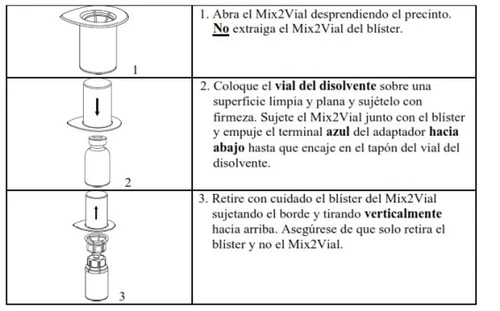
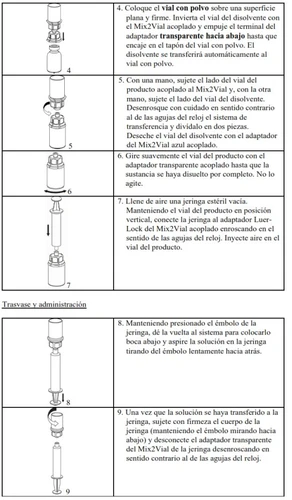
Use the venipuncture kit supplied with the product and insert the needle into a vein. Allow blood to flow to the end of the tubing. Attach the syringe to the luer-lock end of the venipuncture kit. Slowly inject the reconstituted solution (at a comfortable rate, up to a maximum of 10 mL/min) into the vein, according to your doctor's instructions. Try to avoid blood entering the syringe containing the product.
Monitor for adverse reactions immediately after injection. If you experience any adverse reaction that may be related to the administration of AFSTYLA, the infusion should be stopped (see also section 2).
Use in children and adolescents
AFSTYLA can be used in children and adolescents of all ages. In children under 12 years of age, higher doses or more frequent injections may be required. In adolescents aged 12 years and older, the same dose as in adults may be used.
If you use more AFSTYLA than you should
If you have administered more AFSTYLA than prescribed, inform your doctor immediately.
If you forget to use AFSTYLA
Do not administer a double dose to make up for the missed dose. Administer the next dose as soon as possible and continue following your doctor's instructions.
If you stop using AFSTYLA
If you discontinue treatment with AFSTYLA, you may no longer be protected against bleeding, or you may fail to stop bleeding if you are currently experiencing a bleed. Do not stop using AFSTYLA without first consulting your doctor.
If you have any further questions about the use of this medicine, ask your doctor, pharmacist, or nurse.
4. Possible adverse effects
Like all medicines, AFSTYLA can cause adverse effects, although not everyone will experience them.
Stop using the medicine immediately and contact your doctor if:
- you notice symptoms of an allergic reaction
- Allergic reactions may occur, including the following symptoms: hives, generalized urticaria (itchy rash), chest tightness, wheezing, low blood pressure, and anaphylaxis (a serious reaction causing severe breathing difficulty or dizziness). If this occurs, you must stop taking the medicine immediately and contact your doctor.
- you notice the medicine is no longer working properly (bleeding does not stop). In children who have not previously been treated with factor VIII medicines, inhibitory antibodies (see section 2) may develop frequently (more than 1 in 10 patients); however, in patients who have previously received factor VIII treatment (more than 150 days of treatment), the risk is uncommon (less than 1 in 100 patients). If you or your child has developed an inhibitor due to this medicine, you may experience persistent bleeding. If this occurs, you must contact your doctor immediately.
Frequent adverse effects (may affect up to 1 in 10 people)
- Tingling or numbness (paresthesia).
- Skin rash.
- Fever.
Uncommon adverse effects (may affect up to 1 in 100 people)
- Pruritus.
- Skin redness.
- Pain at injection site.
- Chills.
- Feeling of warmth.
Adverse effects in children and adolescents
No age-specific differences in adverse reactions have been observed between children, adolescents, and adults.
Reporting of adverse effects
If you experience any adverse effect, talk to your doctor, pharmacist, or nurse, even if it is a possible adverse effect not listed in this leaflet. You may also report them directly through the national reporting system detailed in Appendix V. By reporting adverse effects, you can help provide more information on the safety of this medicine.
5. Storage of AFSTYLA
-
Keep this medicine out of the sight and reach of children.
-
Do not use this medicine after the expiry date stated on the label and on the carton.
-
Store in a refrigerator (between 2 °C and 8 °C).
-
Before reconstituting the AFSTYLA powder, it may be stored at room temperature (below 25 °C) for a single period not exceeding 3 months, within the expiry date printed on the cartons and vials. Record the date when storage of AFSTYLA at room temperature is started on the medicine carton.
-
Once removed from the refrigerator, the medicine must not be returned to it.
-
Do not freeze.
-
Keep the vial in its carton to protect it from light.
-
After reconstitution, the medicine should preferably be used immediately.
-
If the reconstituted product is not administered immediately, the storage times and conditions prior to use are the responsibility of the user.
6. Contents of the pack and other information
Composition of AFSTYLA
The active substance is:
250 IU per vial; after reconstitution with 2.5 ml of water for injections, the solution contains 100 IU/ml of lonoctocog alfa.
500 IU per vial; after reconstitution with 2.5 ml of water for injections, the solution contains 200 IU/ml of lonoctocog alfa.
1,000 IU per vial; after reconstitution with 2.5 ml of water for injections, the solution contains 400 IU/ml of lonoctocog alfa.
1,500 IU per vial; after reconstitution with 5 ml of water for injections, the solution contains 300 IU/ml of lonoctocog alfa.
2,000 IU per vial; after reconstitution with 5 ml of water for injections, the solution contains 400 IU/ml of lonoctocog alfa.
2,500 IU per vial; after reconstitution with 5 ml of water for injections, the solution contains 500 IU/ml of lonoctocog alfa.
3,000 IU per vial; after reconstitution with 5 ml of water for injections, the solution contains 600 IU/ml of lonoctocog alfa.
The other components are:
L-histidine, polysorbate 80, calcium chloride dihydrate, sodium chloride (see the last section of section 2), sucrose.
Solvent: water for injections.
Appearance of AFSTYLA and contents of the pack
AFSTYLA is presented as a white or slightly yellowish powder or friable mass, and solvent for a clear, colourless solution for injection.
The reconstituted solution should be clear or slightly opalescent, yellow to colourless; that is, it may shimmer when exposed to light but must not contain any visible particles.
Pack presentations
A pack containing 250, 500 or 1,000 IU comprising:
1 vial with powder
1 vial with 2.5 ml of water for injections
1 transfer device with 20/20 filter
An inner carton containing:
1 disposable 5 ml syringe
1 venous access device
2 alcohol-impregnated wipes
1 non-sterile dressing
A pack containing 1,500, 2,000, 2,500 or 3,000 IU comprising:
1 vial with powder
1 vial with 5 ml of water for injections
1 transfer device with 20/20 filter
An inner carton containing:
1 disposable 10 ml syringe
1 venous access device
2 alcohol-impregnated wipes
1 non-sterile dressing
Only certain pack sizes may be marketed.
Primary packaging
250 IU | Clear glass vial with rubber stopper, orange plastic disc, and green striped aluminum cap |
500 IU | Clear glass vial with rubber stopper, blue plastic disc, and green striped aluminum cap |
1,000 IU | Clear glass vial with rubber stopper, green plastic disc, and green striped aluminum cap |
1,500 IU | Clear glass vial with rubber stopper, turquoise plastic disc, and green striped aluminum cap |
2,000 IU | Clear glass vial with rubber stopper, purple plastic disc, and green striped aluminum cap |
2,500 IU | Clear glass vial with rubber stopper, light grey plastic disc, and green striped aluminum cap |
3,000 IU | Clear glass vial with rubber stopper, yellow plastic disc, and green striped aluminum cap |
Marketing Authorization Holder and Manufacturing Responsible
CSL Behring GmbH
Emil-von-Behring-Straße 76
35041 Marburg
Germany
For further information regarding this medicinal product, please contact the local representative of the Marketing Authorization Holder:
Belgium/Belgium/Belgium CSL Behring NV Tel/Tel: +32 15 28 89 20 | Lithuania CentralPharma Communications UAB Tel: +370 5 243 0444 |
| Luxembourg/Luxembourg CSL Behring NV Tel/Tel: +32 15 28 89 20 |
Czech Republic CSL Behring s.r.o. Tel: +420 702 137 233 | Hungary CSL Behring Kft. Tel.: +36 1 213 4290 |
Denmark CSL Behring AB Tlf: +46 8 544 966 70 | Malta AM Mangion Ltd. Tel: +356 2397 6333 |
Germany CSL Behring GmbH Tel: +49 6190 75 84810 | Netherlands CSL Behring BV Tel: +31 85 111 96 00 |
Estonia CentralPharma Communications OÜ Tel: +3726015540 | Norway CSL Behring AB Tlf: +46 8 544 966 70 |
Greece CSL Behring ΕΠΕ Tel: +30 210 7255 660 | Austria CSL Behring GmbH Tel: +43 1 80101 1040 |
Spain CSL Behring S.A. Tel: +34 933 67 1870 | Poland CSL Behring Sp.z o.o. Tel: +48 22 213 22 65 |
France CSL Behring S.A. Tél: +33 –(0)-1 53 58 54 00 | Portugal CSL Behring Lda Tel: +351 21 782 62 30 |
Croatia Marti Farm d.o.o. Tel: +385 1 5588297 | Romania Prisum Healthcare S.R.L. Tel: +40 21 322 0171 |
Ireland CSL Behring GmbH Tel: +49 6190 75 84700 Iceland CSL Behring AB Sími: +46 8 544 966 70 | Slovenia Emmes Biopharma Global s.r.o. podružnica v Sloveniji Tel: +386 41 42 0002 Slovakia CSL Behring Slovakia s.r.o. Tel: +421 911 653 862 |
Italy CSL Behring S.p.A. Tel: +39 02 34964 200 | Finland/Finland CSL Behring AB Puh/Tel: +46 8 544 966 70 |
Cyprus CSL Behring ΕΠΕ Τηλ: +30 210 7255 660 | Sweden CSL Behring AB Tel: +46 8 544 966 70 |
Latvia CentralPharma Communications SIA Tel: +371 6 7450497 | |
Date of the most recent review of this summary: {MM/YYYY}
Detailed information on this medicine is available on the European Medicines Agency website: http://www.ema.europa.eu.
This information is intended for healthcare professionals only:
Treatment Monitoring
During treatment, appropriate monitoring of factor VIII levels is recommended to determine the dose to be administered and the frequency of injections. Patients' responses to factor VIII may vary, reflecting differences in half-life and recovery. Doses based on body weight may need to be adjusted in patients who are underweight or overweight. In the special case of major surgical procedures, accurate monitoring of replacement therapy using coagulation assays (plasma factor VIII activity) is essential.
When using a one-stage coagulation assay based on activated partial thromboplastin time (aPTT) in vitro to determine factor VIII activity in patient blood samples, the results for plasma factor VIII activity may be significantly affected by both the type of aPTT reagent and the reference standard used in the assay. Significant discrepancies may also occur between results obtained with the one-stage aPTT-based coagulation assay and those obtained with the chromogenic assay according to the European Pharmacopoeia. This is particularly important when changing the laboratory or the reagents used in the assay.
Plasma factor VIII activity in patients receiving AFSTYLA should be monitored using either a chromogenic assay or a one-stage coagulation assay to guide dosing and the frequency of repeated injections. The chromogenic assay result more accurately reflects the clinical haemostatic potential of AFSTYLA and is therefore the preferred method. The result from the one-stage coagulation assay underestimates factor VIII activity levels by approximately 45% compared to the chromogenic assay result. If a one-stage coagulation assay is used, the result should be multiplied by a conversion factor of 2 to determine the patient's factor VIII activity level.
Posology
The dose and duration of replacement therapy depend on the severity of factor VIII deficiency, the location and extent of bleeding, and the patient's clinical condition.
The number of factor VIII units administered is expressed in International Units (IU), corresponding to the current WHO standard concentrate for factor VIII-containing medicinal products. Factor VIII activity in plasma is expressed as a percentage (relative to normal human plasma) or, preferably, in International Units (relative to an international standard for factor VIII in plasma).
One International Unit (IU) of factor VIII activity is equivalent to the amount of factor VIII present in 1 ml of normal human plasma.
Potency assignment is determined using a chromogenic substrate assay.
Plasma factor VIII levels can be monitored using either a chromogenic substrate assay or a one-stage coagulation assay.
On-demand treatment
The calculation of the required dose of factor VIII is based on the empirical finding that 1 International Unit (IU) of factor VIII per kg of body weight increases plasma factor VIII activity by 2 IU/dL.
The required dose is determined using the following formula:
Dose (IU) = body weight (kg) × desired increase in factor VIII (IU/dL or % of normal level) × 0.5 (IU/kg per IU/dL)
The dose and frequency of administration should always be established according to the observed clinical efficacy in each individual case.
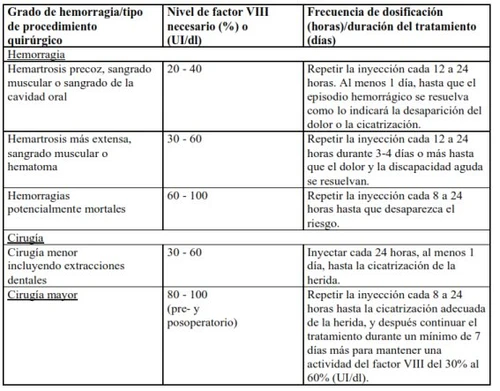
In the following bleeding events, factor VIII activity should not fall below the established plasma activity level (in % of normal level or IU/dL) during the corresponding period. The following table may be used as a dosing guide for bleeding episodes and surgery:
Prophylactic treatment
The recommended initial treatment regimen is 20 to 50 IU/kg of AFSTYLA administered 2 or 3 times per week. This regimen may be adjusted based on the patient's response.
Paediatric population
The recommended initial treatment regimen in children (0 to <12 years of age) is 30 to 50 IU per kg of AFSTYLA administered 2 or 3 times per week. Children <12 years of age may require more frequent or higher doses due to higher clearance observed in this age group.
In adolescents aged 12 years and older, the recommended doses are the same as those for adults.
Elderly population
Subjects aged over 65 years were not included in clinical studies with AFSTYLA.