Adynovi 2000 IU/5 ml powder and solvent for solution for injection
SpainTable of Contents
Package leaflet: Information for the user
Introduction
Package leaflet: information for the user
ADYNOVI250UI/5ml powder and solvent for solution for injection
ADYNOVI500UI/5ml powder and solvent for solution for injection
ADYNOVI1000UI/5ml powder and solvent for solution for injection
ADYNOVI2000UI/5ml powder and solvent for solution for injection
rurioctocog alfa pegol (recombinant pegylated human coagulation factor VIII)
This medicinal product is subject to additional monitoring, which will allow quicker identification of new safety information. You can help by reporting any side effects you may experience. Section 4 includes information on how to report side effects.
Read the entire leaflet carefully before you start using this medicine, as it contains important information for you.
- Keep this leaflet, as you may need to read it again.
- If you have any questions, consult your doctor.
- This medicine has been prescribed for you only, and you should not give it to other people, even if they have the same symptoms as you, since it may harm them.
- If you experience any adverse effects, consult your doctor, even if they are possible side effects not listed in this leaflet. See section 4.
Contents of the leaflet
- What ADYNOVI is and what it is used for
- What you need to know before using ADYNOVI
- How to use ADYNOVI
- Possible side effects
- How to store ADYNOVI
- Contents of the pack and other information
1. What ADYNOVI is and what it is used for
ADYNOVI contains the active substance rurioctocog alfa pegol, a pegylated human coagulation factor VIII. Human coagulation factor VIII has been modified to prolong its duration of action. Factor VIII is necessary for blood to form clots and to stop bleeding. In patients with haemophilia A (a congenital deficiency of factor VIII), factor VIII is either absent or does not function properly.
ADYNOVI is used for the treatment and prevention of bleeding in patients aged 12 years and older with haemophilia A (an inherited bleeding disorder caused by the absence of factor VIII).
2. What you need to know before using ADYNOVI
Do not use ADYNOVI:
- if you are allergic to rurioctocog alfa pegol, octocog alfa, or any of the other components of this medicine (listed in section 6)
- if you are allergic to mouse or hamster proteins
If you have any doubts, consult your doctor.
Warnings and precautions
Talk to your doctor before starting to use ADYNOVI.
There is a very small risk that you may experience an anaphylactic reaction (a sudden, severe allergic reaction) to ADYNOVI. You should be aware of the early signs of allergic reactions, such as rash, hives, welts, widespread itching, swelling of the lips and tongue, difficulty breathing, wheezing, chest tightness, general malaise, and dizziness. These could be early symptoms of anaphylactic shock. Other symptoms may include severe dizziness, loss of consciousness, and severe difficulty breathing.
If any of these symptoms occur, stop the injection immediately and contact your doctor. Severe symptoms such as difficulty breathing and (pre) fainting require urgent medical treatment.
If you have any heart condition, inform your doctor, as there is an increased risk of complications due to blood clot formation.
Patients who develop factor VIII inhibitors
The development of inhibitors (antibodies) is a known complication that may occur during treatment with any factor VIII-containing medicine. These inhibitors, especially when present in high amounts, can prevent the treatment from working properly. Therefore, you and your child will be closely monitored for the development of inhibitors. If your bleeding or your child's bleeding is not controlled with ADYNOVI, contact your doctor immediately.
Catheter-related complications
If a central venous catheter (CVC) is required, the risk of complications related to the device should be considered, such as local infections, presence of bacteria in the blood, and thrombosis at the catheter site.
Children and adolescents
ADYNOVI can only be used in adolescents and adults (over 12 years of age). The warnings and precautions mentioned also apply to adolescents.
Other medicines and ADYNOVI
Inform your doctor if you are taking, have recently taken, or might need to take any other medicines.
Pregnancy and breastfeeding
If you are pregnant or breastfeeding, think you might be pregnant, or are planning to become pregnant, consult your doctor before using this medicine. Haemophilia A rarely affects women. Therefore, there is no experience with the use of ADYNOVI during pregnancy and breastfeeding.
Driving and using machines
ADYNOVI has no influence on the ability to drive or use machines.
ADYNOVI contains sodium
This medicine contains 0.45 mmol of sodium (10 mg) per vial. This should be taken into account in patients on a low-sodium diet.
3. How to use ADYNOVI
Treatment with ADYNOVI will be initiated and supervised by a physician experienced in the treatment of patients with haemophilia A.
Your doctor will calculate your dose of ADYNOVI based on your condition, body weight, and whether it is used for prevention or treatment of bleeding. The frequency of administration will depend on how ADYNOVI works in your individual case. Replacement therapy with ADYNOVI is usually a lifelong treatment.
Follow exactly the dosing instructions for this medicine given by your doctor. If in doubt, consult your doctor again.
Prevention of bleeding
The usual dose of ADYNOVI is 40 to 50 IU per kg of body weight, administered twice weekly.
Treatment of bleeding
The dose of ADYNOVI is calculated based on your body weight and the factor VIII levels you need to achieve. The required factor VIII levels will depend on the severity and location of the bleeding.
Consult your doctor if you think the effect of ADYNOVI is insufficient.
Your doctor will perform appropriate laboratory tests to ensure you have adequate factor VIII levels. This is especially important if you are undergoing major surgery.
Use in children and adolescents
ADYNOVI can only be used in adolescents and adults (over 12 years of age). The dose for adolescents is also calculated according to body weight and is the same as for adults.
How ADYNOVI is administered
ADYNOVI is usually injected into a vein (intravenous route) by a doctor or nurse. You or another person may also administer the ADYNOVI injection, but only after receiving proper training. Detailed instructions for self-administration are described at the end of this leaflet.
If you use more ADYNOVI than you should
Follow exactly the dosing instructions for ADYNOVI given by your doctor. If you have any doubts, consult your doctor. If you inject more ADYNOVI than recommended, contact your doctor as soon as possible.
If you forget to use ADYNOVI
Do not inject a double dose to make up for a missed dose. Administer the next injection as scheduled and continue as directed by your doctor.
If you stop using ADYNOVI
Do not stop using ADYNOVI without consulting your doctor.
If you have any further questions about the use of this medicine, ask your doctor.
4. Possible adverse effects
Like all medicines, this medicine can cause adverse effects, although not everyone will experience them.
If severe and sudden allergic (anaphylactic) reactions occur, the injection must be stopped immediately. Contact your doctor immediately if you experience any of the following initial symptoms of allergic reactions:
- rash, urticaria, hives, generalized itching,
- swelling of lips and tongue,
- difficulty breathing, wheezing, chest tightness,
- feeling of general malaise,
- dizziness and loss of consciousness.
Severe symptoms, such as difficulty breathing and (near) fainting, require immediate emergency treatment.
In patients who have received prior treatment with factor VIII (more than 150 days of treatment), inhibitor antibodies may form infrequently (less than 1 in 100 patients) (see section 2). If this occurs, the medicine you are taking may no longer work properly and you may experience persistent bleeding. In this case, contact your doctor immediately.
Common side effects (may affect up to 1 in 10 people)
Headache, nausea, diarrhoea, rash
Uncommon adverse effects (may affect up to 1 in 100 people)
Flushing, allergic reaction (hypersensitivity)
Factor VIII inhibitors (in patients previously treated with factor VIII (more than 150 days of treatment))
Other adverse effects in children
The frequency, type, and severity of adverse reactions in children are expected to be the same as in adults.
Reporting of adverse effects
If you experience any type of adverse effect, consult your doctor, even if it is a possible adverse effect not listed in this leaflet. You may also report them directly through the national reporting system detailed in Appendix V. By reporting adverse effects, you can help provide more information on the safety of this medicine.
5. Storage of ADYNOVI
Keep this medicine out of the sight and reach of children.
Do not use this medicine after the expiry date stated on the label and the carton after EXP. The expiry date refers to the last day of the month indicated.
Store in a refrigerator (between 2 ºC and 8 ºC).
Do not freeze.
Keep the blister pack in the outer packaging to protect it from light.
During its shelf life, the vial of powder may be stored at room temperature (up to 30 ºC) for a single period not exceeding 3 months. In such a case, this medicine expires at the end of this 3-month period or on the expiry date printed on the product vial, whichever comes first. Please record on the medicine package the end date of the 3-month room temperature storage period. The medicine must not be refrigerated again after being stored at room temperature. Do not refrigerate the medicine after reconstitution.
Use the medicine within 3 hours after complete dissolution of the powder.
This medicine is for single use only. Dispose of any unused solution appropriately.
Medicines must not be disposed of via wastewater or household waste. Ask your pharmacist how to dispose of medicines you no longer require. This will help protect the environment.
6. Contents of the pack and other information
Composition of ADYNOVI
-
The active substance is rurioctocog alfa pegol (recombinant DNA-derived human coagulation factor VIII). Each vial of powder contains nominally 250, 500, 1000, or 2000 IU of rurioctocog alfa pegol.
-
The solvent vial contains 5 ml of sterile water for injection.
-
Other ingredients are: mannitol, trehalose dihydrate, histidine, glutathione, sodium chloride, calcium chloride dihydrate, tris(hydroxymethyl)aminomethane, polysorbate 80, and sterile water for injection. ADYNOVI contains sodium; see section 2.
Appearance of the product and contents of the pack
ADYNOVI is supplied as a powder and solvent for solution for injection. The powder is a white to off-white friable powder. The solvent is a clear, colourless solution. After reconstitution, the solution is clear, colourless, and free from foreign particles.
Marketing Authorisation Holder
Baxalta Innovations GmbH
Industriestrasse 67
A-1221 Vienna
Tel: +44(0)1256 894 959
Email: [email protected]
Manufacturer
Baxalta Belgium Manufacturing SA
Boulevard René Branquart 80
B-7860 Lessines
Belgium
Date of the most recent revision of this leaflet:
Detailed information on this medicine is available on the European Medicines Agency website: http://www.ema.europa.eu/
Instructions for preparation and administration
ADYNOVI must not be mixed with other medicines or solvents.
It is strongly recommended to record the product name and batch number each time ADYNOVI is administered. The blister pack includes removable labels.
Instructions for reconstitution
- Do not use after the expiry date stated on the labels and packaging.
- Do not use if the blister seal is not intact.
- Do not refrigerate the medicine after preparation.
- If the medicine is still in the refrigerator, remove the sealed blister (containing the pre-assembled vials of powder and solvent in the reconstitution system) and allow it to reach room temperature (between 15 °C and 25 °C).
- Wash hands with soap and lukewarm water.
- Open the ADYNOVI blister by removing the lid. Remove the BAXJECT III system from the blister.
- Place the powder vial on a flat surface with the solvent vial on top (Figure 1). The solvent vial has a blue stripe. Do not remove the blue protector until instructed later.
- While holding the powder vial with one hand in the BAXJECT III system, firmly press the solvent vial with the other hand until the system is fully compressed and the solvent flows into the powder vial (Figure 2). Do not tilt the system until the transfer is complete.
- Check that the transfer of solvent is complete. Gently swirl until all material is dissolved (Figure 3). Ensure that the powder is completely dissolved; otherwise, the entire reconstituted solution will not pass through the filter in the device. The medicine dissolves rapidly (usually within less than 1 minute). After reconstitution, the solution should be clear, colourless, and free from foreign particles.
Figure 1 | Figure 2 | Figure 3 |
|
|
|
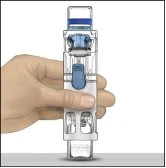
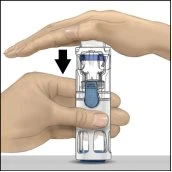
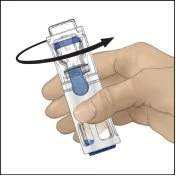
Injection Instructions
During administration, an aseptic technique (under clean, low-germ conditions) must be used.
Important Note:
- Examine the prepared solution for particles or discoloration before administration (the solution should be clear, colorless, and free of particles).
Do not use if the solution is not completely clear or if the product is not completely dissolved.
- Remove the blue protector from the BAXJECT III device. Do not introduce air into the syringe. Attach the syringe to the BAXJECT III. Use of a Luer-lock syringe is recommended.
- Turn the system upside down (the powder vial will now be on top). Draw the reconstituted solution into the syringe by slowly pulling back the plunger.
- Disconnect the syringe, attach a butterfly needle to the syringe, and inject the reconstituted solution into a vein. The solution should be administered slowly, at a rate determined according to the patient's comfort level, not exceeding 10 ml per minute. (See section 4, "Possible side effects").
- Dispose of any unused solution properly.
‑‑‑‑‑‑‑‑‑‑‑‑‑‑‑‑‑‑‑‑‑‑‑‑‑‑‑‑‑‑‑‑‑‑‑‑‑‑‑‑‑‑‑‑‑‑‑‑‑‑‑‑‑‑‑‑‑‑‑‑‑‑‑‑‑‑‑‑‑‑‑‑‑‑‑‑‑‑‑‑‑‑‑‑‑‑‑‑‑‑‑‑‑‑‑‑‑‑‑‑‑‑‑‑‑‑‑‑‑‑‑‑‑‑‑‑‑‑‑‑‑
This information is intended for healthcare professionals only:
On-demand treatment
For the following bleeding episodes, factor VIII activity should not fall below the plasma activity level indicated (in % of normal or IU/dL) during the respective period. The following table may be used as a dosing guideline for surgery and bleeding episodes:
Table 1 Dosage regimen guidelines for bleeding episodes and surgery | ||
Severity of bleeding/surgical procedure type | Required factor VIII level (% or IU/dL) | Dosing frequency (hours)/duration of treatment (days) |
Bleeding | ||
Early hemarthrosis or muscle or oral bleeding. | 20–40 | Repeat injections every 12 to 24 hours. For at least 1 day, until the bleeding episode has resolved, based on pain, or until healing occurs. |
More extensive hemarthrosis, muscle bleeding, or hematoma | 30–60 | Repeat injections every 12 to 24 hours for 3–4 days or more, until acute pain and disability have resolved. |
Potentially life-threatening bleeding | 60–100 | Repeat injections every 8 to 24 hours until the risk has passed. |
Surgery | ||
MinorIncluding dental extractions | 30–60 | Every 24 hours for at least 1 day, until healing occurs. |
Major | 80–100 (pre- and postoperative) | Repeat injections every 8 to 24 hours until the wound has adequately healed, and then continue treatment for at least another 7 days to maintain factor VIII activity between 30% and 60% (IU/dL). |
Prophylaxis
For long-term prophylaxis, the recommended dose is 40 to 50 IU of ADYNOVI per kg body weight twice weekly, administered at intervals of 3 to 4 days. Dose and administration interval adjustments may be considered based on observed factor VIII levels and individual bleeding tendency (see section 5.2).
Paediatric population
The dosing regimen for on-demand treatment in paediatric patients (12 to 18 years of age) is the same as for adult patients. Prophylactic treatment for patients aged 12 to <18 years is the same as for adult patients. The long-term safety of ADYNOVI has not yet been established in children under 12 years of age. Dose and administration interval adjustments may be considered based on observed factor VIII levels and individual bleeding tendency (see section 5.2).