Adrenaline Level 1 mg/ml solution for injection in pre-filled syringe
Spain
Table of Contents
Package leaflet: Information for the user
Introduction
PACKAGE LEAFLET: INFORMATION FOR THE USER
Adrenalina Level 1 mg/ml solution for injection
Epinephrine
Read all of this leaflet carefully before you start using this medicine, because it contains important information for you.
- Keep this leaflet. You may need to read it again.
- If you have any further questions, ask your doctor or pharmacist.
- This medicine has been prescribed for you only and must not be given to other people, even if they have the same symptoms as you. It may harm them.
- If you get any side effects, talk to your doctor or pharmacist, even if they are not listed in this leaflet. See section 4.
Contents of this leaflet:
- What Adrenalina Level is and what it is used for
- What you need to know before using Adrenalina Level
- How to use Adrenalina Level
- Possible side effects
- How to store Adrenalina Level
- Contents of the pack and other information
1. What Adrenalina Level is and what it is used for
Adrenalina Level belongs to the group of medicines known as cardiac stimulants, excluding cardiac glycosides: adrenergic and dopaminergic agents. It is indicated in the following cases:
- Treatment of sudden, involuntary muscle contraction in the airways during acute asthma attacks (sudden sensation of suffocation).
- Rapid relief of allergic reactions to drugs or other substances.
- Emergency treatment of shock due to an allergic reaction.
- Cardiac arrest and cardiopulmonary resuscitation (physical measures should first be applied).
2. What you need to know before using Adrenalina Level
Do not use Adrenalina Level
- If you are allergic (hypersensitive) to adrenaline, sympathomimetics (medicines that stimulate the central nervous system), or to any of the other components of this medicine (listed in section 6).
- If you have cardiac dilation, coronary insufficiency, cardiac arrhythmias, or heart failure (impaired heart function).
- If you have cerebral organic lesions, such as cerebral arteriosclerosis (chronic inflammation of the brain arteries with a tendency to obstruction).
- If you have closed-angle glaucoma (an eye condition characterized by increased intraocular pressure).
- If you have hypertension, hyperthyroidism (thyroid gland disorder), or pheochromocytoma (a tumor of the adrenal medulla).
- During childbirth.
- If you have received general anesthesia with halogenated hydrocarbons (chloroform, trichloroethylene) or cyclopropane, as the combination with adrenaline could cause serious arrhythmias (abnormal heart rhythms).
However, in situations of extreme severity, there are no absolute contraindications.
Warnings and precautions
Talk to your doctor or pharmacist before starting to use Adrenalina Level.
Take special care with Adrenalina Level
If you have or have had cerebrovascular insufficiency (a condition affecting the blood vessels in the brain), heart disease (such as angina or myocardial infarction), chronic lung disease, or urinary difficulty due to prostate hypertrophy (prostate enlargement).
If you are taking any other medicine that may cause potassium loss, such as corticosteroids (medicines used for their anti-inflammatory and immunosuppressive properties), diuretics (promote urination), aminophylline (a medicine used to aid breathing), or theophylline (an anti-asthmatic and diuretic agent), your blood potassium levels should be monitored.
If you are diabetic, you should exercise particular caution due to possible adverse reactions, especially those related to metabolic disturbances, as the dose should be carefully monitored.
This medicine may be used in elderly patients, but special caution is recommended.
Repeated administration of local injections may cause necrosis at the injection site due to vasoconstriction (narrowing of blood vessels). Injection sites should be alternated.
Adrenaline must be diluted before intravenous or intracardiac use (see section 3). In cases of extreme emergency, such as cardiopulmonary resuscitation (CPR) or cardiac arrest, when dilution of the medicine cannot be performed and direct intravenous administration of the undiluted pre-filled syringe content through a catheter is considered essential, it is necessary to be aware of the compatibility of the pre-filled syringe with the anti-reflux valve to avoid administration problems due to possible blockage of the syringe by components of the anti-reflux valve located in the catheter. In case of incompatibility, use an appropriate adapter between the syringe and the anti-reflux valve. Cases have been reported where the medicine could not be administered due to such incompatibility issues, posing a risk to the patient.
Consult your doctor, even if any of the above circumstances have occurred in the past.
Other medicines and Adrenalina Level
Tell your doctor or pharmacist if you are taking, have recently taken, or might need to take any other medicine.
Adrenergic blockers (drugs acting on neurons and modifying the physiology of organs and tissues) antagonize some of the effects of adrenaline. They are used as therapy in cases of adrenaline intoxication.
If this medicine is administered together with digitalis glycosides (heart medications), cardiac arrhythmias (abnormal heart rhythms) may occur.
If this medicine is administered together with certain antidepressants or guanethidine (an antihypertensive agent), a marked increase in blood pressure may occur.
If this medicine is administered together with COMT or MAO inhibitors (medicines acting on metabolic systems responsible for eliminating adrenaline), the effects of this medicine may be potentiated, albeit to a lesser extent.
Adrenalina Level may reduce the effectiveness of hypoglycemic agents (medicines that lower blood sugar).
Interference with laboratory tests
If you are to undergo any laboratory tests (blood or urine analysis), inform your doctor that you are being treated with adrenaline, as this medicine may alter blood test results for glucose, bilirubin, cholesterol, lactates, uric acid, and insulin. In urine, adrenaline may alter the results for vanillylmandelic acid and catecholamines.
Pregnancy and breastfeeding
If you are pregnant or breastfeeding, think you might be pregnant, or plan to become pregnant, consult your doctor or pharmacist before using this medicine.
Talk to your doctor or pharmacist before using any medicine.
If you are pregnant, you will only receive adrenaline if your doctor considers it absolutely necessary for your treatment.
This medicine is excreted in breast milk; therefore, it is recommended to discontinue breastfeeding or avoid administering this medicine.
Driving and use of machines
Not applicable in the context of treatment with this medicine.
Adrenalina Level contains sodium metabisulfite (E-222) and sodium (in the form of sodium metabisulfite and sodium chloride).
This medicine contains sodium metabisulfite (E-222). Rarely, it may cause severe hypersensitivity reactions and bronchospasm (sudden sensation of suffocation).
This medicine contains less than 1 mmol of sodium (23 mg) per 1 ml, i.e., essentially "sodium-free".
Use in athletes
This medicine contains adrenaline, which may result in a positive finding in doping control tests.
The use of adrenaline is not prohibited when administered in combination with local anesthetics or in locally acting preparations, such as nasal or ophthalmic formulations.
3. How to use Adrenaline Level
Adrenaline Level will be administered by qualified healthcare personnel if given intravenously or intracardially.
Adrenaline Level can be administered subcutaneously, intramuscularly, or intravenously. Intracardial administration may only be used in cases of extreme severity and if intravenous access is not feasible. Intravenous and intracardial routes must only be used after dilution in water for injection, 0.9% sodium chloride solution, 5% glucose solution, or 5% glucose in 0.9% sodium chloride solution, always in a hospital setting and under cardiac monitoring.
In cases of extreme emergency such as cardiopulmonary resuscitation (CPR) and cardiac arrest, when dilution of the medication cannot be performed and direct intravenous administration of the pre-filled syringe content without dilution is considered essential, administration must be done via a catheter. It is necessary to be aware of the compatibility of the pre-filled syringe with the anti-return valve to avoid administration problems due to possible blockage of the syringe by components of the anti-return valve located in the catheter. In case of incompatibility, use an appropriate adapter between the syringe and the anti-return valve. Cases have been reported where the drug could not be administered due to such incompatibility issues, resulting in risk to the patient.
The lowest effective dose should be used. After prolonged use, doses may need to be increased due to the development of resistance to adrenaline's effects.
Intramuscular injection of this medicine into the buttocks should be avoided, as it may lead to gas gangrene (diffuse, rapid tissue necrosis under the skin with gas production), and also in peripheral body areas such as fingers of the hands and feet, earlobe, nose, or penis.
Acute asthma attacks, allergic reactions, and anaphylactic shock
-
Adults: The usual dose for treating acute asthma attacks and allergic reactions is 0.3–0.5 mg (0.3–0.5 ml) administered intramuscularly or subcutaneously, with the intramuscular route being faster and more effective. If necessary, administration may be repeated after 15–20 minutes and subsequently every 4 hours. In cases of anaphylactic shock, the intramuscular route should be used, or in very severe cases, the intravenous route. If the intravenous route is used, adrenaline must be administered in a hospital setting. In severe cases, the dose may be increased up to 1 mg if necessary.
-
Children: The usual dose is 0.01 mg (0.01 ml) per kg of body weight administered intramuscularly or subcutaneously, up to a maximum dose of 0.5 mg (0.5 ml). If necessary, administration may be repeated after 15–20 minutes and subsequently every 4 hours.
It cannot be administered in children weighing less than 20 kg, as the minimum volume that the syringe allows to be dosed is 0.2 ml.
In elderly patients, the recommended doses are the same as for adults, although special caution should be exercised.
Cardiac arrest and cardiopulmonary resuscitation
In the treatment of cardiac arrest and cardiopulmonary resuscitation, the recommended dose of adrenaline is 1 mg intravenously, which must be administered after dilution to 1:10,000 and may be repeated as often as necessary every 3–5 minutes.
In children, the standard dose is 0.01 mg/kg intravenously, which may be repeated every 5 minutes if necessary.
It cannot be administered in children weighing less than 20 kg, as the minimum volume that the syringe allows to be dosed is 0.2 ml.
If intravenous access is not feasible, the intracardial route may be used (using the same diluted solution). However, it should be noted that this route carries significant risks and should only be used if intravenous access is persistently inaccessible.
Instructions for correct administration
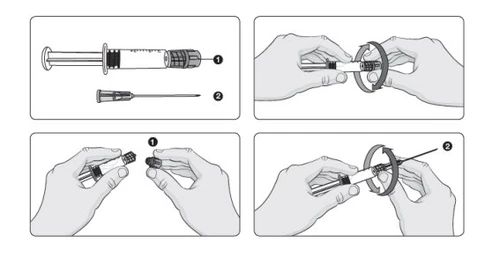
Unscrew the removable part of the protective sheath (1) located at the cone of the syringe and screw on the needle (2) instead. Expel air and the syringe will be ready for use.
This syringe should be used once and then destroyed. Sharing syringes poses a risk of infection.
To avoid degradation by light or oxidation, it is recommended to use the product immediately after dilution.
If you use more Adrenaline Level than you should
Adrenaline overdose may cause sudden increases in blood pressure and tachycardia (accelerated heart rate), which may follow an initial phase of transient bradycardia (abnormally slow heart rate). Potentially fatal arrhythmias (irregular heartbeats) may also occur.
The adverse effects of adrenaline are short-lived due to its rapid inactivation in the body, so treatment of adverse reactions is supportive. To counteract adverse effects on blood pressure and heart rhythm, certain medications such as phentolamine and propranolol may be administered. In case of a sudden rise in blood pressure, vasodilator drugs such as nitrites may be given. Anginal attacks are treated with sublingual trinitrin, while ventricular fibrillation (abnormal heart contraction) requires electrical defibrillation.
In case of overdose or accidental injection, consult your doctor or pharmacist immediately or call the Toxicology Information Service at telephone number 91 562 04 20 (indicating the medication and the amount injected).
4. Possible adverse effects
Like all medicines, this medicine can cause adverse effects, although not everyone will experience them.
It should be noted that the occurrence and severity of these effects depend on the route of administration, with subcutaneous and intramuscular routes having the lowest incidence compared to intravenous and intracardiac routes.
- Frequent (>1/100, <1/10)
Nervous system disorders: fear, anxiety, pulsating headache, breathing difficulty, sweating, nausea, vomiting, tremors, and dizziness.
Cardiovascular disorders: tachycardia, palpitations, pallor, slight increase in blood pressure.
These manifestations are not serious and resolve with rest and reassurance of the patient.
- Uncommon (>1/1000, <1/100)
Cardiovascular disorders (heart and blood vessels): arterial hypertension, which could lead to cerebral hemorrhage or acute heart failure with pulmonary edema (fluid infiltration in the lungs), angina pectoris (even at usual doses in patients with coronary insufficiency), ventricular arrhythmias (alteration of heartbeats), tachycardia (accelerated rhythm), and ventricular fibrillation (abnormal heart contraction), which may be fatal.
Also observed in some cases are difficulty in urination, necrosis at the injection site, metabolic acidosis, and renal failure.
If you consider any of the adverse effects you experience to be severe, or if you notice any adverse effect not listed in this leaflet, inform your doctor or pharmacist.
Reporting of adverse effects
If you experience any type of adverse effect, consult your doctor or pharmacist, even if it is a possible adverse effect not listed in this leaflet. You may also report them directly through the Spanish Pharmacovigilance System for Human Medicinal Products: https://www.notificaram.es. By reporting adverse effects, you can help provide more information on the safety of this medicine.
5. Storage of Adrenaline Level
Keep this medicine out of sight and reach of children.
Do not use this medicine after the expiry date stated on the packaging after EXP. The expiry date refers to the last day of the month indicated.
No special storage conditions are required. Store in the original container.
Adrenaline Level must be used immediately after opening the syringe. Discard any unused portion.
Do not use Adrenaline Level if you observe that the solution has changed colour or contains sediment.
Medicines must not be disposed of via wastewater or household waste. Dispose of empty containers and unused medicines at the SIGRE collection point at your pharmacy. If in doubt, ask your pharmacist how to dispose of containers and medicines you no longer need. This will help protect the environment.
6. Contents of the pack and other information
Composition of Adrenalina Level
- The active substance is epinephrine (adrenaline). Each millilitre of solution contains 1 milligram of epinephrine.
- The other components are sodium chloride, sodium bisulphite (E-222), hydrochloric acid (for pH adjustment) and water for injection.
Appearance of the product and contents of the pack
Adrenalina Level is a clear, slightly yellowish aqueous solution supplied in 1 ml glass prefilled syringes of Type I.
Pack sizes: Cartons containing 1 or 50 units.
Marketing Authorisation Holder and Manufacturer
Marketing Authorisation Holder:
LABORATORIOS ERN, S.A.
Perú, 228 - 08020 Barcelona, Spain.
Manufacturer:
LABORATORIOS ERN, S.A.
Gorgs Lladó, 188
08210 Barberà del Vallès, Barcelona, Spain.
Date of the most recent revision of this leaflet: December 2022
Detailed and up-to-date information on this medicinal product is available on the website of the Spanish Agency for Medicines and Health Products (AEMPS) http://www.aemps.gob.es/.