Adrenaline Ethypharm 1 mg/ml solution for injection
Spain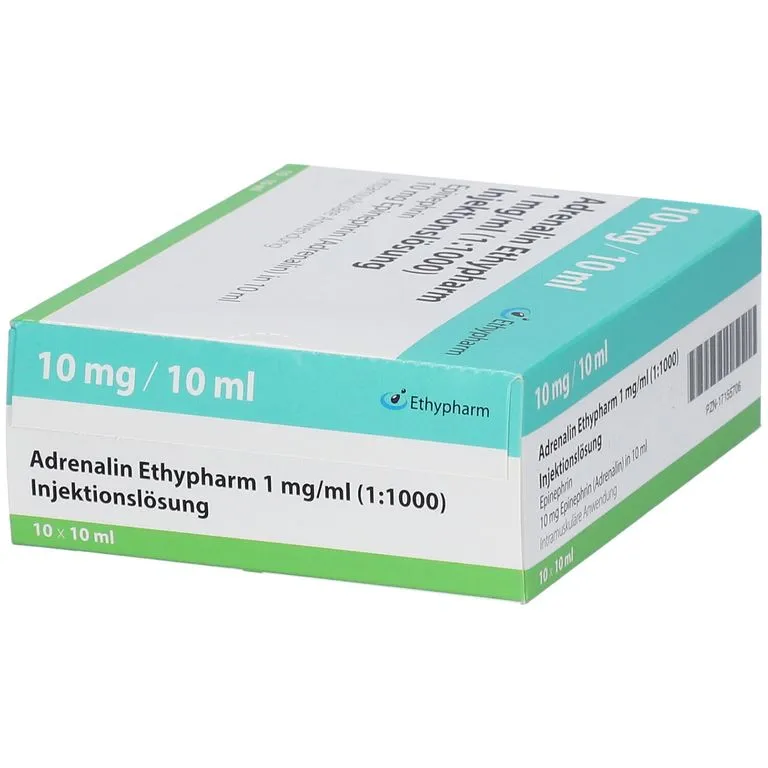
Table of Contents
- Package leaflet: Information for the user
- Introduction
- 1. What Adrenalina Ethypharm is and what it is used for
- 2. What you need to know before using Adrenalina Ethypharm
- 3. How to take Adrenalina Ethypharm
- 4. Possible adverse effects
- 5. Storage of Adrenaline Ethypharm
- 6. Contents of the pack and other information
Package leaflet: Information for the user
Introduction
Package leaflet: Information for the user
Adrenalina Ethypharm 1 mg/ml solution for injection
Epinephrine
Read this entire leaflet carefully before you start using the medicine, as it contains important information for you.
- Keep this leaflet, as you may need to read it again. If you have any questions, consult your doctor or nurse.
- This medicine has been prescribed for you only, and you should not give it to other people, even if they have the same symptoms as you, because it may harm them.
- If you experience any adverse effects, consult your doctor or pharmacist, even if these adverse effects are not listed in this leaflet. See section 4.
Leaflet contents:
- What Adrenalina Ethypharm is and what it is used for
- What you need to know before administration of Adrenalina Ethypharm
- How to use Adrenalina Ethypharm
- Possible side effects
- How to store Adrenalina Ethypharm
- Contents of the pack and other information
1. What Adrenalina Ethypharm is and what it is used for
Adrenaline belongs to a group of medicines known as sympathomimetic agents.
Adrenaline injection can be used for the emergency treatment of severe allergic reactions or cardiac arrest.
2. What you need to know before using Adrenalina Ethypharm
Do not use Adrenalina Ethypharm if:
- you are allergic (hypersensitive) to adrenaline or to any of the ingredients of this medicine (listed in section 6).
- Adrenaline injections should not be administered into areas such as fingers, toes, ears, nose, genitals, or buttocks, as this may impair blood flow to these areas.
Warnings and precautions
Talk to your doctor, pharmacist, or nurse before using Adrenalina Ethypharm if:
- you are elderly
- you have any heart problems, especially if they affect your heart rate or if you suffer from chest pain
- you have brain disorders, such as stroke, brain injury, or vascular disease
- you have an overactive thyroid, diabetes, or glaucoma (high pressure in the eye)
- you have a pheochromocytoma (a tumor of the adrenal gland)
- you have low levels of potassium in the blood or high levels of calcium in the blood
- you have a tumor of the prostate gland or a kidney disease
- you are in shock or have lost a significant amount of blood
- you are scheduled for surgery under general anesthesia
- you suffer from hypertension
- you have arteriosclerosis, i.e., narrowing and hardening of blood vessels in the body (your doctor may advise you).
If you or your child has any of the above conditions, inform your doctor before this medicine is administered.
Other medicines and Adrenalina Ethypharm
Tell your doctor or nurse if you are taking, have recently taken, or might take any other medicines, including those not requiring a prescription.
Many medicines can interact with Adrenalina Ethypharm and significantly alter its effects. These include:
-
monoamine oxidase inhibitors (MAOIs) or tricyclic antidepressants such as imipramine or amitriptyline, both used to treat depression
-
cardiac glycosides such as digoxin, used for heart failure
-
guanethidine, used for rapid blood pressure control
-
diuretics, such as hydrochlorothiazide or furosemide
-
inhalational general anesthetics, such as halothane
-
medicines to increase or decrease blood pressure, including beta-blockers, e.g., propranolol, atenolol, bisoprolol, or phentolamine
-
antidiabetic medicines, such as insulin or oral hypoglycemic agents (e.g., glipizide)
-
aminophylline and theophylline (medicines to help breathing)
-
corticosteroids (medicines used to treat inflammatory conditions in the body, such as asthma or arthritis)
-
antihistamines (e.g., diphenhydramine) used to treat allergies
-
medicines used to treat mental illnesses, such as chlorpromazine, periciazine, or flufenazine
-
medicines used to treat an underactive thyroid gland
-
oxytocin (used to induce labor at term and control bleeding after childbirth)
-
cough and cold remedies (sympathomimetics).
If you are already taking any of these medicines, consult your doctor before receiving Adrenalina Ethypharm.
Pregnancy and breastfeeding
If you are pregnant or breastfeeding, think you may be pregnant, or are planning to become pregnant, consult your doctor or pharmacist before using this medicine.
Adrenaline should only be used during pregnancy and breastfeeding if your doctor considers it essential.
Driving and use of machines
You should not drive or operate machinery if you have been administered Adrenalina Ethypharm.
Adrenalina Ethypharm contains sodium metabisulfite and sodium chloride
This medicine contains sodium metabisulfite, which may cause allergic-type reactions (hypersensitivity), including breathing difficulties or fainting, in some individuals. These reactions are more likely in people with a history of asthma or allergies (hypersensitivities).
This medicine contains less than 1 mmol of sodium (23 mg) per dose (essentially "sodium-free").
3. How to take Adrenalina Ethypharm
Anaphylaxis
Your doctor will administer Adrenalina Ethypharm intramuscularly (IM); however, in an emergency, a diluted injection may be given intravenously (IV).
Adrenaline injections MUST NOT be administered in areas such as the fingers of the hands or feet, ears, nose, genitals, or buttocks, as this could impair blood flow to these areas. If repeated injections are required, your doctor must change the injection site.
It will be administered by a healthcare professional. Your doctor will determine the most appropriate dose and route of administration for your specific case, based on your age and physical condition.
Adults
The usual dose is 0.5 ml. If necessary, this dose may be repeated several times at 5-minute intervals.
Elderly patients
There are no specific dosing regimens for adrenaline injection in elderly patients; however, adrenaline should be used with extreme caution.
Pediatric population
The following doses of Adrenalina Ethypharm are recommended:
Age | Dosage |
Over 12 years | 0.5 mg IM (0.5 ml of 1 mg/ml solution) 0.3 mg IM (0.3 ml of 1 mg/ml solution) in small children or prepubertal individuals |
6 - 12 years | 0.3 mg IM (0.3 ml of 1 mg/ml solution) |
6 months - 6 years | 0.15 mg IM (0.15 ml of 1 mg/ml solution) |
Up to 6 months | 0.01 mg/kg IM (0.01 ml/kg of 1 mg/ml solution) |
If necessary, these doses may be repeated several times at intervals of 5–15 minutes depending on blood pressure, pulse, and respiratory function.
A low-dead-volume syringe must be used.
Cardiac arrest (cardiopulmonary resuscitation)
Adults
1 mg intravenously every 3–5 minutes.
Pediatric population
10 micrograms/kg intravenously or intraosseously. The maximum single dose is 1 mg.
If you think you have been given too much Adrenalina Ethypharm
In case of overdose or accidental ingestion, contact the Toxicology Information Service (telephone: 91.562 04 20) or consult your doctor or pharmacist. Bring this leaflet with you.
Since this medicine will be administered to you in a hospital setting, it is unlikely that you would receive too little or too much; however, speak to your doctor or nurse if you have any concerns.
4. Possible adverse effects
Like all medicines, Adrenalina Ethypharm can cause adverse effects, although not everyone experiences them.
If you experience any of the following adverse effects, stop using the medicine and contact a doctor immediately:
- allergic reactions, although severe allergic reactions are rare
• difficulty breathing, swelling of the eyelids, face or lips, rash or itching (especially if it affects the whole body).
Other adverse effects (frequency unknown: cannot be estimated from available data):
-
headache
-
dizziness
-
feelings of anxiety, fear or agitation
-
tremors
-
insomnia, confusion, irritability
-
abnormal behaviour or mood
-
dry mouth or excessive salivation
-
weakness or sweating
-
changes in heart rate and rhythm
-
palpitations (rapid or irregular heartbeat), tachycardia (abnormally fast resting heart rate), angina (chest pain of variable intensity)
-
hypertension
-
coldness in the upper or lower limbs
-
shortness of breath
-
decreased appetite, nausea or vomiting
-
repeated injections may damage tissue at the injection site
-
fluid retention
-
metabolic acidosis may occur (an imbalance of certain components in the blood)
-
cerebral haemorrhage
-
paralysis on one side of the body
-
increased blood sugar levels
-
breakdown of body fat
-
decreased levels of potassium in the blood
-
pulmonary oedema
-
chest pain (acute angina)
-
heart attack (acute myocardial infarction)
-
pale appearance (pallor)
-
fainting (syncope)
-
dilation of the pupils (mydriasis)
In patients with Parkinson's disease, adrenaline may increase rigidity and tremors.
You may experience mild pain, bruising/bleeding or fluid leakage at the injection site after administration of this medicine.
Reporting of adverse effects
If you experience any adverse effects, consult your doctor, pharmacist or nurse, even if they are possible adverse effects not listed in this leaflet. You can also report them directly via the Spanish Pharmacovigilance System for Human Medicinal Products: www.notificaRAM.es. By reporting adverse effects, you can help provide more information on the safety of this medicine.
5. Storage of Adrenaline Ethypharm
Keep this medicine out of the sight and reach of children.
Do not use this medicine after the expiry date stated on the label after EXP. The expiry date refers to the last day of the month indicated.
Store the ampoule in the outer packaging to protect it from light.
Do not store above 25°C. Do not freeze.
Once diluted, the solution for administration should be used as soon as possible.
Adrenaline Ethypharm must not be administered if it has already been used or shows any visible signs of damage.
Medicines must not be disposed of via wastewater or household waste. Dispose of unused medicines and their containers at the SIGRE collection point at your pharmacy. If you have any doubts, ask your pharmacist how to dispose of unused medicines and their containers. This will help protect the environment.
6. Contents of the pack and other information
Composition of Adrenaline Ethypharm
- The active substance is epinephrine (adrenaline) (as acid tartrate), 1 mg per ml.
- The other components are sodium chloride, sodium metabisulfite, and water for injections. Hydrochloric acid and sodium hydroxide may be added to adjust the pH.
Appearance of the product and contents of the pack
Adrenaline Ethypharm is a clear, colourless solution supplied in a package containing 10 glass ampoules, each containing 0.5, 1, 2, 5 or 10 ml.
Only certain pack sizes may be marketed.
Marketing Authorisation Holder and Manufacturer:
Marketing Authorisation Holder:
Ethypharm
194 Bureaux de la Colline, Bâtiment D
92213 Saint-Cloud CEDEX
France
Manufacturer:
ETHYPHARM,
Chemin de la Poudrière, LE GRAND-QUEVILLY, 76120, France
Or
ETHYPHARM,
Zone Industrielle de Saint-Arnoult, CHÂTEAUNEUF-EN-THYMERAIS,
28170, France
This medicinal product has marketing authorisation in the Member States of the EEA under the following names:
Spain | Adrenaline Ethypharm 1 mg/ml solution for injection |
Finland | Adrenalin Ethypharm 1 mg/ml injection solution, solution |
Germany | Adrenaline Ethypharm 1 mg/ml (1:1000) injection solution |
Denmark | Adrenalin Ethypharm 1 mg/ml (1:1000) injection liquid, solution |
Norway | Adrenalin Ethypharm 1 mg/ml injection liquid, solution |
Sweden | Adrenalin Ethypharm 1 mg/ml (1:1000) injection liquid, solution |
Date of the most recent review of this leaflet: July 2024
Other sources of information
Detailed information on this medicinal product is available on the website of the Spanish Agency for Medicinal Products and Health Products (AEMPS) http://www.aemps.gob.es/.
The following information is intended for healthcare professionals only:
Preparation and handling:
Do not use Adrenalina Ethypharm 1 mg/ml solution for injection if you notice it has discolored.
Repeated local administration may cause necrosis at the injection site.
The optimal site for intramuscular injection is the anterolateral aspect of the mid-portion of the thigh. The needle used for injection must be sufficiently long to ensure that adrenaline reaches the muscle.
Intramuscular injection into the fingers and toes, ears, nose, genitals, or buttocks should be avoided due to the risk of tissue necrosis.
Prolonged administration may cause metabolic acidosis, renal necrosis, or tachyphylaxis.
Adrenaline injections should be avoided or used with extreme caution in patients undergoing general anesthesia with halothane or other halogenated anesthetics, due to the risk of ventricular fibrillation.
Do not mix with other medicinal products unless compatibility has been confirmed.
Adrenaline injections should not be used during the second stage of labor.
Accidental intravascular injection may lead to cerebral hemorrhage due to a sudden increase in blood pressure.
The patient should be monitored as soon as possible (heart rate, blood pressure, ECG, pulse oximetry) to assess response to adrenaline.
Incompatibilities
Adrenaline/epinephrine is rapidly inactivated by oxidizing agents and alkalis, including sodium bicarbonate, halogens, nitrates, nitrites, and salts of iron, copper, and zinc.
Dilution
For intravenous administration, Adrenalina Ethypharm must be diluted to a concentration of 0.1 mg/ml (a 1:10 dilution of the ampoule contents) with 0.9% sodium chloride solution.
Dosage and method of administration
Anaphylaxis
Adrenalina Ethypharm is intended for intramuscular use.
Do not administer Adrenalina Ethypharm 1 mg/ml intravenously without dilution.
Intravenous administration of adrenaline for the treatment of anaphylaxis requires a 0.1 mg/ml adrenaline solution.
The intramuscular (IM) route is generally preferred for initial treatment of anaphylaxis. The intravenous (IV) route is generally more appropriate in the Intensive Care Unit or Emergency Department setting. Adrenalina Ethypharm 1 mg/ml is not suitable for intravenous use. If a 0.1 mg/ml adrenaline solution is not available, Adrenalina Ethypharm must be diluted to 0.1 mg/ml (1:10,000) prior to intravenous administration. Intravenous administration of adrenaline should be used with extreme caution and is best reserved for specialists familiar with its intravenous use.
The intramuscular route is the preferred route of administration for most individuals requiring adrenaline treatment for acute anaphylaxis.
The usual adult dose is 0.5 mg (0.5 ml of adrenaline 1 mg/ml). If necessary, this dose may be repeated several times at 5-minute intervals depending on blood pressure, pulse, and respiratory function.
Elderly patients:
There are no established dosage regimens for adrenaline injections in elderly patients. However, adrenaline should be used with extreme caution in these patients, as they may be more susceptible to the adverse cardiovascular effects of adrenaline.
Paediatric population
The following doses of Adrenalina Ethypharm are recommended:
Age | Dosage |
Over 12 years | 0.5 mg IM (0.5 ml of 1 mg/ml solution) 0.3 mg IM (0.3 ml of 1 mg/ml solution) in small or prepubertal children |
6 - 12 years | 0.3 mg IM (0.3 ml of 1 mg/ml solution) |
6 months - 6 years | 0.15 mg IM (0.15 ml of 1 mg/ml solution) |
Up to 6 months | 0.01 mg/kg IM (0.01 ml/kg of 1 mg/ml solution) |
When the patient is in a critical condition and there is genuine uncertainty regarding the adequacy of circulation and absorption from the intramuscular (i.m.) injection site, Adrenalina Ethypharm may be administered by intravenous (i.v.) injection.
Intravenous adrenaline should only be administered by personnel experienced in the use and titration of vasopressors in their routine clinical practice (see section 4.4 of FT). In the case of intravenous adrenaline, the dose should be adjusted in 50 microgram boluses according to response. This dose must only be administered using a solution of 0.1 mg/mL (i.e., a 1:10 mL dilution of the ampoule content). Undiluted adrenaline solution of 1 mg/mL must not be administered intravenously.
If repeated doses of adrenaline are required, an intravenous adrenaline infusion with dose adjustment according to response, under continuous hemodynamic monitoring, is recommended.
Cardiopulmonary resuscitation
Adults
1 mg of adrenaline intravenously, repeated every 3–5 minutes.
If administered via a peripheral line, it should be followed by a flush of at least 20 mL of 0.9% sodium chloride for injection (to facilitate delivery of the drug to the central circulation).
If intravenous access is not available, intraosseous administration is recommended.
Pediatric population
The recommended intravenous or intraosseous dose of adrenaline in children is 10 micrograms/kg. Depending on body weight, this dose may need to be administered using a solution of 0.1 mg/mL (i.e., a 1:10 mL dilution of the ampoule content). Subsequent doses of adrenaline may be given every 3–5 minutes. The maximum single dose is 1 mg.
If necessary, these doses may be repeated several times at intervals of 5–15 minutes depending on blood pressure, pulse, and respiratory function.
A low-volume syringe should be used.
Disposal
Unused medicines and waste materials must be disposed of in accordance with local regulations.
Overdose
Signs:
An overdose of Adrenalina Ethypharm causes severe hypertension. As a result, cerebrovascular, cardiac, or vascular accidents may occur, potentially leading to fatal consequences (cerebral hemorrhage, arrhythmias such as transient bradycardia followed by tachycardia, which may lead to arrhythmia, myocardial necrosis, acute pulmonary edema, or renal failure).
Treatment
The effects of adrenaline may be counteracted, depending on the patient's condition, by administration of fast-acting vasodilators, fast-acting alpha-adrenergic receptor antagonists (e.g., phentolamine), or beta-adrenergic receptor antagonists (e.g., propranolol). However, due to the short half-life of adrenaline, treatment with these agents may not be necessary. In cases of prolonged hypotensive reactions, administration of another vasopressor agent, such as noradrenaline, may be required.