Adrenaline Bradex 1 mg/ml solution for injection
Spain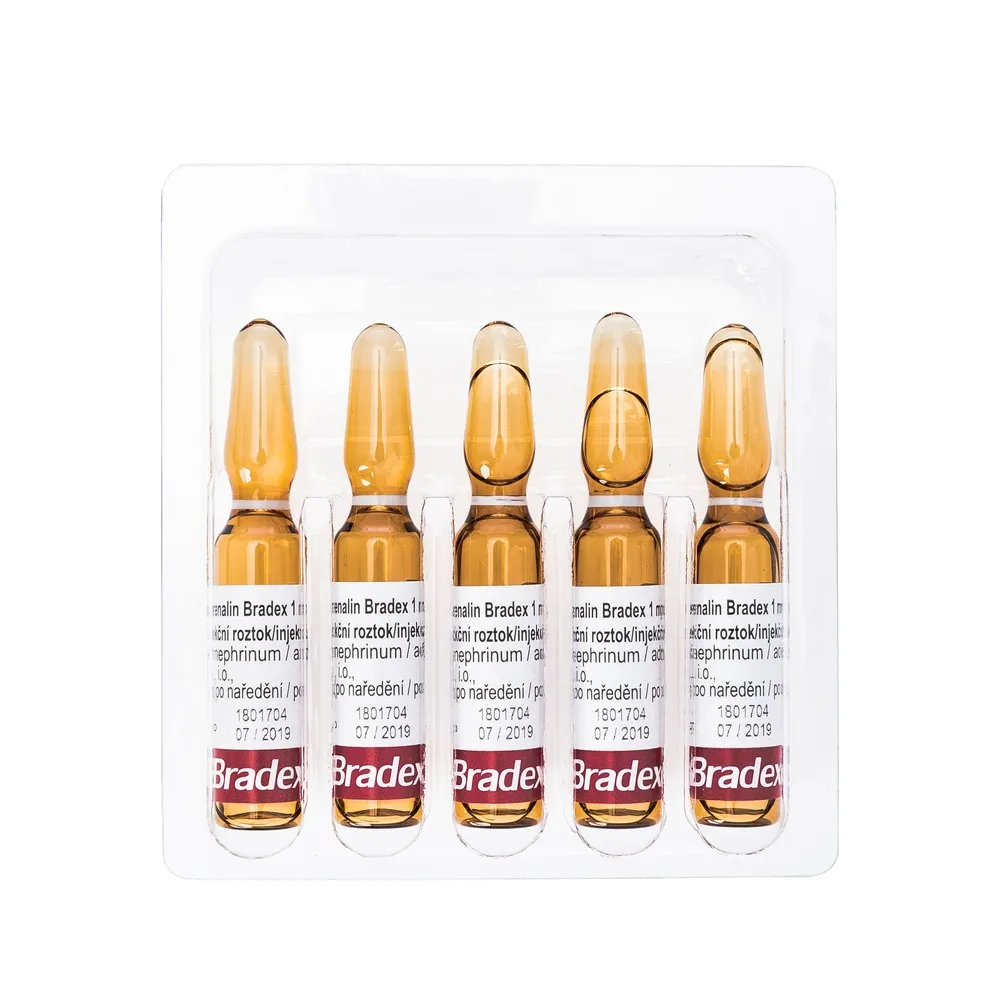
Table of Contents
- Package leaflet: Information for the user
- Introduction
- 1. What Adrenalina Bradex is and what it is used for
- 2. What you need to know before Adrenalina Bradex is administered to you
- 3. How Adrenalina Bradex is administered
- 4. Possible adverse effects
- 5. Storage of Adrenaline Bradex
- 6. Contents of the pack and other information
Package leaflet: Information for the user
Introduction
Package leaflet: Information for the user
Adrenalina Bradex 1 mg / ml Solution for injection
Adrenaline
Read all of this leaflet carefully before you are given this medicine, because it contains important information for you.
- Keep this leaflet, as you may need to read it again.
- If you have any questions, ask your doctor, pharmacist or nurse.
- This medicine has been prescribed for you only, and you should not give it to other people, even if they have the same symptoms as you, because it could harm them.
- If you experience any side effects, talk to your doctor, pharmacist or nurse, even if the side effects are not listed in this leaflet. See section 4.
Contents of the leaflet
- What Adrenalina Bradex is and what it is used for
- What you need to know before you are given Adrenalina Bradex
- How Adrenalina Bradex is administered
- Possible side effects
- How to store Adrenalina Bradex
- Contents of the pack and other information
1. What Adrenalina Bradex is and what it is used for
Adrenaline belongs to a class of medicines called adrenergics and dopaminergics. Adrenalina Bradex is used in potentially life-threatening emergencies such as severe allergic reactions or cardiac arrest.
2. What you need to know before Adrenalina Bradex is administered to you
Do not use Adrenalina Bradex:
- if you are allergic to adrenaline or to any of the other ingredients of this medicine (listed in section 6).
Warnings and precautions
Talk to your doctor, pharmacist, or nurse before you are administered Adrenalina Bradex if:
- you are elderly
- you have heart problems, especially those affecting heart rate or if you suffer from chest pain
- you have brain disorders, e.g., stroke, brain damage, or blood vessel disease
- you have hyperthyroidism, diabetes, or glaucoma (high pressure in the eye)
- you have phaeochromocytoma (a tumor of the adrenal gland)
- you have low blood potassium levels or high blood calcium levels
- you have a tumor of the prostate gland or kidney disease
- you are in shock or have lost a lot of blood
- you are about to undergo surgery with general anesthesia
- you have high blood pressure
- you have atherosclerosis, which is narrowing and hardening of the blood vessels (your doctor will inform you)
Discuss with your doctor if any of these situations apply to you before receiving this medicine.
Use of Adrenalina Bradex with other medicines
Inform your doctor or pharmacist if you are taking, have recently taken, or might need to take any other medicines.
A large number of medicines may interact with Adrenalina Bradex, which can significantly alter its effects. These medicines include:
- monoamine oxidase inhibitors (MAOIs) such as moclobemide or tricyclic antidepressants such as imipramine, amitriptyline, both used for depression
- cardiac glycosides such as digoxin, used for heart failure
- guanethidine, used for rapid blood pressure control
- diuretics, such as hydrochlorothiazide, furosemide
- inhaled general anesthetics, such as halothane
- medicines to increase or decrease blood pressure, including beta-blockers, such as propranolol, atenolol, bisoprolol, phentolamine
- antidiabetic medicines such as insulin or oral hypoglycemics (e.g., glipizide)
- aminophylline and theophylline (medicines used to treat asthma)
- corticosteroids (medicines used to treat inflammatory conditions of the body such as asthma or arthritis)
- antihistamines (e.g., diphenhydramine), used to treat allergies
- medicines used to treat mental illness such as chlorpromazine, periciazine, or fluphenazine
- medicines used to treat hypothyroidism
- oxytocin, used to induce labor at term and to control bleeding after childbirth
- any cough or cold remedies (sympathomimetics)
If you are already taking any of these medicines, talk to your doctor before receiving Adrenalina Bradex.
Pregnancy and breastfeeding
If you are pregnant or breastfeeding, think you might be pregnant, or plan to become pregnant, consult your doctor or pharmacist before using this medicine.
Adrenalina Bradex should not be used during pregnancy or childbirth.
Adrenaline is excreted in breast milk. If you are breastfeeding, talk to your doctor before receiving Adrenalina Bradex.
Adrenaline should only be used during pregnancy and breastfeeding if your doctor considers it essential.
Driving and using machines
It is unlikely to be applicable, as you will not feel well enough to drive or operate machinery.
Consult your doctor before considering such activities.
Adrenalina Bradex contains sodium metabisulfite and sodium chloride
Sodium metabisulfite (as a preservative) may in rare cases cause allergic reactions (hypersensitivity) and bronchospasm.
This medicine contains less than 1 mmol of sodium (23 mg) per dose (essentially "sodium-free").
Adrenalina Bradex may be diluted in 0.9% sodium chloride. This should be taken into account in patients on a low-sodium diet.
3. How Adrenalina Bradex is administered
Adrenaline can be injected into a muscle (intramuscularly) or into a bone (intraosseously). It must be diluted before intravenous injection. Adrenaline injection should not be used in areas such as the fingers or toes, ears, nose, or penis, as blood supply to these areas may become insufficient.
It will be administered by a trained healthcare professional. Your doctor will determine the most appropriate dose and route of administration for your specific case, depending on your age and physical condition.
If you think you have been given more Adrenalina Bradex than you should have
This is unlikely, as the injection will be administered by a doctor or nursing staff.
Possible signs of overdose include restlessness, confusion, pallor, abnormally rapid resting heart rate (tachycardia), slow heart rate (bradycardia), irregular heart rate (cardiac arrhythmias), and cardiac arrest.
Talk to your doctor if you experience any side effects, so that appropriate treatment can be given.
If you have already left the medical facility, contact your nearest hospital, doctor, or pharmacist.
If you have any further questions about the use of this product, consult your doctor, pharmacist, or nurse.
4. Possible adverse effects
Like all medicines, this medicine can cause adverse effects, although not everyone will experience them.
The following adverse effects have also been reported (frequency unknown):
- headache, dizziness
- feeling of anxiety, fear, or restlessness
- tremor
- insomnia, confusion, irritability
- changes in mood or behavior
- dry mouth or excessive salivation
- weakness or sweating
- changes in heart rate and rhythm
- palpitations (rapid or irregular heartbeat), tachycardia (abnormally fast resting heart rate), angina (chest pain of variable intensity)
- high blood pressure
- coldness in the arms or legs
- breathing difficulty
- reduced appetite, nausea, or vomiting
- repeated injections may damage tissue at the injection site and may also cause damage to limbs, kidneys, and liver
- difficulty in urinating, urinary retention
- metabolic acidosis may occur (an imbalance in certain components of the blood)
- increased tremors and rigidity in patients with a condition known as parkinsonism
- cerebral hemorrhage
- paralysis of one side of the body
- increased blood sugar levels
- decreased blood potassium levels
- pulmonary edema
Reporting of adverse effects
If you experience any type of adverse effect, consult your doctor, pharmacist, or nurse, even if it is an effect not listed in this leaflet. You may also report them directly via the Spanish Pharmacovigilance System for Human Medicinal Products: www.notificaRAM.es.
By reporting adverse effects, you can help provide more information on the safety of this medicine.
5. Storage of Adrenaline Bradex
Keep this medicine out of sight and reach of children.
Do not use this medicine after the expiry date stated on the carton and on the label of the ampoule after EXP. The expiry date refers to the last day of the month indicated.
Store below 25 °C. Keep ampoules in the outer packaging to protect them from light.
For single use only. If only part of an ampoule is used, any remaining solution must be discarded.
Do not remove the ampoule from the carton until ready for use.
After dilution, the ready-to-use solution should be administered as soon as possible. Under no circumstances should it be stored for longer than 24 hours at 2–8 °C, 3 hours at 23–27 °C if exposed to light, or 6 hours at 23–27 °C if protected from light.
Do not use this medicine if discoloration, cloudiness, or precipitates are observed.
Medicines must not be disposed of via wastewater or household waste. Ask your pharmacist how to dispose of medicines and packaging you no longer need. This will help protect the environment.
6. Contents of the pack and other information
Composition of Adrenalina Bradex
- The active substance is adrenaline (epinephrine) in the form of adrenaline tartrate. Each 1 ml of this injection solution contains 1 mg of adrenaline (epinephrine) as adrenaline tartrate.
- The other components are sodium metabisulfite (E223), sodium chloride, water for injections, hydrochloric acid, and sodium hydroxide.
Appearance of the product and contents of the pack
Adrenalina Bradex is a sterile, clear, colourless injection solution in amber type I glass ampoules.
Adrenalina Bradex is available in packs containing 5, 10, 25, or 50 ampoules.
Marketing Authorisation Holder and Manufacturer
Marketing Authorisation Holder:
BRADEX S.A.,
27 Asklipiou street
14568 Kryoneri, Greece, T: +30 2106221801, +30 2106220323, F: +30 2106221802.
Manufacturer:
DEMO S.A., 21st km National Road Athens-Lamia, 14568 Krioneri, Attiki, Greece, T: +30 210 8161802, F: +30 210 8161587.
This medicinal product is authorised in the European Economic Area member states under the following names:
United Kingdom: Adrenaline 1:1000 (1 mg / ml) Solution for injection
Germany: Epinephrin BRADEX 1 mg / ml Injektionslösung
Hungary: Adrenalin BRADEX 1 mg / ml oldatos injekció
Spain: Adrenalina Bradex 1 mg / ml Solución inyectable
France: ADRENALINE BRADEX 1 mg / mL, solution injectable
Belgium: Adrenaline (tartrate) Bradex 1 mg / ml solution injectable
Adrenaline (tartrate) Bradex 1 mg / ml oplossing voor injectie
Adrenaline (tartrate) Bradex 1 mg / ml Injektionslösung
Luxembourg: ADRENALINE BRADEX 1 mg / mL, solution injectable
Denmark: Adrenalin Bradex 1 mg / ml injektionsvæske, opløsning
Sweden: Adrenalin Bradex 1 mg / ml injektionsvätska, lösning
Slovakia: Adrenalin Bradex 1 mg / ml, injekcný roztok
Czech Republic: Adrenalin Bradex 1 mg / ml injekcní roztok
Date of the latest revision of this leaflet: 05/2021
This information is intended for healthcare professionals only:
Preparation and handling
Do not use this medicine if discolouration is observed.
Repeated local administration may cause necrosis at the injection sites.
The preferred site for intramuscular (i.m.) injection is the anterolateral aspect of the middle third of the thigh. The needle used for injection must be sufficiently long to ensure that adrenaline is injected into the muscle. Intramuscular injections of Adrenalina Bradex 1 mg / ml Solution for injection should be avoided in the thighs due to the risk of tissue necrosis.
Prolonged administration may induce metabolic acidosis, renal necrosis, and adrenaline resistance or tachyphylaxis.
Adrenaline should be avoided or used with extreme caution in patients who have been anaesthetized with halothane or other halogenated anaesthetics, due to the risk of inducing ventricular fibrillation.
Adrenaline should not be used with local anaesthesia of peripheral structures, including fingers and ear lobes.
It must not be mixed with other medicinal products unless compatibility is known.
Adrenaline should not be used during the second stage of labour.
Accidental intravascular injection may cause cerebral haemorrhage due to a sudden increase in blood pressure.
Patients should be monitored as soon as possible (pulse, blood pressure, ECG, pulse oximetry) to assess response to adrenaline.
Incompatibilities
Dilution
For intravenous administration, Adrenalina Bradex 1 mg / ml Solution for injection must be diluted to a concentration of 0.1 mg / ml (a 1:10 dilution of the ampoule contents) with 0.9% sodium chloride solution.
Dosage and method of administration
Adrenalina Bradex 1 mg / ml Solution for injection is intended for intramuscular or intraosseous administration. For intravenous administration, it must only be used after dilution.
Acute anaphylaxis
The intramuscular (i.m.) route is the preferred route for most individuals requiring adrenaline for the treatment of acute anaphylaxis, using the doses indicated in Table 1.
In general, the recommended dose of adrenaline is 0.01 mg per kilogram of body weight (10 micrograms/kg).
In adults, the usual recommended dose of adrenaline is 0.5 mg (500 micrograms).
In children, when body weight is unknown, the following table may be used, which shows the recommended doses according to age:
Table 1. Doses of adrenaline (epinephrine) BP 1 mg / ml intramuscular injection for a severe anaphylactic reaction
Age | Dose | Volume of adrenaline 1 mg/ml |
Adult | 500 micrograms (0.5 mg) | 0.5 ml |
Children > 12 years | 500 micrograms (0.5 mg) | 0.5 ml |
Children 6 – 12 years | 300 micrograms (0.3 mg) | 0.3 ml |
Children 6 months – 6 years | 150 micrograms (0.15 mg) | 0.15 ml |
Under 6 months | 10 micrograms/kg (0.01 mg/kg) | 0.01 ml/kg |
If necessary, these doses may be repeated several times at intervals of 5–15 minutes according to blood pressure, pulse, and respiratory function. A low-volume syringe should be used. |
When the patient is in a critical condition and there is genuine uncertainty regarding the adequacy of circulation and absorption from the intramuscular (i.m.) injection site, Adrenalina Bradex 1 mg/ml Injection Solution may be administered by intravenous (i.v.) injection.
Intravenous adrenaline should only be administered by personnel experienced in the use and titration of vasopressors in their routine clinical practice (see section 4.4 of FT). In the case of intravenous adrenaline, the dose should be titrated using 50 microgram boluses according to response. This dose must only be administered using a 0.1 mg/ml solution (i.e., a 1:10 ml dilution of the ampoule content). The undiluted 1 mg/ml adrenaline solution must not be administered intravenously. If repeated doses of adrenaline are required, an i.v. adrenaline infusion with dose adjustment according to response, under continuous hemodynamic monitoring, is recommended.
Cardiopulmonary resuscitation
Adults
1 mg of adrenaline administered intravenously or intraosseously, repeated every 3–5 minutes until return of spontaneous circulation. If administered through a peripheral line, it should be followed by a flush of at least 20 ml of fluid and elevation of the limb for 10–20 seconds to facilitate delivery of the drug to the central circulation.
Paediatric population
The recommended intravenous or intraosseous dose of adrenaline in children is 10 micrograms/kg. Depending on body weight, this dose may need to be administered using a 0.1 mg/ml solution (i.e., a 1:10 ml dilution of the ampoule content). Subsequent doses of adrenaline may be given every 3–5 minutes. The maximum single dose is 1 mg.
Disposal
Disposal of unused medication and all materials that have come into contact with it should be carried out in accordance with local regulations.
Overdose
Signs
Overdose with Adrenalina Bradex 1 mg/ml Injection Solution causes restlessness, confusion, pallor, tachycardia, bradycardia, cardiac arrhythmias, and cardiac arrest.
Treatment
Treatment is primarily symptomatic and supportive. Rapid injection of a fast-acting alpha-adrenergic receptor blocker such as phentolamine, followed by a beta-blocker such as propranolol, has been used to counteract the pressor and arrhythmogenic effects of adrenaline. A fast-acting vasodilator such as glyceryl trinitrate has also been used.