Adrenalia Aguettant 0.1 mg/ml solution for injection in pre-filled syringe
Spain
Table of Contents
- Package leaflet: Information for the user
- Introduction
- 1. What Adrenaline Injectable is and what it is used for
- 2. What you need to know before Adrenaline injectable is administered to you
- 3. How Adrenaline Injection is Administered
- 4. Possible adverse effects
- 5. Storage of Injectable Adrenaline
- 6. Package contents and other information
Package leaflet: Information for the user
Introduction
Package leaflet: information for the patient
Adrenaline Aguettant 0.1 mg/ml, solution for injection in pre-filled syringe
(Hereinafter referred to as "Injectable Adrenaline")
Epinephrine
Read all of this leaflet carefully before you start using this medicine, because it contains important information for you.
- Keep this leaflet, as you may need to read it again.
- If you have any questions, ask your doctor, pharmacist or nurse.
- This medicine has been prescribed for you only, and you should not give it to other people, even if they have the same symptoms as you, because it may harm them.
- If you experience any adverse effects, consult your doctor, pharmacist or nurse, even if they are adverse effects not listed in this leaflet. See section 4.
Contents of this leaflet
- What Injectable Adrenaline is and what it is used for
- What you need to know before using Injectable Adrenaline
- How to use Injectable Adrenaline
- Possible adverse effects
- How to store Injectable Adrenaline
- Contents of the pack and other information
1. What Adrenaline Injectable is and what it is used for
Adrenaline injectable belongs to a group of medicines called adrenergic and dopaminergic agents.
This medicine is used for:
- Treatment of cardiac arrest (sudden loss of heart function, breathing, and consciousness).
- Treatment of acute anaphylaxis in adults (severe shock or collapse caused by a serious allergic reaction).
2. What you need to know before Adrenaline injectable is administered to you
Do not administer Adrenaline injectable
- if you are allergic (hypersensitive) to any of the components of this medicine (listed in section 6), when an alternative formulation of adrenaline or an alternative vasopressor is available.
Warnings and precautions
Adrenaline injectable is indicated for emergency treatment. Continuous medical supervision is required after administration.
Precautions for use
The risk of adverse effects increases if you:
- have a medical history of hyperthyroidism (thyroid gland disorder);
- have severe renal insufficiency;
- suffer from hypercalcemia (increased calcium concentration in the blood);
- suffer from hypokalemia (decreased potassium concentration in the blood);
- have diabetes mellitus;
- have heart disease or arterial hypertension;
- have cerebral damage or cerebral arterial hardening;
- have glaucoma (increased pressure in the eye);
- have prostate disorders;
- are an elderly patient;
- are pregnant.
Use in athletes
Athletes are advised that this medicine contains adrenaline, which may result in a positive doping test.
Use of Adrenaline injectable with other medicines
Inform your doctor if you are taking, have recently taken, or might need to take any other medicines.
Medicines that may interact with Adrenaline injectable include:
- volatile halogenated anesthetics (gas used during anesthesia);
- certain antidepressants;
- drugs used to treat high blood pressure, heart conditions;
- drugs used to treat diabetes.
Pregnancy and breastfeeding
If you are pregnant or breastfeeding, think you may be pregnant, or plan to become pregnant, consult your doctor or pharmacist before this medicine is administered to you.
Driving and using machines
Receiving Adrenaline injectable does not affect your ability to drive or operate machinery.
Adrenaline injectable contains sodium
This medicine contains 35.4 mg of sodium (main component of table/cooking salt) per syringe. This corresponds to 1.77% of the maximum daily recommended sodium intake for an adult.
3. How Adrenaline Injection is Administered
Adrenaline Injection will be administered to you by your doctor, nurse, or healthcare assistant. They will determine the correct amount for you, as well as when and how it should be given.
In case of potentially life-threatening allergic reactions (acute anaphylaxis):
Adults: a dose of 0.05 mg (0.5 ml of the 1:10,000 adrenaline solution) will be administered as many times as necessary until the desired response is achieved.
In case of cardiac arrest:
Adults: 1 mg (10 ml of the 1:10,000 adrenaline solution) is administered into a vein or into the bone every 3–5 minutes until the heart starts functioning.
Children over 5 kg: 10 micrograms/kg (0.1 ml/kg of the 1:10,000 adrenaline solution) is administered into a vein or into the bone every 3–5 minutes until the heart starts functioning.
This medicine is not suitable for administering doses smaller than 0.5 ml and therefore should not be used in newborns or children with a body weight below 5 kg.
4. Possible adverse effects
Like all medicines, this medicine may cause adverse effects, although not everyone experiences them.
The following adverse effects have been reported:
- anxiety;
- dyspnoea (difficulty breathing);
- nervousness;
- fear;
- sweating;
- palpitations (irregular or rapid heartbeat);
- tachycardia (increased heart rate);
- pallor;
- tremors;
- weakness;
- dizziness;
- headache;
- nausea;
- vomiting;
- cold extremities;
- hallucinations;
- syncope;
- hyperglycaemia (high blood sugar levels);
- hypokalaemia (low potassium levels in the blood);
- metabolic acidosis (increased blood acidity);
- mydriasis (pupil dilation).
At high doses or in patients sensitive to adrenaline, the adverse effects are:
- cardiac arrhythmia (irregular heartbeat/cardiac arrest);
- arterial hypertension (with risk of cerebral haemorrhage);
- vasoconstriction (narrowing of blood vessels, e.g., cutaneous, in the extremities or in the kidneys);
- acute angina;
- risk of acute myocardial infarction.
Repeated local injections may cause necrosis (tissue damage) at the injection sites, as a result of vascular constriction (narrowing of blood vessels).
Medical supervision is required in all cases after administration of injectable Adrenaline.
Reporting of adverse effects
If you experience any type of adverse effect, consult your doctor, pharmacist, or nurse, even if it is a possible adverse effect not listed in this leaflet. You may also report them directly via the Spanish Pharmacovigilance System for Human Medicines: www.notificaram.es. By reporting adverse effects, you can help provide more information on the safety of this medicine.
5. Storage of Injectable Adrenaline
Keep this medicine out of the sight and reach of children.
Do not use this medicine after the expiry date stated on the label. The expiry date refers to the last day of the month indicated. Your doctor or nurse will check this.
Store in the aluminium pouch to protect it from light and oxygen.
Do not store above 25°C.
Do not open the aluminium pouch until ready to use.
After opening the pouch, the product should be used immediately.
Do not freeze.
Do not use sharp objects to open the pouch.
Do not use injectable adrenaline if it has been partially used or shows any visible signs of deterioration.
Medicines must not be disposed of via wastewater or household waste. Return unused medicines and their containers to the SIGRE collection point at your pharmacy. If in doubt, ask your pharmacist how to dispose of medicines and containers you no longer need. This will help protect the environment.
6. Package contents and other information
Composition of Injectable Adrenaline
The active substance is epinephrine (adrenaline):
Each ml of injectable solution contains 0.1 mg of epinephrine (adrenaline) as adrenaline tartrate.
Each 10 ml pre-filled syringe contains 1 mg of epinephrine (adrenaline) as adrenaline tartrate.
The other components are sodium chloride, hydrochloric acid, sodium hydroxide, water for injections.
Appearance of the product and contents of the pack
Injectable Adrenaline is a clear, colourless solution in a 10 ml polypropylene pre-filled syringe, individually packaged in a transparent blister and enclosed in an aluminium pouch.
Pre-filled syringes are available in packs of 1 and 10 syringes.
Only certain pack sizes may be marketed.
Marketing Authorisation Holder:
Laboratoire Aguettant
1, rue Alexander Fleming
69007 LYON
FRANCE
Manufacturer:
Laboratoire Aguettant
1, rue Alexander Fleming
69007 LYON
FRANCE
Laboratoire Aguettant
Lieu Dit Chantecaille
07340 Champagne
FRANCE
Local Representative:
AGUETTANT IBERICA
C/ Baldini Reixac, 4-8, Torre I, 4º, 08028, Barcelona, Spain
Date of latest revision of this leaflet: July 2024
Detailed and up-to-date information on this medicine is available on the website of the Spanish Agency for Medicines and Health Products (AEMPS) http://www.aemps.gob.es/.
This information is intended for healthcare professionals only:
Intravenous adrenaline should only be administered by individuals experienced in the use and dose adjustment of vasopressors in their routine clinical practice.
Cardiopulmonary resuscitation:
10 ml of 1:10,000 solution (1 mg) administered intravenously or intraosseously, repeated every 3–5 minutes until spontaneous circulation returns.
Endotracheal administration should only be used as a last resort if no other route is accessible, at a dose of 20 to 25 ml of 1:10,000 solution (2 to 2.5 mg).
In cardiac arrest following cardiac surgery, adrenaline should be administered intravenously with great caution at doses of 0.5 ml or 1 ml of 1:10,000 solution (50 or 100 micrograms), with dose adjustments made to achieve the desired effect.
Acute anaphylaxis:
Adjust dose using intravenous boluses of 0.5 ml of 1:10,000 solution (0.05 mg) according to response.
Adrenaline 0.1 mg/ml (1:10,000) injectable solution in pre-filled syringe is not recommended for intramuscular use in acute anaphylaxis. For intramuscular administration, a 1 mg/ml (1:1000) solution should be used.
Paediatric population:
This medicine is not suitable for administering doses smaller than 0.5 ml and therefore should not be used intravenously or intraosseously in neonates and children with body weight below 5 kg.
Cardiac arrest in children:
Intravenous or intraosseous route (only for children over 5 kg): 0.1 ml/kg of 1:10,000 solution (10 micrograms/kg), up to a maximum single dose of 10 ml of 1:10,000 solution (1 mg), repeated every 3–5 minutes until spontaneous circulation returns.
Endotracheal administration (in any weight range) should only be used as a last resort if no other route is accessible, at a dose of 1 ml/kg of 1:10,000 solution (100 micrograms/kg), up to a maximum single dose of 25 ml of 1:10,000 solution (2.5 mg).
Follow strictly the following protocol:
The pre-filled syringe is intended for use in a single patient only. Discard the syringe after use. Do not reuse.
The product should be inspected visually for particles and discoloration before administration. Only clear, colourless solutions free from particles or precipitates should be used.
The product must not be used if the pouch or blister has been opened or if the syringe’s security seal (plastic layer at the base of the tip cap) is broken.
-
Open the aluminium pouch by hand using only the perforation(s).
Do not use sharp objects to open the pouch. -
Remove the pre-filled syringe from the sterile blister.
-
Push the plunger to release the stopper. The sterilisation process may have caused the stopper to adhere to the syringe barrel.
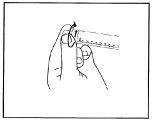
- Unscrew the tip cap to break the security seal. Do not touch the exposed Luer connection to avoid contamination.
-
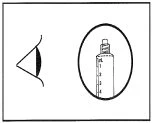
Check that the syringe seal has been completely removed. If not, replace the cap and twist again.
-
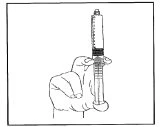 Expel air by gently pushing the plunger.
 -
Connect the syringe to the vascular access device or needle.
Push the plunger to inject the required volume.
Disposal of unused medication and all materials that have been in contact with it must be carried out in accordance with local regulations.