Adenoscan 30 mg/10 ml solution for infusion
Spain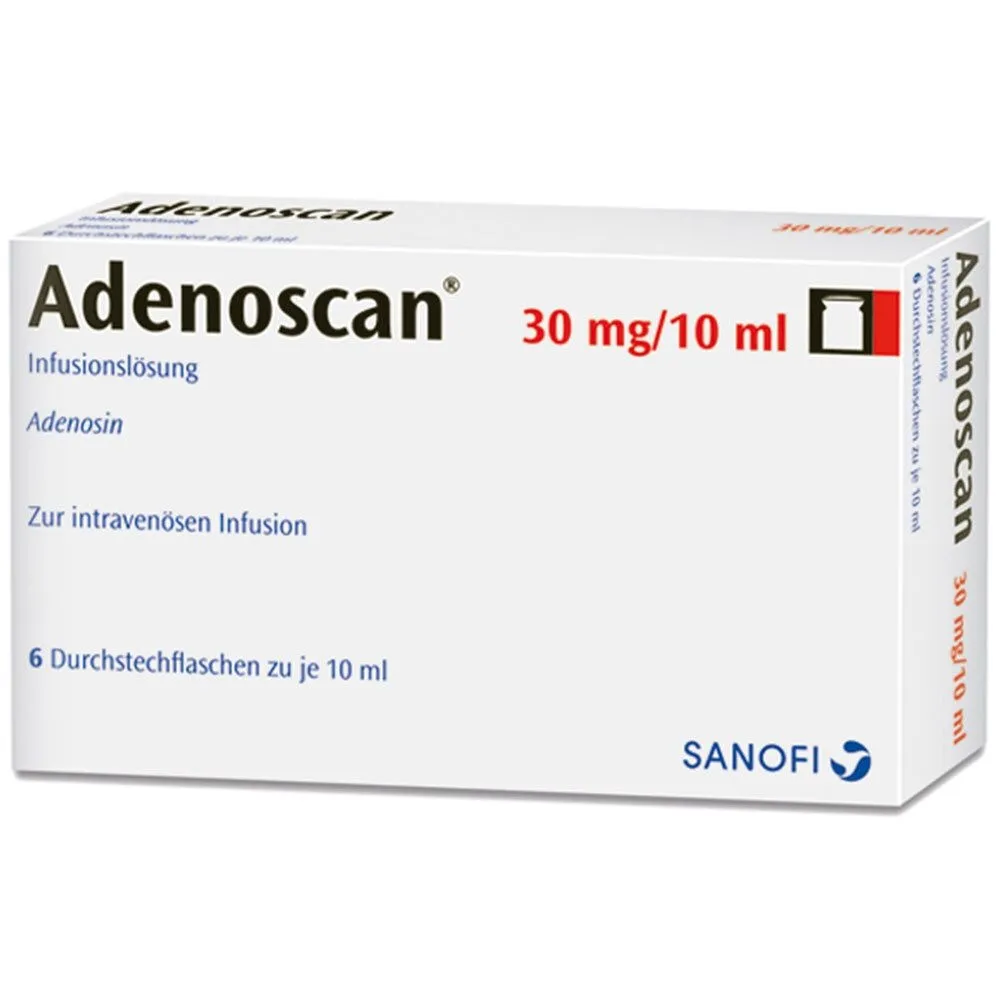
Table of Contents
Package leaflet: Information for the user
Introduction
Package leaflet: information for the user
Adenoscan 30 mg/10 ml, solution for infusion
adenosine
Read all of this leaflet carefully before you start using this medicine, because it contains important information for you.
- Keep this leaflet. You may need to read it again.
- If you have any questions, ask your doctor or nurse.
- If you get any side effects, talk to your doctor or nurse. This includes any possible side effects not listed in this leaflet.
Contents of this leaflet:
- What Adenoscan is and what it is used for
- What you need to know before Adenoscan is administered to you
- How Adenoscan is administered
- Possible side effects
- Storage of Adenoscan
- Contents of the pack and other information
1. What Adenoscan is and what it is used for
Adenoscan contains an active substance called adenosine. It belongs to a group of medicines known as "coronary vasodilators".
This medicine is for diagnostic use only.
Adenoscan is used prior to a test called "myocardial perfusion imaging", which is used to visualise your heart. During this test, you will be given a medicine called a "radiopharmaceutical".
Adenoscan works by widening the blood vessels in the heart, allowing blood to flow more freely. This enables the "radiopharmaceutical" medicine to reach your heart. The doctor can then visualise your heart and assess its condition. This procedure is used when you are unable to exercise or when an exercise stress test is not possible.
2. What you need to know before Adenoscan is administered to you
Do not use this medicine and inform your doctor if:
-
You are allergic to adenosine or to any of the other components of this medicine (listed in section 6).
-
You have symptoms of an allergic reaction including: skin rash, difficulty
swallowing or breathing, swelling of the lips, face, throat, or tongue. -
You have very low blood pressure (severe hypotension).
-
You have unstable angina that is not being treated with medication.
-
You have asthma or other serious breathing problems.
-
You are taking a medicine called dipyridamole used to thin the
blood. -
You have a type of heart failure in which your heart cannot pump
enough blood. -
You have problems with your heart rhythm and do not have a pacemaker implanted (second-
and third-degree atrioventricular block, sick sinus syndrome). -
You have been diagnosed with "long QT syndrome." It is a rare heart condition
that may cause a fast heartbeat and fainting.
Do not use this medicine if any of the above contraindications apply to you. If you are unsure, consult your doctor or nurse before using Adenoscan.
Warnings and precautions
Talk to your doctor or nurse before using Adenoscan if:
-
You have low blood volume (hypovolemia) that is not adequately corrected with
medication treatment. -
You have problems with a part of your nervous system called the "autonomic
nervous system." -
You have narrowing of the main arteries in your neck (carotid artery). This
means insufficient blood reaches the brain (cerebrovascular insufficiency). -
You have had or currently have seizures or fits.
-
You have difficulty breathing (bronchospasm).
-
You have a heart disease caused by narrowing of your heart valves
(valvular stenosis). -
You have inflammation of the membrane surrounding your heart (pericarditis) or
fluid accumulation around your heart (pericardial effusion). -
You have a left-to-right shunt in your heart. This means blood
flows directly from the left side to the right side of your heart. -
You have narrowing of the main left artery supplying blood to your
heart (left main coronary stenosis). You have had or recently had a
heart attack, severe heart failure, or you have undergone a heart transplant
within the past year. -
You have an irregular heart rhythm. For example, your heartbeat is very fast or irregular
(atrial fibrillation or atrial flutter), especially if you have an "accessory conduction pathway." -
You have a minor heart condition (first-degree atrioventricular block or
bundle branch block). These conditions may temporarily worsen when Adenoscan is administered.
Contact your doctor immediately if:
? You experience signs of stroke. This may include sudden numbness or weakness in the face, arms, or legs. Other signs may include confusion, vision problems, difficulty walking, loss of coordination or balance, trouble speaking, or difficulty forming words.
? You experience signs of a heart attack (myocardial infarction). Severe chest pain is the most common symptom. The pain may also radiate to the jaw and down the left arm or both arms.
You may also sweat, feel nauseous, or feel dizzy. A minor heart attack (myocardial infarction) may occasionally occur without causing pain (a "silent myocardial infarction"). It may truly be painless, or sometimes the pain is mild and you might think it is just indigestion or "gas."
Children and adolescents
The use of Adenoscan in children and adolescents has not been sufficiently studied.
Other medicines and Adenoscan
Tell your doctor or nurse if you are using, have recently used, or might need to use any other medicines, including those obtained without a prescription. This includes over-the-counter medicines and herbal supplements. This is because Adenoscan may affect how some medicines work. In particular, check with your doctor or nurse if you are taking any of the following:
-
Dipyridamole (a medicine used to thin the blood). Make sure your
doctor knows you are taking dipyridamole. Your doctor may instruct you to stop
taking dipyridamole 24 hours before Adenoscan is administered or to receive a lower dose of Adenoscan. -
Aminophylline, theophylline, or other xanthines (medicines used to help you breathe). Your doctor may instruct you to stop taking these 24 hours before Adenoscan is administered.
Adenoscan with food and drinks
Avoid food or drinks containing xanthines, such as tea, coffee, chocolate, and cola, for at least 12 hours before Adenoscan is administered.
Pregnancy and breastfeeding
Consult your doctor or nurse before using this medicine if:
-
You are pregnant, could become pregnant, or think you might be pregnant.
Adenoscan should not be administered unless clearly necessary. -
You are breastfeeding. Adenoscan should not be administered.
If you are pregnant or breastfeeding, think you might be pregnant, or plan to become pregnant, consult your doctor or nurse before using this medicine.
Adenoscan contains sodium
This medicine contains 35.4 mg of sodium (a main component of table/cooking salt) per vial. This corresponds to 1.77% of the maximum daily recommended sodium intake for an adult.
3. How to use Adenoscan
How to use Adenoscan
- Adenoscan is a hospital-use medicine.
- It will be administered to you by a doctor or nurse. It will be given through a vein over a period of time (this is called intravenous infusion).
- Your heart and blood pressure will be closely monitored.
Dosage of Adenoscan
If you are unsure why you are being given Adenoscan or have questions about the dose being administered, please ask your doctor or nurse.
Adults (including those aged 65 years and older)
- The dose is calculated according to your body weight.
- The usual dose is 140 micrograms per kilogram of body weight per minute.
- It is administered over a 6-minute period using an infusion pump (slow intravenous injection).
- The dose of Adenoscan does not change if you have liver or kidney problems.
If you have received more Adenoscan than you should
As this medicine is administered by a doctor or nurse, it is unlikely that you will receive more than you should. Your doctor will carefully calculate the amount of Adenoscan to be administered.
If you receive more medicine than you should, the following effects may occur:
- Very low blood pressure (severe hypotension).
- Slow heart rate (bradycardia).
- A heart problem (asystole).
Your doctor will continuously monitor your heart during the procedure.
Because adenosine remains in the blood for a very short time, any adverse effects due to an overdose of Adenoscan will stop rapidly once the infusion is interrupted. Occasionally, you may need an injection of a medicine called aminophylline or theophylline to help manage a possible adverse effect.
If you have further questions about the use of this medicine, consult your doctor or nurse.
4. Possible adverse effects
Like all medicines, this medicine may cause adverse effects, although not everyone experiences them. While you are receiving Adenoscan, you may experience one of the following adverse effects.
If any of the following effects worsen, inform your doctor or nurse immediately; they will decide whether you should continue the infusion or not.
Adverse effects usually resolve within a few seconds or minutes after the infusion has ended, but you should still inform your doctor or nurse if you experience any of them.
Very common (may affect more than 1 in 10 patients)
- Skin flushing with a sensation of warmth (hot flashes).
- Shortness of breath or the need to breathe deeply (dyspnea).
- Headache.
- Chest pain or pressure in the chest.
- Abdominal discomfort.
Common (may affect up to 1 in 10 patients)
- Dizziness or light-headedness.
- Unusual skin sensations such as numbness, tingling, itching, burning, or gradual prickling (paresthesia).
- Low blood pressure.
- A heart problem known as atrioventricular block.
- Rapid or irregular heartbeat (cardiac arrhythmias).
- Dry mouth.
- Discomfort in the throat, jaw, or neck.
Uncommon (may affect up to 1 in 100 patients)
- Metallic taste in the mouth.
- Sweating.
- Discomfort in legs, arms, or back.
- Feeling of weakness or general pain or discomfort.
- Feeling nervous.
- Slow heartbeat (bradycardia).
Rare (may affect up to 1 in 1,000 patients)
- Difficulty breathing (bronchospasm).
- Nasal congestion.
- Drowsiness.
- Blurred vision.
- Ringing in the ears (tinnitus).
- Sudden urge to urinate.
- Nipple discomfort.
- Tremors.
Very rare (may affect up to 1 in 10,000 patients)
- Severe shortness of breath or breathing problems.
- Redness, pain, or swelling at the injection site.
Other adverse effects (frequency cannot be estimated from available data)
- Allergic reactions including swelling of the face or throat, and skin reactions such as hives or rash.
- Serious heart problems that may lead to death (asystole) or irregular heartbeats.
- Seizures.
- Fainting.
- Breathing difficulty (respiratory arrest).
- Nausea or vomiting.
- Spasm of the heart artery that may cause a heart attack.
If any of the following effects worsen, inform your doctor or nurse immediately; they will decide whether you should continue the infusion or not. Adverse effects usually resolve within a few seconds or minutes after the infusion has ended, but you should still inform your doctor or nurse if you experience any of them.
Reporting of adverse effects:
If you experience any type of adverse effect, consult your doctor or nurse, even if they are possible adverse effects not listed in this leaflet. You may also report them directly via the Spanish Pharmacovigilance System for Human Medicines: https://www.notificaram.es. By reporting adverse effects, you can help provide more information on the safety of this medicine.
5. Storage of Adenoscan
Your doctor, nurse, or hospital pharmacist will store this medicine in a safe place out of the sight and reach of children.
Do not use this medicine after the expiry date stated on the container. The expiry date refers to the last day of the month indicated.
Do not refrigerate.
This medicine is for single use only, and once opened, it must be used immediately. Any unused portion of the vial must be discarded.
This medicine must not be used if your doctor or nurse observes any particles in the solution or any discoloration prior to administration. If the appearance of the product has changed, the vial must be discarded.
Medicines must not be disposed of via wastewater or household waste. Unused containers and medicines should be taken to a pharmacy's SIGRE point. If in doubt, please ask your pharmacist how to dispose of unused medicines and containers. This will help protect the environment.
6. Contents of the pack and other information
Composition of Adenoscan
-
The active substance is adenosine. Each 10 ml vial contains 30 mg of adenosine (3 mg per ml).
-
The other components are sodium chloride and water for injections.
Nature of the product and contents of the container
Adenoscan is a sterile, clear, and colourless infusion solution.
Each pack contains 6 vials of 30 mg/10 ml.
Marketing Authorization Holder and Manufacturer
Marketing Authorization Holder:
sanofi-aventis, S.A.
C/ Roselló i Porcel, 21
08016 Barcelona
Spain
Manufacturer:
Famar Health Care Services Madrid, S.A.U.
Avenida de Leganés, 62
28923 Alcorcón Madrid
or
Cenexi HSC
2 rue Louis Pasteur - Herouville
Saint-Clair 14200 France
or
Sanofi-Aventis Deutschland GmbH
Industriepark Hoechst-Brueningstraβe 50
65926 Frankfurt am Main
Germany
This medicinal product is authorized in EU Member States under the following names:
France Adenoscan 30 mg/10 ml, solution for infusion
Germany Adenoscan
Italy ADENOSCAN
Portugal Adenoscan
Spain Adenoscan 30 mg /10 ml solution for infusion
United-Kingdom Adenoscan 30 mg/10 ml, solution for infusion.
Date of the most recent review of this leaflet: August 2023
The following information is intended for healthcare professionals only:
Practical information for the preparation and handling of Adenoscan
Infusion solution 30 mg/10 ml (see also Section 3)
Dosage and method of administration
Adenoscan is intended for use in hospitals with monitoring and cardiopulmonary resuscitation equipment immediately available if needed.
It must be administered following the same procedures as for stress testing, in a facility equipped for cardiac monitoring and cardiopulmonary resuscitation. Continuous ECG monitoring is required during Adenoscan administration, as life-threatening arrhythmias may occur. Heart rate and blood pressure must be continuously monitored.
Dosage
Adults
-
Adenoscan should be administered undiluted as a continuous peripheral intravenous infusion at a rate of 140 μg/kg/min for six minutes using an infusion pump. It is recommended to separate the intravenous administration sites of Adenoscan and the radiopharmaceutical to avoid an adenosine "bolus" effect.
-
After three minutes of Adenoscan infusion, the radiopharmaceutical should be injected to allow sufficient time for peak coronary blood flow to occur. Optimal vasodilatory effect is achieved after six minutes of Adenoscan infusion.
-
To avoid an adenosine "bolus" effect, blood pressure should be measured in the arm opposite to the Adenoscan infusion site. The following table is provided as a guide for adjusting the infusion rate of undiluted Adenoscan according to body weight (total dose of 0.84 mg/kg).
Patient weight (kg) | Infusion rate (ml/min) |
45 - 49 | 2.1 |
50 - 54 | 2.3 |
55 - 59 | 2.6 |
60 - 64 | 2.8 |
65 - 69 | 3.0 |
70 - 74 | 3.3 |
75 - 79 | 3.5 |
80 - 84 | 3.8 |
85 - 89 | 4.0 |
90 - 94 | 4.2 |
95 - 99 | 4.4 |
100 - 104 | 4.7 |
Pediatric population
The safety and efficacy of adenosine in children aged 0–18 years have not been established. The currently available data are described in section 5.1, but no dosage recommendation can be made.
Elderly patients
See recommended dosing for adults.
Overdose
Overdose would cause severe hypotension, bradycardia, or asystole. The plasma half-life of adenosine is very short, and adverse effects of Adenoscan (if they occur) would resolve very rapidly upon discontinuation of the infusion. Intravenous administration of aminophylline or theophylline may be required.
Incompatibilities
Since compatibility studies have not been conducted, this product must not be mixed with other medicinal products.
Shelf life
The shelf life of the unopened product is 3 years.
Once opened, it must be used immediately.
Special precautions for storage
Do not refrigerate.
Special precautions for disposal and other handling
The product is for single use only.
The solution should be visually inspected for color and the absence of particles prior to administration. If there is any change in the visual appearance, the vial must be discarded.
Disposal of unused medicine and of all materials that have come into contact with it must be carried out in accordance with local regulations.
Detailed information on this medicinal product is available on the website of the Spanish Agency of Medicines and Medical Devices (AEMPS) http://www.aemps.gob.es