Adartrel 0.5 mg film-coated tablets
Spain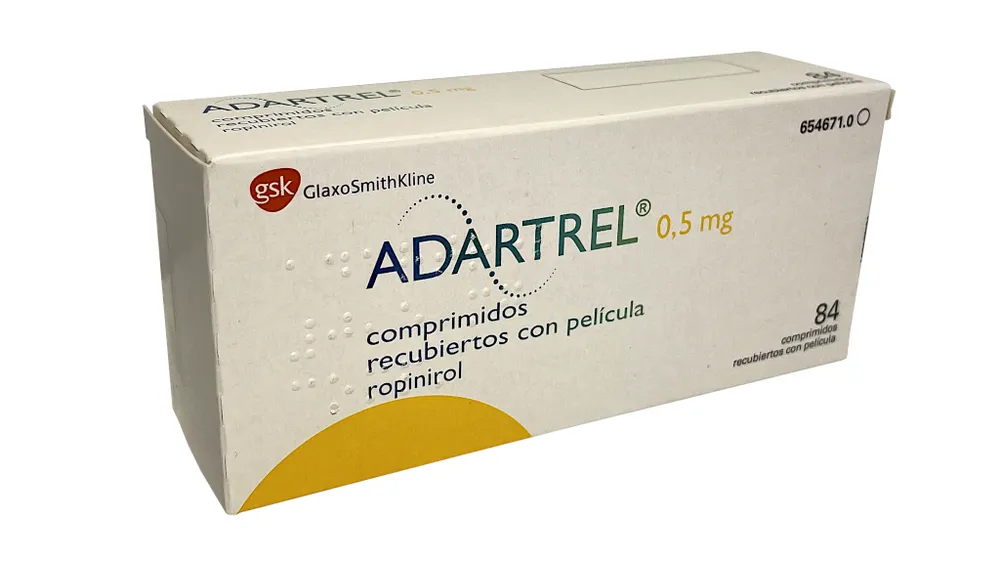
Table of Contents
- Package leaflet: Information for the user
- Introduction
- 1. What Adartrel is and what it is used for
- 2. What you need to know before taking Adartrel
- **Pregnancy and lactation**
- **Adartrel is not recommended during pregnancy,** unless your doctor determines that the benefit to you outweighs any potential risk to the fetus. **Adartrel must not be used during breastfeeding,** as milk production may be affected.
- **While taking Adartrel**
- **Driving and using machines**
- 3. How to take Adartrel
- **How to take your dose of Adartrel**
- 4. Possible adverse effects
- 5. Storage of Adartrel
- 6. Contents of the pack and other information
Package leaflet: Information for the user
Introduction
Package leaflet: information for the user
Adartrel 0.5 mg film-coated tablets
ropinirole (as hydrochloride)
Read the entire leaflet carefully before you start taking this medicine, because it contains important information for you.
- Keep this leaflet; you may need to read it again.
- If you have any questions, ask your doctor or pharmacist.
- This medicine has been prescribed for you only, and you should not give it to others, even if they have the same symptoms as you, because it could harm them.
- If you experience any adverse reactions, consult your doctor or pharmacist, even if they are adverse reactions not listed in this leaflet. See section 4.
Leaflet contents
- What Adartrel is and what it is used for
- What you need to know before taking Adartrel
- How to take Adartrel
- Possible side effects
- How to store Adartrel
- Contents of the pack and other information
1. What Adartrel is and what it is used for
The active substance in Adartrel is ropinirole, which belongs to a group of medicines called dopamine agonists. Dopamine agonists work in a similar way to a natural substance found in the brain called dopamine.
Adartrel is used to treat moderate to severe symptoms of Restless Legs Syndrome.
Restless Legs Syndrome (RLS) is also known as Ekbom's syndrome. People with restless legs syndrome have an irresistible urge to move their legs, and sometimes their arms and other parts of the body. These individuals usually experience unpleasant sensations in the limbs—sometimes described as "tingling" or "burning"—which typically begin when sitting or lying down and are relieved only by movement. These people often have difficulty remaining seated and, especially, problems sleeping.
Adartrel relieves these unpleasant sensations, thereby reducing the need to move the legs and other limbs.
2. What you need to know before taking Adartrel
Do not take Adartrel
- if you are allergic to ropinirole or to any of the other ingredients of this medicine (listed in section 6)
- if you have severe kidney disease
- if you have severe liver disease.
- Tell your doctor if you think you are in any of these situations.
Warnings and precautions
Talk to your doctor or pharmacist before taking Adartrel:
- if you are pregnant or think you may be pregnant
- if you are breastfeeding
- if you are under 18 years of age
- if you have liver disease
- if you have serious heart problems
- if you have severe mental illness
- if you have impulse control disorders and/or abnormal behaviour (such as an excessive urge to gamble or excessive sexual behaviour)
- if you have intolerance to certain sugars (such as lactose monohydrate).
Tell your doctor if you experience symptoms such as depression, apathy, anxiety, fatigue, sweating, or pain when stopping or reducing treatment with Adartrel (known as dopamine agonist withdrawal syndrome or DAWS). If these problems persist after a few weeks, your doctor may need to adjust your treatment.
Tell your doctor if you or your family/carer notice that you are developing impulses or urges to behave in ways that are unusual for you and that you cannot resist the impulse, urge, or temptation to carry out certain activities that could harm you or others. This is known as impulse control disorders and may include behaviours such as pathological gambling, compulsive eating or spending, abnormally increased sex drive, or increased sexual thoughts or feelings. Your doctor may need to adjust or stop your treatment.
Tell your doctor if you or your family/carer notice episodes of hyperactivity, euphoria, or irritability (symptoms of mania). These may occur with or without symptoms of impulse control disorders (see above). Your doctor may need to adjust or stop your treatment.
- Tell your doctor if you think you are in any of these situations. Your doctor will decide whether treatment with Adartrel is suitable for you, or whether you need additional monitoring while taking it.
Other medicines and Adartrel
Tell your doctor or pharmacist if you are taking, have recently taken, or might need to take any other medicines, including herbal medicines or those obtained without a prescription. Remember to inform your doctor or pharmacist if you start taking a new medicine while on Adartrel.
Some medicines may affect how Adartrel works, or make it more likely that you will experience side effects. Adartrel may also alter the way other medicines work.
These medicines include:
- the antidepressant fluvoxamine
- medicines for other mental disorders, such as sulpiride
- metoclopramide, used to treat nausea and stomach acid reflux
- hormone replacement therapy (also called HRT)
- the antibiotics ciprofloxacin or enoxacin
- any other medicine that blocks the action of dopamine in the brain.
- Tell your doctor if you are taking, or have recently taken, any of these medicines.
If you are taking the following medicines with Adartrel, you may need additional blood tests:
- Vitamin K antagonists (used to reduce blood clotting) such as Warfarin.
Pregnancy and lactation
Adartrel is not recommended during pregnancy, unless your doctor determines that the benefit to you outweighs any potential risk to the fetus. Adartrel must not be used during breastfeeding, as milk production may be affected.
? Inform your doctor immediately if you are pregnant, think you may be pregnant, or are planning to become pregnant. Your doctor will advise you on what to do if you are breastfeeding or planning to breastfeed. Your doctor may recommend that you discontinue treatment with Adartrel.
While taking Adartrel
Inform your doctor if you or your family members notice that you are developing any abnormal behaviour (such as an unusual urge to gamble or an increase in sexual urges and/or behaviours) while taking Adartrel. Your doctor may need to adjust or stop your dosage.
Driving and using machines
Adartrel may make you feel sleepy. In very rare cases, Adartrel may cause you to feel extremely sleepy, and sometimes may cause you to suddenly fall asleep without warning.
Adartrel may cause hallucinations (seeing, hearing, or feeling things that are not present). If this occurs, do not drive or operate machinery.
If you experience this: do not drive, do not use machines, and do not place yourself in situations where feeling sleepy or falling asleep could put you (or others) at risk of serious harm or death. Do not engage in these activities until you are no longer affected.
? Consult your doctor if you are unsure whether this applies to you.
Smoking and Adartrel
Inform your doctor if you start or stop smoking while taking Adartrel. Your doctor may need to adjust your dose.
Taking Adartrel with food and drinks
Taking Adartrel with food makes it less likely that you will feel nauseous or vomit. Whenever possible, it is better to take it with food.
If your symptoms worsen
Some patients taking Adartrel experience a worsening of RLS, for example, symptoms may start earlier than usual, become more intense, affect other limbs not previously affected (such as the arms), or reappear early in the morning.
? Inform your doctor as soon as possible if you think you are experiencing any of these symptoms.
Adartrel contains lactose and sodium
This medicine contains lactose monohydrate. If your doctor has informed you that you have an intolerance to certain sugars, consult him before taking this medicine.
This medicine contains less than 23 mg of sodium (1 mmol) per tablet; essentially “sodium-free”.
3. How to take Adartrel
Follow exactly the instructions for using this medicine as given by your doctor or pharmacist. If in doubt, consult your doctor or pharmacist again.
Do not give Adartrel to children. Adartrel is not normally prescribed for people under 18 years of age.
What dose of Adartrel should you take?
It may take some time to determine the most appropriate dose of Adartrel for you.
The usual starting dose is 0.25 mg once daily. After two days, your doctor may increase your dose to 0.5 mg daily for the remainder of the week. Your doctor may then gradually increase your dose over the following three weeks up to a daily dose of 2 mg.
If the 2 mg dose is not sufficient to improve RLS symptoms, your doctor may gradually increase your dose up to a maximum of 4 mg daily. After you have taken Adartrel for three months, your doctor may adjust your dose or recommend that you stop treatment.
If you find that the effects of Adartrel are too strong or too weak, inform your doctor or pharmacist. Do not take more tablets than your doctor has recommended.
Continue taking Adartrel as directed by your doctor, even if you do not feel better. Adartrel may take several weeks to take effect.
How to take your dose of Adartrel
Take Adartrel once daily.
Swallow the tablets with a glass of water.
You may take Adartrel with or without food. If taken with food, you are less likely to experience nausea.
Adartrel is usually taken before going to bed, but you may take it up to 3 hours before bedtime.
If you take more Adartrel than you should
In case of overdose or accidental ingestion, contact a doctor or pharmacist immediately or call the Toxicology Information Service at telephone number 91 562 04 20, indicating the medication and the amount ingested.
Someone who has overdosed on Adartrel may experience one or more of the following symptoms: nausea, vomiting, dizziness (sensation of spinning), somnolence, fatigue (mental or physical tiredness), feeling faint, hallucinations.
If you forget to take Adartrel
Do not take extra tablets or a double dose to make up for missed doses. Take the next dose at your usual time.
If you have forgotten to take your dose for several days, consult your doctor for advice on how to restart treatment.
If you stop taking Adartrel
Do not stop treatment with Adartrel without first consulting your doctor.
Take Adartrel for as long as your doctor tells you to. Do not stop treatment unless your doctor advises you to do so.
If you stop treatment with Adartrel abruptly, symptoms of restless legs syndrome may worsen rapidly.
Sudden discontinuation of treatment may cause a condition known as neuroleptic malignant syndrome, which can pose a serious health risk. Symptoms include: akinesia (loss of muscle movement), muscle rigidity, fever, unstable blood pressure, tachycardia (increased heart rate), confusion, decreased level of consciousness (e.g., coma).
If you need to stop treatment with Adartrel, your doctor will gradually reduce your dose.
If you have any further questions about the use of this medicine, ask your doctor or pharmacist.
4. Possible adverse effects
Like all medicines, this medicine can cause adverse effects, although not everyone will experience them.
Adverse reactions to this medicine are more likely to occur at the beginning of treatment or when the dose is increased. They are generally mild in nature and may decrease after you have been taking the medicine for some time.
If you experience any type of adverse effect, consult your doctor or pharmacist, even if it is a possible adverse effect not listed in this leaflet.
Very common adverse effects
These may affect more than 1 in 10 patients taking Adartrel:
- nausea
- vomiting
Common adverse effects
These may affect up to 1 in 10 patients taking Adartrel:
- nervousness
- fainting
- drowsiness
- fatigue (physical or mental tiredness)
- dizziness (sensation of spinning)
- stomach pain
- worsening of RLS symptoms (symptoms may start earlier than usual, may be more intense, or may affect other limbs not previously involved, such as the arms, or may reappear in the early morning)
- swelling of the legs, feet, or hands
Uncommon adverse effects
These may affect up to 1 in 100 patients taking Adartrel:
- confusion
- hallucinations (seeing things that are not really there)
- dizziness or fainting, especially when standing up suddenly (this is due to a drop in blood pressure)
- low blood pressure (hypotension)
- hiccups
Rare adverse effects
A very small number of patients taking Adartrel (up to 1 in 10,000) have experienced:
- liver function abnormalities, which have been detected in blood tests
- extreme sleepiness during the day (excessive somnolence)
- falling asleep suddenly without feeling sleepy beforehand (sudden sleep episodes)
Some patients may experience the following adverse effects (frequency not known: cannot be estimated from available data)
- allergic reactions such as redness, skin swelling with itching (urticaria), swelling of the face, lips, mouth, tongue, or throat, which may cause difficulty swallowing or breathing, rash or severe itching (see section 2)
- other psychotic reactions in addition to hallucinations, such as severe confusion (delirium), irrational thoughts (delusions), or irrational suspicions (paranoia)
- aggression
- misuse of Adartrel (compulsion to take excessive doses of dopaminergic medication beyond that needed to control motor symptoms, known as dopamine dysregulation syndrome)
- after stopping or reducing treatment with Adartrel: depression, apathy, anxiety, fatigue, sweating, or pain (known as dopamine agonist withdrawal syndrome or DAWS)
- spontaneous penile erection
You may experience the following adverse effects:
-
inability to resist the impulse, desire, or temptation to carry out certain actions that may be harmful to you or others, which may include:
- strong urge to gamble excessively, despite significant personal or family consequences
- altered or increased sexual interest and behavior that is troubling to you or others, such as excessive sexual behavior
- uncontrollable excessive shopping or spending
- binge eating (consuming large amounts of food in a short period of time) or compulsive eating (eating more food than needed to satisfy hunger)
-
episodes of overactivity, euphoria, or irritability.
Tell your doctor if you experience any of these behaviors; they will advise you on ways to manage or reduce the symptoms.
Reporting of adverse effects
If you experience any adverse effect, talk to your doctor or pharmacist, even if it is a possible adverse effect not listed in this leaflet. You can also report them directly via the Spanish Pharmacovigilance System for Human Medicines: www.notificaRAM.es. By reporting adverse effects, you can help provide more information on the safety of this medicine.
5. Storage of Adartrel
Keep this medicine out of the sight and reach of children.
Do not use this medicine after the expiry date stated on the packaging and blister after EXP. The expiry date refers to the last day of the month indicated.
Do not store above 25°C. Keep in the original packaging to protect from light.
Medicines must not be disposed of via wastewater or household waste. Dispose of unused medicines and their packaging at the SIGRE collection point at your pharmacy. If you are in doubt, ask your pharmacist how to properly dispose of unused medicines and packaging. This way, you will help protect the environment.
6. Contents of the pack and other information
Composition of Adartrel
The active substance in Adartrel is ropinirole (as hydrochloride).
Each tablet contains 0.5 mg of ropinirole (as hydrochloride).
The other components are:
- Tablet core: lactose monohydrate, microcrystalline cellulose, sodium croscarmellose, magnesium stearate.
- Film coating: hypromellose, macrogol 400, titanium dioxide (E171), yellow iron oxide (E172), red iron oxide (E172), indigotine (indigo carmine) (E132).
Appearance of the product and contents of the pack
Adartrel 0.5 mg is available as film-coated, pentagonal, yellow tablets, engraved with "SB" on one side and "4891" on the other.
Each pack contains 28 or 84 tablets.
Only certain pack sizes may be marketed.
Marketing Authorization Holder and Manufacturer
Marketing Authorization Holder | GlaxoSmithKline, S.A. P.T.M. C/ Severo Ochoa, 2 28760 Tres Cantos (Madrid) Tel: +34 900 202 700 |
Manufacturer Responsible | Glaxo Wellcome S.A., Avenida de Extremadura 3, 09400 Aranda de Duero, Burgos Spain |
This medicinal product is authorized in the European Economic Area member states and in the United Kingdom (Northern Ireland) under the following names:
Germany, Slovakia, Spain, France, Poland, Portugal, United Kingdom (Northern Ireland), Sweden: Adartrel
Date of the most recent review of this package leaflet: June 2023
Detailed and up-to-date information on this medicinal product is available on the website of the Spanish Agency of Medicines and Medical Devices (AEMPS): http://www.aemps.gob.es/