Adalgur 500 mg/2 mg tablets
Spain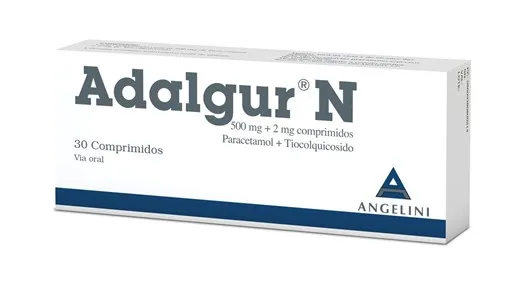
Table of Contents
Package leaflet: Information for the user
Introduction
PACKAGE LEAFLET: INFORMATION FOR THE USER
Adalgur 500 mg/2 mg tablets
Paracetamol / Thiocolchicoside
Read the entire leaflet carefully before you start taking this medicine because it contains important information for you.
- Keep this leaflet as you may need to read it again.
- If you have any questions, ask your doctor or pharmacist.
- This medicine has been prescribed for you only, and you should not give it to others, even if they have the same symptoms as you, because it could harm them.
- If you experience any adverse reactions, consult your doctor or pharmacist, even if they are adverse reactions not listed in this leaflet. See section 4.
Leaflet contents
- What Adalgur is and what it is used for
- What you need to know before taking Adalgur
- How to take Adalgur
- Possible side effects
- How to store Adalgur
- Contents of the pack and other information
1. What Adalgur is and what it is used for
Adalgur is a combination of an analgesic (to reduce pain) and a muscle relaxant. It is used in adults and adolescents over 16 years of age as an adjunctive treatment for painful muscle spasms. It should be used for acute conditions related to the spine.
2. What you need to know before taking Adalgur
Do not take Adalgur:
- if you are allergic to paracetamol, tiocolchicoside, or any of the other ingredients of this medicine (listed in section 6).
- if you have severe liver disease.
- in case of paralysis or muscle weakness.
- if you have a serious blood disorder called severe haemolytic anaemia.
- if you are pregnant, may become pregnant, or think you might be pregnant (see section 2 “Pregnancy, breastfeeding and fertility”).
- if you are breastfeeding (see section 2 “Pregnance, breastfeeding and fertility”).
- if you are a woman of childbearing age who is not using effective contraceptive methods (during treatment and for one month after stopping).
- if you are a man who is not using effective contraceptive measures (during treatment and for three months after discontinuation).
Warnings and precautions
Strictly follow the dose and duration of treatment indicated in section 3. You should not take this medicine at high doses or for longer than 7 days. This is because one of the substances formed in your body when taking high-dose tiocolchicoside may damage certain cells (abnormal number of chromosomes). This has been demonstrated in animal studies and laboratory studies. In humans, this type of cellular damage is a risk factor for cancer, fetal damage, and reduced male fertility. Consult your doctor if you have any questions.
Your doctor will advise you on all measures relating to effective contraception and the potential risk of pregnancy.
During treatment with Adalgur, inform your doctor immediately if:
- you have epilepsy or are at risk of seizures, as epileptic seizures may occur with the use of this medicine.
- you have chronic alcoholism, as you should take care not to exceed 2 g/day of paracetamol.
- you have liver problems, including Gilbert's syndrome (mild jaundice), or kidney problems,
- you suffer from chronic malnutrition or are dehydrated,
- you have heart or lung disease, or have anaemia (reduced haemoglobin levels in the blood, with or without reduced red blood cells), or have low levels of an enzyme in the blood called glucose-6-phosphate dehydrogenase.
- you have asthma or a history of asthma, and/or are also sensitive to acetylsalicylic acid.
If you have serious conditions such as severe renal failure or sepsis (when bacteria and their toxins circulate in the blood, causing organ damage), or if you have malnutrition, chronic alcoholism, or are also taking flucloxacillin (an antibiotic). A serious condition called metabolic acidosis (an abnormality in blood and body fluids) has been reported in patients in these situations when paracetamol is used at regular doses over a prolonged period or when paracetamol is taken together with flucloxacillin. Symptoms of metabolic acidosis may include: severe breathing difficulties with deep and rapid breathing, drowsiness, feeling unwell (nausea), and vomiting.
Consumption of alcoholic beverages may cause paracetamol to damage the liver.
If pain persists for more than 3 days, worsens, or new symptoms appear, treatment should be stopped and you should consult your doctor.
Children and adolescents
This medicine should not be given to children and adolescents under 16 years of age for safety reasons.
Using Adalgur with other medicines
Inform your doctor or pharmacist if you are taking, have recently taken, or might need to take any other medicines.
Other medicines and paracetamol
Inform your doctor or pharmacist if you are taking:
- Oral anticoagulants (used to treat thromboembolic disorders)
- Antiepileptics (used to treat epileptic seizures)
- Antibiotics (chloramphenicol)
- Oral contraceptives
- Activated charcoal (used for diarrhoea or treatment of gas)
- Metoclopramide and domperidone (used to prevent nausea and vomiting)
- Diuretics (used to increase urine elimination)
- Isoniazid (used to treat tuberculosis)
- Lamotrigine (used to treat epilepsy)
- Probenecid (used to treat gout)
- Propranolol (used to treat hypertension, cardiac arrhythmias)
- Rifampicin (used to treat tuberculosis)
- Anticholinergics (used to relieve spasms or contractions of the intestine and bladder)
- Zidovudine (used to treat HIV infections)
- Cholestyramine (used to lower blood cholesterol levels)
- Flucloxacillin (antibiotic), due to a serious risk of blood and fluid abnormalities (called metabolic acidosis) requiring urgent treatment (see section 2).
Do not use with other analgesics (medicines to relieve pain) without consulting your doctor.
Interference with laboratory tests:
If you are due to have any laboratory tests (including blood and urine tests, skin tests using allergens, etc.), inform your doctor that you are taking this medicine, as it may alter the results of these tests.
Taking Adalgur with food, drinks and alcohol
Alcohol consumption may increase the liver toxicity of paracetamol.
Pregnancy, breastfeeding and fertility
Do not take this medicine if:
- you are pregnant, may become pregnant, or think you might be pregnant (see section 2 “Do not take Adalgur”).
This is because this medicine may harm the unborn baby.
Do not take this medicine if you are breastfeeding. This is because the medicine is excreted in breast milk (see section 2 “Do not take Adalgur”).
Do not take this medicine if:
- you are a man who does not use effective contraceptive methods (see section 2 “Do not take Adalgur”).
This medicine may cause problems with male fertility due to potential damage to sperm (abnormal number of chromosomes). These data are based on laboratory studies (see section 2 "Warnings and precautions").
Contraception in women and men
Women who may become pregnant must use an effective contraceptive method while taking Adalgur and for one month after stopping treatment.
Adalgur and its metabolites may cause harm to the fetus if used during pregnancy. If you are pregnant or become pregnant while taking Adalgur, consult a doctor immediately.
Men must use effective contraceptive methods and should be advised not to father children while taking Adalgur and for three months after stopping treatment (see section 2 “Do not take Adalgur”).
Driving and using machines
You may feel drowsy with this medicine, so it is recommended that you do not drive or operate machinery until you know how this medicine affects you.
3. How to take Adalgur
Follow exactly the instructions for use of this medicine as given by your doctor or pharmacist. If in doubt, consult your doctor or pharmacist again.
Adults and adolescents over 16 years of age:
The recommended dose is 1 or 2 tablets per dose. Doses may be repeated 2 to 4 times daily.
The maximum recommended single dose is 2 tablets per administration, and the minimum interval between doses should be 6 hours.
The recommended and maximum dose of tiocolchicoside is 4 mg every 6 hours (i.e., 16 mg per day). The treatment duration is limited to 7 consecutive days.
Do not exceed the recommended dose or treatment duration.
This medicine should not be used as long-term treatment (see section 2 “Warnings and precautions”).
If pain persists for more than 3 days, or if pain worsens or new symptoms appear, consult your doctor.
Use in children and adolescents
This medicine must not be administered to children and adolescents under 16 years of age for safety reasons.
Patients with liver or kidney disease: consult your doctor before taking this medicine.
Elderly patients: consult your doctor.
If you take more Adalgur than you should
If you accidentally take more Adalgur than you should, consult your doctor or pharmacist immediately or go to the nearest hospital, taking the remaining tablets with you to inform the doctor. You may also call the Toxicology Information Service. Telephone: 91 562 04 20.
If an overdose has occurred, you must go immediately to a medical centre even if there are no symptoms, as symptoms often do not appear until three days after the overdose, even in cases of severe poisoning. Symptoms of overdose may include dizziness, vomiting, loss of appetite, yellowing of the skin and eyes (jaundice), and abdominal pain.
Treatment of overdose is most effective if started within 4 hours of ingestion of the medicine.
Patients undergoing treatment with barbiturates or chronic alcoholics may be more susceptible to the toxicity of a paracetamol overdose.
If you forget to take Adalgur
Do not take a double dose to make up for forgotten doses. If you forget to take a dose of Adalgur at the scheduled time, take it as soon as you remember, and then wait the recommended interval between doses (at least 4 to 6 hours, depending on the dose) before taking the next one.
If you have any further questions about the use of this medicine, ask your doctor, pharmacist, or nurse.
4. Possible adverse effects
Like all medicines, this medicine can cause adverse effects, although not everyone experiences them.
Rare adverse effects (may affect up to 1 in 1,000 patients)
- Malaise
- Agitation, fainting
- Allergic skin reactions
- Increased levels of hepatic transaminases (liver enzymes)
- Stomach pain or burning, diarrhea, nausea, vomiting
- Hypotension (low blood pressure)
Very rare adverse effects (may affect up to 1 in 10,000 patients)
- Allergic reactions (hypersensitivity), ranging from a simple skin rash (redness or inflammation of the skin) or urticaria (hives) to anaphylactic shock (a severe type of allergic reaction). In such cases, treatment must be stopped immediately and you should consult your doctor.
- Somnolence
- Hepatotoxicity (liver toxicity) and jaundice (yellowing of the skin and mucous membranes)
- Hypoglycemia (reduced blood glucose levels)
- Thrombocytopenia (reduced platelet count), agranulocytosis, leucopenia, neutropenia (abnormalities in white blood cells), hemolytic anemia (reduced red blood cells)
- Sterile pyuria (cloudy urine), adverse kidney effects
- Very rare cases of severe skin reactions have been reported
Frequency not known (cannot be estimated from available data): A serious condition that may cause the blood to become more acidic (called metabolic acidosis) in patients with severe illness who use paracetamol (see section 2).
Reporting of adverse effects
If you experience any type of adverse effect, consult your doctor or pharmacist, even if it is a possible adverse effect not listed in this leaflet. You may also report them directly through the Spanish Pharmacovigilance System for Human Medicines: https://www.notificaram.es. By reporting adverse effects, you can help provide more information on the safety of this medicine.
5. Storage of Adalgur
Keep this medicine out of the sight and reach of children.
No special storage conditions are required.
Do not use this medicine after the expiry date stated on the container after EXP. The expiry date is the last day of the month indicated.
Medicines must not be disposed of via wastewater or household waste. Dispose of containers and unused medicines at the SIGRE Point at your pharmacy. If you are in doubt, ask your pharmacist how to dispose of containers and medicines you no longer need. This will help protect the environment.
6. Contents of the pack and other information
Composition of Adalgur tablets
- The active substances are paracetamol and tiocolchicoside. Each tablet contains 500 mg of paracetamol and 2 mg of tiocolchicoside.
- Other components are: maize starch, sodium carboxymethyl potato starch, magnesium stearate (E572), hydroxypropylcellulose (E463), talc (E553b).
Appearance of the product and contents of the container
Adalgur is yellowish, round, flat tablets, scored on one side. The score line is intended only to facilitate breaking the tablet if you have difficulty swallowing it whole, and does not allow for dividing the tablet into equal doses.
It is available in packs of 30 tablets.
Marketing Authorization Holder and Manufacturer
Teofarma S.r.l.
Via F.lli Cervi, 8
27010 Valle Salimbene (PV) - Italy
Date of the most recent revision of this leaflet: August 2025
Detailed and up-to-date information on this medicinal product is available on the website of the Spanish Agency for Medicinal Products and Health Products (AEMPS) http://www.aemps.gob.es/.
?----------------------------------------------------------------------------------------------------------------
PATIENT CARD FOR PATIENTS TAKING ADALGUR (PARACETAMOL AND TIOCOLCHICOSIDE)
Adalgur may cause harm to the fetus. Your doctor will inform you about all necessary measures regarding effective contraceptive methods and the potential risk of pregnancy.
Do not take this medicine if:
- You are pregnant or think you might be pregnant.
- You are breastfeeding.
- You are a woman of childbearing potential who is not using effective contraceptive methods (during treatment and for 1 month after stopping treatment).
- You are a man who is not using effective contraceptive methods (during treatment and for 3 months after stopping treatment).
If you are pregnant, become pregnant during treatment with Adalgur, or suspect pregnancy, contact your doctor immediately.
For more information, read the package leaflet included in the pack, also available at https://cima.aemps.es/.
Risk prevention information agreed with the Spanish Agency for Medicinal Products and Health Products (AEMPS). April 2025.
Available on the AEMPS website: www.aemps.gob.es.