Actithiol mucolytic antihistamine oral solution
Spain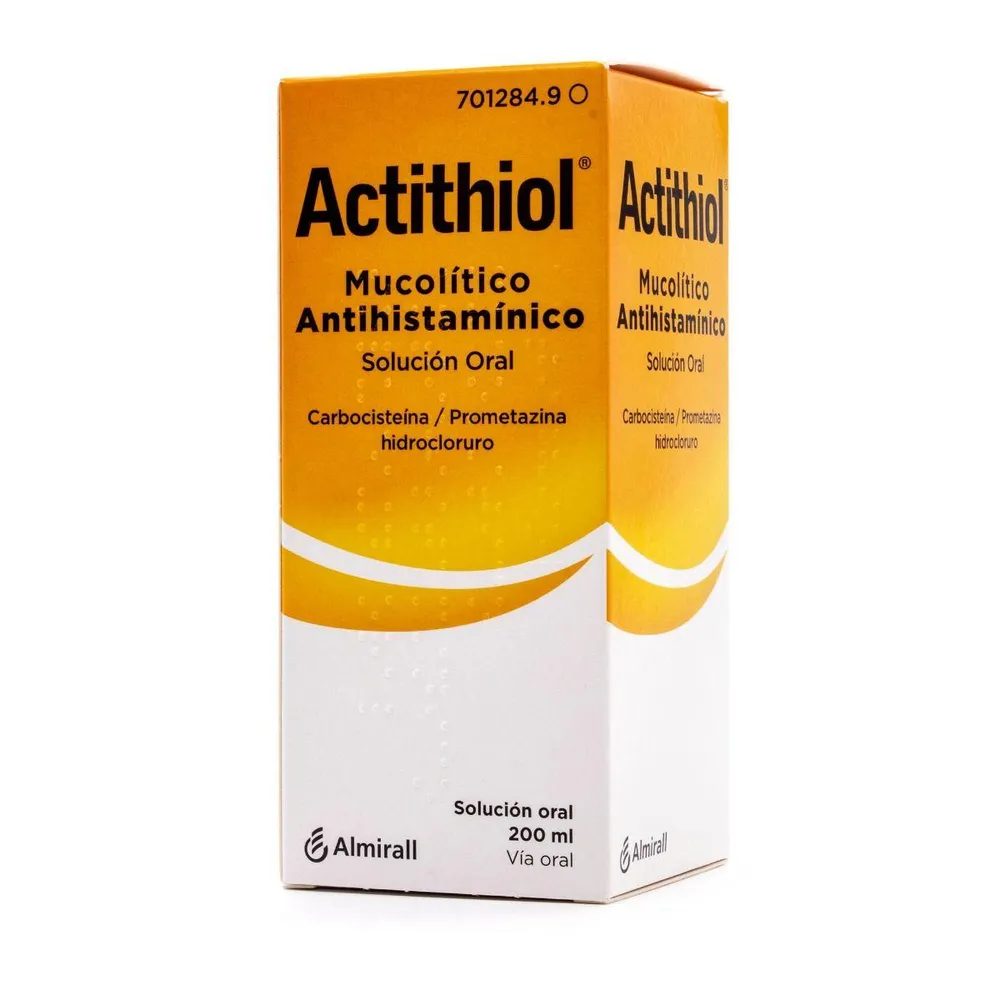
Table of Contents
- Package leaflet: Information for the user
- Introduction
- 1. What Actithiol Mucolytic Antihistamine is and what it is used for
- 2. What you need to know before taking Actithiol Mucolytic Antihistamine
- 3. How to take Actithiol Mucolytic Antihistamine
- 4. Possible adverse effects
- 5. Storage of Actithiol Mucolytic Antihistamine
- 6. Package contents and other information
Package leaflet: Information for the user
Introduction
Package leaflet: information for the user
Actithiol Mucolytic Antihistamine Oral Solution
carbocysteine/promethazine hydrochloride
Read the entire leaflet carefully before you start taking this medicine, because it contains important information for you.
- Keep this leaflet, as you may need to read it again.
- If you have any questions, ask your doctor or pharmacist.
- This medicine has been prescribed for you only and must not be given to other people, even if they have the same symptoms as you, because it could harm them.
- If you experience any adverse effects, consult your doctor or pharmacist, even if they are adverse effects not listed in this leaflet. See section 4.
Leaflet contents:
- What Actithiol Mucolytic Antihistamine is and what it is used for
- What you need to know before taking Actithiol Mucolytic Antihistamine
- How to take Actithiol Mucolytic Antihistamine
- Possible adverse effects
- How to store Actithiol Mucolytic Antihistamine
- Contents of the pack and other information
1. What Actithiol Mucolytic Antihistamine is and what it is used for
Actithiol Mucolytic Antihistamine contains carbocisteine and promethazine.
Carbocisteine is a mucolytic agent that liquefies mucus and reduces its viscosity, facilitating its elimination, and has anti-inflammatory activity.
Promethazine is a phenothiazine with antihistaminic properties that is effective in relieving symptoms of nasal and throat irritation.
This medicine is used for the symptomatic relief of respiratory tract conditions with an allergic component, such as sinusitis, rhinopharyngitis, and acute, subacute, and chronic bronchitis.
2. What you need to know before taking Actithiol Mucolytic Antihistamine
Do not take Actithiol Mucolytic Antihistamine
- if you are allergic to carbocysteine or promethazine or phenothiazines in general, or to any of the other ingredients of this medicine (listed in section 6).
- if you have gastroduodenal ulcer.
- if you have asthma or another serious respiratory disease.
- if you have a history of blood disorders (agranulocytosis: absence or decrease of white blood cells) or jaundice (yellowing of the skin and mucous membranes).
- if you have urinary disorders or prostate problems due to risk of urine retention.
- if you are at risk of closed-angle glaucoma (an eye disease in which pressure inside the eye increases and which may lead to blindness).
- if you have myasthenia (a neuromuscular disease characterized by muscle weakness).
- if you have taken a monoamine oxidase inhibitor (MAOI) within the last two weeks (medicines used to treat depression).
- if your bone marrow function is reduced.
- if your doctor has told you that you have an intolerance to certain sugars, consult him before taking this medicine.
- if you are a child suffering from severe dehydration or acute illness (chickenpox, measles, central nervous system infections, gastroenteritis), as you may be more susceptible to neuromuscular reactions including abnormal movements (dystonias).
Actithiol Mucolytic Antihistamine is contraindicated in children under 2 years of age.
Warnings and precautions
Talk to your doctor or pharmacist before starting to take Actithiol Mucolytic Antihistamine.
-
If you have hypothyroidism.
-
If you have pyloro-duodenal obstruction.
-
If you have difficulty urinating.
-
If you have porphyria (a metabolic disorder causing disturbance in a component of red blood cells).
-
In elderly patients who are especially sensitive to the adverse effects of carbocysteine or promethazine.
-
In patients with cardiovascular conditions.
-
In case of severe hepatic and/or renal impairment.
-
Do not take simultaneously with a medicine that suppresses the cough reflex or dries bronchial secretions (e.g. medicines known as "anticholinergics").
-
Increase monitoring in epileptic patients.
-
Avoid alcoholic beverages during treatment.
-
Avoid exposure to sunlight, as there is a risk of abnormal skin reactions caused by the sun (photosensitization).
-
If you have any serious heart condition.
-
If you have personal or family history of heart disease.
-
If you have irregular heartbeats.
Interference with diagnostic tests
This medicine may interfere with urine pregnancy tests, causing either false positives or false negatives.
It must be discontinued at least 72 hours before starting skin allergy tests, as it inhibits the histamine response in the skin and may produce false negative results.
Other medicines and Actithiol Mucolytic Antihistamine
Inform your doctor or pharmacist if you are taking, have recently taken, or might need to take any other medicines.
- Concomitant use of carbocysteine with drugs that suppress the cough reflex or inhibit bronchial secretions (anticholinergics) is not recommended, as it may cause retention of bronchial secretions and hinder sputum expulsion.
- Do not take concurrently with anticholinergic drugs, such as tricyclic antidepressants, monoamine oxidase inhibitors, anticholinergic antiparkinsonian agents, atropine-like antispasmodics, disopyramide, or phenothiazine neuroleptics, as they may increase the adverse effects of promethazine (dry mouth, urinary retention, constipation).
- Do not take concurrently with central nervous system depressants (sedatives, hypnotics, anxiolytics, analgesics), as they may enhance the sedative effect of promethazine.
- Medicines that may affect heart rhythm.
Taking Actithiol Mucolytic Antihistamine with food, drinks and alcohol
It is recommended to take this medicine before meals (see section 3. How to take Actithiol Mucolytic Antihistamine). Consumption of alcoholic beverages during treatment is not advised.
Pregnancy, breastfeeding and fertility
If you are pregnant or breastfeeding, think you may be pregnant or plan to become pregnant, consult your doctor or pharmacist before using this medicine.
Do not take Actithiol Mucolytic Antihistamine if you are pregnant.
If you are breastfeeding, do not take Actithiol Mucolytic Antihistamine, as it is excreted in breast milk.
Driving and using machines
Actithiol Mucolytic Antihistamine may cause drowsiness, especially at the beginning of treatment, which could impair your ability to drive and/or operate machinery. Patients should avoid operating dangerous machinery, including cars, until they know how they tolerate the medicine.
Actithiol Mucolytic Antihistamine contains sucrose, methyl parahydroxybenzoate, and propyl parahydroxybenzoate, propylene glycol, ethanol and sodium.
This medicine contains sucrose. If your doctor has told you that you have an intolerance to certain sugars, consult him before taking this medicine. Patients with diabetes mellitus should be aware that this medicine contains 6 g of sucrose per 10 ml.
This medicine may cause allergic reactions (possibly delayed) because it contains methyl parahydroxybenzoate (E-218) and propyl parahydroxybenzoate (E-216).
This medicine contains 1.036 mg of propylene glycol (E-1520) in each 10 ml. If you are pregnant or breastfeeding, do not take this medicine unless recommended by your doctor. Your doctor may perform additional check-ups while you are taking this medicine. If you have hepatic or renal impairment, do not take this medicine unless recommended by your doctor. Your doctor may perform additional check-ups while you are taking this medicine. If the child is under 5 years of age, consult your doctor or pharmacist, particularly if other medicines containing propylene glycol or alcohol have been administered.
This medicine contains 2.4% ethanol (alcohol), corresponding to 0.12 g per 5 ml of solution, equivalent to 2.4 ml of beer or 1 ml of wine. This medicine is harmful for people suffering from alcoholism. The alcohol content should be taken into account in pregnant or breastfeeding women, children, and high-risk groups such as patients with liver disease or epilepsy.
This medicine contains 27.6 mg of sodium (main component of table/cooking salt) per 10 ml. This corresponds to 1.38% of the maximum daily recommended sodium intake for an adult.
3. How to take Actithiol Mucolytic Antihistamine
Actithiol Mucolytic Antihistamine is administered orally.
Follow exactly the administration instructions for this medicine as given by your doctor or pharmacist. If in doubt, consult your doctor or pharmacist again.
Remember to take your medicine.
Recommended dose for children aged 2 to 5 years:
1 dose of 5 ml from the dosing cup (100 mg of carbocysteine and 2.5 mg of promethazine) 2 to 3 times daily.
Recommended dose for children over 5 years of age:
1 dose of 5 ml from the dosing cup (100 mg of carbocysteine and 2.5 mg of promethazine) 3 to 5 times daily.
Recommended dose for adolescents from 16 years of age and adults:
1 dose of 10 ml from the dosing cup (200 mg of carbocysteine and 5 mg of promethazine) 3 to 5 times daily.
It is recommended to use the dosing cup provided in the package for accurate dosing.
Actithiol Mucolytic Antihistamine is intended for short-term treatment.
It is recommended to take this medicine before meals, and to space doses preferably in the afternoon or at bedtime due to the pronounced sedative effect of promethazine.
Do not take more than the recommended dose.
Your doctor may adjust the dose according to your clinical condition.
If you feel that the effect of Actithiol Mucolytic Antihistamine is too strong or too weak, inform your doctor or pharmacist.
If you take more Actithiol Mucolytic Antihistamine than you should
Contact your doctor or pharmacist immediately.
Signs of overdose in children may include various combinations of excitability, ataxia, athetosis, incoordination, and hallucinations, whereas in adults they may include drowsiness and coma. Seizures, preceded by excitability or coma, may occur in both populations. In case of overdose or accidental ingestion, go immediately to a medical center or contact the Toxicology Information Service at telephone 915 620 420, indicating the medicine and the dose ingested.
If you forget to take Actithiol Mucolytic Antihistamine
If you miss a dose, take it as soon as possible. However, if it is almost time for your next dose, skip the missed dose and take the next one at the usual time.
Do not take a double dose to make up for missed doses.
4. Possible adverse effects
Like all medicines, this medicine may cause adverse effects, although not everyone will experience them.
Sedation, drowsiness, dizziness, dry mouth, visual disturbances, constipation, and urinary retention may occur.
In some cases, allergic reactions such as skin rashes, urticaria, or asthma attacks may occur.
Gastrointestinal disorders (gastric discomfort, diarrhea, nausea, vomiting, and very rarely gastrointestinal bleeding), headache, vertigo, lack of motor coordination, tremor in elderly patients, postural hypotension (dizziness upon standing or getting up), bradycardia (slow heart rate), tachycardia (fast heart rate), increased blood pressure, or jaundice (yellowing of the skin and mucous membranes) may also occur. Rarely, mental confusion or disorientation may occur, and very rarely bronchospasm (narrowing of the bronchial lumen).
Excitation may be observed in children.
Very rarely, hematological disorders (reduction in platelets, red blood cells, or white blood cells) may occur.
Extrapyramidal disorders (incoordinated movements) have also been reported at high doses.
In such cases, dose reduction or discontinuation of treatment is recommended.
Frequency not known (cannot be estimated from available data), the following may occur:
- Abnormal electrical activity of the heart affecting its rhythm, including potentially life-threatening rhythm disturbances
- A severe reaction with fever, muscle rigidity, changes in blood pressure, and coma (neuroleptic malignant syndrome)
- Low levels of platelets in the blood (which may cause bleeding and bruising)
- Restlessness
- Hallucinations
- Aggressiveness
Reporting of adverse effects
If you experience any type of adverse effect, consult your doctor, pharmacist, or nurse, even if it is a possible adverse effect not listed in this leaflet. You may also report them directly via the Spanish Pharmacovigilance System for Human Medicinal Products: https://www.notificaram.es. By reporting adverse effects, you can help provide more information on the safety of this medicine.
5. Storage of Actithiol Mucolytic Antihistamine
Keep this medicine out of the sight and reach of children.
No special storage conditions are required.
Do not use this medicine after the expiry date stated on the packaging after EXP. The expiry date is the last day of the month indicated.
Medicines must not be disposed of via wastewater drains or household waste. Dispose of empty containers and unused medicines at the SIGRE collection point at your pharmacy. If you are in doubt, ask your pharmacist how to dispose of containers and unused medicines. This will help protect the environment.
6. Package contents and other information
Composition of Actithiol Mucolytic Antihistamine Oral Solution
The active substances in Actithiol Mucolytic Antihistamine are carbocysteine and promethazine.
Each 5 ml of oral solution contains 100 mg of carbocysteine and 2.5 mg of promethazine hydrochloride.
Each 10 ml of oral solution contains 200 mg of carbocysteine and 5 mg of promethazine hydrochloride.
The other components are: citric acid, sodium hydroxide, sucrose, ethanol, methyl parahydroxybenzoate (E-218), propyl parahydroxybenzoate (E-216), propylene glycol (E-1520), pineapple flavour, peach flavour and purified water.
Appearance of the product and contents of the container
Actithiol Mucolytic Antihistamine Oral Solution is supplied in 200 ml bottles, with a dosing cup.
Marketing Authorisation Holder and Manufacturer
Marketing Authorisation Holder
Almirall, S.A. General Mitre, 151 08022 Barcelona (Spain)
Manufacturer
Industrias Farmacéuticas Almirall, S.A., Ctra. de Martorell, 41-61, 08740 - Sant Andreu de la Barca – Barcelona (Spain).
or
Manufacturer
Almirall Hermal, GmbH, Scholtzstrasse, 3 D-21465 Reinbek (Germany)
Date of latest revision of this leaflet: March 2025
Detailed information on this medicine is available on the website of the Spanish Agency of Medicines and Health Products (AEMPS) (http://www.aemps.gob.es)