Actimag 400 mg/ml oral solution
Spain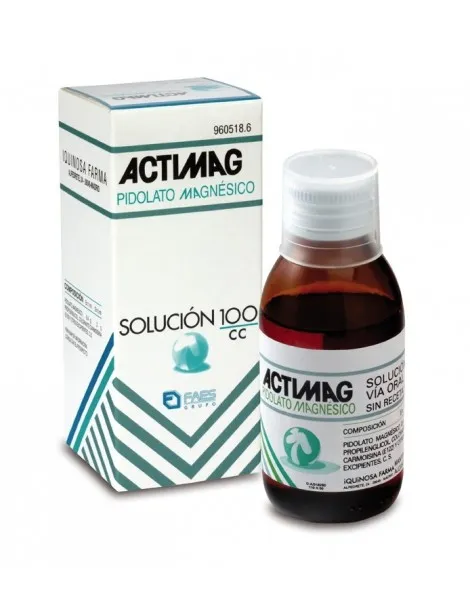
Table of Contents
Package leaflet: Information for the user
Introduction
Package leaflet: information for the user
ACTIMAG 400 mg/mL oral solution
magnesium pidolate
Read the entire leaflet carefully before you start taking this medicine, because it contains important information for you.
Follow exactly the instructions for taking this medicine as described in this leaflet or as advised by your doctor or pharmacist.
- Keep this leaflet, as you may need to read it again.
- If you need advice or more information, consult your pharmacist.
- If you experience any side effects, consult your doctor or pharmacist, even if they are side effects not listed in this leaflet. See section 4.
- You should consult a doctor if you worsen or do not improve after 7 days.
Contents of the leaflet
- What Actimag is and what it is used for
- What you need to know before taking Actimag
- How to take Actimag
- Possible side effects
- How to store Actimag
- Contents of the pack and other information
1. What Actimag is and what it is used for
Actimag 400 mg/mL oral solution belongs to a group of medicines called magnesium supplements. It is indicated in adults and children over 12 years of age for the prevention and treatment of low levels of magnesium in the body.
2. What you need to know before taking Actimag
Do not take Actimag
- If you are allergic to magnesium pidolate, magnesium, or any of the other components of this medicine (listed in section 6).
- If you have abnormally high levels of magnesium in your blood.
- If you have had serious kidney problems.
- If you suffer from chronic diarrhea.
- If you have any intestinal disorder, consult your doctor before using this medicine.
- If you suffer from muscle weakness and/or fatigue (myasthenia gravis).
- If you have had part of your intestine surgically removed.
- If you have Cushing's disease (excess cortisol).
- If you currently have or have previously had diabetic coma (loss of consciousness due to extremely high or low blood glucose levels).
- If you currently have or have previously had heart conditions such as angina or myocardial infarction.
- If you have any disorders in calcium metabolism.
Warnings and precautions
Consult your doctor or pharmacist before starting to take Actimag.
- Do not use this medicine continuously without medical supervision. Prolonged use of this medicine may cause hypermagnesemia (high magnesium levels in blood), characterized by nausea, vomiting, respiratory depression (weak breathing), and depression of the central nervous system (symptoms may range from drowsiness to coma), hyperreflexia (exaggerated reflexes), muscle weakness, and certain cardiovascular effects such as low blood pressure, reduced heart rate, and cardiac arrest.
- Prolonged use of this medicine may cause hypercalcemia (high calcium levels in blood).
- Use this medicine with caution during long-term treatment, as regular monitoring of magnesium and calcium levels in blood may be necessary.
- Taking this medicine on an empty stomach may cause diarrhea.
- Patients with kidney disease should consult their doctor before starting this medicine.
Children and adolescents
Do not administer to children under 12 years of age unless otherwise directed by a physician.
Other medicines and Actimag
Inform your doctor or pharmacist if you are currently taking, have recently taken, or might need to take any other medicines, including those obtained without a prescription.
Please note that these instructions may also apply to medicines previously used or that may be used in the future.
Magnesium may bind to certain medicines and impair their complete absorption.
This medicine reduces the absorption of:
- Antibiotics such as tetracyclines (doxycycline, minocycline, oxytetracycline, tetracycline) and quinolones (ciprofloxacin, levofloxacin, norfloxacin, ofloxacin).
- Bisphosphonates (medicines used in the treatment of osteoporosis, such as alendronate).
- Antifungal agents of the azole type (e.g., ketoconazole).
The administration of Actimag and these medicines should be spaced by at least 2 hours to avoid unwanted interactions.
If you are taking any of the following medicines:
- Sodium polystyrene sulfonate (a medicine used to treat hyperkalemia)
- Calcium supplements
ask your doctor or pharmacist how much you should space the doses to establish a dosing schedule that facilitates taking these medicines.
- Simultaneous administration of delavirdine (a medicine used as part of antiretroviral therapy for treatment of HIV-1) with Actimag may reduce the effectiveness of delavirdine; therefore, administration of delavirdine and Actimag should be spaced by at least 1 hour.
Review the information for any medicine or herbal remedy you are taking (such as antacids, laxatives, vitamins), as they may contain magnesium. Additionally, other possible interactions between Actimag and medicines used to treat heart conditions, as well as with alcohol and glucose, may exist. Ask your doctor or pharmacist how to safely use these products.
Use of Actimag with food and drinks
Excessive and prolonged consumption of products containing magnesium and calcium may lead to excessive calcium concentrations in blood. In such cases, calcium intake and calcium-rich foods such as dairy products should be monitored.
Take this medicine with food intake.
Pregnancy and breastfeeding
If you are pregnant or breastfeeding, think you may be pregnant, or plan to become pregnant, consult your doctor or pharmacist before using this medicine.
Pregnancy
This medicine may be used during pregnancy only when strictly necessary.
It is recommended to meet magnesium requirements through a diet rich in vegetables, whole grains, and legumes to prevent consequences of magnesium deficiency during pregnancy.
Breastfeeding
Consult your doctor if you are breastfeeding.
No problems have been reported in breastfed infants whose mothers take magnesium at recommended doses.
Driving and using machines
The effect of Actimag on the ability to drive or operate machinery is none or negligible.
Actimag contains sucrose, methyl parahydroxybenzoate (E-218), propyl parahydroxybenzoate (E-216), amaranth (E-123), propylene glycol (E-1520), and sodium.
This medicine contains sucrose. If your doctor has diagnosed you with an intolerance to certain sugars, consult him or her before taking this medicine.
It may cause allergic reactions (possibly delayed) because it contains methyl parahydroxybenzoate (E-218) and propyl parahydroxybenzoate (E-216).
This medicine may cause allergic reactions because it contains amaranth (E-123). It may provoke asthma, especially in patients allergic to acetylsalicylic acid.
This medicine contains 8.66 mg of propylene glycol in each dose unit (10 mL).
This medicine contains less than 23 mg of sodium (1 mmol) per dose unit (5 mL); hence, it is essentially “sodium-free”.
3. How to take Actimag
Follow exactly the dosage instructions for this medicine as stated in this leaflet or as directed by your doctor or pharmacist. If in doubt, consult your doctor or pharmacist.
This medicine is administered orally.
The recommended dose for adults and children over 12 years of age is 5 mL twice daily.
Do not exceed the recommended daily doses.
Method of administration
It is advisable to take this medicine with food unless your doctor advises otherwise, in order to reduce gastrointestinal discomfort and diarrhea.
Use in children
This medicine should not be used in children unless prescribed by a doctor.
Use in elderly patients
In elderly patients (65 years of age) who have reduced kidney function, the dose and frequency of administration of magnesium salts should be adjusted by the doctor according to the degree of renal impairment.
If you take more Actimag than you should
If you take an excessive dose of this medicine, the following symptoms may occur: nausea, vomiting, decreased blood pressure, and in very severe cases, skin vasodilation, slowing of the heart rate, and depression of the central nervous system.
If you experience any of these symptoms, consult your doctor or pharmacist immediately or go to the nearest hospital emergency department. Take this leaflet with you. You may also call the Toxicology Information Service at telephone number 91.562.04.20, indicating the medicine and the amount ingested.
If you forget to take Actimag
Remember to take your medicine. If you forget to take a dose, take it as soon as possible, unless it is almost time for your next dose. Do not take a double dose to make up for a missed dose.
If you stop taking Actimag
If you have any further questions about the use of this medicine, ask your doctor or pharmacist.
4. Possible adverse effects
Like all medicines, this medicine may cause adverse effects, although not everyone experiences them.
The following adverse effects have been observed, although their frequency cannot be precisely determined:
Gastrointestinal disorders:
-
Occasionally: gastric discomfort, diarrhoea
-
Vascular disorders
-
Hypotension
A serious allergic reaction may occur in rare cases. Consult your doctor immediately if you experience any of the following symptoms: flushing, itching/swelling (especially of the face, tongue or throat), dizziness and/or breathing difficulties.
Reporting of adverse effects
If you experience any type of adverse effect, consult your doctor or pharmacist, even if it is a possible adverse effect not listed in this leaflet. You may also report them directly through the Spanish Pharmacovigilance System for Human Medicines: https://www.notificaRAM.es/. By reporting adverse effects, you can help provide more information on the safety of this medicine.
5. Storage of Actimag
Keep this medicine out of the sight and reach of children.
No special storage conditions are required.
Do not use this medicine after the expiry date stated on the packaging, after EXP. The expiry date refers to the last day of the month indicated.
Medicines must not be disposed of via wastewater or household waste. Dispose of unused medicines and their packaging at the SIGRE collection point at your pharmacy. If you are unsure, ask your pharmacist how to dispose of medicines and packaging you no longer need. This will help protect the environment.
6. Contents of the package and other information
Composition of Actimag 400 mg/mL oral solution
- The active substance is magnesium pidolate. Each mL of oral solution contains 400 mg of magnesium pidolate (equivalent to 34.7 mg of magnesium).
- The other components are: sucrose, propylene glycol, sodium saccharin, methylparahydroxybenzoate (E-218), propylparahydroxybenzoate (E-216), raspberry flavor, peppermint flavor, amaranth dye (E-123), and water.
Appearance of the medicinal product and contents of the container
Glass bottle with a high-density polyethylene/polypropylene (PP/HDPE) child-resistant cap, containing 100 mL of oral solution and a dosing device.
Marketing Authorization Holder
Faes Farma, S.A.
Autonomia Etorbidea, 10
48940 Leioa (Bizkaia)
Spain
Manufacturer
Faes Farma, S.A.
Scientific and Technological Park of Bizkaia
Ibaizabal Bidea, Building 901
48160 Derio (Bizkaia)
Spain
Date of the most recent revision of this leaflet: November 2021
Detailed and up-to-date information on this medicinal product is available on the website of the Spanish Agency of Medicines and Health Products (AEMPS) http://www.aemps.gob.es/