Aciclovir Sala 250 mg powder for solution for infusion EFG
Spain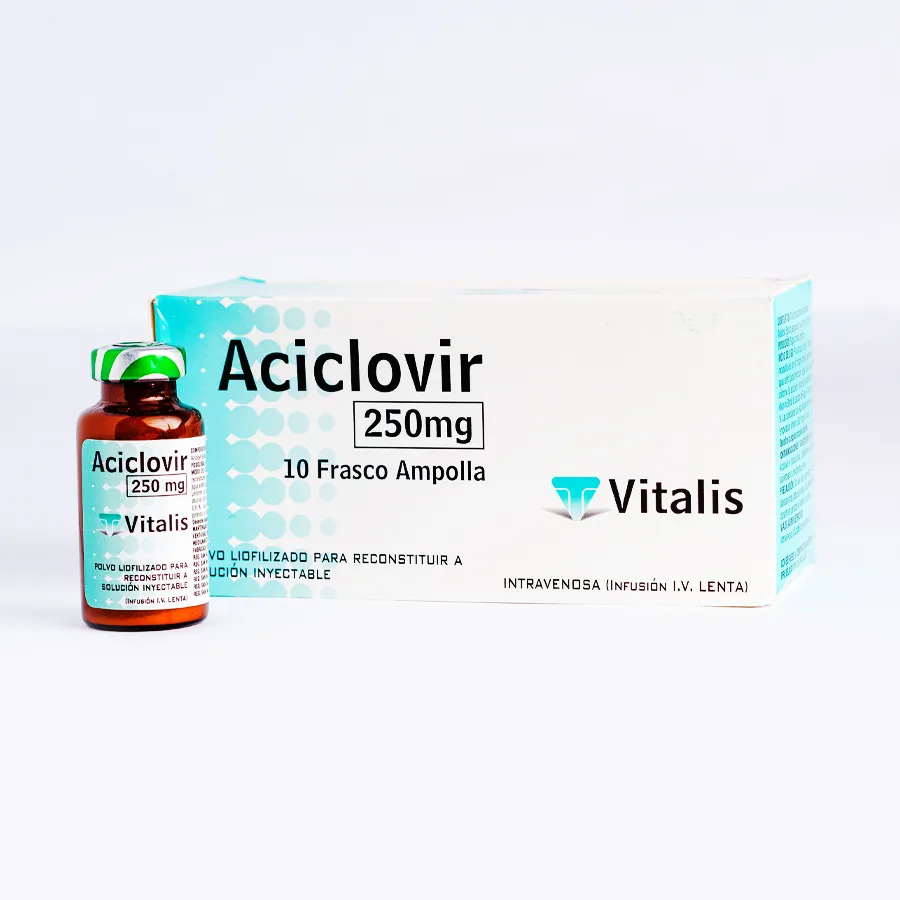
Table of Contents
Package leaflet: Information for the user
Introduction
Package leaflet: information for the patient
Aciclovir Sala 250 mg powder for solution for infusion EFG
Read the entire leaflet carefully before you start using this medicine, because it contains important information for you.
- Keep this leaflet, as you may need to read it again.
- If you have any questions, consult your doctor, pharmacist, or nurse.
- This medicine has been prescribed for you only, and you should not give it to other people, even if they have the same symptoms as you, because it could harm them.
- If you experience any adverse effects, consult your doctor, pharmacist, or nurse, even if they are effects not listed in this leaflet. See section 4.
In this leaflet:
- What Aciclovir Sala is and what it is used for
- What you need to know before using Aciclovir Sala
- How to use Aciclovir Sala
- Possible side effects
- How to store Aciclovir Sala
- Contents of the pack and other information
1. What Aciclovir Sala is and what it is used for
Aciclovir Sala is a medicine that contains the active substance called aciclovir. Aciclovir belongs to a group of medicines known as antivirals, which are active against herpesviruses. It works by eliminating or inhibiting the growth of viruses.
This medicine is indicated for:
-
Treatment of herpes simplex virus infections.
-
Prevention of herpes simplex virus infections in patients with a poorly functioning immune system, meaning their bodies are less able to fight infections.
-
Initial and recurrent treatment of varicella zoster virus infections in patients with a poorly functioning immune system.
-
Treatment of immunocompetent patients with herpes zoster, particularly in progressive or disseminated skin infections.
-
Treatment of herpes encephalitis (inflammation of the brain). This is rarely caused by the virus responsible for cold sores and genital herpes.
-
Treatment of herpes simplex virus infections in newborns and children up to 3 months of age.
2. What you need to know before using Aciclovir Sala
Do not use Aciclovir Sala:
- If you are allergic to aciclovir, valaciclovir, ganciclovir, or to any of the excipients (listed in section 6).
Warnings and precautions
Take special care with Aciclovir Sala:
Consult your doctor or nurse before starting to use aciclovir:
-
If you have kidney disease or are elderly (over 65 years of age), your doctor may use a lower dose. Also, you should drink sufficient amounts of fluid during treatment to maintain adequate hydration.
-
If you have undergone kidney transplantation, your doctor should monitor kidney function, as a slight increase in serum creatinine or urea may occur, which could be mistaken for a rejection reaction.
-
If you have a weakened immune system.
If you are unsure whether any of the above apply to you, consult your doctor or nurse before using aciclovir.
Other medicines and Aciclovir Sala
Inform your doctor, pharmacist, or nurse if you are taking, or have recently taken, any other medicines, including those obtained without a prescription.
It is especially important that you talk to your doctor or pharmacist if you are taking any of the following medicines:
- probenecid, used for the treatment of gout;
- cimetidine, used for the treatment of stomach ulcers;
- tacrolimus, cyclosporine, or mycophenolate mofetil, used to prevent the body from rejecting transplanted organs;
- lithium, used to treat manic-depressive disorders;
- theophylline, used to treat certain respiratory disorders.
Pregnancy and breastfeeding
If you are pregnant or breastfeeding, think you may be pregnant, or are planning to become pregnant, consult your doctor before using this medicine.
The safety of this medicine in pregnant women has not been demonstrated; it will only be used if your doctor considers that the benefit outweighs the risk.
Aciclovir is excreted in breast milk; breastfeeding is therefore not recommended during treatment.
Driving and using machines
There are no data indicating limitations for this activity.
Important information about some of the components of Aciclovir:
This medicine contains 26 mg of sodium per vial (the main component of table/cooking salt). This corresponds to 1.3% of the maximum daily sodium intake recommended for an adult.
3. How to use Aciclovir Sala
You should never administer this medicine yourself. The medicine will always be given by a trained healthcare professional. Aciclovir will be administered to you as a continuous intravenous infusion. This means that the medicine is slowly delivered into a vein over a period of 1 hour.
Aciclovir is usually administered every 8 hours.
You may receive additional fluids to ensure that you do not become dehydrated.
The dose, frequency, and duration of treatment will depend on:
- the type of infection you have,
- your body weight,
- your age.
Your doctor may adjust your aciclovir dose if:
- you have kidney problems. If you have kidney problems, it is important that you receive plenty of fluids during aciclovir treatment.
- you are overweight.
- you are over 65 years of age.
Talk to your doctor before receiving aciclovir if any of the above conditions apply to you.
Use in children
The aciclovir dose given to:
- children between 3 months and 12 years of age is calculated based on body surface area.
- newborns and children up to 3 months of age is calculated based on body weight.
If a child has kidney problems, the dose of the medicine may be reduced.
Use in elderly patients
The dose should be reduced in patients with renal impairment.
Your doctor will determine the appropriate dose and duration of your intravenous aciclovir treatment. For acute herpes simplex virus infections, 5 days of treatment is usually adequate; however, the duration may vary depending on the severity of the infection, the patient's clinical condition, and response to treatment. Treatment of herpes encephalitis and neonatal herpes simplex typically lasts 10 days. The duration of prophylactic intravenous aciclovir administration will be determined according to the length of the risk period.
If you use more Aciclovir Sala than you should: If you think you have been given too much aciclovir, speak to your doctor or nurse immediately.
If you have received too much aciclovir, you may: feel confused or agitated, experience hallucinations (seeing or hearing things that are not real), have seizures, or lose consciousness (coma).
In case of overdose or accidental ingestion, contact your doctor or pharmacist immediately, or call the Toxicology Information Service at telephone number: 91 562 04 20, providing details of the medicine taken and the amount ingested.
If you forget to use Aciclovir Sala
Do not administer a double dose to make up for missed doses.
4. Possible adverse effects
Like all medicines, this medicine can cause adverse effects, although not everyone experiences them.
This medicine may cause the following adverse effects:
Allergic reactions (affect fewer than 1 in 10,000 people)
If you have an allergic reaction, stop taking aciclovir and speak to your doctor immediately. Signs may include:
- skin rash, itching or hives;
- swelling of the face, lips, tongue or other parts of the body;
- shortness of breath, wheezing or difficulty breathing;
- unexplained fever (high temperature) and feeling faint, especially when standing up.
Other adverse effects include:
Common (affect fewer than 1 in 10 people)
- nausea and vomiting;
- skin rash with itching and appearance of hives;
- skin reaction after exposure to light (photosensitivity);
- itching;
- swelling, redness and sensitivity at the injection site;
- increased liver enzymes.
Uncommon (affect fewer than 1 in 100 people)
- reduction in the number of red blood cells (anemia);
- reduction in the number of white blood cells (leucopenia);
- reduction in the number of platelets (thrombocytopenia, which may lead to nosebleeds and bruising more easily than usual).
Rare (affect up to 1 in 10,000 people)
- headache or dizziness;
- diarrhea or stomach pain;
- fatigue;
- fever;
- effects on certain blood and urine laboratory tests;
- feeling of weakness;
- feeling agitated or confused;
- spasms or tremors;
- hallucinations (seeing or hearing things that do not exist);
- seizures;
- unusual drowsiness or somnolence;
- unsteadiness when walking and lack of coordination;
- difficulty speaking;
- inability to think or judge clearly;
- unconsciousness (coma);
- paralysis of part or all of your body;
- changes in behavior, speech and eye movements;
- neck stiffness and sensitivity to light;
- inflammation of the liver (hepatitis);
- yellowing of the skin and whites of the eyes (jaundice);
- kidney problems (little or no urine passed);
- lower back pain, in the kidney area of your back or just above the hips (renal pain).
Reporting of adverse effects
If you experience any type of adverse effect, consult your doctor or nurse, even if it is a possible adverse effect not listed in this leaflet. You may also report them directly via the Spanish Pharmacovigilance System for Human Medicinal Products: www.notificaRAM.es. By reporting adverse effects, you can help provide more information on the safety of this medicine.
5. Storage of Aciclovir Sala
Keep Aciclovir Sala out of the sight and reach of children.
This medicine does not require any special storage conditions.
Do not use this medicine after the expiry date stated on the label and on the carton after EXP. The expiry date refers to the last day of the month indicated.
Solutions obtained after reconstituting the vial with 10 ml of water for injections remain stable for 12 hours at 25°C or for 24 hours at 2°C–8°C.
From a microbiological standpoint, the solution should be used immediately after preparation. If not used immediately, the time and conditions of storage prior to use are the responsibility of the user.
Do not use this medicine if you observe any visible turbidity or crystallization in the solution.
Medicines must not be disposed of via wastewater or household waste. Ask your pharmacist how to dispose of medicines and containers you no longer need. This will help protect the environment.
6. Contents of the container and other information
Composition of Aciclovir Sala
- The active substance is aciclovir.
- Each vial contains 250 mg of aciclovir as the sodium salt.
- The other excipients are: sodium hydroxide.
Appearance of the product and contents of the container
Aciclovir Sala is presented in glass vials containing a white or almost white, spongy lyophilized cake, closed with a rubber stopper and sealed with a metal cap.
The 250 mg dose is available in 10 ml vials, in packs of 5 and 50 vials.
Only some pack sizes may be marketed.
Marketing Authorization Holder and Manufacturer:
Laboratorio Reig Jofré, S.A
Gran Capitán, 10 - 08970 Sant Joan Despí - Barcelona - Spain
Date of the most recent revision of this leaflet: February 2023
Detailed and up-to-date information on this medicinal product is available on the website of the Spanish Agency for Medicines and Health Products (AEMPS) http://www.aemps.gob.es/
This information is intended for healthcare professionals only
The solution must be administered intravenously only, continuously and very slowly, over a period of not less than one hour.
Reconstitution and/or dilution should be performed immediately before use. The vial does not contain any preservative; therefore, any unused solution must be discarded. If visible turbidity or crystallization occurs before or during infusion, the solution must be discarded. The diluted solution must not be refrigerated.
Reconstitution of the lyophilized powder:
The aciclovir intravenous vial, containing 250 mg of lyophilized aciclovir, must be reconstituted by adding 10 ml of water for injection or 0.9% sodium chloride solution for intravenous infusion. The concentration of the reconstituted solution is 25 mg/ml.
Method of administration
Direct intravenous infusion:
The reconstituted solution is administered using a controlled-rate infusion pump over a period of not less than one hour.
Intravenous perfusion:
The reconstituted solution may be further diluted for infusion administration. Dilution is performed either totally or partially, depending on the required dose, by adding and mixing it with at least 100 ml of infusion solution to achieve a maximum concentration of 0.5% (250 mg/50 ml). The contents of 2 vials (500 mg of aciclovir) may be added to 100 ml of infusion solution. If the required dose exceeds 500 mg, a second volume of infusion solution may be used.
Intravenous aciclovir is compatible with the following infusion solutions:
- Sodium chloride (0.45%, 0.9% w/v).
- Sodium chloride (0.18% w/v) and glucose (4% w/v).
- Sodium chloride (0.45% w/v) and glucose (2.5% w/v).
- Sodium lactate (Hartmann's solution).
After adding intravenous aciclovir to the infusion solution, the mixture must be shaken vigorously to ensure complete mixing.
Following accidental extravascular administration of intravenous aciclovir, severe inflammation of extravascular tissue may occur, sometimes followed by ulceration. Administration via mechanical infusion pumps carries higher risks than gravity-driven infusion. Phlebitis and local inflammation at the infusion site may occur.
Expiry
Do not use Aciclovir Sala 250 mg powder for infusion solution after the expiry date stated on the container.
Date of the most recent revision of this leaflet: February 2023
Detailed and up-to-date information on this medicinal product is available on the website of the Spanish Agency for Medicines and Health Products (AEMPS) http://www.aemps.gob.es/