Aciclovir Accord 25 mg/ml concentrate for solution for infusion
Spain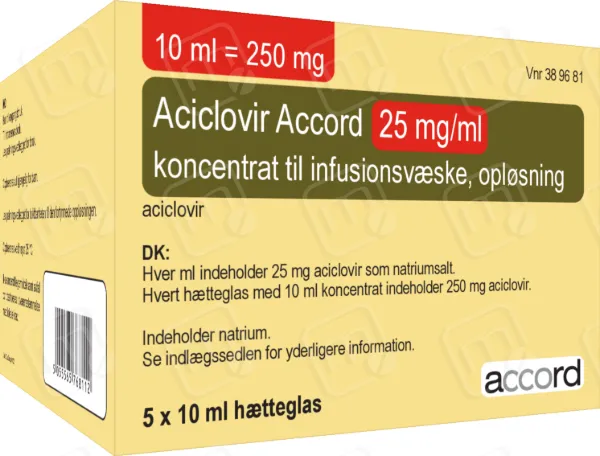
Table of Contents
- Patient Information Leaflet
- Introduction
- **Package Leaflet: Information for the User**
- **Package leaflet contents**:
- 1. What Aciclovir Accord is and what it is used for
- 2. What you need to know before starting to use Aciclovir Accord
- **Warnings and precautions**
- **Use of Aciclovir Accord with other medicines**
- **Pregnancy, breastfeeding, and fertility**
- **Driving and use of machines**
- **Aciclovir Accord contains sodium**
- 3. How to use Aciclovir Accord
- 4. Possible adverse effects
- **Reporting of Adverse Effects**
- 5. Storage of Aciclovir Accord
- 6. Contents of the container and other information
- **Appearance of the product and contents of the container**
- **Marketing Authorization Holder**
- **Manufacturer**
Patient Information Leaflet
Introduction
Package Leaflet: Information for the User
Aciclovir Accord 25 mg/ml concentrate for solution for infusion
aciclovir
Read the entire leaflet carefully before you start using this medicine, as it contains important information for you.
- Keep this leaflet as you may need to read it again.
- If you have any questions, ask your doctor or pharmacist.
- This medicine has been prescribed for you only and must not be given to other people, even if they have the same symptoms as you, since it could harm them.
- If you experience any adverse effects, consult your doctor or pharmacist, even if they are adverse effects not listed in this leaflet. See section 4.
Package leaflet contents:
- What Aciclovir Accord is and what it is used for.
- What you need to know before using Aciclovir Accord
- How to use Aciclovir Accord
- Possible side effects.
- Storage of Aciclovir Accord
- Contents of the pack and other information.
1. What Aciclovir Accord is and what it is used for
This medicine contains aciclovir as the active substance. Aciclovir is an antiviral medicine (antiviral means active against viruses) and prevents the multiplication of viruses.
Aciclovir is indicated for:
- Treatment and prevention of infections caused by a virus called herpes simplex. Aciclovir is mainly used in patients with reduced immune response due to bone marrow transplantation or treatment for acute leukemia.
- Treatment of shingles or herpes zoster in patients with reduced resistance, and treatment of severe shingles or herpes zoster in patients with normal resistance. Shingles or herpes zoster is caused by a virus called varicella zoster.
- Treatment of severe genital infections caused by a virus called genital herpes.
- Treatment of meningitis (encephalitis) caused by the herpes simplex virus.
- Treatment of infections in neonates caused by a virus called neonatal herpes.
2. What you need to know before starting to use Aciclovir Accord
Do not use Aciclovir Accord
- if you are allergic to aciclovir or to any of the other ingredients of this medicine (listed in section 6).
If the above applies to you, do not use Aciclovir Accord. If you have any doubts, consult your doctor or pharmacist before using this medicine.
Warnings and precautions
Consult your doctor or pharmacist before starting to use Aciclovir Accord if:
- You have kidney problems.
- You are over 65 years of age.
If you are unsure whether any of the above points apply to you, consult your doctor or pharmacist before taking Aciclovir Accord.
It is important to drink plenty of water while taking aciclovir.
Use of Aciclovir Accord with other medicines
Inform your doctor or pharmacist if you are taking, have recently taken, or might need to take any other medicines. This includes medicines obtained without a prescription and herbal medicines.
Specifically, tell your doctor or pharmacist if you are taking any of the following medicines:
- Probenecid, used to treat gout
- Cimetidine, used to treat gastric ulcers
- Tacrolimus, cyclosporine, or mycophenolate mofetil, used to prevent rejection of transplanted organs
- Lithium
- Theophylline
Pregnancy, breastfeeding, and fertility
If you are pregnant or breastfeeding, think you might be pregnant, or plan to become pregnant, consult your doctor or pharmacist before using this medicine.
Driving and use of machines
Aciclovir Accord is generally used in hospitalized patients. Therefore, information regarding driving and use of machines is not applicable.
Aciclovir Accord contains sodium
This medicine contains 26.7 mg of sodium (the main component of table/cooking salt) in each 10 ml vial. This corresponds to 1.41% of the maximum daily sodium intake recommended for an adult. This medicine contains 53.4 mg of sodium (the main component of table/cooking salt) in each 20 ml vial. This corresponds to 2.82% of the maximum daily sodium intake recommended for an adult. This medicine contains 106.8 mg of sodium (the main component of table/cooking salt) in each 40 ml vial. This corresponds to 5.65% of the maximum daily sodium intake recommended for an adult.
3. How to use Aciclovir Accord
How this medicine is administered
You must never attempt to administer this medicine yourself. It will always be given to you by a qualified healthcare professional.
Before the medicine is administered, it must be diluted.
Aciclovir will be administered to you as a continuous intravenous infusion. This means that the medicine is given slowly over a period of time.
The dose, frequency, and duration of treatment will depend on:
- The type of infection you have
- Your body weight
- Your age
The usual dose of Aciclovir Accord in adults is between 5 and 10 mg per kg of body weight administered every 8 hours.
In children between 3 months and 12 years of age, the doctor will calculate the dose of Aciclovir Accord based on body surface area.
In neonates being treated for neonatal herpes infection, the usual dose is 20 mg per kg of body weight administered every 8 hours for 14–21 days.
In elderly patients and in patients with reduced kidney function, the doctor may reduce the dose by administering infusions less frequently.
Your doctor may adjust the dose of Aciclovir Accord if:
- You have kidney problems. If you have kidney problems, it is important that you receive plenty of fluids while being treated with aciclovir.
If any of the above applies to you, speak with your doctor before aciclovir is administered.
If you have been given more Aciclovir Accord than you should have
If you think you have been given more aciclovir than you should have, speak to your doctor or nurse immediately.
If you have been given too much aciclovir, you may:
- Feel confused or agitated
- Experience hallucinations (seeing or hearing things that are not there)
- Have seizures
- Lose consciousness (coma)
In case of overdose or accidental ingestion, contact your doctor or pharmacist immediately, or call the Toxicology Information Service at telephone number: 91 562 04 20, indicating the medicine and the amount ingested.
4. Possible adverse effects
Like all medicines, this medicine can cause adverse effects, although not everyone will experience them.
Allergic reactions (may affect up to 1 in 10,000 people)
If you experience an allergic reaction, stop taking aciclovir and contact your doctor immediately. Signs may include:
- rash, itching or hives on the skin
- swelling of the face, lips, tongue or other parts of the body
- difficulty breathing, wheezing or trouble breathing
- unexplained fever (high temperature) and dizziness, especially when standing up.
Other adverse effects are:
Common (may affect up to 1 in 10 people)
- dizziness or feeling dizzy
- itching, such as urticaria
- skin reaction after exposure to light (photosensitivity)
- itching
- swelling, redness and sensitivity at the injection site
- increased liver enzymes
Uncommon (may affect up to 1 in 100 people)
- Low levels of red blood cells in the blood (anaemia)
- Low levels of white blood cells in the blood (leucopenia)
- Low levels of platelets (cells that help blood to clot) (thrombocytopenia)
Very rare (may affect up to 1 in 10,000 people)
- headache or feeling dizzy
- diarrhoea or stomach pain
- feeling tired
- fever
- effects on certain blood and urine laboratory tests
- feeling weak
- agitation or confusion
- tremors
- hallucinations (seeing or hearing things that are not real)
- seizures
- unusual sensation of numbness or drowsiness
- unsteadiness when walking and lack of coordination
- difficulty speaking
- inability to think or judge clearly
- unconsciousness (coma)
- paralysis of part or all of the body
- changes in behaviour, speech and eye movements
- neck stiffness and sensitivity to light
- inflammation of the liver (hepatitis)
- yellowing of the skin and whites of the eyes (jaundice)
- kidney problems resulting in little or no urine production
- pain in the lower back, kidney area, back or just above the hip (renal pain)
Reporting of Adverse Effects
If you experience any type of adverse effect, consult your doctor or pharmacist, even if it is a possible adverse effect not listed in this leaflet. You may also report them directly via the Spanish Pharmacovigilance System for Human Medicinal Products at www.notificaRAM.es. By reporting adverse effects, you can help provide more information on the safety of this medicine.
5. Storage of Aciclovir Accord
Keep out of the sight and reach of children.
Store below 25 °C.
Do not use this medicine after the expiry date stated on the container after EXP. The expiry date refers to the last day of the month indicated.
Dispose of any unused solution.
Medicines should not be disposed of via wastewater or household waste. Ask your pharmacist how to properly dispose of medicines and containers you no longer need. This will help protect the environment.
6. Contents of the container and other information
Composition of Aciclovir Accord:
The active substance is aciclovir. Each ml contains sodium aciclovir equivalent to 25 mg of aciclovir.
Each 10 ml vial of concentrate contains sodium aciclovir equivalent to 250 mg of aciclovir.
Each 20 ml vial of concentrate contains sodium aciclovir equivalent to 500 mg of aciclovir.
Each 40 ml vial of concentrate contains sodium aciclovir equivalent to 1 g of aciclovir.
The other components are sodium hydroxide and/or concentrated hydrochloric acid, and water for injections. Sodium hydroxide and concentrated hydrochloric acid are used to adjust the pH of the solution.
Appearance of the product and contents of the container
This medicine is a concentrate for solution for infusion. It is supplied in a glass vial containing a clear, colourless or almost colourless solution. It is a concentrated solution which is diluted to form the solution for infusion. The pH value ranges between 10.7 and 11.7.
Clear glass vials of 10, 20 or 50 ml (containing volumes of 10, 20 and 40 ml respectively), with a rubber stopper and an aluminium seal.
Pack sizes of 1 vial, 5 vials or 10 vials are available.
Only some pack sizes may be marketed.
Marketing Authorization Holder
Accord Healthcare, S.L.U.
World Trade Center
c/ Moll de Barcelona, s/n,
Edifici Est, 6th floor
08039 Barcelona.
Spain
Manufacturer
Accord Healthcare Polska Sp. z o.o.,
ul. Lutomierska 50, 95-200 Pabianice, Poland
Date of latest revision of this leaflet: February 2022
Detailed and up-to-date information on this medicinal product is available on the website of the Spanish Agency of Medicines and Health Products (AEMPS):
http://www.aemps.gob.es/
This information is intended for healthcare professionals only:
For single use only: Discard any unused solution. Disposal of unused medicine and of all materials that have been in contact with it must be carried out in accordance with local regulations.
Based on the calculated dose, determine the appropriate number of vials and the dose to be used.
Administration
The required dose of aciclovir must be administered by slow intravenous infusion over a period exceeding one hour. Aciclovir Accord may be administered using a controlled-rate infusion pump.
Alternatively, Aciclovir Accord may be further diluted to achieve a concentration of no more than 5 mg/ml (0.5% w/v) for infusion administration.
Add the required volume of Aciclovir Accord to the chosen infusion solution as recommended below, and shake well to ensure proper mixing.
For children and neonates, where it is advisable to keep the volume of infusion fluid to a minimum, dilution should be based on 4 ml of solution (100 mg of aciclovir) added to 20 ml of infusion fluid.
For adults, infusion bags containing 100 ml of infusion fluid are recommended, even when this results in aciclovir concentrations substantially lower than 0.5% w/v. Therefore, a 100 ml infusion bag may be used for any dose between 250 mg and 500 mg of aciclovir (10 and 20 ml of solution), but a second bag must be used for doses between 500 mg and 1000 mg.
When diluted according to the recommended instructions, aciclovir is compatible with the following infusion fluids and remains stable for up to 24 hours at room temperature (below 25°C):
Sodium chloride (0.45% and 0.9% w/v) for intravenous infusion
Sodium chloride (0.18% w/v) and glucose (4% w/v) for intravenous infusion
Sodium chloride (0.45% w/v) and glucose (2.5% w/v) for intravenous infusion
 Sodium lactate (Hartmann's solution) for intravenous infusion
When aciclovir is diluted according to the instructions above, the final concentration of aciclovir should not exceed 0.5% w/v.
Since no antimicrobial preservative is included, dilution must be performed under fully aseptic conditions, immediately before use, and any unused solution must be discarded.
The solution must be discarded if turbidity or crystallization is observed before or during infusion.
Compatibility has been demonstrated with polypropylene (PP) syringes, intravenous administration sets without polyvinyl chloride (PVC), and infusion bags without polyvinyl chloride (PVC).