Abicrem 0.25 mg/g + 5 mg/g cream
Spain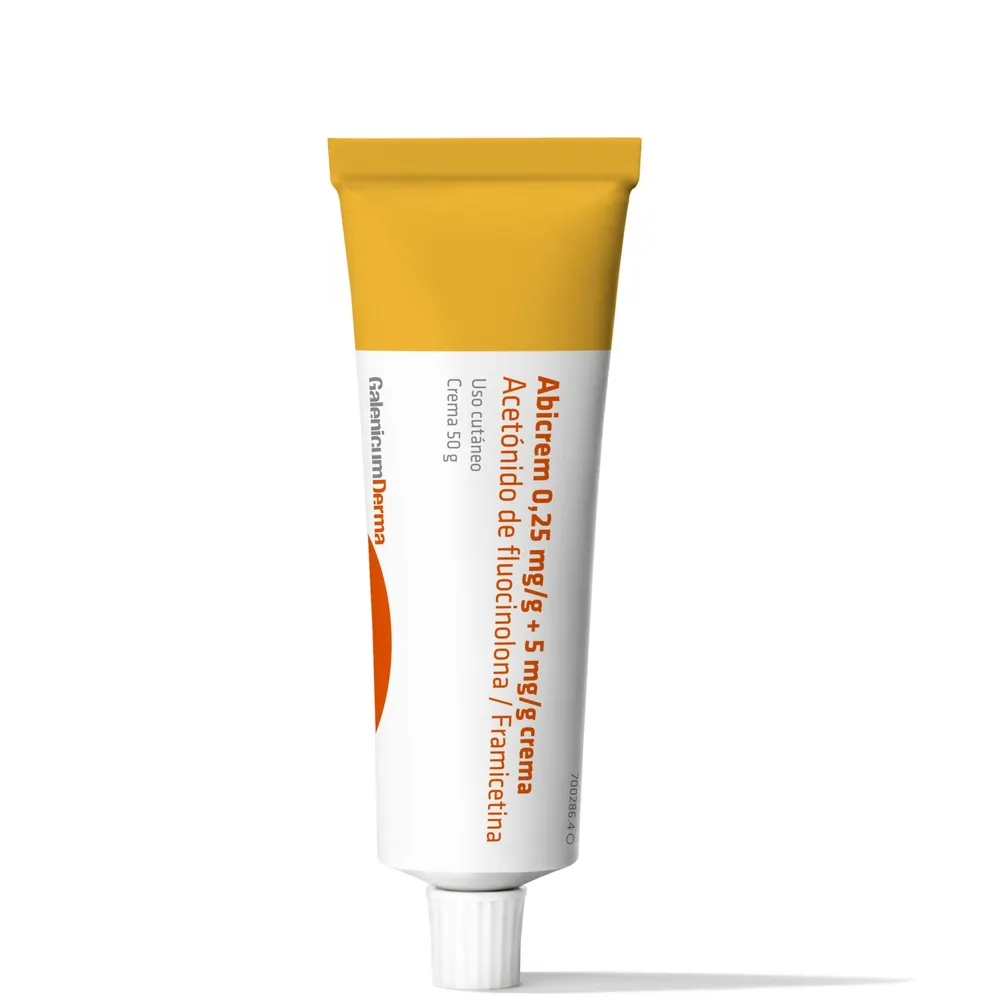
Table of Contents
Package leaflet: Information for the user
Introduction
PACKAGE LEAFLET: INFORMATION FOR THE USER
Abicrem 0.25 mg/g + 5 mg/g cream
Fluocinolone acetonide/Framycetin
Read the entire leaflet carefully before you start using this medicine, as it contains important information for you.
- Keep this leaflet, as you may need to read it again.
- If you have any questions, consult your doctor, pharmacist, or nurse.
- This medicine has been prescribed for you only, and you should not give it to others, even if they have the same symptoms as you, because it could harm them.
- If you experience any adverse effects, consult your doctor, pharmacist, or nurse, even if they are effects not listed in this leaflet. See section 4.
Contents of the leaflet:
- What Abicrem cream is and what it is used for
- What you need to know before using Abicrem cream
- How to use Abicrem cream
- Possible adverse effects
- How to store Abicrem cream
- Contents of the pack and other information
1. What Abicrem cream is and what it is used for
This medicine contains two active substances, a corticosteroid (fluocinolone acetonide) and an antibiotic (framycetin).

Antibiotics are used to treat bacterial infections and are not effective against viral infections.
It is important that you follow your doctor's instructions regarding dose, dosing interval, and duration of treatment.
Do not store or reuse this medicine. If you have any antibiotic left over after finishing treatment, return it to the pharmacy for proper disposal. Do not dispose of medicines via wastewater or household waste.
It is used for the superficial treatment, in adults and adolescents over 12 years of age, of eczematous dermatitis, such as: atopic eczema, discoid eczema (circular patches), stasis eczema (eczema on the legs occurring in some patients with hypertension), contact eczema, and seborrheic eczema, when your doctor confirms or suspects a secondary bacterial infection.
Consult a doctor if your condition worsens or does not improve after 14 days.
2. What you need to know before using Abicrem cream
Do not use Abicrem cream
- If you are allergic to the active substances or to any of the other ingredients of this medicine (listed in section 6).
- If you currently have a fungal, viral, or tuberculosis-related skin infection.
- If you have ulcers (wounds) on your limbs.
- In children under two years of age.
Warnings and precautions
Talk to your doctor, pharmacist, or nurse before starting to use Abicrem Cream.
- Corticosteroids should be used at the lowest possible dose and only for as long as necessary to achieve the desired therapeutic effect. Use of this medicine should be limited to 14 days. Long-term treatment may lead to skin thinning and may risk masking infections for which this medicine is not appropriate.
- If a local reaction due to hypersensitivity (allergy) occurs, treatment should be discontinued, the treated area should be washed, and medications for itching or inflammation such as antihistamines and/or corticosteroids should be applied topically or systemically (medicine reaching the bloodstream), under medical judgment and supervision.
- Do not apply occlusive dressings (airtight and waterproof, poorly breathable) over large skin areas, as this may increase absorption of the medicine into the bloodstream, increasing the risk of toxicity.
- Do not abruptly stop treatment.
- Avoid contact with eyes, open wounds, or mucous membranes. If accidental contact with the eyes occurs, rinse thoroughly with plenty of water and consult an ophthalmologist if necessary (see section 4).
Contact your doctor if you experience blurred vision or other visual disturbances.
Children and adolescents
- This medicine is contraindicated in children under 2 years of age and is not recommended in adolescents under 12 years of age.
- Children and adolescents during growth periods have higher skin absorption, making them more susceptible to adverse effects, which may include symptoms such as obesity or growth retardation (Cushing's syndrome). Prolonged treatments, large amounts of medication, and occlusion of the treated area should be avoided. Always consult your doctor.
Other medicines and Abicrem cream
Tell your doctor or pharmacist if you are taking, have recently taken, or might need to take any other medicines.
During treatment with Abicrem cream, other topical antibiotics or antimicrobials (substances that inhibit the growth of microorganisms such as bacteria, fungi, parasites, or viruses) should not be used due to a possible chemical interaction between them.
Do not use Abicrem cream together with anionic synthetic detergent-type substances.
Pregnancy and breastfeeding
If you are pregnant or breastfeeding, think you may be pregnant, or are planning to become pregnant, consult your doctor or pharmacist before using this medicine.
Pregnancy
Abicrem cream should only be used during pregnancy if the potential benefit outweighs the potential risk to the fetus.
Breastfeeding
Do not apply this medicine on the breasts during breastfeeding; avoid contact of the child with treated areas.
Driving and using machines
Treatment with this medicine does not affect the ability to drive or operate machinery.
Abicrem cream contains cetyl alcohol, methyl para-hydroxybenzoate (E-218), and propylene glycol (E-1520)
This medicine contains 10 mg of propylene glycol (E-1520) in each gram of cream.
This medicine may cause local skin reactions (such as contact dermatitis) because it contains cetyl alcohol.
It may cause allergic reactions (possibly delayed) because it contains methyl para-hydroxybenzoate (E-218).
Information for athletes
Consult your doctor before using this medicine, as this medicine may result in a positive anti-doping test. However, with the use of Abicrem cream, this is unlikely unless large skin areas are treated.
3. How to use Abicrem Cream
Follow exactly the instructions for use of this medicine provided by your doctor or pharmacist. If in doubt, consult your doctor or pharmacist again.
Administration: topical (cutaneous) use.
Clean the area to be treated, preferably with mild neutral detergents, and allow it to dry without rubbing the lesion.
The recommended dose for adults and adolescents over 12 years of age is a thin layer of cream applied to the affected area two to three times a day, gently rubbed in until completely absorbed, for a maximum of 14 days.
After applying this medicine, wash your hands thoroughly, unless your hands are the area being treated.
After applying the cream, do not cover the area with air- and water-impermeable, poorly breathable materials, unless otherwise directed by your doctor.
If you use more Abicrem cream than you should
If you have applied more cream than you should, consult your doctor or pharmacist.
In case of overdose or accidental ingestion, contact your doctor or pharmacist immediately or call the Toxicology Information Service: Telephone (91) 562 04 20, indicating the medicine and the amount used or ingested.
If you forget to use Abicrem cream
Do not apply a double dose to make up for missed doses.
Apply the dose as soon as possible, then continue with your usual treatment schedule.
If you stop using Abicrem cream
Do not stop treatment abruptly. It is advisable to gradually reduce and discontinue the treatment to avoid the so-called withdrawal syndrome or rebound syndrome due to sudden discontinuation of treatment.
If you have any further questions about the use of this product, ask your doctor or pharmacist.
4. Possible adverse effects
Like all medicines, Abicrem cream may produce adverse effects, although not everyone will experience them.
Due to hypersensitivity (allergy), local reactions may occur, which disappear when the dose is reduced or treatment is discontinued.
The use of corticosteroids on the skin may cause the following adverse effects. The frequency of these effects is unknown (cannot be estimated from available data):
Blurred vision, cataracts
Cutaneous infections, inflammation of hair follicles (folliculitis), thinning of the skin (atrophy), dryness or cracking of the skin, itching or burning, redness (erythema), appearance of red spots, spider veins, cutaneous striae, acne, hair loss or increased hair growth, allergic skin reaction (contact dermatitis), specific skin inflammation around the upper lip and chin (perioral dermatitis), and changes in skin color.
Adverse effects may occur not only in the treated area but may also affect the entire body. This may happen when the medicine is administered for prolonged periods, over extensive areas, with dressings or occlusive materials, and/or in children (in whom absorption is increased). A condition characterized by a round face, fat accumulation, weakness, etc. (Cushing's syndrome), increased blood pressure (hypertension), fluid retention (edema), tingling and numbness in the extremities, increased blood glucose (hyperglycemia), presence of glucose in urine (glucosuria), low potassium levels in blood, and gastric ulcer may occur.
Children and adolescents
With prolonged use, growth may be impaired, along with other symptoms such as general malaise, weight loss, abdominal pain, nausea, vomiting, confusion, and muscle weakness.
Reporting of adverse effects
If you experience any type of adverse effect, consult your doctor, pharmacist, or nurse, even if it is a possible adverse effect not listed in this leaflet. You may also report them directly via the Spanish Pharmacovigilance System for Human Medicines: www.notificaRAM.es By reporting adverse effects, you can help provide more information on the safety of this medicine.
5. Storage of Abicrem cream
Keep this medicine out of the sight and reach of children.
No special storage conditions are required.
After first opening, the cream is stable for up to 2 weeks. Once opened, store below 25°C. Any unused medicine should be discarded after 2 weeks from opening.
Do not use Abicrem cream after the expiry date stated on the packaging after EXP. The expiry date refers to the last day of the month indicated.
Medicines must not be disposed of via wastewater or household waste. Unused containers and medicines should be returned to the SIGRE collection point at your usual pharmacy. Ask your pharmacist how to dispose of containers and medicines you no longer need. This will help protect the environment.
6. Package contents and additional information
Composition of Abicrem cream
- The active substances are fluocinolone acetonide and framycetin (as sulfate). Each gram of cream contains 0.25 mg of fluocinolone acetonide and 5 mg of framycetin (as sulfate).
- The other components are Eumulgin B-1, cetyl alcohol, cutina MD, isopropyl myristate, propylene glycol (E-1520), liquid paraffin, methyl 4-hydroxybenzoate (E-218), and purified water.
Appearance of the medicinal product and contents of the pack
Abicrem cream is presented as a brilliant white, odourless cream in 50 g tubes.
Marketing Authorization Holder and Manufacturer
Marketing Authorization Holder:
Galenicum Derma, S.L.U.
Ctra N-1, Km 36,
28750 San Agustin del Guadalix (Madrid)
Spain
Manufacturer:
Laboratorios Salvat, S.A.
C/ Gall, 30-36,
08950 – Esplugues de Llobregat, Barcelona (Spain)
Date of the most recent revision of this leaflet:
August 2024
Detailed information on this medicine is available on the website of the Spanish Agency of Medicines and Health Products (AEMPS) http://www.aemps.gob.es/