Zedan
Ukraine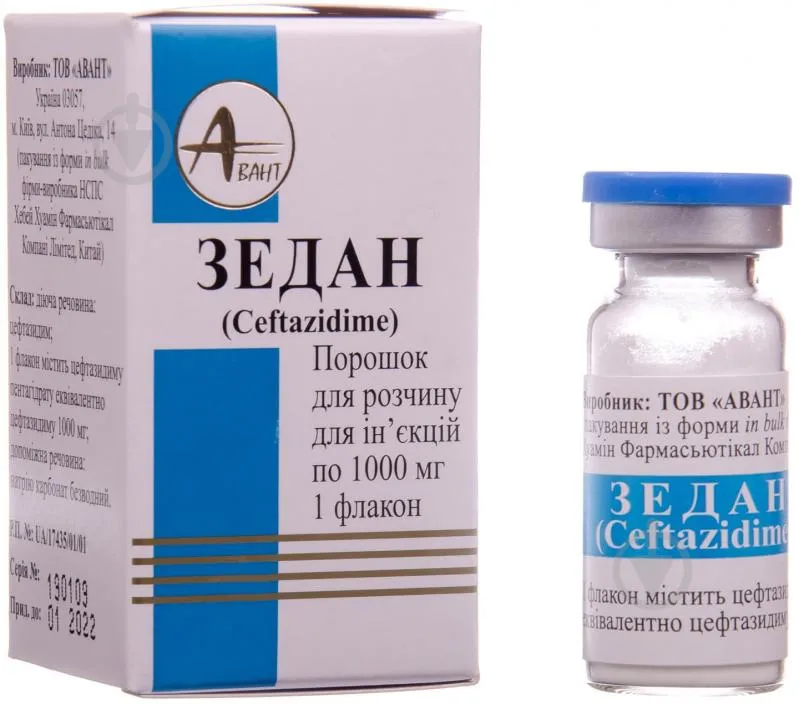
Table of Contents
INSTRUCTIONS FOR MEDICAL USE OF THE MEDICINAL PRODUCT ZEDAN
Composition:
Active substance: ceftazidime;
1 vial contains ceftazidime pentahydrate equivalent to ceftazidime 1000 mg;
Excipients: sodium carbonate.
Pharmaceutical form. Powder for solution for injection.
Main physicochemical properties: almost white or yellowish powder.
Pharmacotherapeutic group. Antibacterial agent for systemic use. Third-generation cephalosporins. ATC code J01D D02.
Pharmacological Properties
Pharmacodynamics
Ceftazidime is a bactericidal cephalosporin antibiotic whose mechanism of action is related to inhibition of bacterial cell wall synthesis.
Acquired resistance to the antibiotic varies across different regions and may change over time, with significant differences observed among individual strains. Local data on antibiotic susceptibility should be used whenever possible, especially when treating severe infections.
Susceptible microorganisms
Gram-positive aerobes: Streptococcus pyogenes, Streptococcus agalactiae.
Gram-negative aerobes: Citrobacter koseri, Escherichia coli, Haemophilus influenzae, Moraxella catarrhalis, Neisseria meningitidis, Proteus mirabilis, Proteus spp., Providencia spp.
Strains capable of developing resistance
Gram-negative aerobes: Acinetobacter baumannii, Burkholderia cepacia, Citrobacter freundii, Enterobacter aerogenes, Enterobacter cloacae, Klebsiella pneumoniae, Klebsiella spp., Pseudomonas aeruginosa, Serratia spp., Morganella morganii.
Gram-positive aerobes: Staphylococcus aureus, Staphylococcus pneumoniae.
Gram-positive anaerobes: Clostridium perfringens, Peptococcus spp., Peptostreptococcus spp.
Gram-negative anaerobes: Fusobacterium spp.
Resistant microorganisms
Gram-positive aerobes: Enterococcus spp., including E. faecalis and E. faecium, Listeria spp.
Gram-positive anaerobes: Clostridium difficile.
Gram-negative anaerobes: Bacteroides spp., including B. fragilis.
Others: Chlamydia spp., Mycoplasma spp., Legionella spp.
Pharmacokinetics
After intramuscular injection of 1 g, an average peak serum concentration of 37 mg/L is rapidly achieved in patients. Five minutes after intravenous bolus administration of 1 g, average serum concentrations of 87 mg/L are reached. Therapeutically effective concentrations persist in serum for up to 8–12 hours after both intravenous and intramuscular administration. Plasma protein binding is approximately 10%. Concentrations of ceftazidime exceeding the minimum inhibitory concentration (MIC) for most common pathogenic microorganisms are achieved in tissues and body fluids such as bone, heart, bile, sputum, intraocular fluid, synovial fluid, pleural fluid, and peritoneal fluid. Ceftazidime rapidly crosses the placenta and is excreted into breast milk. The drug poorly penetrates the intact blood-brain barrier; in the absence of inflammation, concentrations in the central nervous system (CNS) are low. However, during meningitis, CNS concentrations of ceftazidime reach 4–20 mg/L or higher, which corresponds to therapeutic levels.
Ceftazidime is not metabolized in the body. After parenteral administration, high and sustained serum concentrations of ceftazidime are achieved. The elimination half-life is approximately 2 hours. The drug is excreted unchanged, in its active form, primarily via glomerular filtration into urine; approximately 80–90% of the administered dose is recovered in urine within 24 hours. In patients with impaired renal function, ceftazidime elimination is reduced, necessitating dose adjustment. Less than 1% of the drug is excreted in bile, significantly limiting the amount reaching the intestinal tract.
Clinical characteristics.
Indications.
Treatment of the following infections in adults and children, including newborns:
-
hospital-acquired pneumonia;
-
respiratory tract infections in patients with cystic fibrosis;
-
bacterial meningitis;
-
chronic suppurative otitis media;
-
malignant external otitis;
-
complicated urinary tract infections;
-
complicated skin and soft tissue infections;
-
complicated intra-abdominal infections;
-
bone and joint infections;
-
peritonitis associated with dialysis in patients undergoing continuous ambulatory peritoneal dialysis.
Treatment of bacteremia arising in patients as a result of any of the above-mentioned infections.
Zedan may be used for the treatment of patients with neutropenia and fever resulting from bacterial infection.
Zedan may be used for prophylaxis of infectious complications during urological surgery (transurethral resection of the prostate).
When prescribing Zedan, it should be taken into account that its antibacterial activity is directed primarily against aerobic Gram-negative microorganisms (see sections "Special precautions for use" and "Pharmacological properties").
Zedan should be used in combination with other antibacterial agents if it is expected that some of the microorganisms causing the infection are not covered by the spectrum of activity of ceftazidime.
The drug should be prescribed in accordance with current official recommendations on the use of antibacterial agents.
Contraindications.
Hypersensitivity to ceftazidime or to any of the excipients of the drug.
Hypersensitivity to cephalosporin antibiotics.
History of severe hypersensitivity (e.g., anaphylactic reactions) to other beta-lactam antibiotics (penicillins, monobactams, and carbapenems).
Interaction with other medicinal products and other forms of interaction.
Concomitant administration of high doses of the drug with nephrotoxic medicinal products may adversely affect renal function (see section "Special precautions for use").
Chloramphenicol is an in vitro antagonist of ceftazidime and other cephalosporins. The clinical significance of this phenomenon is unknown; however, if concomitant use of the drug with chloramphenicol is proposed, the possibility of antagonism should be considered.
Like other antibiotics, Zedan may affect intestinal flora, leading to reduced reabsorption of estrogens and decreased efficacy of combined oral contraceptives.
Ceftazidime does not interfere with enzymatic methods for determination of glucosuria; however, a minor interference may be observed with copper reduction methods (Benedict, Fehling, Clinitest).
Ceftazidime does not interfere with the alkaline picrate method for creatinine determination.
Special precautions for use.
As with other beta-lactam antibiotics, severe and occasionally fatal hypersensitivity reactions have been reported. If severe hypersensitivity reactions occur, ceftazidime therapy should be discontinued immediately and appropriate emergency measures initiated.
Prior to initiating therapy, patients should be questioned about previous hypersensitivity reactions to ceftazidime, cephalosporin antibiotics, or other beta-lactam antibiotics. The drug should be administered with caution to patients who have experienced non-severe hypersensitivity reactions to other beta-lactam antibiotics.
Zedan has a limited spectrum of antibacterial activity. It is not an appropriate agent for monotherapy of certain types of infections, except when the causative organism is known to be susceptible to this drug or when there is a high likelihood that the pathogen will be susceptible to ceftazidime. This is particularly important when considering treatment of patients with bacteremia, bacterial meningitis, skin and soft tissue infections, and bone and joint infections. In addition, ceftazidime is susceptible to hydrolysis by certain extended-spectrum beta-lactamases. Therefore, when selecting ceftazidime for treatment, information regarding the prevalence of microorganisms producing extended-spectrum beta-lactamases should be taken into account.
Concomitant therapy with high doses of cephalosporins and nephrotoxic agents, such as aminoglycosides or potent diuretics (e.g., furosemide), may adversely affect renal function. Clinical experience with ceftazidime has shown that this phenomenon is unlikely when recommended dosages are followed. There are no data indicating that ceftazidime adversely affects renal function at usual therapeutic doses.
Zedan is eliminated by the kidneys; therefore, the dose should be reduced according to the degree of renal impairment. Cases of neurological complications have been reported when the dose was not appropriately reduced (see sections "Dosage and administration" and "Side effects").
As with other broad-spectrum antibiotics, prolonged use of the drug may result in overgrowth of nonsusceptible microorganisms (e.g., Candida, Enterococci); in such cases, discontinuation of therapy or other necessary measures may be required. Careful and continuous monitoring of the patient is essential.
Cases of pseudomembranous colitis, ranging from mild to life-threatening severity, have been reported with antibiotic use. Therefore, it is important to consider this diagnosis in patients who develop diarrhea during or after antibiotic therapy. If diarrhea is persistent and severe, or if abdominal cramps occur, therapy should be discontinued immediately, further evaluation performed, and specific treatment for Clostridium difficile initiated if necessary. Medicinal products that inhibit intestinal peristalsis should not be administered.
As with other broad-spectrum cephalosporins and penicillins, some previously susceptible strains of Enterobacter spp. and Serratia spp. may become resistant during ceftazidime therapy. In such cases, periodic susceptibility testing should be performed.
The drug contains sodium (1 g of ceftazidime – 52 mg of sodium), which should be taken into account when treating patients on a sodium-restricted diet.
Use during pregnancy or breastfeeding.
Data on the use of Zedan in pregnant women are limited. Animal studies do not indicate a direct or indirect harmful effect on pregnancy, embryonal or postnatal development. The drug should be administered to pregnant women only if the potential benefit justifies the possible risk.
Ceftazidime is excreted in breast milk in small amounts, but no effect on the breastfed infant is expected when therapeutic doses are used.
Zedan may be used during breastfeeding.
Ability to affect reaction speed when driving vehicles or operating machinery.
No specific studies have been conducted. However, the occurrence of side effects such as dizziness may affect the ability to drive vehicles or operate machinery (see section "Side effects").
Method of administration and dosage.
Adults and children with body weight ≥ 40 kg
| Intermittent administration |
|
| Infection |
Dose administered |
| respiratory tract infections in patients with cystic fibrosis |
100–150 mg/kg body weight per day every 8 hours, maximum 9 g per day1 |
| febrile neutropenia |
2 g every 8 hours |
| hospital-acquired pneumonia |
|
| bacterial meningitis |
|
| bacteremia* |
|
| bone and joint infections |
1–2 g every 8 hours |
| complicated skin and soft tissue infections |
|
| complicated intra-abdominal infections |
|
| peritonitis associated with continuous ambulatory peritoneal dialysis |
|
| complicated urinary tract infections |
1–2 g every 8 or 12 hours |
| prophylaxis of infectious complications during prostate surgery (transurethral resection) |
1 g during induction of anesthesia, 1 g at the time of catheter removal |
| chronic otitis media |
1–2 g every 8 hours |
| malignant external otitis |
|
| Continuous infusion |
|
| Infection |
Dose administered |
| febrile neutropenia |
A loading dose of 2 g is administered, followed by continuous infusion of 4 to 6 g every 24 hours1 |
| hospital-acquired pneumonia |
|
| respiratory tract infections in patients with cystic fibrosis |
|
| bacterial meningitis |
|
| bacteremia* |
|
| bone and joint infections |
|
| complicated skin and soft tissue infections |
|
| complicated intra-abdominal infections |
|
| peritonitis associated with continuous ambulatory peritoneal dialysis |
|
| 1 In adult patients with normal renal function, administration of 9 g per day did not cause adverse reactions. |
|
Children with body weight <40 kg
| Infants and children > 2 months of age with body weight < 40 kg |
Infection |
Standard dose |
| Intermittent administration |
||
| complicated urinary tract infections |
100–150 mg/kg body weight per day in 3 divided doses, maximum 6 g per day |
|
| chronic otitis media |
||
| malignant external otitis |
||
| neutropenia in children |
150 mg/kg body weight per day in 3 divided doses, maximum 6 g per day |
|
| respiratory tract infections in patients with cystic fibrosis |
||
| bacterial meningitis |
||
| bacteraemia* |
||
| bone and joint infections |
100–150 mg/kg body weight per day in 3 divided doses, maximum 6 g per day |
|
| complicated skin and soft tissue infections |
||
| complicated intra-abdominal infections |
||
| peritonitis associated with continuous ambulatory peritoneal dialysis |
||
| Continuous infusion |
||
| febrile neutropenia |
A loading dose of 60–100 mg/kg body weight is administered, followed by continuous infusion of 100–200 mg/kg body weight per day, up to a maximum of 6 g per day |
|
| hospital-acquired pneumonia |
||
| respiratory tract infections in patients with cystic fibrosis |
||
| bacterial meningitis |
||
| bacteraemia* |
||
| bone and joint infections |
||
| complicated skin and soft tissue infections |
||
| complicated intra-abdominal infections |
||
| peritonitis associated with continuous ambulatory peritoneal dialysis |
||
| Infants and children ≤ 2 months of age |
Infection |
Standard dose |
| Intermittent administration |
||
| Most infections |
25–60 mg/kg body weight per day in 2 divided doses1 |
|
| 1In infants and children ≤ 2 months of age, the serum half-life may be 2–3 times longer than in adults |
||
*If this is associated or suspected to be associated with infections listed in the section "Indications".
Children
The safety and efficacy of administering Zedan by continuous intravenous infusion in infants and children aged ≤ 2 months have not been established.
Geriatric patients
Due to reduced ceftazidime clearance, for elderly patients with acute infections, the total daily dose should generally not exceed 3 g, particularly in patients aged 80 years and older.
Hepatic impairment
Dosage adjustment is not required in patients with mild to moderate hepatic impairment. Clinical studies in patients with severe hepatic impairment have not been conducted. Careful clinical monitoring of efficacy and safety of use is recommended.
Renal impairment
Ceftazidime is excreted unchanged by the kidneys. Therefore, the dose should be reduced in patients with impaired renal function.
The initial dose should be 1 g. The maintenance dose should be based on glomerular filtration rate.
Recommended maintenance doses of ceftazidime in renal impairment: intermittent administration
Adults and children with body weight ≥ 40 kg
| Creatinine clearance, mL/min |
Approximate serum creatinine level, µmol/L (mg/dL) |
Recommended single dose of ceftazidime, g |
Dosing interval, h |
| 50–31 |
150–200 (1.7–2.3) |
1 |
12 |
| 30–16 |
200–350 (2.3–4) |
1 |
24 |
| 15–6 |
350–500 (4–5.6) |
0.5 |
24 |
| < 5 |
> 500 (> 5.6) |
0.5 |
48 |
For patients with severe infections, the single dose may be increased by 50%, or the frequency of administration may be correspondingly increased. In such patients, it is recommended to monitor serum levels of ceftazidime.
In children, creatinine clearance should be adjusted according to body surface area or body weight.
Children with body weight < 40 kg
| Creatinine clearance, mL/min** |
Approximate serum creatinine level*, µmol/L (mg/dL) |
Recommended individual dose mg/kg body weight |
Dosing frequency, hours |
| 50–31 |
150–200 (1.7–2.3) |
25 |
12 |
| 30–16 |
200–350 (2.3–4) |
25 |
24 |
| 15–6 |
350–500 (4–5.6) |
12.5 |
24 |
| < 5 |
> 500 (> 5.6) |
12.5 |
48 |
*This is the serum creatinine level calculated according to recommendations, and it may not precisely reflect the degree of renal function impairment in all patients with renal insufficiency.
** Creatinine clearance calculated based on body surface area, or measured.
Careful clinical monitoring of efficacy and safety of administration is recommended.
Recommended maintenance doses of ceftazidime in renal insufficiency: continuous infusion
Adults and children with body weight ≥ 40 kg
| Creatinine clearance, mL/min |
Approximate serum creatinine level, µmol/L (mg/dL) |
Administration frequency, hours |
| 50–31 |
150–200 (1.7–2.3) |
A loading dose of 2 g is administered, followed by continuous infusion of 1 to 3 g every 24 hours |
| 30–16 |
200–350 (2.3–4) |
A loading dose of 2 g is administered, followed by continuous infusion of 1 g every 24 hours |
| ≤ 15 |
> 350 (4–5.6) |
Not studied |
Dose selection should be cautious. Careful clinical monitoring of efficacy and safety of use is recommended.
Children with body weight < 40 kg
The safety and efficacy of administering the drug by continuous intravenous infusion in children with impaired renal function and body weight < 40 kg have not been established. Careful clinical monitoring of efficacy and safety of use is recommended.
If administration of the drug by continuous intravenous infusion is required in children with impaired renal function, creatinine clearance should be adjusted according to the child's body surface area or body weight.
Hemodialysis
The serum half-life of ceftazidime during hemodialysis is 3 to 5 hours.
A maintenance dose of ceftazidime, as recommended in the table below, should be administered after each hemodialysis session.
Peritoneal dialysis
Ceftazidime can be used during peritoneal dialysis, including in continuous ambulatory peritoneal dialysis.
In addition to intravenous administration, ceftazidime can be added to the dialysis fluid (usually 125 to 250 mg per 2 L of dialysis solution).
For patients with renal insufficiency undergoing prolonged arteriovenous hemodialysis or high-flux hemofiltration in intensive care units, the recommended dose is 1 g per day as a single dose or divided doses. For low-flux hemofiltration, doses should be adjusted as in renal impairment.
Dosing recommendations for patients undergoing venovenous hemofiltration and venovenous hemodialysis are provided in the tables below.
Dosing recommendations for ceftazidime in patients undergoing prolonged venovenous hemofiltration
| Residual renal function (creatinine clearance, ml/min) |
Maintenance dose (mg) according to ultrafiltration rate (ml/min)a |
|||
| 5 |
16.7 |
33.3 |
50 |
|
| 0 |
250 |
250 |
500 |
500 |
| 5 |
250 |
250 |
500 |
500 |
| 10 |
250 |
500 |
500 |
750 |
| 15 |
250 |
500 |
500 |
750 |
| 20 |
500 |
500 |
500 |
750 |
The maintenance dose should be administered every 12 hours.
Dosing recommendations for ceftazidime in patients undergoing prolonged venovenous hemodialysis
| Residual renal function (creatinine clearance, mL/min) |
Replacement dose (mg) for dialysate at flow rate (mL/min)a |
|||||
| 1 L/h |
2 L/h |
|||||
| Ultrafiltration rate (L/h) |
Ultrafiltration rate (L/h) |
|||||
| 0.5 |
1 |
2 |
0.5 |
1 |
2 |
|
| 0 |
500 |
500 |
500 |
500 |
500 |
750 |
| 5 |
500 |
500 |
750 |
500 |
500 |
750 |
| 10 |
500 |
500 |
750 |
500 |
750 |
1000 |
| 15 |
500 |
750 |
750 |
750 |
750 |
1000 |
| 20 |
750 |
750 |
1000 |
750 |
750 |
1000 |
The maintenance dose should be administered every 12 hours.
Administration.
Zedan should be administered intravenously by injection or infusion, or by deep intramuscular injection. Recommended sites for intramuscular administration are the upper outer quadrant of the gluteus maximus muscle or the lateral part of the thigh.
Ceftazidime solutions may be administered directly into the vein or into an intravenous infusion system if the patient is receiving parenteral fluids.
The dosage depends on the severity of the disease, sensitivity, location and type of infection, as well as on the patient's age and renal function.
Acquired resistance to the antibiotic varies in different regions and may change over time, with significant differences possible among individual strains. It is advisable to use local data on antibiotic susceptibility, especially when treating severe infections.
Preparation of injection solution
Zedan is compatible with most intravenous infusion solutions. However, sodium bicarbonate for injection should not be used as a solvent (see "Incompatibilities").
All vial sizes are manufactured under reduced pressure. As the drug dissolves, carbon dioxide is released and pressure within the vial increases. Small bubbles of carbon dioxide in the reconstituted solution may be disregarded.
| Dose administered |
Required amount of solvent (ml) |
Approximate concentration (mg/ml) |
|
| 1 g |
Intramuscular Intravenous bolus Intravenous infusion |
3 10 50* |
260 90 20 |
*Dissolution should be carried out in two steps (see below).
The colour of the solution varies from light yellow to amber depending on concentration, solvent, and storage conditions. Provided the recommendations are followed, the drug's activity is not affected by variations in its colour.
Ceftazidime at concentrations from 1 mg/mL to 40 mg/mL is compatible with the following solutions: 0.9% sodium chloride solution; M/6 sodium lactate solution; Hartmann's solution; 5% glucose solution; 0.225% sodium chloride and 5% glucose solution; 0.45% sodium chloride and 5% glucose solution; 0.9% sodium chloride and 5% glucose solution; 0.18% sodium chloride and 4% glucose solution; 10% glucose solution; 10% dextran 40 and 0.9% sodium chloride solution; 10% dextran 40 and 5% glucose solution; 6% dextran 70 and 0.9% sodium chloride solution; 6% dextran 70 and 5% glucose solution.
Ceftazidime at concentrations from 0.05 mg/mL to 0.25 mg/mL is compatible with peritoneal dialysis fluid (lactate).
For intramuscular administration, ceftazidime may be dissolved in 0.5% or 1% lidocaine hydrochloride solution.
The efficacy of both agents is maintained when ceftazidime at a concentration of 4 mg/mL is mixed with the following substances: hydrocortisone (hydrocortisone sodium phosphate) 1 mg/mL in 0.9% sodium chloride injection or 0.5% glucose solution; cefuroxime (cefuroxime sodium) 3 mg/mL in 0.9% sodium chloride injection; cloxacillin (cloxacillin sodium) 4 mg/mL in 0.9% sodium chloride injection; heparin 10 IU/mL or 50 IU/mL in 0.9% sodium chloride injection; potassium chloride 10 mEq/L or 40 mEq/L in 0.9% sodium chloride injection.
Preparation of solution for intramuscular or intravenous bolus injection:
- Insert the needle of the syringe through the stopper of the vial and inject the recommended volume of solvent.
- Remove the syringe needle and shake the vial until a clear solution is obtained.
- Invert the vial. With the syringe plunger fully depressed, insert the needle into the vial. Withdraw the entire solution into the syringe, keeping the needle submerged in the solution at all times. Small bubbles of carbon dioxide gas may be disregarded.
Preparation of solution for intravenous infusion
- Insert the needle of the syringe through the stopper of the vial and inject 10 mL of solvent.
- Remove the syringe needle and shake the vial until a clear solution is obtained.
- Do not insert the air vent needle through the stopper until the drug is completely dissolved. Insert the air vent needle through the stopper into the vial to relieve internal pressure.
- Without removing the air vent needle, adjust the total volume to 50 mL. Remove the air vent needle, shake the vial, and set up the infusion system as usual.
Note. To maintain sterility of the preparation, it is essential not to insert the air vent needle through the stopper before the drug is fully dissolved.
The prepared solution may be stored for 24 hours at temperatures below 25°C or for 7 days at temperatures up to 4°C.
Children.
Can be used in children from the first days of life.
Overdose.
Overdose may lead to neurological complications such as encephalopathy, seizures, and coma. Symptoms of overdose may occur in patients with renal impairment if the dose is not appropriately reduced (see sections "Dosage and Administration" and "Special Warnings and Precautions"). Serum concentrations of ceftazidime can be reduced by haemodialysis or peritoneal dialysis.
Adverse Reactions
Adverse effects have been classified by organ systems and frequency of occurrence: very common ≥ 1/10; common ≥ 1/100 and < 1/10; uncommon ≥ 1/1000 and < 1/100; rare ≥ 1/10000 and < 1/1000; very rare < 1/10000; frequency not known.
Infections and infestations
Uncommon – candidiasis (including vaginal vaginitis and aphthous stomatitis).
Blood and lymphatic system disorders
Common – eosinophilia and thrombocytosis.
Uncommon – leukopenia, neutropenia, and thrombocytopenia.
Frequency not known – lymphocytosis, hemolytic anemia, and agranulocytosis.
Immune system disorders
Frequency not known – anaphylaxis (including bronchospasm and/or arterial hypotension).
Nervous system disorders
Uncommon – dizziness, headache.
Frequency not known – paresthesia.
Cases of neurological complications such as tremor, myoclonus, seizures, encephalopathy, and coma have been reported in patients with renal impairment who did not receive appropriate dose reduction of ceftazidime.
Vascular disorders
Common – phlebitis or thrombophlebitis at the site of injection.
Gastrointestinal disorders
Common – diarrhea.
Uncommon – nausea, vomiting, abdominal pain, and colitis.
As with other cephalosporins, colitis may be associated with Clostridium difficile and may present as pseudomembranous colitis (see section "Special precautions").
Frequency not known – taste disturbances.
Renal and urinary disorders
Very rare – interstitial nephritis, acute renal failure.
Hepatobiliary disorders
Common – transient increase in levels of one or more liver enzymes (alanine aminotransferase (ALT), aspartate aminotransferase (AST), lactate dehydrogenase (LDH), gamma-glutamyl transferase (GGT), alkaline phosphatase).
Frequency not known – jaundice.
Skin and subcutaneous tissue disorders
Common – maculopapular rash or urticaria.
Uncommon – pruritus.
Frequency not known – angioneurotic edema, polymorphic erythema, Stevens-Johnson syndrome, and toxic epidermal necrolysis.
General disorders and administration site conditions
Common – pain and/or inflammation at the site of intramuscular injection.
Uncommon – fever.
Investigations
Common – positive Coombs test.
Uncommon – transient increase in blood urea, blood urea nitrogen, and/or serum creatinine.
A positive Coombs test is observed in approximately 5% of patients, which may interfere with blood group determination.
Shelf life.
2 years (from the date of manufacture in bulk).
Storage conditions.
Store in the original packaging, protected from light, in a place inaccessible to children, at a temperature not exceeding 25 °C.
Incompatibilities.
Zedan is less stable in sodium bicarbonate solution for injection than in other intravenous solutions; therefore, sodium bicarbonate is not recommended as a solvent.
Ceftazidime and aminoglycosides should not be mixed in the same infusion system or syringe.
Cases of precipitate formation have been observed when vancomycin was added to a ceftazidime solution. Therefore, it is recommended to flush infusion systems and intravenous catheters between administration of these two drugs.
Packaging. 1 vial of powder per cardboard box.
Prescription status. Prescription only.
Manufacturer. LLC "AVANT" (packaging from bulk form by Zeiss Pharmaceuticals Pvt. Ltd., India).
Manufacturer's address. 14 Yezhena Potye Street, Kyiv, Ukraine, 03057.