Yohimbine hydrochloride
Ukraine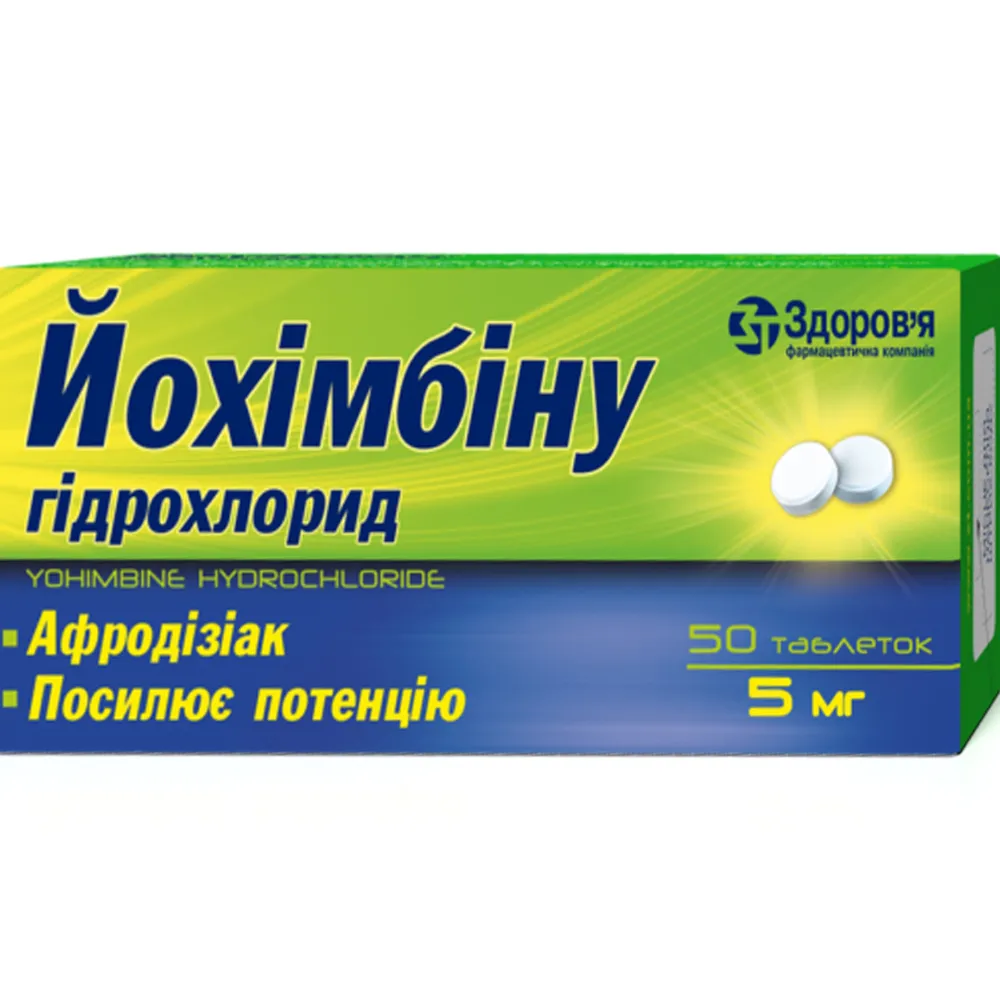
Table of Contents
INSTRUCTION FOR MEDICAL USE|CONSUMPTION| OF THE MEDICINAL PRODUCT YOHIMBINE HYDROCHLORIDE (YOHIMBINE HYDROCHLORIDE)
Composition:
Active substance: yohimbine hydrochloride;
One tablet contains 5 mg of yohimbine hydrochloride;
Excipients: potato starch; lactose monohydrate; calcium stearate; hypromellose; celactose (a mixture of lactose monohydrate and powdered cellulose (75:25)).
Dosage form. Tablets.
Main physicochemical properties: tablets of white or white with a yellowish tint, with a bevel.
Pharmacotherapeutic group. Agents used in erectile dysfunction. Yohimbine. ATC code G04BE04.
Pharmacological properties.
Pharmacodynamics.
Yohimbine hydrochloride is a medicinal agent that enhances potency (an aphrodisiac), an alkaloid derived from the bark of the West African tree Corynanthe.
Its mechanism of action is due to selective blockade of α2-adrenoceptors. It increases central adrenaline metabolism, thereby activating adrenergic neurons in the central nervous system, resulting in a psychostimulant effect and enhanced responsiveness. In addition, it may affect serotonergic, dopaminergic, and cholinergic systems of nerve impulse transmission.
Experimentally, it has been established that yohimbine stimulates sexual behavior and normalizes stress-induced reduction in sexual activity and copulatory ability, and restores erectile dysfunction caused by activation of α-adrenoceptors.
The therapeutic effect in humans is primarily explained by yohimbine's effects on the central nervous system. Furthermore, a possible mechanism of action includes vasodilation of penile blood vessels and a direct effect on tissues involved in erection.
The frequent delay in onset of effect by 2–3 weeks may be explained by accumulation of the active metabolite 11-hydroxyyohimbine.
Pharmacokinetics.
Absorption. Yohimbine is completely absorbed from the gastrointestinal tract within 1 hour. Cmax in blood is reached within 45–75 minutes. AUC (area under the plasma concentration-time curve) as a parameter of bioavailability shows marked variability. This is not due to incomplete absorption from the gastrointestinal tract, but rather to the first-pass effect in the liver. Cmax and AUC are dose-dependent. With oral administration of the drug at recommended doses, no drug accumulation occurs.
Distribution. It is evenly distributed in tissues. In plasma, 82% of yohimbine is protein-bound. Only a small fraction of yohimbine and its active metabolite 11-hydroxyyohimbine (approximately 2% of plasma concentration) penetrates into the interstitial fluid.
Metabolism. Yohimbine is metabolized in the liver and extrahepatically. Two hydroxylated metabolites have been identified: the active metabolite 11-hydroxyyohimbine and the less active 10-hydroxyyohimbine.
Elimination. The half-life (T½) of yohimbine after a single dose ranges from 0.25 to 2.5 hours. The T½ of 11-hydroxyyohimbine is longer—approximately 6 hours. After repeated administration, yohimbine is eliminated over a time range of less than 1 hour to more than 8 hours.
Clinical characteristics.
Indications.
Erectile dysfunction of various origins.
Contraindications.
Hypersensitivity to any component of the drug. Severe arterial hypotension. Severe liver or kidney diseases, treatment with adrenomimetics.
Interaction with other medicinal products and other types of interactions.
Concomitant use with clonidine is not recommended, as the effects of the drugs mutually neutralize each other; a sharp decrease in blood pressure is also possible. Yohimbine may alter the activity of antihypertensive agents (calcium antagonists, β-blockers, angiotensin-converting enzyme inhibitors). Yohimbine may potentiate the effects of antidepressants and increase the risk of their adverse effects; it may reduce the activity of tranquilizers, particularly alprazolam – therefore, yohimbine should not be used together with these medicinal products. Clomipramine increases yohimbine plasma levels. When used concomitantly with adrenomimetics (epinephrine, norepinephrine, mesaton, phenylephrine, ephedrine), their efficacy may be reduced; in individual cases, hypertensive effects may be enhanced.
Special precautions for use.
The drug should be prescribed with caution to patients with arterial hypertension, heart diseases (ischemic heart disease, tachyarrhythmias), peptic ulcer of the stomach and duodenum, renal or hepatic impairment, psychiatric disorders with affective symptoms or anxiety states, and glaucoma.
The drug should not be used in elderly patients.
The use of the drug is not recommended in cases where there is a risk of sudden drop in arterial pressure with reflex tachycardia.
The drug contains lactose; therefore, if the patient has established intolerance to certain sugars, medical advice should be sought before taking this medicinal product.
Use during pregnancy or breastfeeding.
The drug is not intended for use in women.
Ability to influence reaction rate when driving or operating machinery.
Given that adverse reactions (dizziness, tremor) may occur in patients with increased individual sensitivity during administration of the drug, patients should refrain from driving vehicles or performing other tasks requiring concentration of attention.
Method of Administration and Dosage
For oral use in adults, taken during meals, without chewing, and swallowed with a glass of water.
The recommended dose is 1–2 tablets 1–3 times daily.
The dose should be individually adjusted, starting with 2.5 mg of yohimbine 3 times daily, and gradually increasing the dose up to a maximum of 1–2 tablets (5–10 mg) 3 times daily.
In cases where a single dose of 2.5 mg of yohimbine is required, a formulation allowing such dosing should be used.
Therapeutic effect often appears with a delay of 2–3 weeks. If adverse effects occur, dose reduction is recommended. After the adverse effects subside, the dose may be gradually increased again.
The duration of treatment depends on the severity of the condition and typically lasts 3–4 weeks.
Children. Not to be used in children.
Overdose.
Symptoms of intoxication. Approximately 20–30 minutes after oral ingestion of an excessive dose, symptoms include general weakness, generalized paresthesia, memory and coordination disturbances, severe headache, dizziness, tremor, tachycardia, arterial hypertension, feelings of fear and anxiety, a significant increase in plasma norepinephrine levels (normal range 150–550 pg/mL), nausea, vomiting, mydriasis, salivation and lacrimation, and increased sweating. Approximately 4 hours later, chest pain may develop, lasting several hours. Headache, arterial hypertension, and tachycardia may also persist for several hours.
Treatment. Discontinue the drug. In early stages—gastric lavage followed by administration of activated charcoal and sodium sulfate (Glauber's salt), or activated charcoal alone.
Clonidine may be used as an antidote in overdose, rapidly neutralizing both psychological effects and effects on the sympathetic nervous system. The initial dose of clonidine is 0.1–0.2 mg orally. Subsequently, several individual doses of 0.1 mg should be taken at 1-hour intervals until cardiovascular function normalizes and other symptoms subside.
For treatment of hypertensive crisis, β-adrenoblockers may be used in combination with an α-adrenoblocker (e.g., phentolamine) or a peripheral vasodilator (e.g., nitroprusside). Benzodiazepines may be prescribed for fear, anxiety, or hallucinations, provided sympathomimetic reactions are absent or mild. Neuroleptics of the phenothiazine group must not be used.
Adverse reactions.
Cardiac disorders: increased heart rate.
Neurological disorders: headache, dizziness, sleep disturbances, nervousness, tremor, increased excitability, increased anxiety, mania, sweating.
Gastrointestinal disorders: rarely − nausea and vomiting, loss of appetite, diarrhea.
Skin and subcutaneous tissue disorders: skin redness.
Vascular disorders: increased blood pressure.
Other: decreased diuresis, priapism (a pathological condition characterized by prolonged erection not associated with sexual arousal); allergic reactions (including bronchospasm, lupus-like syndrome, angioneurotic edema) may occur in individuals with increased individual sensitivity.
Shelf life. 3 years.
Storage conditions. Store in the original packaging at a temperature not exceeding 25 °C.
Keep out of reach of children.
Packaging. Tablets No. 50 in a container in a box; No. 50 in a container; No. 10×5 in blisters in a box.|tablets|
Prescription category. Prescription only.
Manufacturer. LIMITED LIABILITY COMPANY "CORPORATION "ZDOROVIYA".
Manufacturer's address and place of business.
22, Shevchenka Street, Kharkiv, Kharkiv Oblast, 61013, Ukraine.