Ioddicerin®
Ukraine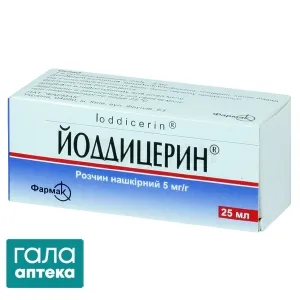
Table of Contents
INSTRUCTIONS FOR MEDICAL USE OF THE MEDICINAL PRODUCT ЙОДДИЦЕРИН® (IODDICERIN®)
Composition:
Active substance: iodine;
1 g of solution contains 5 mg of iodine;
Excipients: dimethyl sulfoxide, glycerol, potassium iodide.
Pharmaceutical form. Topical solution.
Main physicochemical properties: clear, viscous, brown-orange liquid with a characteristic odor.
Pharmacotherapeutic group.
Antiseptics and disinfectants. ATC code D08AG03.
Pharmacological Properties
Pharmacodynamics
An antibacterial agent with broad-spectrum activity, exerting bactericidal, anti-inflammatory, and local analgesic effects. The antimicrobial and antiviral activity is associated with a similar mechanism of action on surface polysaccharides, lipids, and protein biopolymers of the cell wall of various infectious agents.
The bactericidal effect of Ioddicerin® covers staphylococci, streptococci, meningococci, gonococci, pneumococci, Escherichia, including enteropathogenic, invasive, and toxigenic strains, salmonellae, klebsiellae, Proteus, Serratia, citrobacteria, Haemophilus influenzae, Pseudomonas, Fusobacteria, Clostridia, non-clostridial anaerobes, peptococci, mycoplasmas, chlamydiae, herpes viruses, and varicella virus.
The drug is weakly active against microorganisms with waxy or wax-like components in their cell wall (tuberculosis and lepra mycobacteria, all corynebacteria, Nocardia), whose surface is hydrophobic and not wetted by Ioddicerin®.
Unlike other iodine-containing drugs intended for topical use, Ioddicerin® does not concentrate or accumulate at the site of application, thus avoiding pain, irritation, and necrotizing effects. Due to the presence of dimexide in the formulation, the iodine cation easily penetrates through biomembranes without damaging membrane structures. Moreover, dimethyl sulfoxide (dimexidum) is capable of ionizing iodine molecules, which exert a strong bactericidal effect on microorganisms directly within the tissues of the purulent inflammatory focus.
Pharmacokinetics
Ioddicerin® is rapidly absorbed from the site of application and penetrates into the tissues of intact skin and mucous membranes to a depth determined by the dose of the drug and duration of contact with the surface. No cumulative effect occurs. After a single application and with a moderate degree of pus accumulation, the effect persists for 8–12 hours. The majority of iodine is excreted by the kidneys.
Clinical characteristics.
Indications.
In surgery – for the treatment of purulent wounds, burns, frostbite, purulent processes in soft tissues, gangrene, pleurisy, peritonitis; in obstetrics and gynecology – for the prevention of complications after abortion, and for the treatment of inflammatory processes, erosions, mastitis; in dermatology and venereology – in bacterial and viral dermatitis, pyoderma, herpes of lips and skin, trichomoniasis, gonorrhea; in proctology – in paraproctitis at the infiltration stage; in otolaryngology – for the treatment of otitis, sinusitis, maxillary sinusitis; in dentistry – for stomatitis, gingivitis, periodontitis. Effective in the treatment of bacterial carriage in the upper respiratory tract.
Contraindications.
Hypersensitivity to iodine and to any component of the drug, hyperthyroidism, thyroid adenoma, dermatitis herpetiformis (Duhring's disease), period before and after radioactive iodine therapy, concomitant use with radioactive iodine, hepatic and renal insufficiency, myocardial infarction, angina pectoris, severe atherosclerosis, glaucoma, cataract, stroke, coma.
Interaction with other medicinal products and other forms of interactions.
Enhances skin penetration of drugs soluble in dimethyl sulfoxide (some nonsteroidal anti-inflammatory agents, antibiotics, etc.), leading to increased specific activity, and in some combinations, to increased toxicity. Pharmaceutically incompatible with ether oils, ammonia solutions, precipitated white mercury (forms an explosive mixture).
When used concomitantly with yellow mercury ointment, formation of mercuric iodide is possible, which exerts a cauterizing effect.
Reduces the hypothyroid and arrhythmogenic effects of lithium preparations.
Ioddicerin® is incompatible with other disinfectants and antiseptics, especially those containing alkalis, enzymes, and mercury. In an acidic environment, the drug's activity decreases. When used simultaneously with enzymatic preparations, the latter become ineffective. Ioddicerin® is incompatible with hydrogen peroxide and drugs containing silver. In patients receiving lithium preparations, regular use of Ioddicerin®, especially over large areas, should be avoided, since in this case iodine may cause hypofunction of the thyroid gland. Ioddicerin® is incompatible with reducing agents, alkaloid salts, and cationic antiseptics. Dimethyl sulfoxide potentiates the effects of ethanol, insulin, digoxin preparations, butadione, antibiotics, quinidine, nitroglycerin, and sensitizes the body to anesthetic agents.
Special precautions.
Use with caution in combination with other agents applied to the purulent-inflammatory site: their toxicity may increase.
Use with caution in elderly patients.
Due to the risk of chemical burns caused by mercury iodide, concomitant use or immediate application after mercury-containing derivatives is not permitted.
During prolonged use of the medicinal product, periodic monitoring of thyroid function is necessary.
Avoid contact of the product with eyes; do not use internally.
Use during pregnancy or breastfeeding.
Use of the product during pregnancy and breastfeeding is contraindicated. If use of the product is necessary, breastfeeding should be discontinued.
Ability to influence reaction rate while driving or operating machinery.
The drug Ioddicerin® does not affect reaction speed while driving or operating machinery.
Method of Administration and Dosage.
Apply externally as applications (compresses, dressings) to the entire area of the purulent-inflammatory focus 2–3 times daily for 20–30 minutes, depending on the size of the purulent focus, using 5–15 ml of Ioddicerin® each time.
The duration of treatment is determined by the time required for complete wound debridement, granulation, and epithelialization. Usually, the treatment course lasts from 3 to 5 days.
For large or deep lesions, gauze pledgets, tampons, or gauze dressings are soaked with Ioddicerin®, applied to purulent wounds or inserted into the wounds, then bandaged or secured with adhesive tape. If necessary, the medicated tampons or gauze dressings may be covered with polyethylene film to enhance the antibacterial effect.
Into serous cavities or abscess cavities, after removal of pus and irrigation with sterile physiological solution or hydrogen peroxide (depending on the size of the lesion), 5–10 ml of Ioddicerin® solution is introduced, followed by drainage to ensure continuous outflow of contents. The procedure is repeated 2–3 times daily until complete wound debridement, granulation, and epithelialization occur.
Children. The drug should not be used in children under 1 year of age.
Overdose.
In case of overdose, symptoms of iodism may occur (metallic taste in the mouth, rhinitis, urticaria, lacrimation, salivation), as well as skin burns and irritation. Treatment is symptomatic.
In case of accidental ingestion of large amounts (50–100 ml) of Ioddicerin®, vomiting, diarrhea, and signs of intoxication may develop. In such cases, gastric lavage should be performed using a 0.5% solution of sodium thiosulfate. In severe cases, up to 5–10 ml of a 30% solution of sodium thiosulfate may be administered intravenously.
Side effects.
Immune system disorders: hypersensitivity reactions.
Skin and subcutaneous tissue disorders: itching, rash, erythema, angioneurotic edema, dermatitis, urticaria, dry skin.
General disorders and administration site conditions: hyperthermia, asthenia, local reactions including pain at application site, burning sensation, redness at the site of application.
Gastrointestinal disorders: nausea, vomiting, diarrhea.
Injury, poisoning and procedural complications: prolonged use (more than 7–10 days) may lead to signs of iodism (rhinitis, skin rash resembling urticaria, hypersalivation, metallic taste in the mouth, lacrimation).
Blood and lymphatic system disorders: neutropenia (due to systemic absorption of iodine when applied over large wound surfaces or mucous membranes).
Endocrine disorders: hypothyroidism, hyperthyroidism (due to systemic absorption of iodine when applied over large wound surfaces or mucous membranes).
Investigations: changes in thyroid function test results; changes in blood osmolality.
Metabolism and nutrition disorders: metabolic acidosis, electrolyte imbalances (hypernatremia).
Renal and urinary disorders: impaired kidney function, acute renal failure.
Nervous system disorders: dizziness.
Psychiatric disorders: insomnia.
Respiratory, thoracic and mediastinal disorders: bronchospasm.
Shelf life.
3 years.
Do not use the medicinal product after the expiry date stated on the packaging.
Storage conditions.
Store in a light-protected place at a temperature not exceeding 25 °C.
Keep out of reach of children.
Packaging.
25 ml in a bottle. 1 bottle in a carton.
Availability. Over-the-counter.
Manufacturer.
JSC "Farmak".
Manufacturer's address.
74 Kyrylivska Street, Kyiv, 04080, Ukraine.