Iod-normil
Ukraine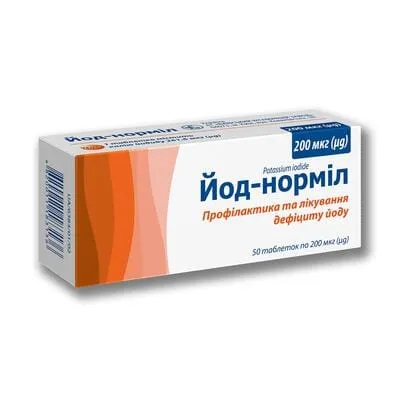
Table of Contents
INSTRUCTION for medical use of the medicinal product IODINE-NORMIL (iodine-normil)
Composition:
Active substance: potassium iodide;
1 tablet contains 130.8 mcg or 261.6 mcg of potassium iodide, corresponding to 100 mcg or 200 mcg of iodine, respectively;
Excipients: lactose monohydrate, microcrystalline cellulose, corn starch, colloidal anhydrous silicon dioxide, magnesium stearate, methylcellulose.
Pharmaceutical form. Tablets.
Main physicochemical properties: round-shaped, biconvex tablets with a score line, white or almost white (100 mcg); round-shaped, flat-faced tablets with bevelled edges and a score line, white or almost white (200 mcg).
Pharmacotherapeutic group. Iodine preparations used in thyroid disorders. ATC code H03C A.
Pharmacological properties.
Pharmacodynamics.
Iodine is an inorganic iodine preparation and an essential trace element which is part of thyroid hormones – thyroxine (T4) and triiodothyronine (T3), ensuring normal thyroid function.
After iodides enter the epithelial cells of thyroid follicles, under the influence of the enzyme iodide-peroxidase, oxidation of iodine occurs, resulting in the formation of elemental iodine.
The substance undergoes a substitution reaction with the aromatic ring of tyrosine, forming thyronines: 3,5-iodinated derivative (thyroxine hormone – T4) and 3-iodinated derivative (triiodothyronine hormone T3). Thyronines form a complex with the protein thyroglobulin, which is deposited in the colloid of the thyroid follicle and stored in this form for several days and weeks.
In case of iodine deficiency, this process is impaired. Iodine administered in physiological amounts prevents the development of endemic goiter associated with deficiency of this element in food;
normalizes thyroid gland size in newborns, children, and young adult patients; affects T3/T4 ratio parameters and TSH levels.
Pharmacokinetics.
After oral administration, iodine is almost completely absorbed in the small intestine.
Within 2 hours after absorption, it is distributed into the interstitial space; accumulates in the thyroid gland, kidneys, stomach, mammary and salivary glands. The volume of distribution in healthy individuals averages 23 liters (38% of body weight). Plasma concentration after administration of a standard dose is 10–50 ng/mL, while iodine content in breast milk, saliva, and gastric juice is 30 times higher than plasma concentration.
The thyroid gland contains ¾ (10–20 mg) of the total iodine present in the body. Iodine is excreted mainly via urine, to a lesser extent via lungs and feces. At equilibrium, the amount of iodine excreted is proportional to daily intake from food.
Clinical characteristics.
Indications.
- Prophylaxis of iodine deficiency development, including during pregnancy or breastfeeding.
- Prophylaxis of recurrence of iodine-deficiency goiter after surgical removal, as well as after completion of combined therapy with thyroid hormones.
- Treatment of diffuse euthyroid goiter in children, including newborns, and in adults.
Contraindications.
- Hypersensitivity to iodine or to any of the other components of the medicinal product;
- pronounced hyperthyroidism;
- manifest hyperthyroidism;
- use of potassium iodide in doses exceeding 150 mcg iodine per day in latent hyperthyroidism;
- use of potassium iodide in doses from 300 to 1000 mcg iodine per day in autonomous adenoma, focal and diffuse autonomous foci of the thyroid gland, except for preoperative iodine therapy for thyroid blockade according to Plummer;
- pulmonary tuberculosis;
- hemorrhagic diathesis;
- dermatitis herpetiformis Duhring (Duhring-Brocq syndrome).
Interaction with other medicinal products and other types of interactions.
Iodine deficiency increases, while iodine excess reduces, the response to antithyroid drugs in hyperthyroidism treatment; therefore, whenever possible, iodine administration should be avoided before or during antithyroid therapy. Conversely, antithyroid drugs inhibit the incorporation of iodine into organic compounds in the thyroid gland and thus may promote goiter formation.
Uptake of iodine by the thyroid gland is competitively inhibited by substances that enter the thyroid gland via the same uptake mechanism as iodine, e.g., perchlorate, as well as substances that are not themselves transported, e.g., thiocyanate, at concentrations exceeding 5 mg/dL.
Iodine uptake by the thyroid gland and its metabolism within the gland are stimulated by endogenous and exogenous thyroid-stimulating hormone (TSH).
Concomitant use of high doses of iodine, which suppress thyroid hormone secretion, and lithium salts may promote the development of goiter and hypothyroidism.
Higher doses of potassium iodide in combination with potassium-sparing diuretics may lead to hyperkalemia.
Concomitant use enhances the cardiac effect of quinidine due to increased potassium concentration in blood plasma.
Concomitant use with plant alkaloids and heavy metal salts may result in the formation of an insoluble precipitate and impair iodine absorption.
Special precautions for use
The medicinal product contains lactose and therefore should not be administered to patients with rare hereditary galactose intolerance, lactase deficiency, or glucose-galactose malabsorption syndrome.
The medicinal product should not be used in hypothyroidism, except in cases where hypothyroidism is caused by iodine deficiency.
Administration of iodine should be avoided during radioactive iodine therapy, or in the presence of, or suspicion of, thyroid carcinoma.
It should be taken into account that during treatment with this drug, hyperkalemia may develop in patients with renal insufficiency.
Use during pregnancy or breastfeeding
Iodine requirements are increased during pregnancy and breastfeeding; therefore, adequate iodine intake (200 mcg per day) is particularly important. Due to the ability of iodine to cross the placenta and the fetus's sensitivity to pharmacologically active doses of the drug, administration should be limited to recommended doses. This also applies to the breastfeeding period, since iodine concentration in milk is 30 times higher than in blood serum. The exception is high-dose iodine prophylaxis administered after nuclear accidents.
Ability to affect the speed of reactions when driving vehicles or operating machinery
There is no data on harmful effects.
Dosage and Administration.
Prophylaxis of iodine deficiency and endemic goiter (in cases where the daily intake of iodine in adults is less than 150–200 mcg – the following additional amounts are required):
- Infants and children under 12 years of age: 50–100 mcg iodine per day;
- Children aged 12 years and older, and adults: 100–200 mcg iodine per day;
- Pregnancy or breastfeeding period: 200 mcg iodine per day.
Prophylaxis of recurrence of iodine-deficiency goiter after surgical removal, as well as after completion of combined treatment with thyroid hormones.
Children and adults: 100–200 mcg iodine per day. These recommendations are general; in each individual case, the daily iodine intake from food must be taken into account. These dosage recommendations also apply to ongoing treatment following completion of therapy for euthyroid goiter with levothyroxine.
Treatment of euthyroid goiter:
- Infants and children: 100–200 mcg iodine per day;
- Adults: 300–500 mcg iodine per day.
The medicinal product should be taken after meals and washed down with sufficient fluid. If the medicinal product is prescribed for infants, it should be crushed and mixed with food.
Prophylactic use of the medicinal product should last for several years, and often for life. For treatment of goiter in newborns, 2–4 weeks is usually sufficient in most cases; in children and adults, treatment typically requires 6–12 months or longer. Overall, the dosage and duration of treatment with the medicinal product Iod-Normil for prophylactic purposes or for treatment of thyroid disorders should be determined individually by a physician.
Children. The medicinal product may be used in children of any age when indicated.
Overdose.
Symptoms.
Iodine overdose may result in brown discoloration of mucous membranes, reflex vomiting (vomitus may appear blue if starch-containing foods are present), abdominal pain, and diarrhea (which may even be bloody). Dehydration and shock may develop. In isolated cases, esophageal strictures have been reported. Fatalities have been observed only after ingestion of large amounts of tincture of iodine (from 30 to 250 mL). Prolonged use may sometimes lead to iodism, characterized by a metallic taste in the mouth, and swelling and inflammation of mucous membranes (rhinitis, conjunctivitis, gastroenteritis, bronchitis). Latent conditions such as tuberculosis may be activated by iodine. Development of edema, erythema, acneiform and bullous rashes, hemorrhages, urticaria, and nervous excitability may also occur.
Treatment.
Treatment of acute intoxication. Gastric lavage with a solution of starch, egg white, or 5% sodium thiosulfate solution until all traces of iodine are removed. Symptomatic therapy should be administered to correct disturbances in water and electrolyte balance; anti-shock therapy should be initiated if necessary.
Treatment of chronic intoxication. Discontinuation of iodine.
Iodine-induced hyperthyroidism. This is not an overdose in the literal sense, as hyperthyroidism may also occur with iodine amounts considered physiological in other countries. Treatment depends on the clinical presentation: mild forms usually do not require treatment; in more pronounced cases, antithyroid (thyrostatic) therapy is required (though its effectiveness may be delayed). In severe cases (thyrotoxic crisis), intensive therapy, plasmapheresis, or thyroidectomy may be necessary.
Adverse reactions.
When iodide is used prophylactically at any age, as well as therapeutically in infants and children, adverse effects are generally not observed. However, in the presence of large autonomous foci in the thyroid gland and when administering iodine in daily doses exceeding 150 mcg, the occurrence of pronounced hyperthyroidism cannot be completely ruled out.
Immune system side effects: hypersensitivity reactions (such as iodine-induced rhinitis, bullous or tuberous iododerma, exfoliative dermatitis, angioneurotic edema, fever, acne, and salivary gland swelling).
Endocrine system side effects: during treatment of goiter in adults (daily dose of 300 to 1000 mcg of iodine), iodine-induced hyperthyroidism may occur in individual cases.
In the vast majority of cases, the underlying condition for this is the presence of diffuse or localized areas of thyroid autonomy. Patients at risk are usually elderly individuals who have suffered from goiter for a prolonged period.
Other possible side effects: symptoms of iodism (manifested by such symptoms as mucosal swelling of the nose, urticaria, Quincke's edema, skin rashes, itching, anaphylactic shock), eosinophilia, tachycardia, tremor, irritability, sleep disturbances, increased sweating, epigastric discomfort, diarrhea. When used in high doses, goiter and hypothyroidism may develop.
Shelf life. 3 years.
Storage conditions.
Store in the original packaging at a temperature not exceeding 25 °C.
Keep out of reach of children.
Packaging.
10 tablets in a blister; 5 blisters per carton.
Prescription status. Over-the-counter.
Manufacturer: JSC "KYIV VITAMIN PLANT".
Manufacturer's address and location of business activity:
38 Kopilivska Street, Kyiv, 04073, Ukraine.
Web-site: www.vitamin.com.ua.