Voluven
Ukraine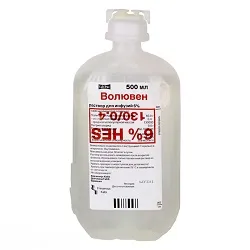
Table of Contents
INSTRUCTIONS FOR MEDICAL USE OF THE MEDICINAL PRODUCT VOLUVEN (VOLUVEN®)
Composition:
Active ingredients: 100 ml of solution contains 6 g of hydroxyethyl starch 130/0.4 and 0.9 g of sodium chloride;
Excipients: hydrochloric acid diluted, sodium hydroxide, water for injections.
Electrolytes: sodium (Na+) — 154 mmol/l, chloride (Cl–) — 154 mmol/l.
Theoretical osmolarity 308 mOsm/l, pH 4.0–5.5, titratable acidity < 1.0 mmol NaOH/l.
Pharmaceutical form. Infusion solution.
Main physicochemical properties: clear or slightly opalescent solution, colorless or slightly yellowish.
Pharmacotherapeutic group. Plasma substitutes and perfusion solutions.
ATC code B05A A07.
Pharmacological Properties
Pharmacodynamics
Voluvan is a colloid used for blood volume replacement. Its pharmacological properties, such as expansion of intravascular volume and hemodilution, depend on the molar substitution by hydroxyethyl groups (0.4), the average molecular weight (130,000 Da), concentration (6%), as well as on the dose and rate of infusion. The hydroxyethyl starch (HES 130/0.4) contained in Voluvan is derived from waxy maize starch, with a degree of substitution (C2/C6 ratio) of approximately 8–12.
Infusion of 500 ml of Voluvan over 30 minutes in volunteers resulted in a plateau-like increase in volume of approximately 100% of the infused volume, which was maintained for about 4 to 6 hours.
The therapeutic effect of Voluvan in expanding circulating blood volume is 100% and persists for at least 6 hours.
Pharmacokinetics
The pharmacokinetics of hydroxyethyl starch are complex and depend on molecular weight, primarily on the degree of molar substitution and substitution pattern (C2/C6 ratio). After intravenous administration, molecules with a molecular weight below the renal excretion threshold of 60,000–70,000 Da are excreted unchanged in urine, whereas larger molecules are degraded by plasma α-amylase before the degradation products are also renally excreted.
The average molecular weight of Voluvan in plasma in vivo during the first minutes after infusion is 70,000–80,000 Da and remains above the excretion threshold throughout the treatment period.
The volume of distribution is approximately 5.9 liters. Thirty minutes after the end of infusion, the plasma concentration of Voluvan is still 75% of the maximum concentration. After 6 hours, the plasma concentration decreases to 14% of the maximum concentration. After a single dose of 500 ml of Voluvan, hydroxyethyl starch molecules are completely eliminated from the body within 24 hours.
Following administration of 500 ml of Voluvan, plasma clearance is 31.4 ml/min, and the AUC (area under the plasma concentration-time curve) is 14.3 mg/ml/h, indicating non-linear pharmacokinetics. After a single 500 ml dose, the plasma half-life values are: t1/2 α = 1.4 hours, t1/2 β = 12.1 hours.
When equivalent doses (500 ml) were administered to volunteers with stable moderate to severe renal impairment, AUC values increased moderately by a factor of 1.7 (95% confidence interval 1.44–2.07) in patients with creatinine clearance < 50 ml/min compared to those with creatinine clearance ≥ 50 ml/min. The degree of renal impairment did not affect the terminal half-life or maximum concentration of hydroxyethyl starch. With creatinine clearance ≥ 30 ml/min, 59% of the drug was recovered in urine, compared to 51% with creatinine clearance of 15 to < 30 ml/min.
Even after administration of 500 ml/day of the hydroxyethyl starch solution contained in Voluvan to healthy volunteers for 10 days, no significant accumulation of the drug in plasma occurred.
After repeated administration of Voluvan at a dose of 0.7 g/kg body weight per day for 18 days in animal experiments (rats), tissue accumulation of 0.6% of the total administered dose was observed 52 days after the last administration.
In another pharmacokinetic study, a single dose of 250 ml (15 g) of HES 130/0.4 (6%) was administered to eight stable dialysis-dependent patients with end-stage renal disease.
3.6 g (24%) of the HES dose was removed during a 2-hour dialysis session (with a dialysate flow rate of 500 ml/min and using the HD Highflux FX 50 dialyzer, Fresenius Medical Care, Germany). The mean plasma concentration of HES was 0.7 mg/ml at 24 hours and 0.25 mg/ml at 96 hours. The use of HES 130/0.4 (6%) is contraindicated in patients requiring dialysis.
Repeated Dose Toxicity
Intravenous infusion of hydroxyethyl starch contained in Voluvan at a dose of 9 g/kg body weight per day administered to rats and dogs for 3 months did not reveal any toxic effects.
Increased burden on the kidneys, liver, and metabolism of hydroxyethyl starch in the reticuloendothelial system led to non-physiological states in animals during the testing period.
The lowest toxic dose of hydroxyethyl starch contained in Voluvan is greater than 9 g/kg body weight per day and thus exceeds the maximum therapeutic dose by at least fivefold.
Reproductive Toxicity
Hydroxyethyl starch contained in Voluvan showed no teratogenic effects in rats and rabbits. Embryo-lethal effects were observed in rabbits at a dose of 5 g of active substance per kg body weight per day. Treatment during pregnancy and lactation resulted in weight loss and developmental delay in offspring of rats receiving this dose as a bolus injection. Signs of volume overload were observed in maternal animals. Fertility studies in animals directly exposed to the drug were not conducted.
Pharmacokinetic data in patients with hepatic impairment or in pediatric and geriatric patients are lacking. The influence of sex on the pharmacokinetics of Voluvan has not been studied.
Clinical characteristics.
Indications.
Hypovolemia caused by acute blood loss in cases where the use of crystalloids alone is considered insufficient.
Contraindications.
Do not use in sepsis, renal failure, or critically ill patients.
- Hypersensitivity to the active substances or to any of the excipients listed in the section "Composition"
- Sepsis
- Burns
- Impaired kidney function or undergoing renal replacement therapy
- Intracranial or intracerebral hemorrhage
- Critically ill patients (typically those requiring admission to intensive care or critical care units)
- Hypervolemia
- Pulmonary edema
- Dehydration
- Severe hypernatremia or severe hyperchloremia
- Severe hepatic dysfunction
- Decompensated heart failure
- Severe coagulation disorders
- Organ transplant recipients
Interaction with other medicinal products and other forms of interaction.
Interaction studies with other medicinal products have not been conducted.
Whenever possible, mixing with other medicinal products should be avoided. If in exceptional cases mixing cannot be avoided, attention must be paid to their compatibility (no cloudiness or precipitation should be observed), adherence to hygienic standards during administration, and thorough mixing.
Special precautions for use.
Due to the risk of allergic reactions, frequent monitoring of the patient's condition is required; moreover, infusion of the drug should be initiated at a low rate. Anaphylactic/anaphylactoid reactions such as hypersensitivity, flu-like symptoms, bradycardia, tachycardia, bronchospasm, and non-cardiogenic pulmonary edema have been associated with solutions containing hydroxyethyl starch. If hypersensitivity reactions occur, administration of the drug must be stopped immediately, and appropriate therapeutic and supportive measures should be initiated until symptoms resolve.
Surgery and trauma
Currently, there are no reliable long-term safety data on the use of HES in surgical patients or in patients with trauma.
Before prescribing HES to such patients, the expected benefit must be carefully weighed against the uncertainty regarding long-term safety, and alternative treatment options should be considered.
Indications for HES use for volume replacement must be carefully evaluated. Hemodynamic parameters should also be monitored to control and adjust volume and dosage.
In all cases, volume overload (hypervolemia) due to overdose or excessively high infusion rate should be avoided. The drug dose must be selected cautiously, especially in patients with lung or cardiovascular diseases. Frequent monitoring of serum electrolyte levels, fluid balance, and renal function is required.
HES-containing drugs are contraindicated in patients with impaired renal function and in patients receiving renal replacement therapy. HES administration must be discontinued at the first signs of kidney injury.
Cases of increased need for renal replacement therapy within 90 days after administration of HES solutions have been reported. Therefore, monitoring of renal function is recommended for at least 90 days after HES administration.
Particular caution is required when treating patients with impaired liver function or coagulation disorders.
Marked hemodilution associated with high-dose HES solutions should also be avoided in the treatment of patients with hypovolemia.
In case of repeated administration, coagulation parameters must be closely monitored. HES therapy should be discontinued at the first signs of coagulation disorders.
If a patient requires open-heart surgery with cardiopulmonary bypass, the use of HES solutions is not recommended due to the risk of severe bleeding.
In cases of severe dehydration, crystalloid solutions should be administered first. Adequate fluid administration is generally required to prevent dehydration. Particular attention should be paid to patients with electrolyte imbalances.
Clinical assessment and periodic laboratory tests are necessary to monitor fluid balance, serum electrolyte concentrations, renal function, acid-base balance, and coagulation parameters during prolonged parenteral therapy and whenever the patient's condition requires such monitoring. Currently, there are no reliable data on the safety of long-term HES use in patients after surgery or trauma.
Before prescribing HES to such patients, the expected benefit must be carefully weighed against the uncertainty regarding long-term safety, and alternative treatment options should be considered.
The daily dose of the drug Voluven depends on the patient's body weight and may contain more than 1 mmol (more than 23 mg) of sodium. This should be taken into account if the patient is on a sodium-controlled diet.
Use during pregnancy or breastfeeding.
There are some clinical data on the use of a single dose of the drug Voluven in pregnant women undergoing cesarean section under spinal anesthesia. The incidence of arterial hypotension in the Voluven group was significantly lower compared to the crystalloid group (36.6% vs. 55.3%, respectively). Overall assessment of efficacy parameters showed a significant benefit of Voluven in preventing arterial hypotension and in reducing the occurrence of severe arterial hypotension compared to the control group receiving crystalloids.
Regarding safety, no negative effects of Voluven on pregnant women were observed, nor were there any negative effects on newborns.
Animal studies did not reveal any direct or indirect adverse effects on pregnancy, embryonic/fetal development, parturition, or postnatal development. No signs of teratogenicity were observed.
Voluven may be used during pregnancy only when the expected benefit outweighs the potential risk to the fetus.
Except for cesarean section, there is no information on the use of Voluven during labor. Voluven should be used only if clearly needed.
It is unknown whether the drug passes into breast milk. Excretion of hydroxyethyl starch into breast milk has not been studied in animals. The decision to continue or discontinue breastfeeding or to continue or discontinue therapy with Voluven should be made taking into account the benefit of breastfeeding for the child and the benefit of therapy with Voluven for the mother.
Currently, there are no clinical data on the use of Voluven during lactation.
Ability to influence reaction rate when driving or operating machinery.
Voluven does not affect the reaction rate when driving or operating machinery.
Method of Administration and Dosage
For intravenous use only.
Dosage for adults.
The maximum daily dose of Voluven is 30 mL/kg body weight.
The use of hydroxyethyl starch (HES) should be restricted to the initial phase of hemodynamic stabilization and should not exceed 24 hours.
The first 10–20 mL of the solution should be administered slowly. The patient must be under close observation due to the possibility of anaphylactic/anaphylactoid reactions.
The daily dose and infusion rate depend on the extent of blood loss, maintenance or restoration of hemodynamics, and hemodilution (dilution effect).
The lowest effective dose should be used. Treatment should be guided by hemodynamic monitoring parameters; once target hemodynamic parameters are achieved, the infusion should be discontinued. The recommended maximum daily dose must not be exceeded.
From a microbiological standpoint, the medicinal product should be used immediately. If the product is not used immediately, the responsibility for storage duration and conditions after opening the package lies with the user.
The product should be used immediately after opening.
Children.
Data on the use of HES in children are limited. Therefore, the use of HES-containing products in this patient group is not recommended.
Overdose.
As with other plasma volume expanders, overdose of Voluven may lead to circulatory overload (e.g., pulmonary edema). In such cases, the infusion must be stopped immediately, and a diuretic should be administered if necessary.
Adverse Reactions
The following classification is used to assess the frequency of adverse reactions:
Very common: ≥ 1/10;
Common: ≥ 1/100 and < 1/10;
Uncommon: ≥ 1/1000 and < 1/100;
Rare: ≥ 1/10,000 and < 1/1000;
Very rare: < 1/10,000;
Frequency not known (cannot be estimated from available data).
Blood and lymphatic system disorders.
Rare (at high doses): Administration of hydroxyethyl starch may lead to coagulation disorders due to dilution effects, which are dose-dependent.
Immune system disorders.
Rare: Medicinal products containing HES may cause anaphylactic/anaphylactoid reactions (hypersensitivity, mild flu-like symptoms, bradycardia, tachycardia, bronchospasm, non-cardiogenic pulmonary edema). If hypersensitivity reactions occur, infusion must be stopped immediately and appropriate therapeutic and supportive measures should be initiated until symptoms resolve.
Skin and subcutaneous tissue disorders.
Common (dose-dependent): Prolonged administration of high doses of hydroxyethyl starch may cause pruritus.
Pruritus may develop several weeks after the last infusion and may persist for several months.
Hepatobiliary disorders.
Frequency not known: Liver injury.
Renal and urinary disorders.
Frequency not known: Kidney injury.
Investigations.
Common (dose-dependent): During HES administration, serum amylase levels may increase, which may interfere with the diagnosis of pancreatitis.
The increase in amylase levels is due to the formation of an amylase-HES complex, resulting in slow elimination, and should not be considered a diagnostic criterion for pancreatitis.
Common (dose-dependent): At high doses, dilution effects may lead to corresponding dilution of blood components such as coagulation factors and other plasma proteins, and decreased hematocrit.
Reporting of suspected adverse reactions
Reporting suspected adverse reactions after marketing authorization is important. It allows continued monitoring of the benefit-risk balance of the medicinal product. Healthcare professionals should report any suspected adverse reactions in accordance with pharmacovigilance legislation requirements.
Shelf life
3 years.
Storage conditions
Store in a light-protected place at a temperature not exceeding 25 °C. Do not freeze! Keep out of reach of children.
Packaging
Polyethylene bottle of 500 ml.
Freeflex® bag with two ports, 250 ml.
Freeflex® bag with two ports, 250 ml, 30 bags per cardboard box.
Prescription status
Prescription only.
Manufacturer
Fresenius Kabi Deutschland GmbH.
Manufacturer's address
Freseniusstraße 1, 61169 Friedberg, Germany.
Marketing Authorization Holder
Fresenius Kabi Deutschland GmbH.
Address of the Marketing Authorization Holder
Else-Kröner-Straße 1, 61352 Bad Homburg, Germany.