Vobilon
Ukraine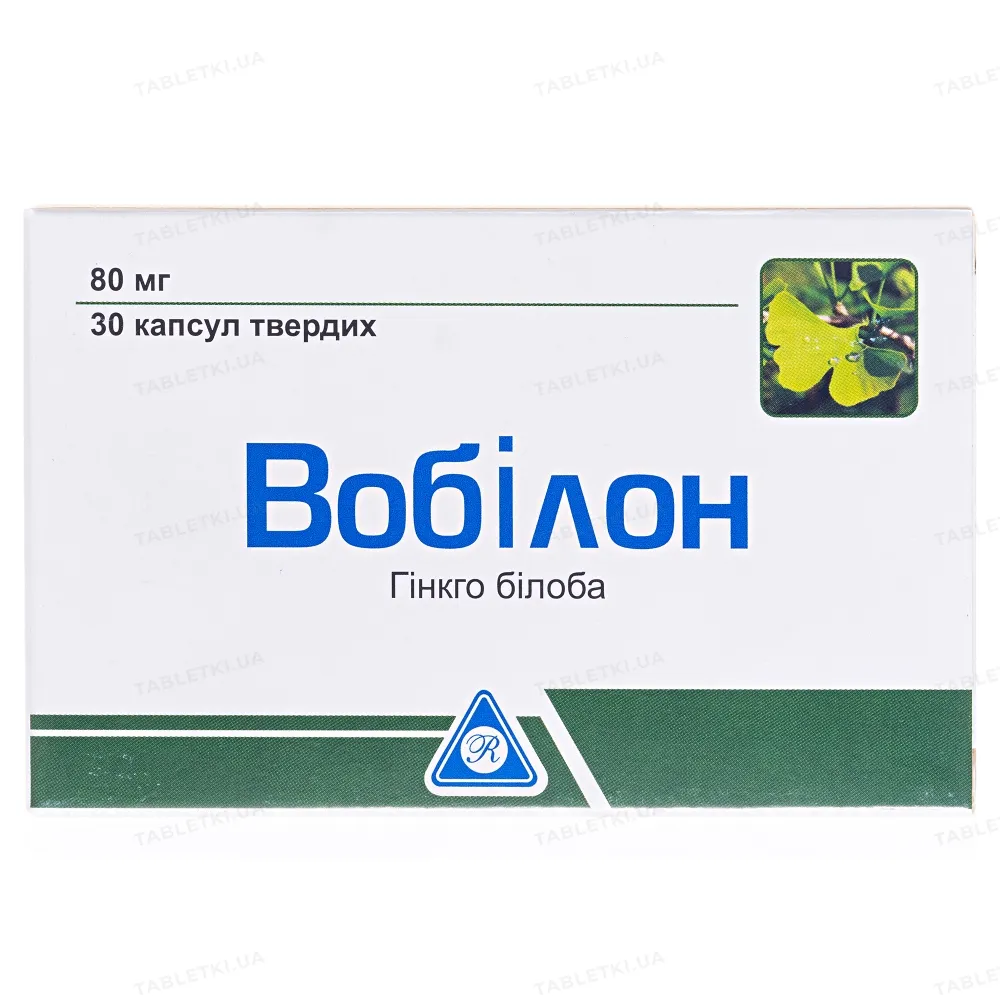
Table of Contents
INSTRUCTIONS FOR MEDICAL USE OF THE MEDICINAL PRODUCT VOBILON (VOBILON)
Composition:
Active substance: ginkgo biloba;
1 hard capsule contains dry extract of ginkgo biloba leaves (Ginkgonis folium) (35–67:1) (extraction solvent — acetone 65% v/v) 80 mg;
Excipients: calcium hydrogen phosphate, colloidal anhydrous silicon dioxide, magnesium stearate;
capsule shell: iron oxide red (E 172), iron oxide black (E 172), titanium dioxide (E 171), iron oxide yellow (E 172), gelatin.
Pharmaceutical form. Hard capsules.
Main physicochemical characteristics:
hard gelatin capsules, size №2, cap and body of matte brown color, containing brown powder with white particles; agglomerates may be present.
Pharmacotherapeutic group.
Agents used in disorders of the nervous system. Other agents for the treatment of dementia. ATC code N06 DX02.
Pharmacological properties.
Pharmacodynamics. The exact mechanism of action of Ginkgo biloba preparations is unknown.
Pharmacological data indicate increased alertness in elderly patients based on electroencephalography results, reduced blood viscosity and increased vascularization in certain areas of the brain in healthy men (aged 60–70 years), as well as reduced platelet aggregation. In addition, a vasodilatory effect on the forearm blood vessels has been observed, leading to an increase in circulating blood volume.
Pharmacokinetics. After oral administration of 120 mg of Ginkgo biloba extract (in solution form), the mean bioavailability of terpene lactones was 80% for ginkgolide A, 88% for ginkgolide B, and 79% for bilobalide. Following administration of the medicinal product in tablet form, maximum plasma concentrations (Cmax) of terpene lactones reached 16–22 ng/mL for ginkgolide A, 8–10 ng/mL for ginkgolide B, and 27–54 ng/mL for bilobalide. The elimination half-life (t1/2) of ginkgolides A and B and bilobalide was 3–4, 4–6, and 2–3 hours, respectively. Plasma concentrations after administration of a solution containing 120 mg of Ginkgo biloba extract were 25–33 ng/mL for ginkgolide A, 9–17 ng/mL for ginkgolide B, and 19–35 ng/mL for bilobalide. The t1/2 of ginkgolide A was 5 hours, that of ginkgolide B was 9–11 hours, and that of bilobalide was 3–4 hours.
Clinical characteristics.
Indications.
For symptomatic treatment of cognitive disorders in elderly patients, except for patients with confirmed dementia, Parkinson's disease, iatrogenic cognitive disorders, or those arising as a complication of depression or metabolic disorders.
Contraindications.
Hypersensitivity to the active substance and/or to any of the excipients of the medicinal product.
Pregnancy period.
Interaction with other medicinal products and other forms of interactions.
Concomitant use of Ginkgo biloba leaf extract with anticoagulants (phenprocoumon, warfarin) or antiplatelet agents (clopidogrel, acetylsalicylic acid or other nonsteroidal anti-inflammatory drugs) may affect the action of these agents.
In clinical studies with warfarin, no interaction between warfarin and Ginkgo biloba leaf extract was demonstrated; however, when used concomitantly, appropriate monitoring is recommended at the beginning and end of treatment or when changing the medicinal product.
A study on interaction with talinolol indicates a potential ability of Ginkgo biloba leaf extract to inhibit P-glycoproteins in the small intestine, which may increase exposure to medicinal products sensitive to P-glycoprotein in the gastrointestinal tract, such as dabigatran etexilate. Caution should be exercised when used concomitantly.
Interaction studies have shown that Cmax of nifedipine may increase by up to 100% when Ginkgo biloba leaf extract is used concomitantly, in some patients experiencing dizziness and increased flushing.
Concomitant use of Ginkgo biloba leaf extract may reduce efavirenz concentrations due to induction of CYP3A4 (see section "Special precautions for use"). Concomitant use is not recommended.
When used concomitantly, Ginkgo biloba leaf extract increases the metabolism of antiepileptic drugs metabolized via the CYP2C enzyme system. Also, during concomitant therapy, antiepileptic agents (valproate, phenytoin) may reduce the seizure threshold, increasing the risk of epileptic seizures.
Interaction of Ginkgo biloba leaf extract with drugs metabolized by the cytochrome P450 enzyme system cannot be completely excluded (in individual cases, inhibition or induction of certain isoenzymes is possible). Results of interaction studies with Ginkgo biloba products have demonstrated potentiation or inhibition of cytochrome P450 isoenzyme activity. Midazolam concentrations were altered following concomitant administration of Ginkgo biloba product, suggesting a possible interaction via CYP3A4. Therefore, caution is recommended when using Ginkgo biloba leaf extract concomitantly with medicinal products primarily metabolized by CYP3A4 and having a narrow therapeutic index.
Special precautions for use
Patients who are concurrently taking drugs metabolized by cytochrome P450 3A4 should be carefully monitored.
Patients with a tendency to bleeding (hemorrhagic tendency), who are receiving concomitant therapy with anticoagulants and antiplatelet agents, should consult their physician prior to using the medicinal product.
Ginkgo biloba extract increases the risk of bleeding. It is recommended to discontinue the use of the medicinal product 3–4 days before surgical procedures.
In patients with epilepsy, the possibility of increased seizure frequency during treatment with Ginkgo biloba extract cannot be excluded.
Concomitant use of Ginkgo biloba extract with efavirenz is not recommended (see section "Interaction with other medicinal products and other forms of interaction").
There is no information available on abuse of Ginkgo biloba preparations. Given its pharmacological profile, the medicinal product has no potential for abuse.
If symptoms worsen during treatment with the medicinal product, patients should consult a physician.
Use during pregnancy or breastfeeding.
Pregnancy. Ginkgo biloba leaf extract may reduce platelet aggregation ability. The risk of bleeding may increase. Animal studies are insufficient to draw conclusions regarding reproductive toxicity.
The medicinal product is contraindicated during pregnancy.
Lactation period. There is no data available on whether metabolites of Ginkgo biloba leaf extract are excreted in human breast milk. However, a risk to newborns and infants cannot be excluded.
Due to the lack of sufficient data, use of this medicinal product during breastfeeding is not recommended.
Fertility. Specific studies on the effect of Ginkgo biloba leaf extract on human fertility have not been conducted. However, certain effects were observed in female mice.
Ability to influence reaction speed when driving or operating machinery.
Studies on the influence of the medicinal product on reaction speed when driving or operating machinery have not been conducted.
Dosage and Administration.
The medicinal product is intended for oral administration.
Take 1 capsule three times a day during meals. Swallow the capsules with ½ glass of water. Maximum daily dose — 240 mg.
The duration of treatment should be at least 8 weeks. If no symptomatic improvement is observed after 3 months, or if the patient's condition worsens, the physician should evaluate the necessity of continuing the medicinal product.
Patients with hepatic and/or renal impairment. There are no dosage data available for patients with renal and/or hepatic impairment.
Children. There are no data on the use of Ginkgo biloba leaf extract in children.
Overdose.
There are no data on overdose with Ginkgo biloba leaf extract.
Adverse Reactions
The following adverse reactions may occur during the use of Ginkgo biloba extract.
The frequency of adverse reactions is defined according to the following classification: very common (≥ 1/10); common (≥ 1/100 and < 1/10); uncommon (≥ 1/1,000 and < 1/100); rare (≥ 1/10,000 and < 1/1,000); very rare (< 1/10,000); and not known (frequency cannot be estimated from available data).
Blood and lymphatic system disorders:
Not known — reports of bleeding in individual organs (eyes, nose, cerebral and gastrointestinal hemorrhages).
Immune system disorders:
Not known — hypersensitivity reactions (including anaphylactic shock).
Nervous system disorders:
Very common — headache; common — dizziness.
Cardiovascular system disorders:
Isolated cases of cardiac arrhythmia have been reported during treatment with medicinal products containing Ginkgo biloba extract.
Gastrointestinal disorders:
Common — diarrhea, nausea, vomiting, abdominal pain.
Skin and subcutaneous tissue disorders:
Not known — skin allergic reactions, including erythema, swelling, itching, rash.
Reporting suspected adverse reactions
Reporting suspected adverse reactions after marketing authorization is highly important. It allows continued monitoring of the benefit-risk balance of the medicinal product. Healthcare professionals, pharmacists, patients, and their legal representatives are encouraged to report any suspected adverse reactions and lack of efficacy via the Automated Pharmacovigilance Information System at the following link: https://aisf.dec.gov.ua.
Shelf life.
3 years.
Storage conditions.
Store at temperatures not exceeding 25 °C in the original packaging and in a place inaccessible to children.
Packaging.
10 capsules in a blister; 3 or 6 blisters per cardboard box.
Availability.
Over-the-counter (without prescription).
Manufacturer.
UORLД MEDICIN ILAC SAN. VE TIC. A.S. /
WORLD MEDICINE ILAC SAN. VE TIC. A.S.
Manufacturer's address and location of its business operations.
15 Temmuz Mahallesi Cami Yolu Caddesi No:50 Gunesli Bagcilar/Istanbul, Turkey /
15 Temmuz Mahallesi Cami Yolu Caddesi No:50 Gunesli Bagcilar/Istanbul, Turkey.