Vitamin c 500 orange
Ukraine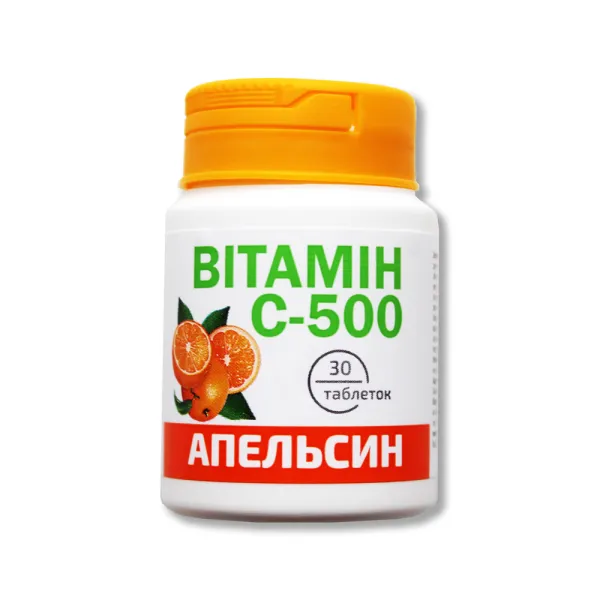
Table of Contents
INSTRUCTION FOR MEDICAL USE OF THE MEDICINAL PRODUCT VITAMIN C 500 ORANGE
Composition:
Active substance: ascorbic acid;
1 tablet contains: ascorbic acid 199.5 mg, sodium ascorbate 338.0 mg (equivalent to 300.5 mg of ascorbic acid);
Excipients: mannite (E 421), sucrose, sodium cyclamate (E 952), aspartame (E 951), stearic acid (E 570), calcium stearate, orange flavor, colloidal anhydrous silicon dioxide, colorant "Yellow FCF" (E 110).
Pharmaceutical form. Chewable tablets.
Main physicochemical properties: tablets ranging in color from pinkish-orange to orange, biconvex. A score line is marked on one of the surfaces. White and bright orange specks, a powdery deposit, and minor surface imperfections may be present on the tablet surface.
Pharmacotherapeutic group. Vitamins. Simple ascorbic acid (vitamin C) preparations. ATC code A11G A01.
Pharmacological properties.
Pharmacodynamics.
Vitamin C (ascorbic acid) belongs to the group of water-soluble vitamins.
Ascorbic acid is essential for the proper functioning and formation of connective tissues, particularly intercellular substance and collagen. In collagen synthesis, it participates in the hydroxylation of proline and lysine in the peptide chain. Ascorbic acid is involved in numerous redox reactions in the body and participates, for example, in the metabolism of phenylalanine, tyrosine, folic acid, norepinephrine, histamine, and certain enzyme systems involved in the synthesis of lipids, proteins, and in the hydroxylation of carnitine or serotonin. Ascorbic acid stabilizes capillary walls and enhances iron absorption.
Pharmacokinetics.
Ascorbic acid is readily absorbed in the gastrointestinal tract and penetrates into tissues. The highest concentrations are found in the adrenal glands, pituitary gland, and intestinal wall. It is biotransformed in the liver. The primary metabolite of ascorbic acid is oxalic acid, which is excreted in urine. Excretion in urine indicates saturation of the body with vitamin C. Ascorbic acid crosses the placenta and is excreted into breast milk. It can be removed from the body by hemodialysis.
Clinical characteristics.
Indications.
- For the treatment of ascorbic acid deficiency.
To meet increased body requirements for vitamin C:
- during acute respiratory and infectious diseases;
- during convalescence after severe illnesses, surgical interventions;
- in various intoxications, hemorrhagic diatheses, connective tissue diseases (rheumatoid arthritis), bleeding (nasal, pulmonary, uterine);
- in radiation sickness, hepatitis, cholecystitis, Addison's disease; in poorly healing soft tissue injuries; infected wounds and bone fractures.
Contraindications.
Hypersensitivity to ascorbic acid and other components of the drug.
Predisposition to thrombosis, thrombophlebitis, diabetes mellitus, urolithiasis.
Children under 14 years of age.
Should be prescribed with special caution to patients with iron metabolism disorders (hemochromatosis, hemochromatosis, thalassemia).
Fructose intolerance, glucose-galactose malabsorption syndrome.
Severe kidney diseases. Phenylketonuria.
Interaction with other medicinal products and other types of interactions.
Ascorbic acid reduces the toxicity of sulfonamide drugs, decreases the effect of heparin and indirect anticoagulants, promotes iron absorption, enhances penicillin absorption, and intensifies the adverse effects of salicylates (increasing the risk of crystalluria).
Quinolone derivatives, calcium chloride, salicylates, glucocorticoids during prolonged use reduce vitamin C stores in the body.
When used concomitantly, the drug reduces the chronotropic effect of isoprenaline.
In high doses, the drug increases renal excretion of mexiletine.
Barbiturates and primidone increase urinary excretion of ascorbic acid.
The drug reduces the therapeutic effect of neuroleptics (phenothiazine derivatives), tubular reabsorption of amphetamines, and tricyclic antidepressants.
Acetylsalicylic acid, oral contraceptives, fresh juices, and alkaline beverages reduce the drug's absorption. When used concomitantly with acetylsalicylic acid, urinary excretion of ascorbic acid increases and excretion of acetylsalicylic acid decreases. Acetylsalicylic acid intake reduces ascorbic acid absorption by approximately one-third, necessitating a corresponding increase in vitamin C dosage.
Vitamin C intake together with deferoxamine increases tissue iron toxicity, especially in myocardial tissue, which may lead to circulatory decompensation. It can be taken 2 hours after deferoxamine injection. Prolonged intake of high doses in patients treated with disulfiram inhibits the disulfiram-alcohol reaction.
High doses of ascorbic acid affect vitamin B12 resorption.
Vitamin C enhances oxalate excretion in urine, thereby increasing the risk of urinary oxalate stone formation.
Ascorbic acid increases the total clearance of ethanol.
Tetracyclines during prolonged use reduce ascorbic acid stores in the body.
When used concomitantly, ascorbic acid enhances ethinylestradiol absorption from the gastrointestinal tract. A similar effect applies to aluminum; therefore, this should be considered when treating concomitantly with aluminum-containing antacids.
Special precautions for use
The absorption process of ascorbic acid may be impaired in intestinal dyskinesia, enteritis, achylia, helminthic infestation, and giardiasis. Concurrent use of the drug with alkaline drinks reduces the absorption of ascorbic acid; therefore, it should not be taken with alkaline mineral water.
Since ascorbic acid enhances iron absorption, its use in high doses may be hazardous for patients with hemochromatosis, thalassemia, polycythemia, leukemia, and sideroblastic anemia. Patients with high iron levels in the body should use the drug in minimal doses.
The drug should be used with caution in patients with a history of kidney disease.
Ascorbic acid increases oxalate excretion in urine and raises the risk of oxalate stone formation. In patients with urolithiasis, the daily dose of ascorbic acid should not exceed 1 g.
High doses of the drug should not be prescribed to patients with increased blood coagulation.
When high doses are used or the drug is administered for a prolonged period, kidney function and arterial blood pressure should be monitored due to the stimulatory effect of ascorbic acid on corticosteroid hormone production.
Prolonged use of high-dose ascorbic acid may suppress the function of the pancreatic islet apparatus, requiring monitoring of pancreatic status.
Ascorbic acid should be used with caution in patients with progressive malignant disease, as its use may complicate the course of the illness.
Long-term use of high doses of ascorbic acid may accelerate its renal clearance, potentially leading to paradoxical ascorbic acid deficiency after discontinuation of treatment.
The recommended dose should not be exceeded.
The drug should not be used concurrently with other medicinal products containing ascorbic acid.
Since ascorbic acid exerts a mild stimulating effect on the central nervous system, it is not recommended to take it late in the day.
As a reducing agent, ascorbic acid may affect the results of laboratory tests (e.g., determination of glucose, bilirubin, uric acid, creatinine, inorganic phosphates, lactate dehydrogenase, and transaminase activity in blood). The test for occult blood in feces may yield false-negative results.
One chewable tablet contains 39 mg of sodium; therefore, patients on a sodium-controlled diet should use this medication with caution.
The drug contains aspartame (E 951), a source of phenylalanine, which may be harmful to patients with phenylketonuria. It also contains the colorant "Yellow Sunset FCF" (E 110), which may cause allergic reactions.
Use during pregnancy or breastfeeding
Prolonged use of vitamin C in high doses during pregnancy may adversely affect fetal development. The drug in this dosage is not intended for use during pregnancy or breastfeeding.
Ability to affect reaction speed when driving or operating machinery
There are no indications that the drug negatively affects reaction speed when driving or operating complex machinery, provided the recommended usage guidelines are followed.
Method of Administration and Dosage.
The drug should be taken orally after meals, chewing the tablet.
For therapeutic purposes, adults and children aged 14 years and older should take 1 tablet (0.5 g) daily. The treatment duration is 10–15 days.
In acute respiratory and infectious diseases, adults are recommended to take 1–2 tablets (0.5–1 g) daily (in 2 divided doses) for 7–10 days.
Thereafter, the dose should be reduced to ½ tablet (0.25 g) daily. To achieve this dosage, tablets containing the appropriate amount of active substance should be used.
The duration of treatment is determined by the physician depending on the patient's condition and the course of the disease.
Children.
The drug is recommended to be administered in another pharmaceutical form for children under 14 years of age.
Overdose.
Ascorbic acid is a water-soluble vitamin, and its excess is excreted in urine. Prolonged use of high doses may lead to suppression of the pancreatic islet apparatus function, kidney function impairment, increased arterial blood pressure, and development of other adverse effects listed in the section "Adverse Reactions."
In case of overdose, symptomatic treatment should be administered.
Adverse reactions.
- Gastrointestinal tract: when used in doses exceeding 1 g per day – irritation of the gastrointestinal mucosa, heartburn, nausea, vomiting, diarrhea, stomach spasms;
- Urinary system: damage to the renal glomerular apparatus, renal failure, crystalluria, formation of urate, cystine, and oxalate stones in kidneys and urinary tract;
- Immune system: occasionally – eczema, urticaria, pruritus, skin rashes, angioneurotic edema, anaphylactic shock in the presence of sensitization;
- Endocrine system: damage to the pancreatic islet apparatus (hyperglycemia, glucosuria) and impaired glycogen synthesis, up to the development of diabetes mellitus;
- Cardiovascular system: arterial hypertension, myocardial dystrophy;
- Hematopoietic system: thrombocytosis, thrombosis, hemolytic anemia, hyperprothrombinemia, erythrocytopenia, neutrophilic leukocytosis; in patients with glucose-6-phosphate dehydrogenase deficiency of erythrocytes, hemolysis of red blood cells is possible;
- Nervous system: increased excitability, fatigue, sleep disturbances, headache;
- Metabolism: disturbances in zinc and copper metabolism;
- General disorders: sensation of warmth, dental enamel erosion, occasionally – back pain.
Shelf life.
2 years.
Do not use after the expiry date stated on the packaging.
Storage conditions.
Store in the original packaging at a temperature not exceeding 25 °C.
Keep out of reach of children.
Packaging.
10 or 12 tablets in blisters.
10 tablets per blister, 2 blisters or 10 blisters per cardboard pack.
12 tablets per blister, 2 blisters per cardboard pack.
Prescription status.
Over-the-counter.
Manufacturer.
JSC "Chemical Pharmaceutical Plant "Chervona Zirka".
Manufacturer's address and location of business activity.
1, Gordienkivska Street, Kharkiv, 61010, Ukraine.