Vita-melatonin®
Ukraine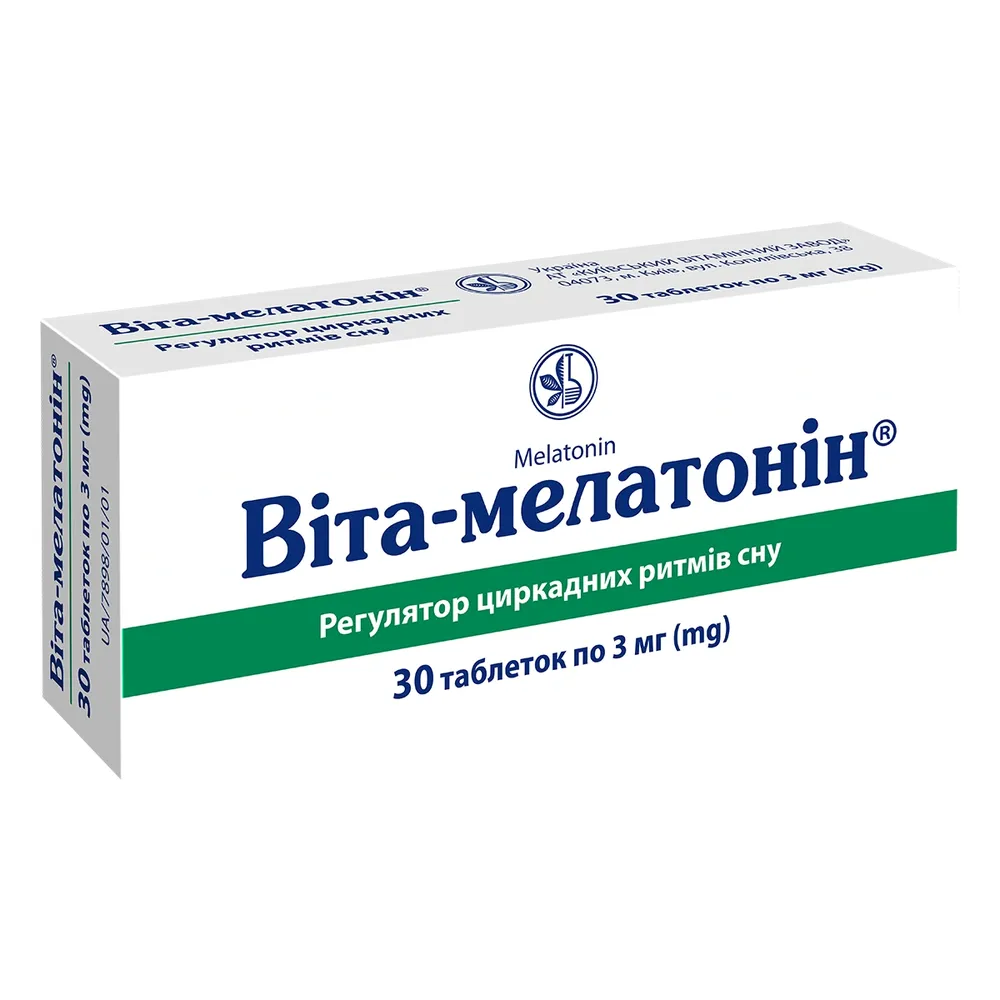
Table of Contents
INSTRUCTIONS FOR MEDICAL USE OF THE MEDICINAL PRODUCT VITA-MELATONIN® (VITA-MELATONIN)
Composition:
Active substance: melatonin;
1 tablet contains melatonin 3 mg;
Excipients: lactose monohydrate, microcrystalline cellulose, potato starch, calcium stearate.
Pharmaceutical form. Tablets.
Main physico-chemical properties: flat cylindrical tablets with bevelled edges and a score line, white or almost white in colour.
Pharmacotherapeutic group. Hypnotics and sedatives. Melatonin receptor agonists. ATC code N05C H01.
Pharmacological Properties.
Pharmacodynamics.
Vita-melatonin® is a synthetic analogue of the pineal gland (epiphysis) neuropeptide melatonin. The main effect of Vita-melatonin® consists in inhibition of gonadotropin secretion. To a lesser extent, the drug inhibits secretion of other adenohypophyseal hormones – corticotropin, thyrotropin, somatotropin. In addition, under the influence of melatonin, the content of GABA and serotonin increases in the midbrain and hypothalamus.
The above-mentioned processes lead to normalization of circadian rhythms, sleep-wake cycle, rhythmicity of gonadotropic effects and sexual function, enhance mental and physical performance, and reduce manifestations of stress reactions.
The drug has antioxidant properties, which determine its membrane-stabilizing action. It normalizes vascular wall permeability and increases its resistance, improves microcirculation. The drug improves only impaired endothelial function, without affecting normal endothelial function. Melatonin reduces systolic pressure and heart rate in elderly patients at rest, decreases the rise in arterial pressure during psychoemotional stress. The drug normalizes autonomic nervous regulation of the cardiovascular system predominantly during the night period, thus contributing to improvement of disturbed daily profile of arterial pressure.
Vita-melatonin®, by stimulating cellular immune responses, exerts immunomodulatory action on the body.
Pharmacokinetics.
After oral administration, melatonin undergoes substantial transformation during first-pass liver metabolism. The bioavailability of the drug is 30–50%. After oral administration at a dose of 3 mg, maximum concentration in blood serum and saliva is reached after 20 and 60 minutes, respectively.
Melatonin penetrates the blood-brain barrier and is detected in the placenta. The mean half-life elimination period of melatonin is 45 minutes. It is excreted from the body by the kidneys.
Clinical characteristics.
Indications.
For the prevention and treatment of circadian rhythm sleep-wake disorders associated with time zone changes, manifested by increased fatigue; sleep disturbances, including chronic functional insomnia, insomnia in elderly individuals (including those with concomitant hypertension and hypercholesterolemia); to enhance mental and physical performance, as well as to alleviate stress reactions and seasonal affective disorders. Elevated arterial pressure and hypertensive disease (Stage I–II) in elderly patients (as part of complex therapy).
Contraindications.
Hypersensitivity to the components of the drug. Autoimmune diseases, lymphogranulomatosis, leukemia, lymphoma, myeloma, epilepsy, diabetes mellitus. Concomitant use of monoamine oxidase inhibitors, corticosteroids, and cyclosporine.
Interaction with other medicinal products and other types of interactions.
Drugs that block β-adrenergic receptors, clonidine, dexamethasone, fluvoxamine, and certain other medicinal agents may alter the secretion of endogenous melatonin. Vita-melatonin® may affect the efficacy of hormonal drugs (estrogens, androgens, etc.) and increase the binding of benzodiazepines to specific receptors; therefore, their concomitant use requires medical supervision.
Melatonin may enhance the sedative properties of benzodiazepines and non-benzodiazepine hypnotics such as zaleplon, zolpidem, and zopiclone. Clear evidence of a pharmacodynamic interaction between melatonin and zolpidem has been obtained one hour after co-administration. Concomitant use leads to greater impairment of attention, memory, and coordination compared to zolpidem alone.
Vita-melatonin® may potentiate the antitumor effect of tamoxifen.
Dopaminergic and serotonergic effects of methamphetamine may be enhanced when used concomitantly with Vita-melatonin®.
Vita-melatonin® may potentiate the antibacterial action of isoniazid.
Melatonin may be used in combination with lisinopril as part of concomitant antihypertensive therapy in patients with functional pineal gland insufficiency, enhancing its effect.
According to existing observations, melatonin induces CYP3A in vitro at concentrations exceeding therapeutic levels. The clinical significance of this finding is unknown. Induction, if it occurs, may lead to reduced plasma concentrations of concurrently administered drugs.
Fluvoxamine increases melatonin levels by inhibiting its metabolism via hepatic isoenzymes CYP1A2 and CYP2C19 of cytochrome P450 (CYP). This combination should be avoided.
Patients receiving 5- or 8-methoxypsoralen, which increases melatonin levels by inhibiting its metabolism, should be closely monitored.
Patients receiving cimetidine—a CYP2D inhibitor that increases plasma melatonin levels by suppressing its metabolism—should be closely monitored.
Smoking may reduce melatonin levels by inducing CYP1A2.
Patients receiving estrogens (e.g., contraceptives or hormone replacement therapy) should be carefully monitored, as melatonin levels increase due to inhibition of its metabolism by CYP1A1 and CYP1A2.
CYP1A2 inhibitors, such as quinolones, may enhance the effects of melatonin.
CYP1A2 inducers, such as carbamazepine and rifampicin, may reduce melatonin plasma concentrations.
Special precautions for use.
Do not use in women planning pregnancy due to the potential contraceptive effect of melatonin.
When using Vita-melatonin®, avoid exposure to bright light.
In patients with liver cirrhosis, melatonin metabolism is reduced; therefore, the drug should be used with caution in these patients.
The drug can be used in patients with elevated arterial pressure (especially systolic) and hypercholesterolemia. With prolonged use, Vita-melatonin® reduces cholesterol levels in patients with hypercholesterolemia, but does not affect cholesterol levels when serum cholesterol is within the normal range. The drug reduces plasma insulin and glucose levels; therefore, it can be used in patients with hypertension and hypercholesterolemia associated with insulin resistance (HOMA index above 3 units).
Use with caution in patients with hormonal disorders and/or those undergoing hormonal therapy, as well as in patients with allergic diseases.
Melatonin may cause drowsiness. The drug should be used cautiously when drowsiness could pose a risk or danger to the patient's health.
Not recommended for patients with autoimmune diseases.
Patients with rare hereditary conditions such as galactose intolerance, Lapp lactase deficiency, or glucose-galactose malabsorption should not take this medication.
Concomitant alcohol intake reduces the effectiveness of melatonin.
Use during pregnancy or breastfeeding.
The drug is not used during pregnancy and breastfeeding due to lack of clinical data.
Ability to influence reaction rate when driving or operating machinery.
Given that the drug may cause drowsiness, patients should refrain from driving vehicles or performing other tasks requiring concentration during treatment.
Method of Administration and Dosage
For treatment, Vita-melatonin® is prescribed orally to adults at a dose of 3 mg to 6 mg (1–2 tablets) per day. Tablets should be taken daily, 30 minutes before bedtime, preferably at the same time each day.
The treatment course lasts until the physiological sleep-wake rhythm is restored, but not longer than 1 month.
When used for prophylactic purposes, the dosage and duration of the drug are determined by a physician based on individual patient characteristics and disease course. Usually, 1–2 tablets are taken daily, 30 minutes before bedtime, preferably at the same time each day, for up to 2 months, with a one-week break between treatment cycles (each treatment cycle lasts 1 month).
For treatment of chronic sleep disorders (including in patients with concomitant hypertension and/or hypercholesterolemia), elderly patients should be prescribed the minimal effective dose of 1.5 mg (½ tablet) once daily, taken 30 minutes before bedtime. If the response is inadequate, the dose may be increased to 3 mg. Discontinuation of the drug should be gradual, with dose reduction over 1–2 weeks.
The same regimen applies to elderly patients with elevated arterial pressure and hypertension. The drug may be used for 3–6 months, with one-week intervals between monthly treatment courses.
Renal impairment. There are no studies on the effect of various degrees of renal impairment on melatonin pharmacokinetics; therefore, melatonin should be used with caution in such patients.
Hepatic impairment. There is no experience with the use of melatonin in patients with impaired liver function. Published data indicate significantly increased levels of endogenous melatonin during daytime hours due to reduced clearance in these patients. Therefore, melatonin is not recommended for patients with impaired liver function.
Children. Experience with the use of this drug in pediatric patients is lacking.
Overdose.
Several cases of melatonin overdose have been reported (single intake of 24–30 mg of melatonin). In case of overdose, symptoms such as disorientation, prolonged sleep, and anterograde amnesia may develop. Treatment is symptomatic.
Adverse reactions.
In some cases, adverse reactions may occur during the use of the medicinal product.
Infections and infestations: herpes zoster.
Blood and lymphatic system disorders: leukopenia, thrombocytopenia.
Cardiac disorders: angina pectoris, palpitations.
Psychiatric disorders: irritability, increased excitability, anxiety, insomnia, unusual dreams, mood changes, aggression, agitation, tearfulness, early morning awakening, increased libido, depression.
Nervous system disorders: migraine, increased psychomotor activity, dizziness, somnolence, memory impairment, attention disturbances, sleep quality disturbances, paresthesia.
Eye disorders: decreased visual acuity, blurred vision, increased lacrimation.
Ear and labyrinth disorders: dizziness upon change in body position.
Vascular disorders: hot flushes.
Gastrointestinal disorders: abdominal pain, constipation, dry mouth, oral mucosal ulcers, vomiting, abnormal bowel sounds, flatulence, increased salivation, bad breath, gastroesophageal reflux.
Metabolism and nutrition disorders: hypertriglyceridemia, hypocalcemia, hyponatremia.
Hepatobiliary disorders: hyperbilirubinemia, increased liver enzyme activity, liver function abnormalities, laboratory test deviations.
Skin and subcutaneous tissue disorders: night sweats, dermatitis, eczema, erythema, pruritic rash; pruritus, dry skin, psoriasis, nail disorders.
Musculoskeletal and connective tissue disorders: limb pain, muscle spasms, neck pain, arthritis.
Renal and urinary disorders: glucosuria, proteinuria, menopausal symptoms, polyuria, hematuria, nocturia, priapism, prostatitis.
General disorders: asthenia, chest pain, fatigue, thirst.
Other disorders: weight gain, electrolyte level changes.
Shelf life. 4 years.
Storage conditions.
Store in the original packaging at a temperature not exceeding 25 °C.
Keep out of reach of children.
Packaging. 10 tablets in a blister; 3 blisters in a carton.
Prescription status. Prescription only.
Manufacturer. JSC "KYIV VITAMIN PLANT".
Manufacturer's location and address of its business activity.
04073, Ukraine, Kyiv, Kopilivska St., 38.
Web-site: www.vitamin.com.ua.