Vicks active medexpecto
Ukraine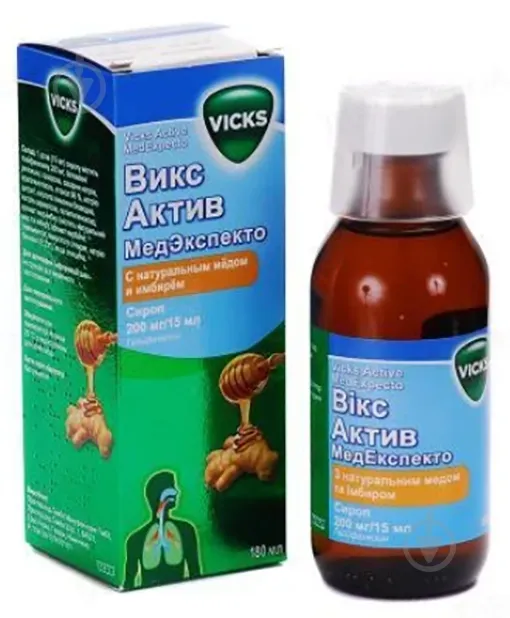
Instructions for Use
INSTRUCTIONS FOR MEDICAL USE OF THE MEDICINAL PRODUCT VICKS ACTIVE MEDEXPECTO (VICKS ACTIVE MEDEXPECTO)
Composition:
Active substance: guaifenesin;
1 dose (15 mL) of syrup contains guaifenesin 200 mg;
Excipients: sucrose, sodium saccharin, propylene glycol, ethanol 96%, sodium citrate, anhydrous citric acid, sodium carmellose, polyethylene oxide, honey-ginger flavor (contains natural honey and ginger), verbena flavor, levomenthol, macrogol stearate, sodium benzoate (E 211), purified water.
Pharmaceutical form. Syrup.
Main physicochemical properties: yellow or yellow-brown viscous liquid with honey, ginger and menthol aroma and taste, free from visible particles.
Pharmacotherapeutic group. Preparations used in cough and colds. Expectorants, excluding combination products containing antitussives. Expectorants. ATC code R05C A03.
Pharmacological properties.
Pharmacodynamics.
Guaifenesin is an expectorant that facilitates the expulsion of mucus during coughing by increasing the volume and reducing the viscosity of secretions in the trachea and bronchi. It increases the secretion of respiratory tract glands, enhances pulmonary surfactant excretion, and stimulates ciliary activity, thereby facilitating mucus clearance and its removal (mucociliary clearance).
Controlled clinical studies have demonstrated the importance of the expectorant effect of the syrup in relieving and reducing cough. After oral administration, guaifenesin is rapidly absorbed from the gastrointestinal tract, reaching a maximum plasma concentration of 1.2 mcg/mL within 30 minutes following a 200 mg dose.
Pharmacokinetics.
Guaifenesin is rapidly metabolized and eliminated via oxidation and demethylation, with a half-life of approximately 1 hour. There are no data regarding changes in the pharmacokinetics of guaifenesin in elderly patients. When administered concomitantly, guaifenesin does not alter the pharmacokinetics of pseudoephedrine or dextromethorphan.
Clinical characteristics.
Indications.
Relief of cough associated with colds and acute infectious diseases of the upper respiratory tract.
Contraindications.
Hypersensitivity to the active substance, levomenthol, or any of the excipients. Porphyria.
Interaction with other medicinal products and other forms of interaction.
This medicinal product may enhance the effect of sedatives and muscle relaxants.
Special precautions for use.
This medicinal product is indicated for adults and adolescents aged 14 years and older.
The product should be used only after careful consideration of the expected benefit and potential risk in the following cases:
- renal impairment;
- myasthenia gravis;
- chronic or persistent cough due to asthma, smoking, chronic bronchitis, or emphysema;
- severe gastrointestinal disorders;
- in combination with antitussive agents.
This medicinal product contains sucrose and invert sugar (honey). Patients with rare hereditary fructose intolerance, glucose-galactose malabsorption, or sucrase-isomaltase deficiency should not take this product.
One dose (15 mL) of syrup contains 5.55 g of sucrose. This should be taken into account for patients with diabetes mellitus.
If you have been diagnosed with intolerance to certain sugars, consult your doctor before taking this medicinal product.
This medicinal product contains ethanol (alcohol): one dose (15 mL) of syrup contains 0.63 g of alcohol, equivalent to 15 mL of beer or 6 mL of wine. It is harmful for patients suffering from alcoholism. Caution is advised when administering to pregnant women, breastfeeding women, children, patients with liver disease, and patients with epilepsy. The amount of alcohol in this medicinal product may affect the action of other drugs.
This medicinal product contains propylene glycol, which may cause symptoms similar to those arising from alcohol consumption.
This medicinal product contains 1.3 mmol (or 30 mg) of sodium per dose. Caution is advised for patients on a controlled sodium intake diet.
Use during pregnancy or breastfeeding.
Pregnancy
The safety of guaifenesin use during pregnancy has not been fully established. The amount of data available in pregnant women is limited. Available data indicate no teratogenic or fetal/neonatal toxicity of guaifenesin.
Breastfeeding
Guaifenesin is excreted in breast milk. Data on the effects of guaifenesin on newborns/infants are insufficient.
As a precautionary measure, it is recommended to avoid using this product during pregnancy or breastfeeding.
Ability to influence reaction speed while driving or operating machinery.
The alcohol content in this medicinal product may affect the ability to drive or operate machinery.
Dosage and Administration
The medication is intended for oral use.
Adults and adolescents aged 14 years and older: 200 mg of guaifenesin, i.e. 15 ml (one measuring cap filled up to the 15 ml mark) 3–4 times daily.
Generally, a maximum of 6 doses per day is recommended; however, guaifenesin should not be taken before going to sleep.
Shake well before use.
Patients may self-administer this medicinal product for no longer than 3–5 days. If no significant improvement occurs during this period, or if mucus production continues or cough persists, medical advice should be sought, as this may indicate a more serious underlying condition.
Children
Studies in children under 14 years of age have not been conducted, and dosage recommendations are not available. Therefore, this medicinal product is not recommended for use in this patient group.
Overdose.
Symptoms. Mild or moderate overdose may cause dizziness, gastrointestinal disturbances, nausea, vomiting, or decreased muscle tone. Very high doses may lead to symptoms such as excitation, confusion, and respiratory depression. Rare cases of bladder or kidney stones have been reported in patients who took large amounts of guaifenesin over prolonged periods.
Treatment. Treatment is symptomatic and includes gastric lavage and general supportive measures.
Side effects.
Side effects are categorized by frequency as follows: very common (≥ 1/10); common (≥ 1/100, < 1/10); uncommon (≥ 1/1000, < 1/100); rare (≥ 1/10000, < 1/1000); very rare (< 1/10000); not known (cannot be estimated from the available data).
Gastrointestinal disorders. Rare: gastrointestinal disturbances, including nausea, vomiting, or diarrhea.
Immune system disorders. Very rare: hypersensitivity reactions such as difficulty swallowing, facial, lip, tongue or throat swelling, severe itching with skin rash or swelling, coma, confusion, bradycardia, bronchospasm, dyspnea, granulocytopenia, and anaphylactic shock. These reactions may be preceded by fever, dizziness, nausea, vomiting, stomach cramps, heartburn, or pain.
In patients sensitized to levomenthol, hypersensitivity reactions may occur, including dyspnea.
Shelf life. 3 years.
After opening the bottle – 3 months.
Storage conditions.
Store at temperatures not exceeding 25 °C in a place inaccessible to children.
Packaging.
120 ml or 180 ml in a bottle, 1 bottle with a measuring cap in a carton.
Availability.
Over-the-counter (without prescription).
Manufacturer.
Procter & Gamble Manufacturing GmbH.
Manufacturer's address and place of business.
Procter & Gamble Str. 1, 64521, Groß-Gerau, Hesse, Germany.
Frequently Asked Questions
What is Vicks active medexpecto prescribed for?
The drug is used to relieve cough during colds and acute infectious diseases of the upper respiratory tract.
How should Vicks active medexpecto be taken correctly?
Adults and adolescents aged 14 and older should take 15 ml (one measuring cap) 3–4 times a day. The maximum dose is 6 doses per day. The syrup should be shaken before use. It is not recommended to take the drug immediately before bedtime.
Who should not take this drug?
Contraindications include hypersensitivity to the components of the product or porphyria. The drug is also not recommended for children under 14 years of age. Caution should be exercised in individuals with diabetes mellitus, renal impairment, myasthenia gravis, serious gastrointestinal disorders, or chronic cough caused by asthma or bronchitis.
What are the possible side effects of Vicks active medexpecto?
Gastrointestinal disorders (nausea, vomiting, diarrhea) are possible. Very rarely, serious allergic reactions may occur: swelling of the face or throat, shortness of breath, rash, itching, or anaphylactic shock.
Can this product be combined with other medicines?
The drug may enhance the effects of sedatives and muscle relaxants. It should not be used in conjunction with antitussive (cough-suppressing) agents.
Does the drug affect the ability to drive a vehicle?
Since the syrup contains ethanol (alcohol), it may affect reaction speed; therefore, caution should be exercised when driving vehicles or operating machinery.
Can the drug be taken by pregnant or breastfeeding women?
As a precautionary measure, it is recommended to avoid using this product during pregnancy or breastfeeding.
This page has been machine-translated and may contain inaccuracies. The original data is available in the manufacturing country's language.
Last data check: July 21, 2026 · Data source: Державний реєстр лікарських засобів України