Vikasol-darnitsa
Ukraine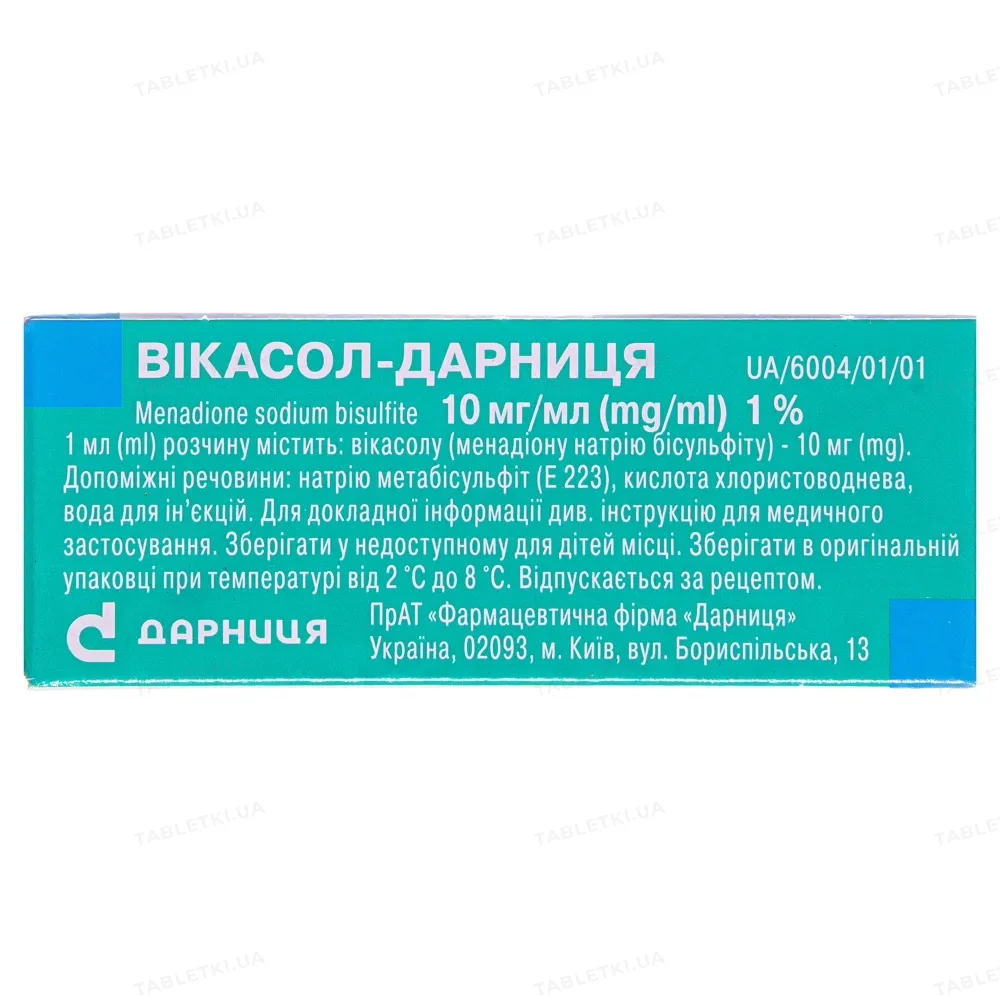
Table of Contents
INSTRUCTIONS FOR MEDICAL USE OF THE MEDICINAL PRODUCT Vikasol-Darnitsa (Vikasol-Darnitsa)
Composition:
Active substance: menadione sodium bisulfite;
1 ml of solution contains vicasol (menadione sodium bisulfite) 10 mg;
Excipients: sodium metabisulfite (E 223), hydrochloric acid, water for injections.
Pharmaceutical form. Solution for injection.
Main physico-chemical properties: clear, colorless or slightly yellowish liquid.
Pharmacotherapeutic group. Vitamin K and other hemostatic agents. ATC code B02B A02.
Pharmacological Properties
Pharmacodynamics
Vitamin K exists in several forms. The main form of vitamin K – vitamin K1 (phylloquinone) – is found in plants, especially green leafy vegetables. Another form of vitamin K is vitamin K2 (menaquinone), which can be absorbed in limited amounts. It is produced by bacteria in the lower part of the small intestine and in the large intestine.
Vikasol-Darnitsya is a synthetic water-soluble analogue of vitamin K and is considered as vitamin K3 (menadione). It promotes the synthesis of prothrombin and proconvertin and enhances blood coagulation by stimulating the synthesis of coagulation factors II, VII, IX, and X. It has a hemostatic effect (vitamin K deficiency leads to increased bleeding). In blood, prothrombin (factor II), in the presence of thromboplastin and Ca2+, and with the participation of proconvertin (factor VII), factor IX (Christmas factor), and factor X (Stuart-Prower factor), is converted into thrombin. Thrombin, in turn, transforms fibrinogen into fibrin, which forms the basis of a blood clot (thrombus). Vikasol-Darnitsya, as a substrate, stimulates vitamin K reductase, thereby activating vitamin K and ensuring its participation in the hepatic synthesis of vitamin K-dependent plasma coagulation factors.
The role of vitamin K in the human and animal body is not limited to its influence on the biosynthesis of procoagulants. It affects bioenergetics and a number of anabolic processes. It is important for the metabolism of macroergic compounds and for ATP formation. Vitamin K deficiency leads to ATP deficiency and reduced energy supply for the biosynthesis of many compounds. These include not only procoagulants but also other rapidly resynthesized proteins, including several enzymes not directly related to the blood coagulation process. Vitamin K deficiency also impairs the biosynthesis of certain biologically active non-protein substances such as serotonin, histamine, and acetylcholine. The onset of effect occurs 8–24 hours after intramuscular administration.
Pharmacokinetics
After intramuscular administration, the drug is easily and rapidly absorbed into the systemic circulation. Plasma protein binding is reversible. Blood from patients with very low albumin levels weakly binds vitamin K or does not bind it at all. The drug accumulates mainly in the liver, spleen, and myocardium. The most intensive transformation processes occur in the myocardium and skeletal muscles, while somewhat slower processes occur in the kidneys. Elimination via kidneys and bile occurs only exceptionally in the form of metabolites. Vitamin K metabolites (monosulfate, phosphate, and diglucuronide of 2-methyl-1,4-naphthoquinone) are excreted in urine – up to 70%. High concentrations of vitamin K in feces are due to its synthesis by intestinal microflora.
Clinical characteristics.
Indications.
Vikasol is indicated for bleeding and hypoprothrombinemia associated with jaundice, acute hepatitis, capillary and parenchymal hemorrhages. After surgical interventions and injuries, in cases of bleeding due to peptic ulcer of the stomach and duodenum, pronounced symptoms of acute radiation sickness, prolonged nasal and hemorrhoidal bleeding.
The drug is indicated for hemorrhagic conditions in premature infants, premenopausal and juvenile uterine bleeding, spontaneous bleeding, preparation for surgical procedures when there is a risk of postoperative bleeding, pulmonary hemorrhages, and hemorrhagic manifestations associated with septic diseases.
Additionally, indications for prescribing Vikasol-Darnytsia include bleeding and hypoprothrombinemia caused by overdose of phenylindione, neodicoumarin, and other vitamin K antagonist anticoagulants.
Contraindications.
Hypersensitivity to the components of the drug. Hypercoagulability, thromboembolism. Hemolytic disease of the newborn. Severe hepatic insufficiency. Glucose-6-phosphate dehydrogenase deficiency.
Third trimester of pregnancy (prophylactic administration of vitamin K is ineffective due to its low placental permeability).
Interaction with other medicinal products and other types of interactions.
When used concomitantly with oral anticoagulants, the anticoagulant effect may be reduced. It diminishes the effect of indirect anticoagulants (including coumarin and indandione derivatives). Does not affect the anticoagulant activity of heparin.
Concomitant use with broad-spectrum antibiotics, quinidine, quinine, salicylates in high doses, and sulfonamides may require an increased dose of vitamin K.
Concomitant use with hemolytic medicinal products increases the risk of adverse effects.
When used simultaneously with platelet aggregation agents and fibrinolysis inhibitors, their hemostatic effect is potentiated.
Special precautions for use.
It should be noted that Vikasol may inhibit platelet aggregation. The drug is ineffective in hemophilia, thrombocytopenic purpura, and von Willebrand's disease.
For prevention of hemorrhagic disease in newborns, phytomenadione is preferred over sodium menadione bisulfite, as it less frequently causes hyperbilirubinemia and hemolytic anemia in newborns (including premature infants).
Use during pregnancy or breastfeeding.
Vikasol-Darnitsya belongs to medicinal products with risk during pregnancy. The use of the drug during the I and II trimesters of pregnancy is possible when indicated, provided that the benefit to the mother outweighs the potential risk to the fetus. Prophylactic administration of vitamin K in the III trimester of pregnancy is ineffective due to its low placental permeability.
If it is necessary to administer the drug, breastfeeding should be discontinued.
Ability to influence the reaction rate when driving or operating machinery.
The drug does not affect reaction speed when driving vehicles or operating machinery. However, if dizziness occurs during treatment with the drug, driving vehicles and working with machinery should be avoided.
Method of Administration and Dosage
The medicinal product should be administered intramuscularly.
Adults: Single dose – 10 mg, maximum single dose – 15 mg; maximum daily dose – 30 mg.
Duration of treatment – 3–4 days; after a 4-day break, the course may be repeated if necessary.
In surgical interventions associated with possible severe parenchymal bleeding, administer for 2–3 days prior to surgery.
Children: under 1 year – 2–5 mg/day, 1–2 years – 6 mg/day, 3–4 years – 8 mg/day, 5–9 years – 10 mg/day, 10–18 years – 15 mg/day. The daily dose should be divided into two administrations. The duration of treatment for children is determined by the physician.
Children
The medicinal product may be used in pediatric practice.
Overdose
Symptoms: Hypervitaminosis of vitamin K, manifested by hyperprothrombinemia and hyperfibrinogenemia, hyperbilirubinemia, jaundice, increased liver enzyme activity; abdominal pain, constipation or diarrhea, general excitement, agitation, and skin rashes have been observed. In isolated cases, children developed toxicity presenting with seizures.
Treatment: Discontinue the medicinal product. Administer anticoagulants under monitoring of blood coagulation parameters. Symptomatic therapy.
Side effects.
Hepatic and biliary disorders: hyperbilirubinemia, jaundice (including nuclear jaundice in infants).
Cardiovascular system disorders: transient decrease in arterial pressure, tachycardia, weak pulse filling.
Blood and lymphatic system disorders: hemolytic anemia, hemolysis in newborns with congenital glucose-6-phosphate dehydrogenase deficiency or in patients with vitamin E deficiency, thromboembolism.
Immune system disorders: hypersensitivity reactions, including facial flushing, skin rash (including erythematous, urticaria), pruritus, bronchospasm.
General disorders and administration site reactions: dizziness, profuse sweating, taste disturbances, sensation of warmth, pain and swelling at the injection site, skin discoloration in the form of spots with repeated injections at the same site. Vikasol may cause local scleroderma.
Shelf life. 2 years.
Storage conditions.
Store in the original packaging at a temperature between 2 °C and 8 °C. Keep out of reach of children.
Incompatibility.
Vikasol is incompatible with sulfonamide drugs, PAS (para-aminosalicylic acid), salicylates, and oxycoumarin. It is incompatible in the same syringe with solutions of alkalis and acids.
The active substance of the medicinal product rapidly degrades under direct sunlight.
Packaging.
1 ml in an ampoule; 5 ampoules in a blister pack; 2 blister packs in a carton.
Prescription status. Prescription only.
Manufacturer: JSC "Pharmaceutical Company "Darnytsia".
Manufacturer's address and location of business activity:
13, Boryspilska Street, Kyiv, 02093, Ukraine.