Vidisik
Ukraine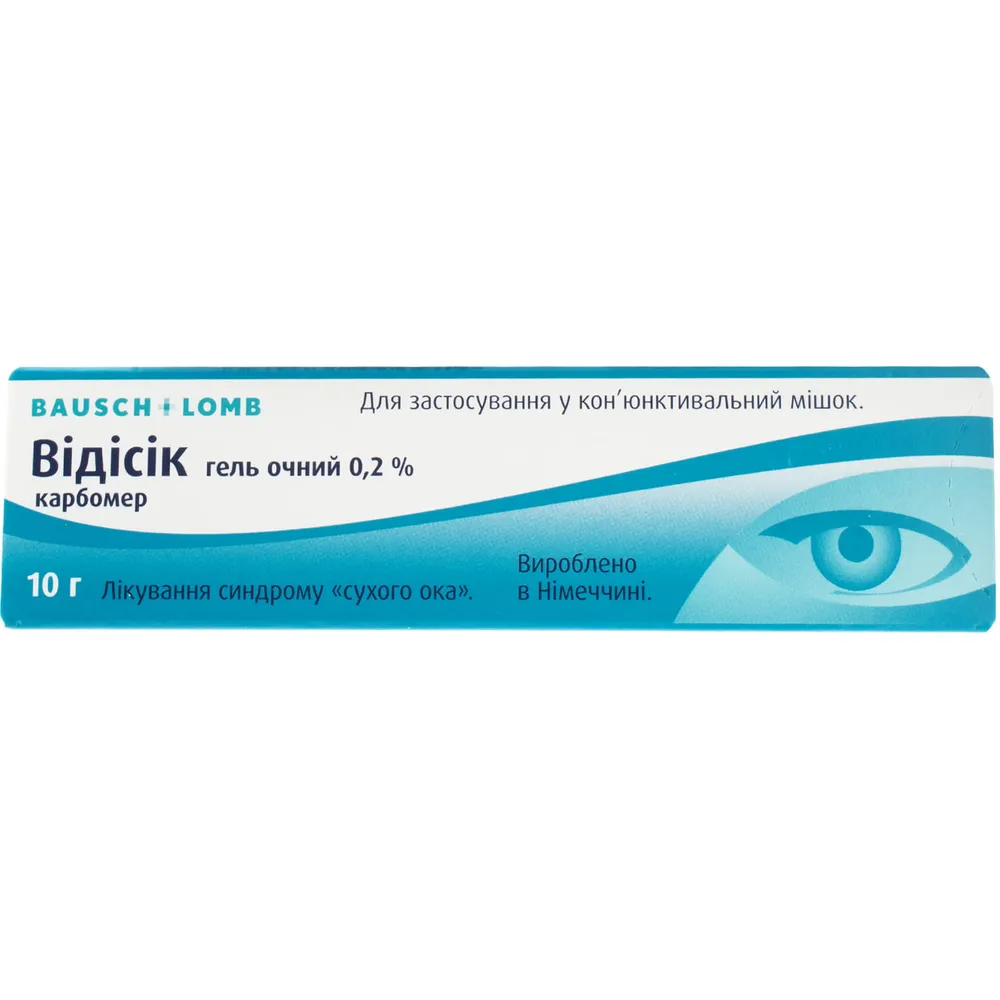
Table of Contents
INSTRUCTION FOR MEDICAL USE OF THE MEDICINAL PRODUCT VİDİŞİK (VIDISIC®)
Composition:
Active substance: carbomer;
1 g of ocular gel contains 2 mg of carbomer;
Excipients: cetrimide, sodium hydroxide, sorbitol (E 420), water for injections.
Pharmaceutical form. Ocular gel.
Main physicochemical properties: transparent, colorless gel.
Pharmacotherapeutic group.
Artificial tear substitutes and other neutral agents. ATC code S01XA20.
Pharmacological properties.
Pharmacodynamics.
The active ingredient of the product is a high-molecular-weight hydrophilic polymer whose pH and osmolarity are similar to those of the physiological tear film. Due to its physical properties, the eye gel retains water and forms a transparent, moist film on the surface of the eye.
Pharmacokinetics.
In pharmacokinetic studies, radiolabeled carbomer was administered to rats. The study results showed that only a negligible amount of carbomer is absorbed. After single administration, 0.75% of the dose was excreted via respiration as carbon dioxide and 0.63% was excreted in urine. The majority of carbomer (92%) was excreted in feces within 24 hours after administration. Considering the macromolecular nature of carbomer, it can be predicted that it is eliminated from the body without undergoing metabolic transformation, i.e., it does not undergo hepatic metabolism.
The maximum residence time of carbomer on the ocular surface is approximately 90 minutes.
Clinical characteristics.
Indications.
Replacement therapy in reduced tear secretion, treatment of dry eye syndrome, symptomatic treatment of dry keratoconjunctivitis.
Contraindications.
Hypersensitivity to any component of the medicinal product.
Interaction with other medicinal products and other forms of interaction.
Unknown.
Vidisic may prolong the contact time of other concurrently administered medicinal products with the eye. If Vidisic is used simultaneously with other eye drops, an interval of at least 5 minutes should be maintained between administrations. If Vidisic is used together with other locally applied ophthalmic medicinal products, including ophthalmic ointments, an interval of at least 15 minutes should be maintained between administrations. In all cases, Vidisic should be administered last.
Special precautions for use.
Use during pregnancy or breastfeeding.
There are no clinical data on the safety of Vedisik during pregnancy and breastfeeding. Preclinical studies of the drug indicate that the risk associated with the use of Vedisik during these periods is very low.
Vedisik may be used during pregnancy or breastfeeding only on the advice of a physician, if the expected benefit from the use of the drug outweighs the potential risk.
Ability to influence reaction speed when driving or operating machinery.
Blurred vision may occur for several minutes after instillation of Vedisik into the conjunctival sac. Therefore, it is recommended to refrain from driving a vehicle or operating machinery until visual acuity is restored.
Method of administration and dosing.
Treatment of dry eye requires an individualized dosing regimen. Depending on the severity and intensity of symptoms, administer 1 drop into the conjunctival sac 3–5 times daily, or more frequently, and approximately 30 minutes before bedtime.
When using Vidisic for the treatment of dry keratoconjunctivitis, consultation with an ophthalmologist is recommended, as this condition usually requires long-term or continuous treatment.
Children.
Safety data regarding the use of the medicinal product in children are lacking; therefore, the product is not recommended for use in this patient population.
Overdose.
Unknown.
Side effects.
Blurred vision may occur immediately after administration of the drug.
In rare cases, hypersensitivity reactions to certain components of the drug, as well as eye pain, may occur.
The product contains the preservative cetrimide, which may cause eye irritation, especially with frequent or prolonged use (burning sensation, redness, foreign body sensation in the eye, stinging), and corneal epithelial damage. Therefore, for the treatment of chronic dry keratoconjunctivitis, preservative-free products should be used.
Shelf life.
3 years.
After first opening the tube, the contents may be used for up to 6 weeks.
Storage conditions.
Store at a temperature not exceeding 25 °C. Keep out of reach of children.
Packaging.
10 g in a tube; 1 tube in a cardboard box.
Supply classification.
Over-the-counter (without prescription).
Manufacturer.
Dr. Gerhard Mann Chem.-pharm. Fabrik GmbH.
Manufacturer's address and place of business.
Brunsbütteleer Damm 165/173, 13581 Berlin, Germany.