Vibrocil
Ukraine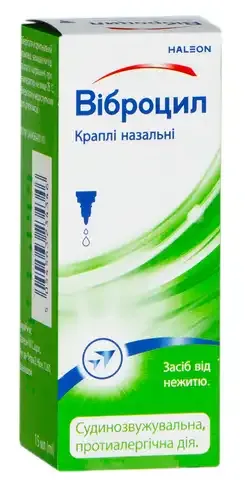
Table of Contents
INSTRUCTIONS for medical use of the medicinal product Vibrocil (Vibrocil®)
Composition:
Active substances: dimetindene maleate, phenylephrine;
1 ml of the preparation contains dimetindene maleate 0.25 mg, phenylephrine 2.5 mg;
Excipients: sorbitol (E 420), anhydrous sodium hydrogen phosphate, citric acid monohydrate, lavender oil, benzalkonium chloride, purified water.
Pharmaceutical form. Nasal drops.
Main physicochemical characteristics: clear solution, not more intensely coloured than yellow 3.
Pharmacotherapeutic group. Anti-edematous and other rhinological preparations for local use. Sympathomimetics, combinations, excluding corticosteroids.
ATC code R01AB01.
Pharmacological properties.
Vibrocil is a combination preparation containing phenylephrine and dimetindene.
Pharmacodynamics. The preparation reduces nasal secretions and promotes nasal decongestion without impairing the physiological functions of the ciliated epithelium and nasal mucosa.
Phenylephrine belongs to sympathomimetic amines. It is used as a nasal decongestant with moderate vasoconstrictor activity, selectively stimulating alpha1-adrenergic receptors of the cavernous venous tissue of the nasal mucosa. Thus, it rapidly and persistently reduces swelling of the nasal mucosa and that of the paranasal sinuses.
Dimetindene maleate, an H1-histamine receptor antagonist, exerts an antiallergic effect.
It is effective at low doses and is well tolerated.
Pharmacokinetics. Vibrocil is administered locally, therefore its activity does not correlate with the concentration of active substances in blood plasma.
Following accidental oral intake, the bioavailability of phenylephrine is reduced, amounting to approximately 38% due to first-pass metabolism in the intestine and liver; the elimination half-life is about 2.5 hours.
Systemic bioavailability of dimetindene after oral administration in solution is about 70%, with an elimination half-life of approximately 6 hours.
Clinical characteristics.
Indications.
In adults and children aged 2 years and older:
symptomatic treatment of common cold, nasal congestion, acute and chronic rhinitis, seasonal (hay fever) and non-seasonal allergic rhinitis, acute and chronic sinusitis, vasomotor rhinitis. Adjunctive therapy in acute otitis media.
Preparation for nasal surgery and reduction of mucosal edema in the nasal cavity and paranasal sinuses following surgical intervention.
Contraindications.
Hypersensitivity to phenylephrine, dexmedetomidine malate, or any of the excipients.
Due to the presence of phenylephrine, the drug, like other vasoconstrictive agents, is contraindicated in atrophic rhinitis (including ozena), angle-closure glaucoma, and in patients receiving monoamine oxidase inhibitors (MAOIs) or who have received them within the previous 14 days.
Interaction with other medicinal products and other forms of interaction.
Concomitant use of the drug with monoamine oxidase inhibitors (MAOIs) and within 14 days after discontinuation of MAOIs is contraindicated.
Vasoconstrictors should be used with caution in combination with tricyclic and tetracyclic antidepressants and antihypertensive agents, such as β-adrenoblockers, since their concomitant use may potentiate the pressor effect of phenylephrine. Phenylephrine may reduce the effectiveness of beta-blockers and antihypertensive drugs.
Special precautions for use
Vibrocil, like other sympathomimetics, should be used with caution in patients who show a pronounced response to adrenergic agents, manifested by such symptoms as insomnia, dizziness, tremor, cardiac arrhythmias, or increased arterial pressure.
Vibrocil should not be used continuously for more than 3 days. If symptoms persist for longer than 3 days or worsen, medical advice should be sought. Prolonged or excessive use of the drug may lead to tachyphylaxis and rebound effect (drug-induced rhinitis).
As with other vasoconstrictive agents, the recommended dose of the drug should not be exceeded. Excessive use of the drug, especially in children and elderly patients, may result in systemic effects of the drug.
The drug should be prescribed with caution to patients with cardiovascular disorders, arterial hypertension, hyperthyroidism, diabetes mellitus, or bladder neck obstruction (e.g. prostate hyperplasia).
Due to the presence of the H1-antihistamine dimetindene maleate, Vibrocil should be used with caution in patients with epilepsy.
The product contains benzalkonium chloride, which may cause irritation of the nasal mucosa.
Use during pregnancy or breast-feeding
Studies on the use of phenylephrine and dimetindene maleate during pregnancy or breast-feeding have not been conducted. Due to the potential systemic vasoconstrictive effect of phenylephrine, the use of the drug during pregnancy is not recommended. If use is necessary, the lowest effective dose for the shortest possible duration should be administered.
Use of the drug during breast-feeding should be avoided unless the benefit to the mother outweighs the potential risk to the infant. Phenylephrine and dimetindene maleate may be excreted in breast milk.
Fertility
There are no adequate data on the effects of phenylephrine and dimetindene maleate on human fertility.
Ability to affect reaction speed when driving or operating machinery
This medicinal product has no or negligible effect on the ability to drive or operate machinery.
Method of Administration and Dosage
Before administering the medication, the nose should be thoroughly cleared. The patient should tilt the head backward while sitting or standing, or to the side if lying in bed. After instillation of the drops, it is advisable to keep the head tilted for several minutes to allow the medication to spread throughout the nasal cavity.
The dropper cap should be washed and dried before screwing it back onto the bottle.
To avoid possible spread of infection, the bottle with drops should be used by only one person.
Children aged 2 to 6 years
1–2 drops into each nostril 3–4 times daily.
Children aged 6 years and older, and adults
3–4 drops into each nostril 3–4 times daily.
Use in children aged 2 to 12 years should be under adult supervision. If there is no improvement after 3 days of treatment or if symptoms worsen, consult a physician. Use the lowest effective dose for the shortest duration possible. Do not exceed the recommended dose or frequency of administration. Be careful—do not apply in the eyes.
Children.
Vibrocil nasal drops are not recommended for use in children under 2 years of age.
Overdose.
Overdose of Vibrocil may cause sympathomimetic and anticholinergic effects such as increased heart rate, premature ventricular contractions, occipital headache, tremor or shaking, mild tachycardia, elevated blood pressure, mydriasis, numbness, excitation, hallucinations, seizures, insomnia, and pallor. Overdose may also lead to moderate sedation, increased fatigue, coma, stomach pain, nausea, and vomiting.
No serious adverse effects have been reported following accidental use of Vibrocil. Accidental ingestion of up to 20 mg of dimetindene has not resulted in severe symptoms.
Treatment: administration of activated charcoal; possibly laxatives in younger children (gastric lavage is not required); adults and older children should drink large amounts of fluids.
Phenylephrine-induced arterial hypertension unresponsive to benzodiazepines can be managed with an alpha-adrenergic blocker. Central anticholinergic symptoms may be treated with physostigmine. Consultation with a physician regarding antidote use is advisable. Since data on ingestion of dimetindene doses exceeding 20 mg are lacking, medical supervision is recommended for patients with significant overdose, and a single dose of activated charcoal may be administered as directed by a physician. Severe agitation and seizures should be treated with benzodiazepines.
Side effects
The product is generally well tolerated. The adverse reactions listed below are categorized by frequency as follows: very common (≥ 1/10), common (≥ 1/100 to < 1/10), uncommon (≥ 1/1000 to < 1/100), rare (≥ 1/10000 to < 1/1000), very rare (< 1/10000), frequency not known (cannot be estimated from available data).
Disorders of the respiratory system, thoracic organs and mediastinum: rare – discomfort in the nasal cavity, nasal dryness, epistaxis.
General disorders and administration site reactions: rare – burning sensation at the site of application; very rare – general weakness, development of allergic reactions (including local skin reactions, body pruritus, eyelid swelling, facial swelling).
Shelf life. 3 years.
Storage conditions.
Store in the original packaging, protected from light and heat, at a temperature not exceeding 25 °C. Keep out of reach of children.
Packaging. 15 ml of drops in a bottle with a dropper cap; 1 bottle per cardboard box.
Availability. Over-the-counter.
Manufacturer.
Haleon CH S.a.r.l. / Haleon CH S.a.r.l.
Manufacturer's address and location of business activity.
Route de l’Etraz 2, Nyon, 1260, Switzerland / Route de l’Etraz 2, Nyon, 1260, Switzerland.