Vessel due f
Ukraine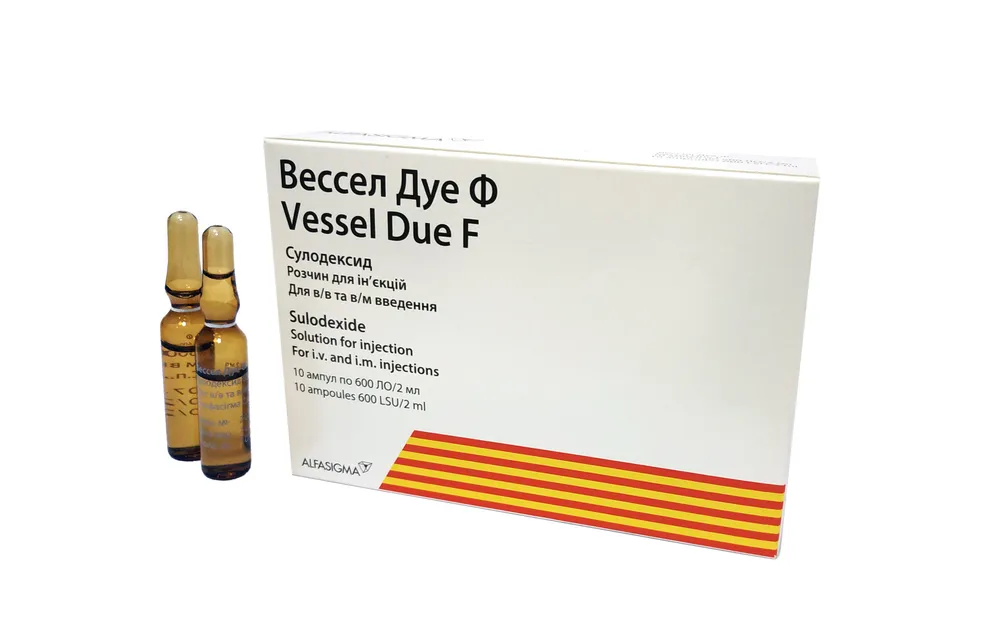
Table of Contents
INSTRUCTIONS for medical use of the medicinal product VESSEL DUE F (VESSELDUEF)
Composition:
Active substance: sulodexide;
1 ampoule (2 ml of solution) contains 600 LU (lipoprotein lipase units) of sulodexide;
Excipients: sodium chloride, water for injections.
Pharmaceutical form. Solution for injection.
Main physico-chemical properties: clear yellow-colored solution, contained in ampoules made of dark glass.
Pharmacotherapeutic group. Antithrombotic agents. Sulodexide. ATC code B01AB11.
Pharmacological Properties.
Pharmacodynamics.
Vessel Due F is a sulodexide preparation, a natural mixture of glycosaminoglycans isolated from the intestinal mucosa of pigs. Sulodexide consists of a heparin-like fraction with a molecular weight of approximately 8,000 Da (80%) and dermatan sulfate (20%).
Sulodexide possesses antithrombotic, anticoagulant, profibrinolytic, and angioprotective properties.
The anticoagulant effect of sulodexide is due to its affinity for heparin cofactor II, which inhibits thrombin.
The antithrombotic effect of sulodexide is mediated through inhibition of factor Xa activity, stimulation of synthesis and secretion of prostacyclin (PGI2), and reduction of plasma fibrinogen levels.
The profibrinolytic effect is due to increased activity of tissue plasminogen activator and decreased activity of its inhibitor.
The angioprotective effect is associated with restoration of the structural and functional integrity of endothelial cells and normalization of the density of the negative charge of vascular basement membranes.
In addition, sulodexide normalizes the rheological properties of blood by reducing triglyceride levels (due to activation of lipoprotein lipase—the enzyme responsible for triglyceride hydrolysis).
The efficacy of the drug in diabetic nephropathy is attributed to sulodexide's ability to reduce basement membrane thickness and extracellular matrix production by inhibiting mesangial cell proliferation.
Pharmacokinetics.
Sulodexide is absorbed in the small intestine. Approximately 90% of the administered dose accumulates in the vascular endothelium, where its concentrations are 20–30 times higher than in tissues of other organs. Sulodexide is primarily metabolized in the liver and mainly excreted by the kidneys. Unlike unfractionated and low-molecular-weight heparins, desulfation—which would lead to reduced antithrombotic activity and significantly accelerated elimination—does not occur with sulodexide. Distribution studies have shown that sulodexide is eliminated by the kidneys with a half-life of approximately 4 hours.
Clinical characteristics.
Indications.
- Angiopathies with increased risk of thrombosis, including thrombosis following acute myocardial infarction;
- cerebrovascular diseases: stroke (acute ischemic stroke and the early rehabilitation period after stroke);
- dyscirculatory encephalopathy caused by atherosclerosis, diabetes mellitus, arterial hypertension, and vascular dementia;
- occlusive diseases of peripheral arteries of both atherosclerotic and diabetic origin;
- phlebopathies and deep vein thrombosis;
- microangiopathies (nephropathy, retinopathy, neuropathy) and macroangiopathies (diabetic foot syndrome, encephalopathy, cardiopathy) associated with diabetes mellitus;
- thrombophilia, antiphospholipid syndrome;
- heparin-induced thrombocytopenia.
Contraindications.
- Hypersensitivity to the active substance, heparin and heparin-like substances, or to any of the other components of the drug;
- hemorrhagic diathesis and diseases associated with impaired blood coagulation.
Interaction with other medicinal products and other forms of interactions.
Since sulodexide is a heparin-like molecule, when used concomitantly it may enhance the anticoagulant effect of heparin and oral anticoagulants. No other clinically significant interactions of the drug with medicinal products have been identified.
Special precautions for use.
During the course of treatment with the drug, hemocoagulation parameters should be monitored periodically (coagulogram testing). At the beginning and after completion of therapy, the following laboratory parameters should be determined: activated partial thromboplastin time, bleeding time/clotting time, and antithrombin III levels. During administration of the drug, activated partial thromboplastin time increases approximately 1.5-fold.
Use during pregnancy or breastfeeding.
Since there is no experience with the use of the drug during the first trimester of pregnancy, administration to pregnant women during this period should be avoided, except in cases where, in the opinion of the physician, the expected benefit to the mother outweighs the potential risk to the fetus.
There is limited experience with the use of sulodexide during the second and third trimesters of pregnancy for the treatment of vascular complications caused by type I and type II diabetes and late toxemia. In such cases, sulodexide was administered intramuscularly at a dose of 600 LU daily for 10 days, followed by oral administration of the drug, 1 capsule twice daily (500 LU/day), for 15–30 days. In cases of toxemia, this treatment regimen may also be combined with conventional treatment methods.
During the second and third trimesters of pregnancy, the drug should be used with caution and under strict medical supervision.
It is currently unknown whether sulodexide or its metabolites pass into human breast milk. Therefore, as a precautionary measure, the drug is not recommended for administration to women during breastfeeding.
Animal studies have not shown any direct or indirect harmful effects of sulodexide on male or female fertility.
Ability to influence reaction speed when driving vehicles or operating machinery.
In general, the drug has no or negligible effect on the ability to drive vehicles or operate machinery. If loss of consciousness occurs during treatment with the drug, patients should refrain from driving vehicles and operating machinery.
Method of Administration and Dosage
General Instructions
The commonly used treatment regimens involve parenteral administration of the drug followed by oral intake of capsules; in some cases, sulodexide treatment may be initiated directly with capsules. The treatment regimen and dosage may be adjusted at the physician’s discretion based on clinical evaluation and laboratory test results.
Capsules are generally recommended to be taken between meals. If the daily dose is divided into multiple administrations, a 12-hour interval between doses should be maintained.
Overall, a full course of treatment should be repeated at least twice a year.
Angiopathies with Increased Thrombosis Risk, including Post-Myocardial Infarction Thrombosis
During the first month, intramuscular injections of 600 LO sulodexide (content of 1 vial) are administered daily. This is followed by continuation of treatment with oral administration of 1–2 capsules twice daily (500–1000 LO/day). Optimal results are achieved when treatment is initiated within the first 10 days after an acute myocardial infarction episode.
Cerebrovascular Disorders: Stroke (Acute Ischemic Stroke and Early Rehabilitation Period After Stroke)
Treatment is initiated with daily intramuscular injections of 600 LO sulodexide or intravenous bolus or infusion, for which the content of 1 vial is dissolved in 150–200 mL of physiological saline. Infusion duration ranges from 60 minutes (rate of 25–50 drops/minute) to 120 minutes (rate of 35–65 drops/minute). The recommended treatment duration is 15–20 days. Subsequently, therapy should be continued with oral capsules, 1 capsule twice daily (500 LO/day), for 30–40 days.
Dyscirculatory Encephalopathy due to Atherosclerosis, Diabetes Mellitus, Arterial Hypertension, and Vascular Dementia
It is recommended to take 1–2 capsules twice daily (500–1000 LO/day) orally for 3–6 months. The treatment course may also begin with intramuscular administration of 600 LO sulodexide daily for 10–30 days.
Occlusive Peripheral Artery Diseases of Both Atherosclerotic and Diabetic Origin
Treatment begins with daily intramuscular administration of 600 LO sulodexide for 20–30 days. This is followed by continuation of therapy with oral administration of 1–2 capsules twice daily (500–1000 LO/day) for 2–3 months.
Phlebopathies and Deep Vein Thrombosis
Oral administration of sulodexide capsules at a dose of 500–1000 LO/day (2 or 4 capsules) is usually prescribed for 2–6 months. The treatment course may also begin with daily intramuscular administration of 600 LO sulodexide for 10–30 days.
Microangiopathies (Nephropathy, Retinopathy, Neuropathy) and Macroangiopathies (Diabetic Foot Syndrome, Encephalopathy, Cardiopathy) Associated with Diabetes Mellitus
Treatment of patients with micro- and macroangiopathies is recommended in two stages. Initially, 600 LO sulodexide is administered intramuscularly daily for 15 days. This is followed by continuation of treatment with 1–2 capsules twice daily (500–1000 LO/day). Since short-term treatment may result in partial loss of therapeutic effect, it is recommended to extend the duration of the second treatment stage to at least 4 months.
Thrombophilia, Antiphospholipid Syndrome
The standard treatment regimen involves oral administration of 500–1000 LO sulodexide daily (2 or 4 capsules) for 6–12 months. Sulodexide capsules are typically prescribed after treatment with low-molecular-weight heparin in combination with acetylsalicylic acid, without the need to modify the dosage regimen of the latter.
Heparin-Induced Thrombocytopenia
In cases of heparin-induced thrombocytopenia, administration of heparin or low-molecular-weight heparin is replaced with sulodexide infusions. For this purpose, the content of 1 vial (600 LO sulodexide) is diluted in 20 mL of 0.9% sodium chloride solution and administered as a slow infusion over 5 minutes (rate of 80 drops/minute). Subsequently, 600 LO sulodexide is diluted in 100 mL of 0.9% sodium chloride solution and administered as 60-minute intravenous infusions (rate of 35 drops/minute) every 12 hours, as long as anticoagulant therapy is required.
Children
There is limited experience with the use of sulodexide in the treatment of diabetic nephropathy and glomerulonephritis in adolescents aged 13–17 years. In such cases, 600 LO sulodexide was administered intramuscularly daily for 15 days, followed by oral administration of 1–2 capsules twice daily (500–1000 LO/day) for 2 weeks.
Data on the efficacy and safety of sulodexide in children under 12 years of age are lacking.
Overdose
Overdose of the drug may lead to hemorrhagic symptoms such as hemorrhagic diathesis or bleeding. In case of bleeding, 1% protamine sulfate solution should be administered. In general, in case of overdose, the drug should be discontinued and appropriate symptomatic therapy initiated.
Adverse Reactions
Adverse reactions identified in clinical studies and associated with the use of sulodexide are classified according to system organ classes and frequency. The following terminology is used to define the frequency of adverse reactions: very common (≥ 1/10); common (≥ 1/100 to < 1/10); uncommon (≥ 1/1000 to < 1/100); rare (≥ 1/10,000 to < 1/1000); very rare (< 1/10,000).
Central and peripheral nervous system disorders
Uncommon: headache.
Rare: loss of consciousness.
Ear and labyrinth disorders
Common: dizziness.
Gastrointestinal disorders
Common: upper abdominal pain, diarrhea, nausea.
Uncommon: abdominal discomfort, dyspepsia, flatulence, vomiting.
Rare: gastrointestinal hemorrhage.
Skin and subcutaneous tissue disorders
Common: skin rash.
Uncommon: eczema, erythema, urticaria.
General disorders and administration site conditions
Uncommon: injection site pain, injection site hematoma.
Rare: peripheral edema.
Additional adverse reactions have been reported during post-marketing use of sulodexide. The frequency of these reactions cannot be estimated reliably based on available data.
Psychiatric disorders: derealization.
Central and peripheral nervous system disorders: convulsions, tremor.
Eye disorders: visual disturbances.
Cardiac disorders: palpitations.
Vascular disorders: flushing.
Respiratory, thoracic and mediastinal disorders: hemoptysis.
Skin and subcutaneous tissue disorders: pruritus, purpura, generalized erythema.
Renal and urinary disorders: bladder neck stenosis, dysuria.
General disorders and administration site conditions: chest pain, pain, burning sensation at injection site.
Shelf life. 5 years.
Do not use after the expiry date stated on the packaging.
Storage conditions.
Store at a temperature not exceeding 30 °C.
Keep out of reach and sight of children.
Incompatibilities.
Since sulodexide is a polysaccharide with weakly acidic properties, when administered as an extemporaneous combination it may form complexes with other substances having basic properties. The following substances, commonly used in extemporaneous combined injections, are incompatible with sulodexide: vitamin K, vitamin B complex, hyaluronidase, hydrocortisone, calcium gluconate, quaternary ammonium salts, chloramphenicol, tetracycline, and streptomycin.
Packaging.
2 ml (600 IU) of solution for injection in ampoules made of amber glass; 5 ampoules in a blister pack; 2 blister packs in a cardboard box.
Prescription category. Prescription only.
Manufacturer. Alfasigma S.p.A.
Manufacturer's address.
Via Enrico Fermi 1, 65020 Alanno (Pescara), Italy.