Venorutinol
Ukraine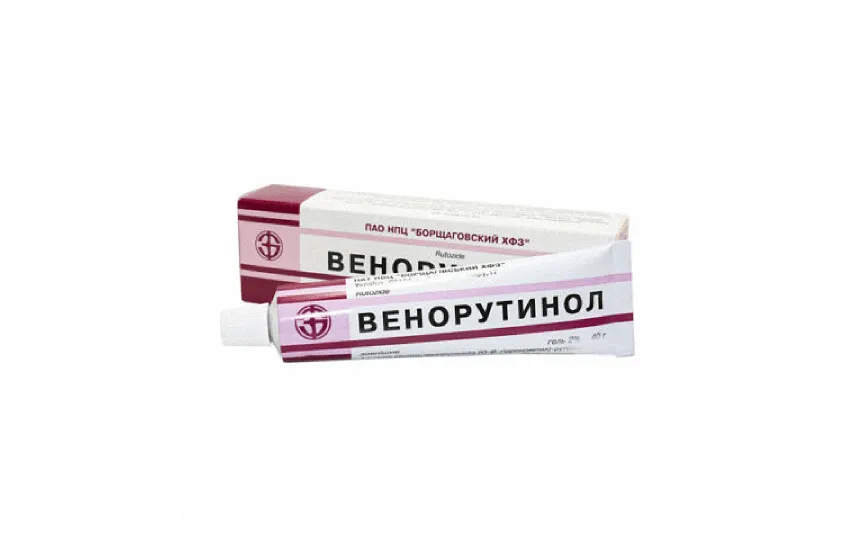
Table of Contents
INSTRUCTIONS for medical use of the medicinal product VENORUTINOL (VENORUTINOL)
Composition:
Active substance: 1 g of gel contains 20 mg of venorutinol (O-(β-hydroxyethyl)-rutosides), calculated as rutin and dry substance;
Excipients: ethanol (96 %), glycerol, disodium edetate, carbomer (carbopol 980 NF), sodium hydroxide, purified water.
Pharmaceutical form. Gel.
Main physicochemical characteristics: yellow gel of homogeneous consistency with a weak specific odor.
Pharmacotherapeutic group. Angioprotectors. Capillary-stabilizing agents. Bioflavonoids. ATC code C05CA01.
Pharmacological properties.
Pharmacodynamics.
Venorutinol is a drug with P-vitamin activity and pronounced angioprotective properties. It reduces capillary permeability and fragility, strengthens the walls of veins and capillaries, and increases the tone of smooth muscles of venous blood vessels. It exhibits anti-edematous, anti-inflammatory, and analgesic effects.
Pharmacokinetics.
Not studied.
Clinical characteristics.
Indications.
- Pain and swelling of the limbs due to chronic venous insufficiency (including after sclerosing therapy);
- pain and swelling of traumatic origin (including sports injuries), for example, ligament injuries, muscle strains, or contusions.
Contraindications.
Hypersensitivity to the active substance or to any of the excipients of the drug.
Interaction with other medicinal products and other forms of interaction.
Enhances the effect of ascorbic acid on the structure and permeability of the vascular wall.
If the patient is taking any other medicinal products, it is essential to inform the physician about it.
Special precautions for use.
Consult a doctor before starting treatment!
Do not apply to wounded skin surfaces, areas with eczema, and ensure that the product does not enter the eyes or mucous membranes. Application under occlusive dressing is permitted. After applying the gel, avoid exposure of the treated skin areas to sunlight.
Patients with chronic venous insufficiency are recommended to use the product both at early and late stages of the disease (reduction in leg heaviness, lower limb edema, and improvement in trophic conditions).
Prolonged use of the product is not recommended in patients with severe renal function impairment.
If symptoms of the disease do not begin to subside, or conversely, if the patient's condition worsens, or adverse reactions occur, discontinue use of the product and consult a doctor for further advice.
Use during pregnancy or breastfeeding.
The use of the product during pregnancy is possible only when, in the opinion of the physician, the expected benefit to the mother outweighs the potential risk to the fetus.
A negligible amount of the active substance passes into breast milk and has no clinical significance for the infant; therefore, use of the product by nursing mothers during breastfeeding is not contraindicated.
Ability to affect reaction rate when driving vehicles or operating machinery.
Does not affect reaction speed when driving vehicles or operating machinery.
Method of Administration and Dosage
The product is intended for topical use. Apply a thin layer of the gel in the morning and evening to affected areas using gentle massaging motions until completely absorbed into the skin. If necessary, the gel may be applied under an occlusive dressing.
In chronic venous insufficiency, combination therapy with Venorutinol capsules is recommended.
The duration of treatment is determined by the physician depending on the severity and course of the disease.
Children
The product is not intended for use in children.
Overdose
Cases of overdose with Venorutinol are unknown.
Treatment
In case of accidental ingestion of a large amount of gel, induce vomiting and seek medical advice immediately. If indicated, perform peritoneal dialysis. Symptomatic therapy should be administered.
Side effects.
In individual cases, local hypersensitivity reactions are possible: hyperemia, skin irritation, itching, rash, including urticaria, angioedema, dermatitis, eczema. Usually these symptoms resolve spontaneously after discontinuation of the drug.
In case of any adverse reactions, it is mandatory to consult a physician regarding further use of the drug.
Shelf life. 4 years.
Do not use the medication after the expiry date stated on the packaging.
Storage conditions. In the original packaging at a temperature not exceeding 25 °C; do not freeze.
Keep out of reach of children.
Packaging. 40 g in a tube and a carton.
Dispensing category. Over-the-counter.
Manufacturer.
Public Joint-Stock Company "Scientific and Production Center "Borshchahivskyy Chemical and Pharmaceutical Plant".
Manufacturer's address and place of business.
17 Myru Street, Kyiv, 03134, Ukraine.