Vazoket
Ukraine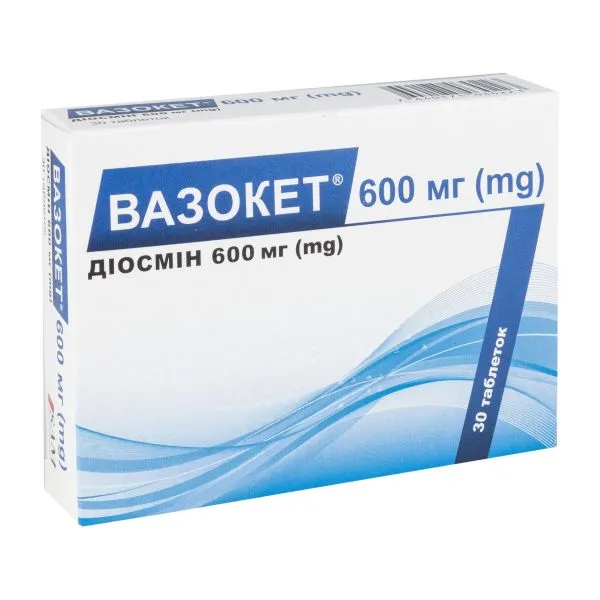
Table of Contents
INSTRUCTIONS FOR MEDICAL USE OF THE MEDICINAL PRODUCT VASOKET® (VASOKET®)
Composition:
Active ingredient: diosmine;
One tablet contains 600 mg of diosmin;
Excipients: povidone, microcrystalline cellulose, corn starch, magnesium stearate.
Pharmaceutical form. Tablets.
Main physico-chemical properties: elongated tablets, greyish-yellow or light yellow in color, with a score line on both sides.
Pharmacotherapeutic group. ATC code. Capillary stabilizing agents. Bioflavonoids.
ATC code C05CA03.
Pharmacological properties.
Pharmacodynamics.
Diosmin increases venous wall tone, normalizes vascular permeability, and exerts an angioprotective effect on the vascular wall.
Effect of diosmin on venous wall tone: enhancement of the vasoconstrictive action of adrenaline, noradrenaline, and serotonin in superficial hand veins and in isolated great saphenous vein; increased venous wall tone measured by tonometric plethysmography and reduction of venous stasis; dose-dependent constrictive (narrowing) effect on veins; reduction of mean venous pressure in both superficial and deep vessels (confirmed by Doppler measurement in a double-blind, placebo-controlled study); elevation of systolic and diastolic arterial pressure in patients with postoperative orthostatic hypotension; prevention of complications following saphenous vein removal.
Protective effect of diosmin on the vascular wall: increased capillary resistance proportional to the administered dose.
Pharmacokinetics.
After oral administration, the drug is rapidly absorbed from the gastrointestinal tract and detectable in blood plasma within 2 hours.
Maximum plasma concentration is reached 5 hours after administration. It is evenly distributed and accumulates in all layers of the wall of empty and subcutaneous veins of the lower limbs, to a lesser extent – in the kidneys, liver, lungs, and other organs. Selective accumulation of diosmin and/or its metabolites in venous vessels reaches its peak 9 hours after administration and persists for up to 96 hours. Diosmin is excreted in urine (79%), feces (11%), and bile (2.4%). Unchanged diosmin, diosmetin, and other metabolites containing radioactive C14 have been detected in feces, indicating a complex mechanism of absorption and elimination of the drug in the gastrointestinal tract (hepato-enteric circulation of diosmin and its metabolites).
Clinical characteristics.
Indications.
- For relief of symptoms caused by lymphovenous insufficiency, such as heaviness in the lower limbs, pain, trophic disorders;
- in complex treatment of hemorrhoid exacerbation;
- as an additional treatment method for increased capillary fragility and microcirculation disorders.
Contraindications.
Hypersensitivity to the components of the drug.
Special precautions.
The drug's efficacy will be maximal if the patient adheres to a proper work and rest regimen. Prolonged standing or sitting, lifting heavy objects, wearing tight footwear, prolonged exposure to sunlight and hot environments should be avoided. Therapeutic exercises and wearing medical compression stockings promote normalization of microcirculation and enhance the drug's effectiveness.
Interaction with other medicinal products and other types of interactions.
Diosmin may enhance the vasoconstrictive effects of adrenaline and noradrenaline.
Special precautions for use.
If symptoms related to varicose enlargement of the rectal veins worsen, treatment with diosmin does not exclude the use of therapies indicated for other diseases of the rectum. Treatment should be short-term – up to 15 days. If during diosmin therapy symptoms related to varicose enlargement of the rectal veins persist or worsen, a proctological examination should be performed and appropriate treatment initiated.
Use during pregnancy or breastfeeding. In experimental studies, no teratogenic effects of diosmin on the fetus have been observed. To date, there have been no clinical reports of adverse effects associated with the use of the drug in pregnant women. However, considering that a potential negative impact cannot be completely ruled out, the drug should be used only when strictly indicated and only if the expected therapeutic benefit outweighs the possible risks. Treatment must be prescribed by a physician and should be discontinued 2–3 weeks before delivery.
Due to lack of data on the passage of the drug into breast milk, it is not prescribed to women who are breastfeeding.
Ability to influence reaction rate while driving or operating machinery. Has no effect.
Dosage and Administration
For oral use.
For chronic venous insufficiency: 1 tablet daily in the morning before breakfast. The duration of treatment is determined by the physician depending on the course of the disease. The treatment duration depends on the indications and the stage of the disease. The average duration of treatment is 2 months.
For acute hemorrhoids: 2–3 tablets daily during meals for 7 days; if necessary, treatment may continue with 1 tablet once daily for up to 1–2 months. If symptoms persist after treatment, consult a proctologist for treatment adjustment. Maximum daily dose – 1800 mg (3 tablets).
Children. Do not use.
Overdose. Symptoms of overdose are unknown. Hypersensitivity reactions are possible, requiring discontinuation of the drug and administration of desensitizing therapy.
Adverse Reactions
Gastrointestinal disorders:
Common (≥ 1/100 to < 1/10): abdominal pain;
Uncommon (≥ 1/1000 to < 1/100): bloating, diarrhea, dyspepsia, nausea;
Rare (≥ 1/10,000 to < 1/1000): vomiting.
In isolated cases, gastrointestinal disorders rarely lead to discontinuation of treatment.
To reduce the frequency of adverse reactions, the medicinal product should be taken with food.
Skin and subcutaneous tissue disorders:
Uncommon (≥ 1/1000 to < 1/100): allergic reactions such as rash, pruritus, urticaria, angioedema.
Reporting of suspected adverse reactions
Reporting suspected adverse reactions after authorization of the medicinal product is important. It allows continued monitoring of the benefit-risk balance of the use of this medicinal product. Healthcare professionals and patients, as well as their legal representatives, are encouraged to report all suspected adverse reactions and lack of efficacy via the automated pharmacovigilance information system at the following link: https://aisf.dec.gov.ua.
Shelf life. 3 years.
Storage conditions. Store at temperatures not exceeding 25 °C. Keep out of reach of children.
Packaging. 15 tablets in a blister; 2 blisters per carton.
Availability. Over-the-counter (without prescription).
Manufacturer.
Phyteo Laboratoire /
Phyteo Laboratoire
Manufacturer's address and location of operations.
11 rue de Montbazon, 37260 MONTS, France.
11 rue de Montbazon 37260 MONTS, France.