Valecard-health
Ukraine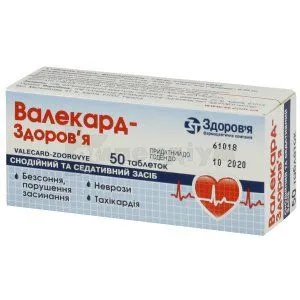
Table of Contents
INSTRUCTIONS FOR MEDICAL USE OF THE MEDICINAL PRODUCT VАLECARD-ZDOROVYE (VALECARD-ZDOROVYE)
Composition:
Active substances: phenobarbital; ethyl ether of alpha-bromoisovaleric acid; peppermint oil;
1 tablet contains: phenobarbital – 7.5 mg; ethyl ether of alpha-bromoisovaleric acid – 8.2 mg; peppermint oil – 0.58 mg;
Excipients: maize starch, lactose monohydrate, microcrystalline cellulose, β-cyclodextrin, povidone, magnesium stearate.
Pharmaceutical form. Tablets.
Main physicochemical properties: white or almost white tablets, cylindrical in shape with flat surfaces and bevelled edges. Specks are permissible.
Pharmacotherapeutic group. Hypnotics and sedatives. ATC code N05C B02.
Pharmacological properties.
Pharmacodynamics.
A sedative, vasodilating, and spasmolytic agent. Reduces excitability of the central nervous system, produces a calming effect, and facilitates the onset of natural sleep. Ethyl ether of alpha-bromoisovaleric acid, included in the formulation, exerts sedative and spasmolytic effects similar to those of valerian extract; at high doses, it also produces a mild hypnotic effect. Phenobarbital exerts sedative and moderate spasmolytic effects. Peppermint oil induces reflex vasodilation and spasmolytic effect.
Clinical characteristics.
Indications.
Neuroses with increased irritability; insomnia; as part of combination therapy for hypertension and vegetative-vascular dystonia; mild coronary vessel spasms, tachycardia; intestinal spasms caused by neurovegetative disorders (as a spasmolytic agent).
Contraindications.
Hypersensitivity to the components of the drug, severe impairment of liver and/or kidney function, hepatic porphyria, severe heart failure. Medicinal products containing phenobarbital are contraindicated in severe arterial hypotension, acute myocardial infarction, diabetes mellitus, depression, myasthenia gravis, alcoholism, drug or medication dependence, respiratory diseases with dyspnea, obstructive syndrome.
Interaction with other medicinal products and other types of interactions.
When used concomitantly with other medicinal products that depress the central nervous system, mutual enhancement of effects is possible. The effect of the drug is enhanced when used together with valproic acid preparations and alcohol. Phenobarbital induces liver enzymes and thus may accelerate the metabolism of certain drugs metabolized by liver enzymes (including indirect anticoagulants, cardiac glycosides, antimicrobial, antiviral, antifungal, antiepileptic, anticonvulsant, psychotropic, oral hypoglycemic, hormonal, immunosuppressive, cytostatic, antiarrhythmic, antihypertensive medicinal products).
Phenobarbital enhances the effect of analgesics and local anesthetics.
Monoamine oxidase inhibitors (MAOIs) prolong the effect of phenobarbital. Rifampicin may reduce the effect of phenobarbital.
When phenobarbital is used concomitantly with gold preparations, the risk of kidney damage increases.
With prolonged concomitant use of phenobarbital and nonsteroidal anti-inflammatory drugs, there is a risk of gastric ulcer formation and bleeding.
Simultaneous use of phenobarbital and zidovudine enhances the toxicity of both agents.
The drug increases the toxicity of methotrexate.
Instructions for Use
During treatment with this medication, activities requiring increased attention and rapid mental and motor reactions should be avoided.
Alcohol consumption should be avoided during the use of this medication.
The presence of phenobarbital in the drug formulation may lead to the development of Stevens-Johnson syndrome and Lyell's syndrome, most likely during the first weeks of treatment. Prolonged use is not recommended due to the risk of drug dependence, possible accumulation of bromine in the body, and bromine poisoning. If chest pain does not subside after taking the medication, medical advice must be sought to rule out acute coronary syndrome. The drug should be prescribed with caution in patients with arterial hypotension, hyperkinesia, hyperthyroidism, adrenal insufficiency, acute or persistent pain, and acute intoxication with medicinal agents.
The medication contains lactose. If a patient has known sugar intolerance, medical advice should be sought before taking this medication.
Use during pregnancy or breastfeeding.
This medication should not be administered to women during pregnancy or breastfeeding.
Effect on the ability to drive or operate machinery.
Valocard-Zdorovya may cause drowsiness and dizziness; therefore, patients are advised not to operate hazardous machinery or drive vehicles during treatment.
Dosage and Administration.
The dosage and duration of treatment are determined individually by a physician for each patient.
For adults, the usual dose is 1–2 tablets 2–3 times daily, taken before meals.
In cases of tachycardia and coronary vessel spasms, the single dose may be increased to 3 tablets.
Children.
There is no experience with the use of the drug in children; therefore, it is not used in pediatric practice.
Overdose.
Overdose is possible with frequent or prolonged use of the drug, associated with accumulation of its components. Long-term and continuous use may lead to dependence, abstinence syndrome, and psychomotor agitation.
Symptoms of overdose: respiratory depression, up to respiratory arrest; central nervous system depression, up to coma; cardiovascular depression, including rhythm disturbances, decreased arterial pressure, up to collapse-like state; nausea, weakness, decreased body temperature, reduced diuresis.
Treatment: symptomatic.
Adverse reactions.
The medicinal product is generally well tolerated.
In individual cases, the following adverse effects may occur:
Gastrointestinal system: constipation, feeling of heaviness in the epigastric region, with prolonged use – liver function disturbances, nausea, vomiting;
Nervous system: weakness, ataxia, impaired motor coordination, nystagmus, hallucinations, paradoxical excitation, decreased attention span, fatigue, slowed reaction time, headache, cognitive disorders, confusion, drowsiness, mild dizziness;
Hematopoietic system: anemia, thrombocytopenia, agranulocytosis;
Cardiovascular system: arterial hypotension, bradycardia;
Immune system: hypersensitivity reactions, including angioedema, allergic reactions (e.g. skin rash, pruritus, urticaria);
Skin and mucous membranes: Stevens-Johnson syndrome, toxic epidermal necrolysis;
Musculoskeletal system: with prolonged use of preparations containing phenobarbital, there is a risk of impaired osteogenesis;
Other: difficulty in breathing.
Prolonged use of preparations containing bromide may lead to bromism, characterized by the following symptoms: central nervous system depression, depressive mood, confusion, ataxia, apathy, conjunctivitis, rhinitis, lacrimation, acne or purpura.
These symptoms resolve upon dose reduction or discontinuation of the drug.
Shelf life. 2 years.
Storage conditions. Store in the original packaging at a temperature not exceeding 25 °C.
Keep out of reach of children.
Packaging. Tablets № 10 (10×1), № 50 (10×5) in blisters in a box.
Supply category. Over-the-counter.
Manufacturer. Limited Liability Company "Kharkiv Pharmaceutical Enterprise "Zdorov'ya Narodu"".
Manufacturer's address. 41 Melnykova Street, Kharkiv, Kharkiv Oblast, 61002, Ukraine.
Marketing Authorization Holder. Limited Liability Company "Pharmaceutical Company "Zdorov'ya"".
Marketing Authorization Holder's address. 22 Shevchenka Street, Kharkiv, Kharkiv Oblast, 61013, Ukraine.