Urosept
Ukraine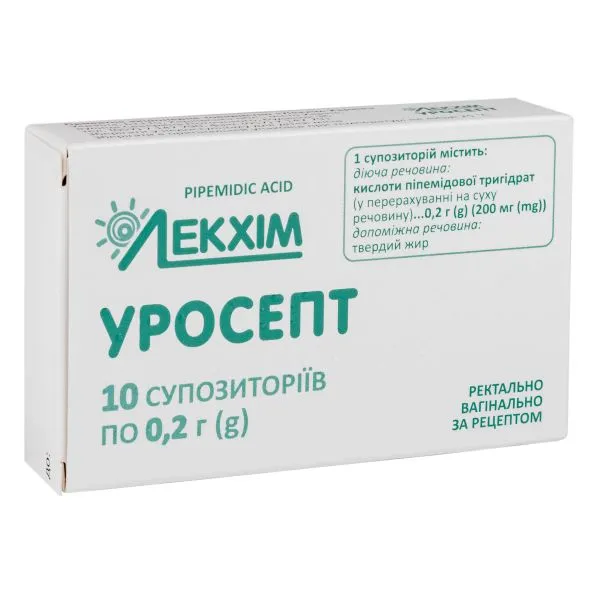
Table of Contents
INSTRUCTIONS for medical use of the medicinal product Urosept (Urosept)
Composition:
Active substance: pipemidic acid;
1 suppository contains 0.2 g (200 mg) of pipemidic acid trihydrate, calculated as anhydrous substance;
Excipient: hard fat.
Dosage form. Suppositories.
Main physicochemical characteristics: suppositories are white or white with a yellowish tinge, bullet-shaped. A surface film on the suppositories is permissible.
Pharmacotherapeutic group. Antibacterial agents of the quinolone group.
ATC code J01M B04.
Pharmacological properties.
Pharmacodynamics.
A urinary antiseptic of the quinolone group. Acts bactericidally, active against most Gram-negative microorganisms, as well as against some Gram-positive microorganisms, in particular Staphylococcus aureus.
Pharmacokinetics.
Maximum drug concentration in blood plasma is reached within 2–3 hours after administration and coincides in time with the maximum drug concentration in urine. Excreted unchanged by the kidneys.
Clinical characteristics.
Indications.
Infectious and inflammatory diseases caused by microorganisms sensitive to pipemidic acid, including pyelonephritis, urethritis, cystitis, prostatitis, nonspecific colpitis.
Contraindications.
Hypersensitivity to pipemidic acid, quinolones, or to any other component of the drug. Severe renal impairment (creatinine clearance less than 10 ml/min), severe hepatic dysfunction. Liver cirrhosis, porphyria. Central nervous system disorders (epilepsy, neurological conditions with reduced seizure threshold).
Interaction with other medicinal products and other types of interactions.
With prolonged use of pipemidic acid, the elimination half-life of theophylline is prolonged, thus increasing its serum concentration by 40–80%. Therefore, in patients receiving theophylline, serum levels should be monitored more frequently.
Quinolones increase serum caffeine concentrations; pipemidic acid may produce an increase factor of 2 to 4.
The drug may enhance the effect of warfarin, rifampicin, and cimetidine when used concomitantly.
Concomitant use of quinolones and nonsteroidal anti-inflammatory drugs increases the risk of seizures.
Antacids (aluminum, magnesium, and calcium-containing preparations) and sucralfate significantly reduce the absorption of pipemidic acid; therefore, they should not be administered simultaneously. The interval between administration of these agents should be 2–3 hours. However, this effect has not been observed with concomitant use of cimetidine and ranitidine.
A synergistic bactericidal effect occurs with aminoglycosides.
Special precautions for use.
During treatment, patients should drink plenty of fluids.
In isolated cases, Urosept may cause seizures; therefore, treatment is contraindicated in patients with epilepsy and other neurological disorders associated with a lowered seizure threshold.
Due to the risk of provoking an acute porphyria attack, treatment is contraindicated in patients with porphyria.
The drug should be prescribed with caution in patients aged 70 years and older, as adverse effects are observed more frequently in elderly individuals.
Patients should be warned about the necessity to avoid direct sunlight and artificial ultraviolet irradiation during pipemidic acid therapy due to possible photosensitization.
Superinfections caused by resistant bacteria and fungi may develop.
The drug should be used with caution in patients with glucose-6-phosphate dehydrogenase deficiency, as quinolones may trigger an acute hemolytic crisis.
With prolonged pipemidic acid therapy, pseudomembranous colitis may develop; therefore, appropriate measures should be taken if diarrhea occurs in the patient.
Pipemidic acid treatment may alter intestinal flora, resulting in increased numbers of Clostridium difficile bacteria, and consequently, pseudomembranous colitis may develop.
In adolescents, drug intake may affect temporary cartilage tissue; therefore, the use of pipemidic acid is contraindicated in children under 18 years of age.
Allergic reactions occur most frequently in individuals with hypersensitivity to acetylsalicylic acid.
Laboratory tests. A false-positive reaction for glucose in urine may occur.
Use during pregnancy or breastfeeding.
The drug is contraindicated during pregnancy and breastfeeding.
Ability to influence reaction rate when driving or operating machinery.
When using this drug, patients should refrain from driving or operating machinery, as dizziness and visual disturbances may occur (see section "Adverse reactions").
Method of Administration and Dosage
Before using the suppository, it is necessary to:
- Detach 1 suppository in its primary packaging along the perforation line of the blister pack;
- Then pull the edges of the film in opposite directions to tear it apart and remove the suppository from its primary packaging.
Administer 1 suppository vaginally or rectally twice daily for 10 days. If necessary, the daily dose may be increased to 3 suppositories, i.e., 1 suppository three times daily.
Children
The drug should not be used for the treatment of children.
Overdose
Symptoms: nausea, vomiting, dizziness, headache, confusion, tremor, and seizures.
Treatment: If the patient remains conscious after ingestion of a large amount of the drug, induce vomiting, perform gastric lavage, and administer activated charcoal.
Pipemidic acid is removed by hemodialysis (90% within 6 hours).
In case of adverse effects involving the central nervous system (including epileptiform seizures), symptomatic treatment (e.g., diazepam) should be administered.
Adverse Reactions
Local reactions: irritation, pain, itching at the injection site.
Systemic reactions:
Blood and lymphatic system disorders: eosinophilia may rarely occur; reversible thrombocytopenia has been observed in elderly patients and patients with renal function impairment. Hemolytic anemia may occur in individuals with glucose-6-phosphate dehydrogenase deficiency.
Psychiatric disorders: agitation, depression, confusion, hallucinations.
Nervous system disorders: tremor, sleep disturbances, sensory disturbances, dizziness; very rarely – seizures, vertigo, headache.
Eye disorders: visual disturbances.
Skin and subcutaneous tissue disorders: hypersensitivity reactions including skin rash, itching, photosensitization, Stevens-Johnson syndrome; angioneurotic edema – rarely. Skin reactions are reversible. There have been reports of anaphylactic reactions. Due to the possibility of cross-sensitivity to other quinolones, caution is required when treating patients who have had an anaphylactic reaction to any quinolone.
Musculoskeletal system disorders: acute arthropathy, tendinitis.
Gastrointestinal disorders: anorexia, epigastric pain, heartburn, nausea, vomiting, flatulence, abdominal pain, diarrhea or constipation; pseudomembranous colitis – rarely.
Other: rarely – weakness, development of resistance, superinfection.
If signs of hypersensitivity reactions, anaphylactic shock, toxic epidermal necrolysis, or seizures occur, treatment should be discontinued immediately.
Shelf life.
3 years.
Storage conditions.
Keep out of reach of children. Store in the original packaging at a temperature not exceeding 25 °C.
Packaging. 5 suppositories per blister; 2 blisters per pack.
Prescription status.
Prescription only.
Manufacturer.
Private Joint-Stock Company "Lekhym-Kharkiv".
Manufacturer's address and location of business activity.
36 Severina Pototskoho Street, Kharkiv, Kharkiv Oblast, 61115, Ukraine.