Urorec
Ukraine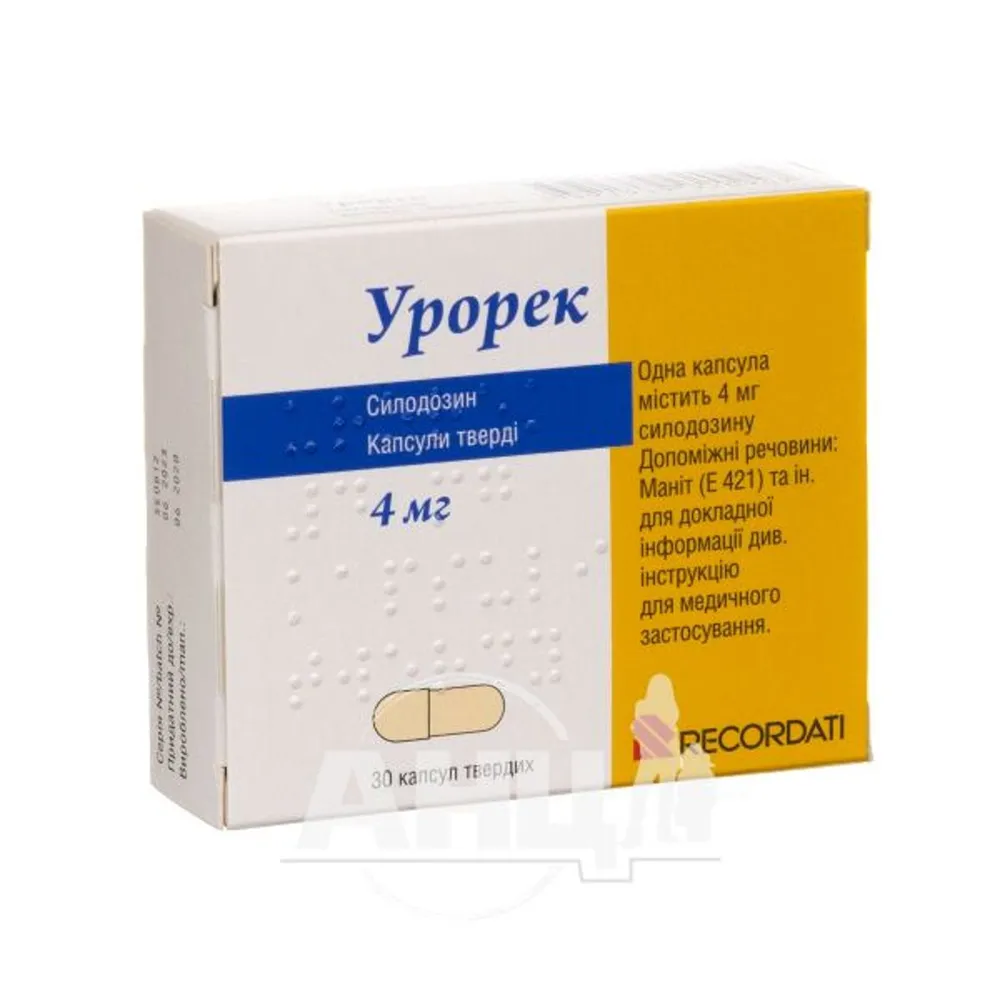
Table of Contents
INSTRUCTIONS FOR MEDICAL USE OF THE MEDICINAL PRODUCT UROREC® (UROREC®)
Composition:
Active substance: 1 capsule contains 4 mg or 8 mg of silodosin;
Excipients: mannitol (E 421), pregelatinized corn starch, purified water, sodium lauryl sulfate, magnesium stearate, gelatin, titanium dioxide (E 171); for the 4 mg dosage: iron oxide yellow (E 172).
Pharmaceutical form. Hard capsules.
Main physicochemical properties:
Hard capsules containing 4 mg silodosin,
Hard capsules containing 8 mg silodosin.
Pharmacotherapeutic group. α-Adrenoreceptor antagonists. Silodosin.
ATC code G04CA04.
Pharmacological Properties.
Pharmacodynamics.
Silodosin is a highly selective agent, an antagonist of α1A-adrenoceptors, which are predominantly located in the prostate gland, bladder neck, urethra, prostate capsule, and prostatic urethra. Blockade of these α1A-adrenoceptors leads to relaxation of smooth muscle in these areas, thereby increasing urinary flow rate without affecting contractility of the detrusor smooth muscle. As a result, symptoms of irritation and obstruction caused by benign prostatic hyperplasia (BPH) are alleviated.
Silodosin has significantly lower affinity for α1B-adrenoceptors, which are primarily located in cardiovascular tissues.
In vitro studies have shown that the binding affinity of silodosin for α1A- and α1B-adrenoceptors is in a ratio of 162:1.
It is well established that improvement in symptom scores according to the American Urological Association (AUA) scale is achieved with silodosin at doses of 4 mg or 8 mg, significantly better than with placebo. Clinical studies conducted in the United States and Europe using silodosin 8 mg once daily demonstrated a significant reduction in both storage (irritative) and voiding (obstructive) symptoms of BPH compared to placebo, as assessed by the International Prostate Symptom Score (IPSS) after 12 weeks of treatment. In European clinical trials, silodosin 8 mg once daily was found to be at least as effective as tamsulosin 0.4 mg once daily. The rate of positive response to treatment—defined as improvement in total IPSS score—was significantly higher in both the silodosin and tamsulosin groups compared to placebo.
In the long-term open-label extension phase of these clinical trials, during which patients received silodosin for up to 1 year, symptom improvement observed at week 12 of treatment was maintained for over 1 year.
In a Phase IV clinical study conducted in Europe according to the International Prostate Symptom Score, treatment response was observed in 77.1% of patients. Approximately half of the patients with the most bothersome symptoms—namely nocturia, increased urinary frequency, weak stream, urgency, post-micturition dribbling, and incomplete bladder emptying—reported symptom improvement, as assessed by the International Continence Society (ICS) male questionnaire.
In all clinical studies conducted with silodosin, no clinically significant reduction in arterial blood pressure was observed in patients in the supine position.
Silodosin at doses of 8 mg and 24 mg daily, compared to placebo, had no statistically significant effect on ECG intervals or cardiac repolarization.
Pharmacokinetics.
The pharmacokinetic characteristics of silodosin and its major metabolites were evaluated in adult male patients, either healthy or with BPH, after single and/or multiple doses ranging from 0.1 mg to 48 mg daily. Within this dose range, the pharmacokinetic characteristics of silodosin change linearly.
Exposure to the main metabolite, silodosin glucuronide (KMD-3213G), in plasma at steady state is 3 times higher than that of the parent drug. Silodosin and its glucuronide reach steady state after 3 days and 5 days of treatment, respectively.
Absorption.
Silodosin is well absorbed after oral administration, with absorption proportional to the administered dose. The absolute bioavailability of the drug is approximately 32%.
In vitro studies using Caco-2 cells have shown that silodosin is a substrate of P-glycoprotein.
When the drug is taken with food, Cmax decreases by approximately 30%, tmax increases by about 1 hour, while no change in AUC is observed. After oral administration of 8 mg once daily immediately after breakfast for 7 days, the following pharmacokinetic parameters were determined: Cmax – 87 ± 51 ng/mL (CV), tmax – 2.5 hours (range 1.0–3.0), AUC – 433 ± 286 ng·hr/mL.
Distribution.
The volume of distribution of silodosin is 0.81 L/kg. Silodosin is 96.6% bound to plasma proteins. It does not distribute into blood cells.
Protein binding of silodosin glucuronide is 91%.
Metabolism.
Silodosin is metabolized primarily via glucuronidation (UGT2B7), alcohol and aldehyde dehydrogenase, and oxidation, mainly by CYP3A4. The major metabolite in plasma is the glucuronide conjugate of silodosin (KMD-3213G), whose activity has been confirmed in vitro. This metabolite has a longer elimination half-life (approximately 24 hours), and its plasma concentration is about 4 times higher than that of silodosin itself. In vitro data indicate that silodosin does not exert inhibitory or inducing effects on cytochrome P450 isoenzymes.
Excretion.
After oral administration of silodosin, approximately 33.5% is excreted in urine and 54.9% in feces over 7 days. The total clearance of silodosin is approximately 0.28 L/hr/kg. Silodosin is excreted predominantly as metabolites, with only a negligible fraction excreted unchanged in urine. The terminal elimination half-life of unchanged silodosin and its glucuronides is approximately 11 hours and 18 hours, respectively.
Pharmacokinetics in Special Patient Populations.
Elderly Patients.
The pharmacokinetic characteristics of silodosin and its major metabolites are independent of patient age. Total clearance of silodosin remains unchanged even in patients over 75 years of age.
Children.
The use of silodosin has not been evaluated in patients under 18 years of age.
Hepatic Impairment.
The pharmacokinetic characteristics of silodosin are similar in patients with moderate hepatic impairment (Child-Pugh score 7–9) and in healthy volunteers. These results should be interpreted with caution, as patients had normal biochemical parameters indicating normal metabolic function, and were classified as having moderate hepatic impairment due to ascites and hepatic encephalopathy. Pharmacokinetics of silodosin in patients with severe hepatic impairment have not been studied.
Renal Impairment.
Single-dose studies showed that Cmax and AUC values of unbound silodosin increased by 1.6 and 1.7 times, respectively, in patients with mild to moderate renal impairment compared to patients with normal renal function. In patients with severe renal impairment, Cmax increased by 2.2 times and AUC by 3.7 times. Pharmacokinetic parameters of the major metabolites, silodosin glucuronide and KMD-3293, were also increased.
Plasma concentrations of silodosin after 4 weeks of treatment in patients with mild renal impairment were similar to those in patients with normal renal function, whereas in patients with moderate renal impairment, drug concentrations doubled.
A review of all safety data indicates that silodosin therapy in patients with mild to moderate renal impairment is not associated with an increased risk of dizziness or orthostatic hypotension compared to patients with normal renal function. Therefore, dose adjustment is not required in patients with mild to moderate renal impairment. Due to limited data on silodosin use in patients with moderate renal impairment, the initial recommended dose is 4 mg. The use of silodosin in patients with severe renal impairment is not recommended.
Clinical characteristics.
Indications. Symptomatic treatment of benign prostatic hyperplasia (BPH).
Contraindications.
Hypersensitivity to silodosin or to any of the excipients in the formulation.
Interaction with other medicinal products and other forms of interaction.
Silodosin is extensively metabolized, particularly by CYP3A4, alcohol dehydrogenase, and UGT2B7. Silodosin is also a substrate for P-glycoprotein. Substances that inhibit or induce these enzymes and transporters may affect plasma concentrations of silodosin and its active metabolites.
α-blockers.
There is insufficient safety data regarding the concomitant use of silodosin with α-adrenoreceptor antagonists. Therefore, concomitant administration with other α-adrenoreceptor antagonists is not recommended (see section "Special precautions").
Inhibitors of CYP3A4 isoenzymes.
Drug interaction studies have shown that co-administration with strong inhibitors of CYP3A4 isoenzymes (e.g., ketoconazole, 400 mg) increases the maximum plasma concentration of silodosin by 3.7-fold and the area under the curve (AUC) by 3.1-fold. Concomitant use with strong inhibitors of CYP3A4 isoenzymes (such as ketoconazole, itraconazole, or ritonavir) is not recommended.
When silodosin was co-administered with moderate inhibitors of CYP3A4 isoenzymes, such as diltiazem, an increase in AUC of approximately 30% was observed, while Cmax and elimination half-life remained unchanged. This change is not clinically significant; therefore, dose adjustment is not required.
Phosphodiesterase type 5 inhibitors (PDE-5).
Minimal pharmacodynamic interaction was observed when sildenafil 100 mg or tadalafil 20 mg were administered concomitantly, with no clinically significant reduction in systolic or diastolic blood pressure according to orthostatic challenge test results (upright vs. supine position). In patients aged over 65 years, mean blood pressure reductions at various time points ranged between 5 and 15 mmHg (systolic) and 0 to 10 mmHg (diastolic). Positive orthostatic tests were slightly more frequent during concomitant use; however, no cases of symptomatic orthostatic hypotension or dizziness were reported. Patients receiving Urorec concomitantly with PDE-5 inhibitors should be monitored to avoid potential adverse reactions.
Antihypertensive agents.
In clinical trial programs, many patients received concomitant antihypertensive therapy (mostly agents affecting the renin-angiotensin system, beta-blockers, calcium antagonists, and diuretics) without increased risk of orthostatic hypotension. Nevertheless, caution is advised when initiating concomitant antihypertensive therapy; patients should be monitored for possible adverse effects.
Digoxin.
When administered concomitantly with silodosin 8 mg once daily, steady-state plasma concentrations of digoxin, a P-glycoprotein substrate, changed only slightly. Dose adjustment is not required.
Special precautions for use.
Intraoperative floppy iris syndrome.
Intraoperative floppy iris syndrome (a variant of the intraoperative miosis syndrome) has been observed during cataract surgery in some patients treated with α1-blockers or who had previously been treated with these agents. This complication may increase the risk of procedural complications during surgery.
Patients should not initiate treatment with Urorec prior to planned cataract surgery. It is recommended to discontinue therapy with α1-blockers 1–2 weeks before cataract surgery; however, the optimal duration of treatment discontinuation prior to cataract surgery and the benefits of such discontinuation have not yet been established.
During the preoperative period for cataract surgery, surgeons and ophthalmologists should determine whether the patient is currently or has previously been treated with Urorec in order to take appropriate measures to prevent intraoperative floppy iris syndrome during surgery.
Orthostatic effects.
Orthostatic effects occur very rarely during treatment with Urorec. However, in some patients, a decrease in blood pressure may occur, which in individual cases could lead to loss of consciousness. In case of first signs of orthostatic hypotension (e.g. orthostatic dizziness), the patient should be seated or laid down until symptoms resolve. Treatment with Urorec is not recommended in patients with orthostatic hypotension.
Renal function impairment.
The use of Urorec in patients with severe renal impairment (CLCR <30 mL/min) is not recommended.
Hepatic function impairment.
The use of Urorec in patients with severe hepatic impairment is not recommended due to lack of sufficient data.
Prostate carcinoma.
Since benign prostatic hyperplasia (BPH) and prostate carcinoma have similar symptoms and may coexist, prostate carcinoma should be excluded before initiating treatment with Urorec for BPH. A digital rectal examination should be performed. Additionally, prostate-specific antigen (PSA) levels should be measured before starting treatment and at regular intervals during treatment, if necessary.
Fertility.
Treatment with Urorec may lead to reduced or absent ejaculation during orgasm and can temporarily affect male fertility. Cases of retrograde ejaculation (orgasm with reduced or no ejaculation) have been reported in patients receiving silodosin. This effect resolves after discontinuation of Urorec.
Patients should be informed about the possibility of retrograde ejaculation prior to initiating therapy.
Use during pregnancy or breastfeeding.
Silodosin is intended only for treatment of male patients.
Ability to affect reaction rate while driving or operating machinery.
No specific studies have been conducted to determine the effect of the drug on the ability to drive or operate machinery. Patients should be warned about the possible occurrence of symptoms related to orthostatic hypotension (such as dizziness) and advised against driving or operating machinery until they know how Urorec affects them.
Dosage and Administration
For adults. Oral use. The recommended dose is 8 mg once daily. For certain patient groups, the recommended dose is one capsule of Urorec 4 mg once daily (see below).
The medication should be taken with food, preferably at the same time each day. The capsule must not be divided, it should be swallowed whole, without chewing, with a glass of water.
Elderly patients
Dose adjustment in elderly patients is not required (see section "Pharmacokinetics").
Patients with renal impairment
Dose adjustment is not required in patients with mild renal impairment (CLCR ≥50 to <80 mL/min). In patients with moderate renal impairment (CLCR ≥30 to <50 mL/min), treatment should be initiated with 4 mg of silodosin once daily; after one week of treatment, the dose may be increased to 8 mg once daily based on individual response. Use of the drug is not recommended in patients with severe renal impairment (CLCR <30 mL/min).
Patients with hepatic impairment
Dose adjustment is not required in patients with mild or moderate hepatic impairment. Since there is no clinical experience with the use of the drug in patients with severe hepatic impairment, administration to these patients is not recommended.
Children
Not to be used in pediatric practice.
Overdose
Silodosin has been evaluated at doses up to 48 mg/day administered to healthy male volunteers. The dose-limiting adverse reaction was orthostatic hypotension.
If drug intake was recent, induction of vomiting or gastric lavage should be considered. If Urorec overdose is accompanied by hypotension, cardiovascular support should be provided. Dialysis is not recommended, as silodosin is almost completely bound to plasma proteins in the body (96.6%).
Adverse reactions
The most commonly reported adverse reactions during silodosin therapy in placebo-controlled clinical trials and during long-term treatment were ejaculation disorders, such as retrograde ejaculation and anejaculation (reduced or absent ejaculation), occurring with an incidence of 23%. These may temporarily affect male fertility. However, fertility is restored within a few days after discontinuation of treatment.
The table below lists adverse reactions reported during all clinical trials and in the post-marketing period, classified according to MedDRA system organ class and frequency: very common (≥1/10); common (≥1/100 to <1/10); uncommon (≥1/1000 to <1/100); rare (≥1/10000 to <1/1000); very rare (<1/10000); and frequency not known (when the frequency cannot be estimated from the available data). Within each group, reactions are listed in order of decreasing severity.
| System organ |
Very common |
Common |
Uncommon |
Rare |
Very rare |
Frequency not known |
| Immune system disorders |
Allergic reactions, including facial swelling, tongue swelling and pharyngeal edema1 |
|||||
| Psychiatric disorders |
Decreased libido |
|||||
| Nervous system disorders |
Confusion |
Loss of consciousness1 |
Fainting |
|||
| Cardiac disorders |
Tachycardia1 |
Pounding heartbeat1 |
||||
| Vascular disorders |
Orthostatic hypotension |
Hypotension1 |
||||
| Respiratory, thoracic and mediastinal disorders |
Nasal congestion |
|||||
| Gastrointestinal disorders tract tract |
Diarrhea |
Nausea, dry mouth |
||||
| Hepatobiliary disorders |
Liver function test abnormalities1 |
|||||
| Skin and subcutaneous tissue disorders |
Rash1, pruritus1, |
|||||
| Reproductive system and breast disorders |
Retrograde ejaculation, |
Erectile dysfunction |
||||
| Injury, poisoning and procedural complications |
Intraoperative floppy iris syndrome |
1 – data on adverse reactions obtained from spontaneous reports during post-marketing use worldwide (frequency calculated based on cases reported in phases I-IV of clinical trials and non-interventional studies).
Orthostatic hypotension: the incidence of orthostatic hypotension in placebo-controlled clinical studies was 1.2% with silodosin treatment and 1.0% with placebo. Orthostatic hypotension may lead to syncope (see section "Special precautions for use").
Intraoperative floppy iris syndrome (a variant of intraoperative iris floppy syndrome) has been observed during cataract surgery (see section "Special precautions for use").
Shelf life. 3 years.
Storage conditions.
Store in the original packaging to protect from light and moisture at a temperature not exceeding 30 °C. Keep out of reach of children.
Packaging.
4 mg strength: 10 capsules in a blister; 1, 3, 5, or 9 blisters in a cardboard box.
8 mg strength: 10 capsules in a blister; 1, 3, 5, or 9 blisters in a cardboard box.
Prescription category. Prescription only.
Manufacturer.
Recordati Industria Chimica e Farmaceutica S.p.A.
Manufacturer's address.
Via M. Civitali 1, 20148, Milan, Italy.
Marketing Authorisation Holder.
Recordati Ireland Ltd.
Address of the Marketing Authorisation Holder.
Raheens East, Ringaskiddy, Co. Cork, Ireland.