Uratore
Ukraine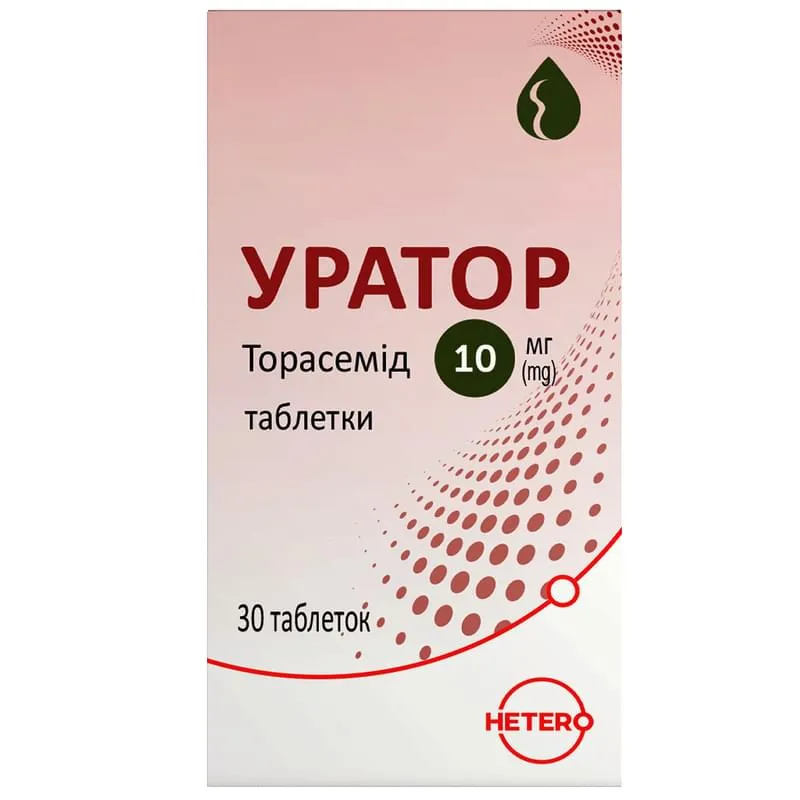
Table of Contents
INSTRUCTIONS FOR MEDICAL USE OF THE MEDICINAL PRODUCT URATOR (URATOR)
Composition:
Active substance: torasemide;
1 tablet contains 5 mg or 10 mg or 20 mg of torasemide;
Excipients: lactose monohydrate, microcrystalline cellulose, crospovidone, povidone, magnesium stearate.
Pharmaceutical form. Tablets.
Main physicochemical properties:
5 mg tablets: white or almost white, oval-shaped tablets with a score line and embossing "56" on one side and "H" on the other;
10 mg tablets: white or almost white, oval-shaped tablets with a score line and embossing "57" on one side and "H" on the other;
20 mg tablets: white or almost white, oval-shaped tablets with a score line and embossing "59" on one side and "H" on the other.
Pharmacotherapeutic group. Diuretics. High-ceiling diuretics. Sulfonamide-type agents.
ATC code C03C A04.
Pharmacological Properties
Pharmacodynamics
Torasemide inhibits the Na+/K+/2Cl cotransporter system (by acting at the chloride binding site) in the lumen of the thick ascending limb of the loop of Henle, thereby reducing the reabsorption of sodium and chloride. This leads to an increased delivery rate of tubular fluid and electrolytes to the distal segments, enhancing secretion of hydrogen and potassium ions, while plasma volume reduction increases aldosterone production. Increased delivery and elevated aldosterone levels promote sodium reabsorption in the distal tubules. By increasing sodium delivery to the distal renal tubules, torasemide indirectly enhances potassium excretion via the sodium-potassium exchange mechanism. Effects of torasemide in other nephron segments have not been demonstrated. Thus, torasemide increases the urinary excretion of sodium, chlorides, and water, but does not significantly alter glomerular filtration rate, renal plasma flow, or acid-base balance. The antihypertensive effect of torasemide is due to its diuretic action. Increased diuresis, resulting from a reduction in extracellular and plasma fluid volume, leads to a temporary decrease in arterial pressure and reduced cardiac output.
Pharmacokinetics
Absorption. After oral administration, torasemide is rapidly and almost completely absorbed; maximum serum concentration (Cmax) is achieved within 1 hour after intake. Cmax and the area under the serum concentration-time curve (AUC) after oral administration are proportional to the dose within the range of 2.5 mg to 200 mg. Concomitant food intake delays the time to reach Cmax by approximately 30 minutes, but overall bioavailability (AUC) and diuretic activity remain unchanged. In patients with renal or hepatic dysfunction, absorption of the drug is practically unaffected.
Protein Binding. Over 99% of torasemide is bound to plasma proteins.
Distribution. The volume of distribution of torasemide ranges from 12 to 15 liters in healthy adults, as well as in patients with mild to moderate renal insufficiency and in patients with congestive heart failure. In patients with liver cirrhosis, the volume of distribution is approximately doubled.
Metabolism. Torasemide is metabolized into three metabolites—M1, M3, and M5—via stepwise oxidation, hydroxylation, or ring hydroxylation.
Elimination. The terminal half-life (t1/2) of torasemide and its metabolites is 3–4 hours in healthy volunteers. Total clearance of torasemide is 40 ml/min, with renal clearance being approximately 10 ml/min. In healthy volunteers, about 80% of the administered dose is excreted in urine as torasemide and its metabolites in the following approximate proportions: torasemide—24%, metabolite M1—12%, metabolite M3—3%, metabolite M5—41%. In renal insufficiency, the t1/2 of torasemide remains unchanged.
Clinical characteristics.
Indications.
For the treatment of edema associated with congestive heart failure, kidney or liver diseases.
For the treatment of essential hypertension — as monotherapy or in combination with other antihypertensive agents.
Contraindications.
- Hypersensitivity to the active substance, sulphonilurea drugs, or to any of the excipients of the medicinal product;
- renal failure with anuria;
- hepatic coma or precoma;
- arterial hypotension;
- arrhythmia;
- hypovolemia; hyponatremia; hypokalemia;
- acute urinary obstruction, for example due to prostatic hyperplasia;
- gout;
- concomitant use with aminoglycosides or cephalosporins;
- renal failure following administration of drugs causing renal damage;
- pregnancy and lactation period.
Interaction with other medicinal products and other types of interactions.
When torasemide is used concomitantly with cardiac glycosides, the myocardial sensitivity to these drugs may increase due to potassium and/or magnesium deficiency. Concomitant use with mineralocorticoids, glucocorticoids, or laxatives may enhance potassium excretion.
Concomitant use of torasemide enhances the effect of antihypertensive agents, particularly angiotensin-converting enzyme (ACE) inhibitors.
Sequential or combined treatment, or initiation of new concomitant therapy with an ACE inhibitor, may lead to severe hypotension. This can be minimized by reducing the initial dose of the ACE inhibitor and/or by decreasing or temporarily discontinuing torasemide 2 or 3 days prior to starting the ACE inhibitor.
Torasemide may reduce vasoconstrictive effects, for example, those of adrenaline or noradrenaline.
Torasemide, especially at high doses, may potentiate the ototoxic and nephrotoxic effects of aminoglycoside antibiotics and ethacrynic acid, particularly in patients with renal impairment; it may also increase the toxicity of cisplatin-containing agents, the nephrotoxic effect of cephalosporins, and the cardio- and neurotoxic effects of lithium.
It may enhance the action of curare-like muscle relaxants and theophylline.
When used concomitantly with high doses of salicylates, the toxic effects of salicylates are increased.
Torasemide may reduce the effectiveness of antidiabetic agents.
Nonsteroidal anti-inflammatory drugs (e.g., indomethacin) and probenecid may reduce the antihypertensive and diuretic effects of torasemide.
Concomitant use of torasemide and cholestyramine in humans has not been studied, but animal studies have shown that co-administration of cholestyramine reduces the absorption of orally administered torasemide.
Special precautions for use.
Warnings
Liver disease with cirrhosis and ascites. Torasemide should be used with particular caution in patients with liver diseases associated with hepatic cirrhosis and ascites, as sudden changes in water-electrolyte balance may lead to hepatic coma. Therapy with torasemide (as well as other diuretics) in patients of this group should be conducted under hospital conditions. To prevent hypokalemia and metabolic alkalosis, the drug should be prescribed in combination with aldosterone antagonists or potassium-sparing agents.
Ototoxicity. Cases of ototoxicity (tinnitus and hearing loss) have been observed after torasemide administration, which were reversible, but a direct relationship with the drug has not been established. Ototoxicity was also observed in animal studies showing very high plasma levels of torasemide.
Hypovolemia and electrolyte imbalance. When prescribing diuretics, careful monitoring of clinical symptoms of electrolyte imbalance, hypovolemia, extrarenal azotemia, and other disturbances is necessary. These may manifest as dry mouth, thirst, weakness, lethargy, drowsiness, excitement, muscle pain or cramps, myasthenia, arterial hypotension, oliguria, tachycardia, nausea, vomiting. Excessive diuresis may cause dehydration, leading to reduced circulating blood volume, thrombosis, and vascular embolism, especially in elderly patients.
In patients with disturbances of water-electrolyte balance, hypovolemia, or extrarenal azotemia, laboratory test changes may occur: hypernatremia, hyponatremia, hyperchloremia, hypochloremia, hyperkalemia, hypokalemia, acid-base imbalance, increased blood urea nitrogen levels. In such patients, the drug should be discontinued, and after resolution of adverse effects, torasemide therapy may be resumed starting with lower doses.
In controlled studies conducted in the United States, torasemide was administered to patients with arterial hypertension at doses of 5 or 10 mg daily. During one year of observation, no changes in mean serum potassium levels were noted. Dose-dependent hypokalemia was more frequently observed in patients with congestive heart failure, liver cirrhosis, or kidney disease who received torasemide at doses higher than those used in antihypertensive studies.
In patients with cardiovascular diseases, diuretic-induced hypokalemia may lead to the development of arrhythmias, particularly in patients receiving digitalis.
The highest risk of hypokalemia occurs in patients with liver cirrhosis, increased diuresis, on a salt-free diet, or receiving concomitant corticosteroids or adrenocorticotropic hormone.
With prolonged use of torasemide, regular laboratory monitoring of electrolyte balance, particularly serum potassium levels, is required.
Excipients
The medicinal product contains lactose; therefore, it should not be administered to patients with hereditary lactase deficiency, galactose intolerance, or glucose/galactose malabsorption syndromes. If intolerance to certain sugars is diagnosed, consultation with a physician is necessary before taking this medicinal product.
Use during pregnancy or breastfeeding.
Pregnancy
There are no reliable data on the effects of torasemide on the embryo and fetus in humans. Reproductive toxicity of torasemide has been demonstrated in animal studies. Torasemide crosses the placental barrier. Therefore, torasemide is not recommended during pregnancy. Torasemide may be used during pregnancy only if strictly indicated and at the minimum effective dose. Diuretics are not suitable for standard treatment regimens of arterial hypertension or edema in pregnant women, as they may reduce placental perfusion and exert toxic effects on fetal development. If torasemide is used to treat pregnant women with heart or kidney failure, careful monitoring of electrolyte levels, hematocrit, and fetal development is required.
Lactation period
Currently, it has not been established whether torasemide passes into breast milk in animals or humans. The risk to newborns/infants cannot be excluded if the drug is used. Therefore, the use of torasemide during lactation is contraindicated. If torasemide must be used during this period, breastfeeding should be discontinued.
Fertility
Studies on the effect of torasemide on fertility in humans have not been conducted. In animal experiments, no such effect of torasemide was observed.
Labour and delivery
The effect of torasemide on labour and delivery is unknown.
Ability to influence reaction speed when driving or operating machinery.
Patients taking torasemide should be warned that the drug may cause changes in blood pressure and may affect reaction speed. Therefore, patients should refrain from driving vehicles or operating machinery if they experience dizziness or related symptoms.
Dosage and Administration
Tablets can be taken at any time, regardless of food intake.
Congestive heart failure.
The usual initial dose is 10–20 mg once daily. If the desired diuretic effect is not achieved, the dose should be doubled (20–40 mg daily) until the desired effect is attained.
Chronic renal failure.
The usual initial dose is 20 mg once daily. If the desired diuretic effect is not achieved, the dose should be doubled (40 mg daily) until the desired effect is attained.
Cirrhosis of the liver.
The usual initial dose is 5–10 mg once daily, administered concomitantly with aldosterone antagonists or potassium-sparing diuretics. If the desired diuretic effect is not achieved, the dose should be doubled (10–20 mg daily) until the desired effect is attained.
There are no data regarding single doses exceeding 40 mg daily.
Patients with hepatic impairment.
Treatment of such patients should be performed with caution, as increased plasma concentrations of torasemide may occur.
Essential hypertension.
The usual initial dose is 5 mg once daily. If this dosage regimen does not provide adequate blood pressure reduction within 4–6 weeks, the dose should be increased to 10 mg once daily. If necessary, combination therapy with other antihypertensive agents should be considered.
Edema.
The usual initial dose is 5 mg once daily; if necessary, the dose may be gradually increased up to 20 mg once daily. In individual cases, doses up to 40 mg daily have been administered.
Elderly patients.
No specific dose adjustment is required.
Children.
Torasemide should not be used in children due to lack of sufficient clinical experience.
Overdose.
Symptoms of intoxication. The typical clinical picture is unknown. Overdose may cause profound diuresis with risk of excessive loss of water and electrolytes, somnolence, confusion, symptomatic arterial hypotension, cardiovascular insufficiency (development of circulatory collapse), and gastrointestinal disturbances.
Treatment of overdose. No specific antidote is known. Symptoms of intoxication usually resolve with dose reduction or discontinuation of the drug, along with appropriate fluid and electrolyte replacement (monitoring of blood electrolyte levels is required). Torasemide is not removed from blood by hemodialysis.
Treatment in case of hypovolemia: fluid volume replacement.
Treatment in case of hypokalemia: administration of potassium supplements.
Treatment of cardiovascular insufficiency: place the patient in a supine position and, if necessary, administer symptomatic therapy.
Anaphylactic shock (emergency measures). In case of skin reactions (such as urticaria or skin redness), patient agitation, headache, excessive sweating, nausea, cyanosis, perform venous catheterization; place the patient in a horizontal position, ensure free air access, administer oxygen. If necessary, administer epinephrine, intravenous volume-expanding solutions, and glucocorticoid hormones.
Adverse reactions.
The following criteria were used to assess the frequency of adverse reactions: very common: ≥ 1/10; common: ≥ 1/100 to < 1/10; uncommon: ≥ 1/1000 to < 1/100; rare: ≥ 1/10000 to < 1/1000; very rare: < 1/10000; frequency not known: cannot be estimated from the available data.
Metabolic disorders.
Common – worsening of metabolic alkalosis; hyperglycemia; hypokalemia in patients on a low-potassium diet, with vomiting, diarrhea, after excessive use of laxatives, as well as in patients with chronic liver dysfunction. Depending on dosage and duration of treatment, disturbances in water and electrolyte balance may develop, such as hypovolemia, hypokalemia and/or hyponatremia (see section "Special precautions").
Symptoms and signs of electrolyte and volume depletion, such as headache, dizziness, arterial hypotension, asthenia, somnolence, confusion, loss of appetite, and cramps, may occur during pronounced diuresis, particularly at the beginning of treatment and in elderly patients. Dose adjustment is required.
Blood and lymphatic system disorders.
Very rare – hemoconcentration, decreased number of platelets, erythrocytes and/or leukocytes (see section "Special precautions").
Immune system, skin and subcutaneous tissue disorders.
Very rare: allergic reactions (including pruritus, rash), photosensitivity reactions, severe skin reactions.
Nervous system disorders.
Common: headache, dizziness (especially at the beginning of treatment), somnolence.
Uncommon: paresthesia, cramps in lower limbs (especially at the beginning of treatment).
Very rare: syncope, cerebral ischemia, confusion.
Eye disorders.
Very rare: visual disturbances.
Ear and labyrinth disorders.
Very rare: tinnitus, hearing loss.
Cardiac disorders.
Uncommon: extrasystoles, palpitations, tachycardia, facial flushing.
Very rare: myocardial ischemia, arrhythmia, angina pectoris, acute myocardial infarction.
Frequency not known: acute myocardial infarction, syncope, cerebral ischemia, embolism, hypotension.
Vascular disorders.
Very rare: thromboembolic complications, arterial hypotension, as well as circulatory and cardiac disorders.
Respiratory system disorders.
Uncommon: epistaxis.
Gastrointestinal disorders.
Common: gastrointestinal disturbances (including anorexia, stomach pain, nausea, vomiting, diarrhea, constipation), especially at the beginning of treatment.
Uncommon: abdominal pain, flatulence, dry mouth.
Very rare: pancreatitis.
Hepatobiliary disorders.
Common: increased blood concentration of certain liver enzymes (gamma-glutamyl transpeptidase).
Musculoskeletal and connective tissue disorders.
Common: muscle cramps (especially at the beginning of treatment).
Renal and urinary disorders.
Common: increased frequency of urination, polyuria, nocturia.
Uncommon: urgent need to urinate, urinary retention, bladder distension (in patients with prostatic hyperplasia, increased urine production may lead to urinary retention and excessive bladder distension).
General disorders.
Common: increased fatigue, general weakness (especially at the beginning of treatment).
Uncommon: asthenia, thirst, increased activity, nervousness.
Laboratory test abnormalities.
Common: increased platelet count, increased concentration of uric acid, glucose, and lipids (triglycerides, cholesterol) in blood.
Uncommon: increased serum urea and creatinine levels.
Frequency not known: thrombocytopenia, leukopenia.
Other adverse reactions may include impotence, shunt thrombosis.
Reporting of suspected adverse reactions
Reporting suspected adverse reactions after drug authorization is important. It allows continued monitoring of the benefit-risk balance of the medicinal product. Healthcare professionals and pharmacists, as well as patients or their legal representatives, should report any suspected adverse reactions and lack of efficacy via the Automated Pharmacovigilance Information System at: https://aisf.dec.gov.ua/.
Shelf life.
2 years.
Storage conditions.
Store in the original packaging at a temperature not exceeding 25 °C.
Keep out of the reach of children.
Packaging.
30 tablets in a container; 1 container in a cardboard box.
Prescription status.
Prescription only.
Manufacturer.
Hetero Labs Limited.
Manufacturer's address and location of operations.
Unit III, Formulation Plot No 22 - 110 IDA, Jeedimetla, Hyderabad, 500 055 Telangana, India.