Uniflox
Ukraine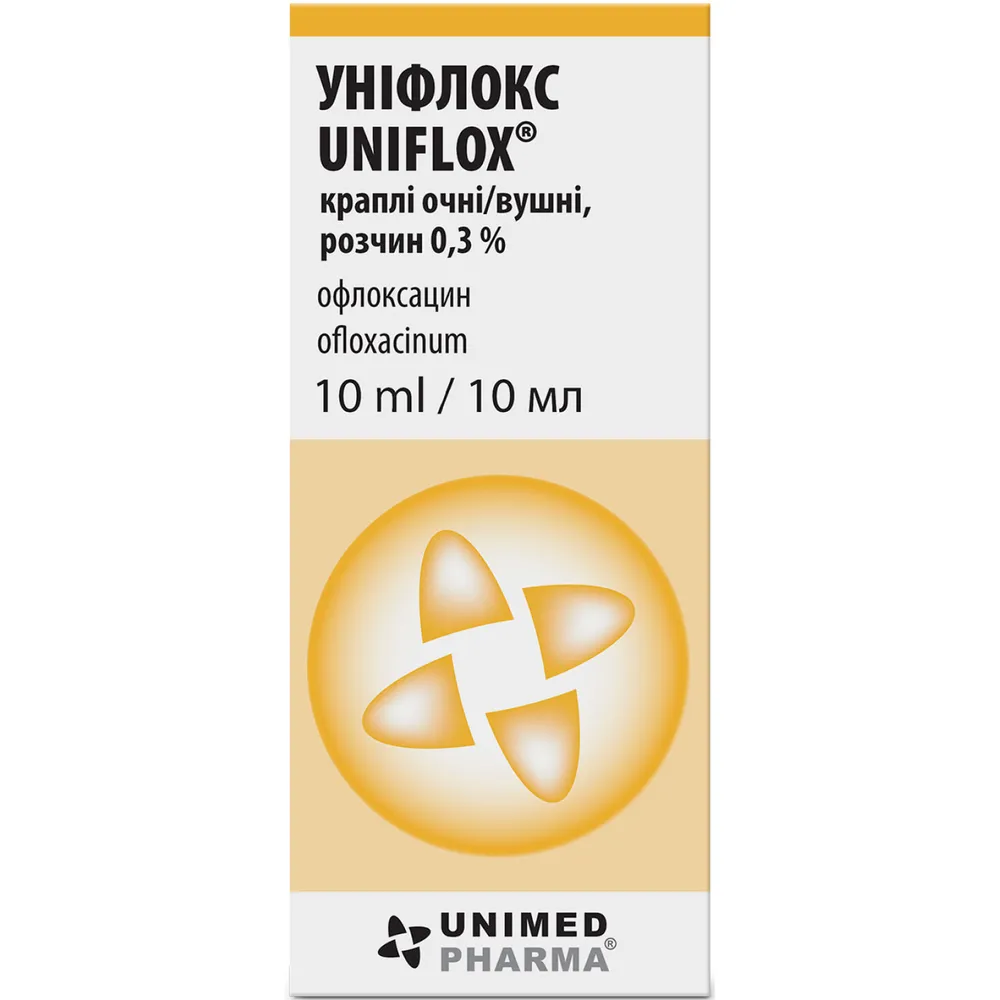
Table of Contents
INSTRUCTIONS FOR MEDICAL USE OF THE MEDICINAL PRODUCT UNIFLOX (UNIFLOX®)
Composition:
Active substance: ofloxacin;
1 ml of solution contains ofloxacin 3 mg;
Excipients: sodium hydrogen phosphate dodecahydrate, sodium dihydrogen phosphate dihydrate, benzalkonium chloride, water for injections.
Pharmaceutical form. Eye/ear drops, solution.
Main physicochemical properties: clear yellowish-green solution without visible mechanical particles.
Pharmacotherapeutic group. Agents used in ophthalmology and otology. Antimicrobial agents. ATC Code S03AA.
Pharmacological properties.
Pharmacodynamics.
Uniflox contains ofloxacin, a synthetic chemotherapeutic bactericidal agent belonging to the group of fluoroquinolones. Ofloxacin has a broad spectrum of antimicrobial activity. In bacterial cells, ofloxacin inhibits DNA gyrase, an enzyme essential for bacterial DNA replication and transcription. It is active against Staphylococcus aureus (including penicillinase-producing strains and some methicillin-resistant strains), Streptococcus pneumoniae, St. faecalis, St. pyogenes, species of Corynebacterium, Micrococcus, Bacillus, Enterobacteriaceae (Escherichia coli, Citrobacter, Enterobacter, Klebsiella, Proteus, Salmonella, Serratia, Shigella, etc.), Pseudomonas aeruginosa and other Pseudomonas species, Haemophilus influenzae, Haemophilus ducreyi, Branhamella catarrhalis, Neisseria gonorrhoeae, Neisseria meningitidis, species of Acinetobacter, Campylobacter, Gardnerella vaginalis, Helicobacter pylori, Brucella. It is also effective against Chlamydia trachomatis, Chlamydia pneumoniae, Mycoplasma pneumoniae, and some other mycoplasmas.
Resistant strains include species of Clostridium, Bacteroides, and Peptococcus. Resistance rates are 15–20% for Pseudomonas aeruginosa and 5–10% for Staphylococcus aureus.
Pharmacokinetics.
A significant advantage of the drug compared to other locally-acting antibiotics is its high penetration into the cornea and anterior chamber of the eye. Among all fluoroquinolones, ofloxacin has the best ability to penetrate into the cornea and anterior chamber of the eye. Its effective concentration in the tear film persists even 4 hours (240 minutes) after administration. The mean concentration of ofloxacin in tears measured 4 hours after instillation was 9.2 µg/g. Systemic absorption following local administration into the conjunctival sac is negligible and not clinically significant. After administration of two drops of the drug at 30-minute intervals, the concentration of ofloxacin in the cornea 4 hours later was 4.4 µg/g.
After a single administration of 0.3% ofloxacin ear drops, the concentration of ofloxacin in blood serum was 1000 times lower than the concentration achieved after oral administration. The concentration of ofloxacin in otorrhea from the middle ear was very close to the concentration in the administered drug (3 g/L). 0.3% ofloxacin ear drops effectively penetrate into the middle ear when the earlobe is pulled outward and downward during administration.
Clinical characteristics.
Indications.
Ophthalmology.
Bacterial infections of the anterior segment of the eye caused by pathogens sensitive to ofloxacin: infectious conjunctivitis, keratitis, keratoconjunctivitis, blepharitis, blepharoconjunctivitis, dacryocystitis, hordeolum, chalazia, and corneal ulcers. The drug is indicated for prevention of ocular infections during preparation for surgery, after intraocular surgeries, after removal of foreign bodies, and in eye injuries. As part of comprehensive therapy for treatment of bacterial endophthalmitis.
Otorhinolaryngology.
Treatment of bacterial infections caused by pathogens sensitive to ofloxacillin in adults and children aged 12 years and older: treatment of external otitis, chronic suppurative otitis media (with perforation of the tympanic membrane), and in adults – prophylaxis during ear surgery. For treatment of children aged 1 to 11 years: external otitis and acute otitis media with tympanostomy.
Contraindications.
Hypersensitivity to the active substance or to other fluoroquinolones, or to any of the excipients of the drug.
Chronic conjunctivitis of non-bacterial origin.
Infectious inflammation of the anterior and posterior segments of the eye or of the ocular adnexa, as well as of the external auditory canal or inner ear, caused by bacterial strains resistant to ofloxacin.
Interaction with other medicinal products and other types of interactions.
No interaction studies have been conducted. To date, there have been no reports of interactions during treatment with Uniflox when other ocular or otic medicinal products were used concomitantly. It should be noted that magnesium, aluminum, iron, and zinc reduce the absorption of ofloxacin. When using Uniflox eye and ear drops, concomitant use of other eye or ear medicinal products is not recommended.
Although there have been reports of increased central nervous system toxicity with systemic administration of fluoroquinolones when used concomitantly with systemic nonsteroidal anti-inflammatory drugs (NSAIDs), such effects have not been reported with concomitant systemic use of NSAIDs and ofloxacin.
Caution is advised when using simultaneously with medicinal products that prolong the QT interval (such as class IA and III antiarrhythmics, tricyclic antidepressants, macrolides, antipsychotics).
Special precautions for use
Prior to the first administration of the drug, it is advisable to perform microbiological examination of smears taken from the conjunctival sac or external auditory canal to determine bacterial strain sensitivity to the drug.
Avoid exposure to sunlight or ultraviolet radiation during ofloxacin use due to the possibility of photosensitivity.
Cases of precipitate formation on the cornea have been reported during topical ophthalmic use of ofloxacin. However, a causal relationship has not been established.
Severe, and sometimes fatal, hypersensitivity reactions, occasionally after the first dose, have been observed during systemic administration of quinolones. If an allergic reaction to the drug develops, administration must be discontinued.
With prolonged use, bacterial resistance may develop and microorganisms insensitive to the antibacterial agent may emerge. If symptoms worsen or no clinical improvement occurs, treatment should be discontinued and alternative therapy initiated.
The drug should be used with caution in patients at risk of QT interval prolongation, namely those with congenital long QT syndrome, those receiving concomitant medications that prolong the QT interval (such as class IA and III antiarrhythmics, tricyclic antidepressants, macrolides, antipsychotics), those with uncorrected electrolyte imbalances (e.g., hypokalemia, hypomagnesemia), elderly patients, and those with cardiac conditions (e.g., heart failure, myocardial infarction, bradycardia).
Soft contact lenses must not be worn during drug use. Also, if possible, rigid contact lenses should not be used during treatment. Therefore, it is recommended to remove rigid contact lenses before applying the drug and not to reinsert them earlier than 20 minutes after instillation of the drops.
Use during pregnancy or breastfeeding
Pregnancy
Since quinolones have been shown to cause arthropathy in immature animals, Uniflox is not recommended for use in pregnant women.
Breastfeeding
With systemic administration, ofloxacin and other quinolones are excreted in breast milk. If treatment with the drug is necessary, breastfeeding should be discontinued.
Ability to influence the speed of reaction while driving or operating machinery
Uniflox has almost no effect or a negligible effect on the ability to drive or operate machinery. However, a brief sensation of burning and blurred vision may occur immediately after instillation. Therefore, it is recommended to wait 15 minutes after drug administration and until vision has returned to normal before engaging in such activities.
Method of Administration and Dosage
The dosage of the medication and duration of treatment are always determined by a physician depending on the severity of the disease and the patient's age.
Ophthalmology
Adults. During the first 2 days, instill 1–2 drops every 2–4 hours, then reduce to 4 times daily at regular intervals. The treatment duration should be at least 7 days (3 days after cessation of purulent discharge) and should not exceed 10 days.
Children from 1 year of age. The use and dosage of the medication must be specifically prescribed by an ophthalmologist, and the entire course of treatment must be conducted under his/her supervision. Usually, 1 drop is administered 4 times daily for a period not exceeding 7 days.
Otorhinolaryngology
The drops should be administered into the external auditory canal with the patient lying down, the affected ear facing upward. The patient should remain in this position for at least 5 minutes after instillation. Cold solution should be avoided, as it may cause a thermal reaction (dizziness). It is recommended to warm the bottle by holding it in the palm of the hand for 1–2 minutes prior to use. For successful delivery of drops into the middle ear, the earlobe should be gently pulled outward and forward, toward the face, during instillation.
Adults and children from 12 years of age. In the treatment of external otitis, the usual dose is 10 drops twice daily for 10 days. For treatment of chronic suppurative otitis media with chronic tympanic membrane perforation, the recommended dose is 10 drops twice daily for 14 days.
Children from 1 to 11 years of age. The method of administration and dosage for children must be specifically prescribed by an otolaryngologist, and the entire treatment must be conducted under his/her supervision in an outpatient setting. The recommended dose for treatment of external otitis and acute otitis media with tympanostomy is 5 drops twice daily for 10 days.
Children
The medication is not intended for use in children under 1 year of age.
Overdose
Overdose has not been observed with proper use. In case of accidental ingestion, symptomatic treatment is recommended. Since QT interval prolongation is possible, ECG monitoring should be performed.
Side effects.
Serious reactions following systemic administration of ofloxacin occur rarely, and most symptoms are reversible. Although only a small amount of ofloxacin is absorbed into the systemic circulation after topical application, the possibility of adverse effects, as reported, cannot be excluded.
Frequency: very common (≥ 1/10), common (≥ 1/100 to < 1/10), uncommon (≥ 1/1000 to < 1/100), rare (≥ 1/10000 to < 1/1000), very rare (< 1/10000), unknown (frequency cannot be estimated from available data).
Blurred vision may occur immediately after instillation and may last for several minutes.
Immune system.
Very rare: hypersensitivity, including angioedema, dyspnea, anaphylactic reactions/shock, swelling of the mouth and tongue.
Nervous system.
Unknown: dizziness, paresthesia.
Eye disorders.
Common: eye irritation; ocular discomfort.
Rare: itching or increased sensitivity at the application site.
Very rare: corneal deposits have been reported with the use of phosphate-containing eye drops, particularly in patients with a history of corneal disease.
Unknown: keratitis, conjunctivitis, blurred vision, photophobia, eye swelling, eye redness, foreign body sensation, increased lacrimation, dry eyes, eye pain, eye itching; eyelid itching; eye hyperemia, periorbital edema (including eyelid swelling).
Gastrointestinal disorders.
Unknown: nausea, dry mouth.
Cardiovascular system.
Unknown: ventricular arrhythmia, paroxysmal torsades de pointes tachycardia, QT prolongation on ECG.
Skin and subcutaneous tissue.
Unknown: facial swelling, periorbital edema, Stevens-Johnson syndrome, toxic epidermal necrolysis.
Severe, sometimes fatal, hypersensitivity reactions, occasionally after the first dose, have been observed with systemic administration of quinolones.
Ear and labyrinth disorders.
Uncommon: itching or increased sensitivity at the application site.
Unknown: tinnitus, ear pain.
Shelf life. 2 years.
The shelf life of the product after first opening of the container is 28 days.
Storage conditions.
Store out of reach of children, at a temperature not exceeding 25 °C, in the original packaging. Do not freeze. After first opening, do not store for more than 28 days.
Packaging.
5 ml or 10 ml in a plastic dropper container closed with a tamper-evident cap.
One dropper container per cardboard box.
Prescription category.
Prescription only.
Manufacturer.
LLC "UNIMED PHARMA" / "UNIMED PHARMA Ltd".
Manufacturer's address and location of business operations.
Orieskova 11, 821 05 Bratislava, Slovak Republic / Orieskova 11, 821 05 Bratislava, Slovak Republic.