Ultrex
Ukraine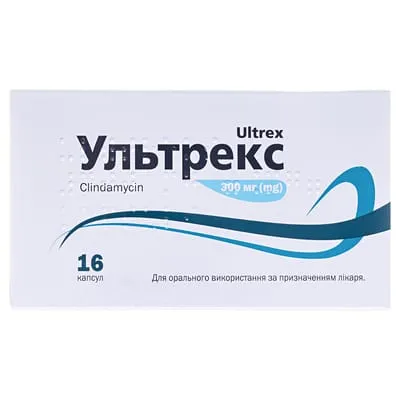
Table of Contents
INSTRUCTIONS FOR MEDICAL USE OF THE MEDICINAL PRODUCT ULTREX (ULTREX)
Composition:
Active substance: clindamycin;
1 capsule contains clindamycin 150 mg or 300 mg;
Excipients: lactose monohydrate; corn starch; talc; magnesium stearate;
capsule shell for 150 mg: hard gelatin Capsugel size 1 (titanium dioxide (E 171), gelatin, black pigment 10A1);
capsule shell for 300 mg: hard gelatin Capsugel size 0e1 (titanium dioxide (E 171), gelatin, black pigment 10A1);
composition of black pigment 10A1: shellac, black iron oxide (E 172), propylene glycol (E 1520), ammonium hydroxide (E 527).
Pharmaceutical form. Capsules.
Main physicochemical properties:
150 mg capsules: hard gelatin capsules, white in color, size 1, with the imprint «CLIN 150», filled with white crystalline powder;
300 mg capsules: hard gelatin capsules, white in color, size 0e1, with the imprint «CLIN 300», filled with white crystalline powder.
Pharmacotherapeutic group.
Antibacterials for systemic use. Lincosamides. ATC code J01F F01.
Pharmacological properties.
Pharmacodynamics.
Mechanism of action. Clindamycin belongs to the lincosamide group of antibiotics. The mechanism of action of clindamycin is based on inhibition of protein biosynthesis by binding to the 50S subunit, thereby affecting both ribosome assembly and the translation process. Although clindamycin phosphate is inactive in vitro, rapid in vivo hydrolysis converts it into the bacteriologically active clindamycin. At usual doses, clindamycin exhibits bacteriostatic activity.
Pharmacokinetic/pharmacodynamic relationship. Efficacy will depend significantly on the time during which drug concentrations exceed the minimum inhibitory concentration (MIC) for the causative pathogen (%T/MIC).
Mechanism of resistance development. Resistance to clindamycin most commonly arises due to mutations at the antibiotic binding site of rRNA or methylation of specific nucleotides within the 23S rRNA of the 50S subunit. These changes may lead to in vitro cross-resistance to macrolides and type B streptogramins (MLSB phenotype). Resistance may occasionally be caused by alterations in ribosomal proteins. In staphylococci and streptococci, resistance is primarily due to increased methylation of 23S rRNA (so-called constitutive MLSB resistance), which substantially reduces the binding affinity of clindamycin to the ribosome. Most methicillin-resistant S. aureus (MRSA) strains exhibit a constitutive MLSB phenotype and are therefore resistant to clindamycin. Thus, infections caused by macrolide-resistant staphylococci should not be treated with clindamycin, even if in vitro susceptibility has been demonstrated, due to the risk of selecting during therapy mutant strains with constitutive MLSB resistance.
Strains with constitutive MLSB resistance show complete cross-resistance between clindamycin and lincomycin, macrolides (e.g., azithromycin, clarithromycin, erythromycin, roxithromycin, spiramycin), and streptogramin B. Resistance to clindamycin may be induced by macrolides in macrolide-resistant bacterial isolates. Inducible resistance can be confirmed using the disk diffusion D-test method or broth dilution method.
Less commonly, resistance mechanisms include antibiotic modification and active efflux. Complete cross-resistance exists between clindamycin and lincomycin. As with many antibiotics, the frequency of resistance development depends on the bacterial species and geographical region. Resistance rates to clindamycin are higher among methicillin-resistant staphylococcal isolates and penicillin-resistant pneumococcal isolates than among organisms susceptible to these agents.
Breakpoints. The prevalence of acquired resistance may vary among species depending on geographical location and time, and therefore local information on resistance patterns is needed, especially when treating severe infections. If the efficacy of clindamycin against certain infections is questionable due to local resistance patterns, expert advice should be sought. Particularly in cases of severe infections or treatment failure, microbiological diagnosis should be established, including identification of the pathogen and determination of its susceptibility to clindamycin.
Resistance is generally defined by interpretive criteria (breakpoints) established by the European Committee on Antimicrobial Susceptibility Testing (EUCAST) for systemic antibiotics. Clindamycin susceptibility testing has been performed using the standard serial dilution method.
EUCAST breakpoints (see Table 1). (European Committee on Antimicrobial Susceptibility Testing.)
Table 1.
| Breakpoint MIC values (mg/ml) |
Breakpoint zone diameter values (mm)a |
|||
| Microorganism |
Susceptible |
Resistant |
Susceptible |
Resistant |
| Staphylococcus species 1,3 |
≤ 0.25 mg/L |
> 0.5 mg/L |
≥ 22A |
< 19A |
| Streptococcus species (groups A, B, C, G)1, 2 |
≤ 0.5 mg/L |
> 0.5 mg/L |
≥ 17B |
< 17B |
| Streptococcus pneumoniae 1 |
≤ 0.5 mg/L |
> 0.5 mg/L |
≥ 19B |
< 19B |
| Viridans group streptococci 1 |
≤ 0.5 mg/L |
> 0.5 mg/L |
≥ 19B |
< 19B |
| Gram-negative anaerobes |
≤ 4 mg/L |
> 4 mg/L |
Not applicable |
Not applicable |
| Gram-positive anaerobes |
≤ 4 mg/L |
> 4 mg/L |
Not applicable |
Not applicable |
Clinical breakpoints according to EUCAST in table form, version 8.0
1 Inducible clindamycin resistance can be detected by determining antagonistic activity between clindamycin and macrolides. If resistance is not detected, it should be reported that testing was performed according to clinical breakpoints. If resistance is detected, the result should be reported as "resistant", and consideration should be given to adding a comment to the report: "Clindamycin may be used for short-term treatment of mild skin and soft tissue infections, as the development of constitutive resistance during such therapy is unlikely."
2 The clinical significance of inducible clindamycin resistance in combination therapy for severe S. pyogenes infections is unknown.
3 Inducible clindamycin resistance can be detected by determining antagonistic activity between clindamycin and macrolides. If resistance is not detected, it should be reported that testing was performed according to clinical breakpoints. If resistance is detected, the result should be reported as "resistant".
A To detect inducible clindamycin resistance, erythromycin and clindamycin disks are placed 12–20 mm apart (edge to edge), and antagonism (D-zone phenomenon) is assessed.
B To detect inducible clindamycin resistance, erythromycin and clindamycin disks are placed 12–16 mm apart (edge to edge), and antagonism (D-zone phenomenon) is assessed.
a Disk content – 2 μg clindamycin
EUCAST quality control ranges for MIC and disk diffusion testing are presented in Table 2.
Table 2
| Quality control strain |
MIC range (µg/ml) |
Diffusion range |
| Staphylococcus aureus ATCC 29213 |
0.06-0.25 |
23-29 |
| Streptococcus pneumoniae ATCC 49619 |
0.03-0.125 |
22-28 |
ATCC® is a registered trademark of the American Type Culture Collection.
Prevalence of acquired resistance. Prevalence of acquired resistance based on data from the past 5 years obtained within national surveillance programs and studies (as of February 2018).
Typically susceptible organisms.
Aerobic gram-positive microorganisms: without p\j
- Actinomyces israelii °
- Gardnerella vaginalis °
- Staphylococcus aureus (methicillin-susceptible)
- Streptococcus pneumoniae
- Streptococcus pyogenes
- Viridans group streptococci ○^
Anaerobic microorganisms: without p\j
- Bacteroides species ° (except B. fragilis)
- Clostridium perfringens °
- Fusobacterium species °
- Peptoniphilus species °
- Peptostreptococcus species °
- Prevotella species ○
- Propionibacterium species °
- Veillonella species °
Other microorganisms:
- Chlamydia trachomatis °
- Chlamydophila pneumoniae °
- Mycoplasma hominis °
Organisms for which acquired resistance may be a problem.
Aerobic gram-positive microorganisms:
- Staphylococcus aureus
- Staphylococcus aureus (methicillin-resistant) +
- Staphylococcus epidermidis +
- Staphylococcus haemolyticus
- Staphylococcus hominis
- Staphylococcus agalactiae
Aerobic gram-negative microorganisms:
- Moraxella catarrhalis $
Anaerobic microorganisms:
- Bacteroides fragilis °
Resistant microorganisms.
Aerobic gram-positive microorganisms:
- Enterococcus species
- Listeria monocytogenes
Aerobic gram-negative microorganisms:
- Escherichia coli
- Haemophilus influenzae
- Klebsiella species
- Pseudomonas aeruginosa
Anaerobic microorganisms:
- Clostridium difficile
Other microorganisms:
- Mycoplasma pneumoniae
- Ureaplasma urealyticum
° Updated data were not available at the time of publication. Primary literature, standard references, and treatment guidelines assume susceptibility.
$ The intrinsic susceptibility of most strains lies within the intermediate range.
- Resistance frequency exceeds 50% in at least one region.
^ General term for a heterogeneous group of streptococcal species. Resistance frequency may vary depending on the specific streptococcal species.
Pharmacokinetics.
Absorption, distribution, and protein binding. The difference between the clindamycin derivatives used lies only in the timing of absorption and hydrolysis of esters. Thereafter, clindamycin circulates in the body as the free base (active form). Its esters should be considered prodrugs.
After oral administration, clindamycin hydrochloride and clindamycin 2-palmitate hydrochloride are rapidly and almost completely absorbed from the gastrointestinal tract. Concomitant food intake slightly delays absorption. When administered on an empty stomach, peak serum concentrations are reached within approximately 45–60 minutes; when administered after food, peak concentrations occur within approximately 2 hours. After single oral doses of 150 mg or 300 mg, serum concentrations range from 1.9 to 3.9 µg/mL and 2.8 to 3.4 µg/mL, respectively (administered fasting).
Clindamycin binding to plasma proteins depends on its concentration and ranges from 60% to 94% within the therapeutic range.
Clindamycin readily penetrates tissues, crosses the placental barrier, and enters breast milk. Diffusion into the subarachnoid space is insufficient even during meningitis. High concentrations are achieved in bone tissue.
Biotransformation and elimination. Clindamycin is primarily metabolized in the liver. Some metabolites are microbiologically active. Drugs acting as inducers of hepatic enzymes shorten the mean elimination half-life of clindamycin.
In vitro studies using human liver and intestinal microsomes have demonstrated that clindamycin oxidation occurs primarily via CYP3A4, with minor involvement of CYP3A5, forming clindamycin sulfoxide and the minor metabolite N-desmethyl-clindamycin.
Elimination of clindamycin occurs approximately 2/3 via feces and 1/3 via urine.
The elimination half-life of clindamycin in serum is approximately 3 hours in adults and about 2 hours in children. The half-life is prolonged in cases of renal impairment and moderate to severe hepatic insufficiency.
Clindamycin is not removed by dialysis.
Bioavailability. Absolute bioavailability of clindamycin was determined in a clinical study (1994). Each of 16 healthy male volunteers received 600 mg clindamycin intravenously (as clindamycin phosphate) and orally (2 capsules, each containing 300 mg clindamycin hydrochloride).
Prerequisite for administration: on an empty stomach.
Arithmetic mean values (mA), standard deviation(s), and geometric mean values (mG) after oral and intravenous (i.v.) administration.
Table 3.
| Parameters |
Oral |
IV |
||||
| mA |
s |
mG |
mA |
s |
mG |
|
| Maximum plasma concentration (Cmax) [μg/mL] |
5.3 |
1.0 |
5.2 |
11.1 |
3.9 |
10.6 |
| Area under the concentration-time curve (AUC) [μg/mL*h] |
16.9 |
6.1 |
15.9 |
31.8 |
6.7 |
31.1 |
| Time to maximum plasma concentration (tmax) [h] |
0.76 |
0.36 |
0.70 |
0.46 |
0.10 |
0.45 |
Clinical characteristics.
Indications.
Acute and chronic bacterial infections caused by pathogens sensitive to clindamycin, including:
- infections of bones and joints;
- infections of the ear, nose, and throat area;
- infections of the teeth and jaw;
- lower respiratory tract infections;
- pelvic and abdominal infections;
- female genital tract infections;
- skin and soft tissue infections;
- scarlet fever.
In severe clinical cases, treatment should initially be carried out using medicinal products containing clindamycin administered intravenously by infusion.
Contraindications.
Hypersensitivity to clindamycin, lincomycin, or to any of the excipients of the medicinal product.
Ultricef is not suitable for the treatment of meningitis, as the concentration of the antibiotic achieved in cerebrospinal fluid is too low.
Interaction with other medicinal products and other forms of interaction.
Antagonism (induced resistance) has been observed in vitro between clindamycin and erythromycin against a subgroup of macrolide-resistant bacterial isolates. Both agents should not be used concomitantly due to potential clinical significance, except in cases where appropriate sensitivity testing has been performed.
Pathogenic microorganisms exhibit cross-resistance between clindamycin and lincomycin.
Due to the inherent properties of Ultricef in blocking neuromuscular transmission, it may potentiate the effect of muscle relaxants (e.g. ether, tubocurarine, pancuronium bromide). This may lead to unexpected life-threatening situations during surgery. Therefore, Ultricef should be used with caution in patients receiving the aforementioned medicinal products.
Concomitant use of Ultricef may reduce the effectiveness of oral contraceptives. Therefore, during treatment with Ultricef, additional contraceptive methods should be used.
Vitamin K antagonists. In patients receiving clindamycin in combination with vitamin K antagonists (e.g. warfarin, acenocoumarol, and fluindione), increased coagulation test parameters (prothrombin time/international normalized ratio) and/or bleeding have been reported. Therefore, such patients should be frequently monitored for coagulation parameters.
Clindamycin is primarily metabolized via CYP3A4 and to a lesser extent via CYP3A5, forming the major metabolite clindamycin sulfoxide and the minor metabolite N-desmethyl-clindamycin. Therefore, inhibitors of CYP3A4 and CYP3A5 may reduce clindamycin clearance, while inducers of these isoenzymes may increase clindamycin clearance. When using potent CYP3A4 inducers, such as rifampicin, monitoring for loss of efficacy is recommended.
In vitro studies show that clindamycin does not inhibit CYP1A2, CYP2C9, CYP2C19, CYP2E1, or CYP2D6 and only moderately inhibits CYP3A4. Therefore, clinically significant interactions between clindamycin and concomitantly administered drugs metabolized by these CYP enzymes are unlikely.
Special precautions for use.
Ultrax should be used with caution in the following patient groups:
- with impaired liver function;
- with neuromuscular transmission disorders (myasthenia gravis, Parkinson's disease);
- with a history of gastrointestinal diseases (e.g. colitis);
- with atopy;
- with allergies and asthma.
Note: Ultrax should not be used in patients with acute viral respiratory tract infections.
Ultrax is not suitable for the treatment of meningitis, as the concentrations of the antibiotic achieved in cerebrospinal fluid are too low.
Severe hypersensitivity reactions have been reported in patients receiving clindamycin therapy, including serious skin reactions such as drug reaction with eosinophilia and systemic symptoms (DRESS syndrome), Stevens–Johnson syndrome, toxic epidermal necrolysis, and acute generalized exanthematous pustulosis. In case of hypersensitivity reaction or serious skin reactions, clindamycin therapy should be discontinued and appropriate treatment initiated (see section "Contraindications" and "Adverse reactions").
Acute kidney injury.
Rare cases of acute kidney injury, including acute renal failure, have been reported. Therefore, monitoring of kidney function should be considered in patients receiving prolonged therapy, those with pre-existing kidney dysfunction, or those taking concomitant nephrotoxic drugs (see section "Adverse reactions").
During prolonged treatment (more than 10 days), clinical blood tests and liver and kidney function should be monitored regularly.
Long-term and repeated use of Ultrax may lead to the development of superinfection or colonization of the skin and mucous membranes by resistant microorganisms or yeast fungi.
During treatment with nearly all antibacterial agents, including clindamycin, cases of diarrhea caused by Clostridium difficile (CDAD) have been reported, with severity ranging from mild diarrhea to fatal colitis. Antibacterial therapy disrupts the normal flora of the colon, leading to overgrowth of C. difficile.
C. difficile produces toxins A and B, which contribute to the development of CDAD and are the primary cause of "antibiotic-associated colitis." Strains of C. difficile producing hypervirulent toxins are associated with increased morbidity and mortality, as these infections may be unresponsive to antimicrobial therapy and may require colectomy.
CDAD should be considered in all patients with diarrhea following antibiotic use. A careful medical history is essential, as cases of CDAD have been reported up to two months after antibiotic administration. The condition may progress to colitis, including pseudomembranous colitis, with severity ranging from mild to fatal.
Upon diagnosis or suspicion of antibiotic-associated diarrhea or antibiotic-associated colitis, antibacterial agents, including clindamycin, should be discontinued and appropriate therapeutic measures initiated. Antiperistaltic agents are contraindicated in this situation.
In cases of moderate to severe pseudomembranous colitis, fluid and electrolyte replacement, additional protein intake, and administration of antibacterial agents clinically effective against Clostridium difficile-induced colitis should be considered.
If therapy is prolonged, liver and kidney function tests should be performed.
Clindamycin may be a possible alternative in cases of penicillin allergy (hypersensitivity to penicillin). Cross-allergy between clindamycin and penicillin is unknown and not expected due to structural differences between these substances. However, in rare cases, anaphylactic reactions (hypersensitivity) to clindamycin have been reported in individuals with a history of penicillin allergy. This should be taken into account when using clindamycin to treat patients with penicillin allergy.
Ultrax contains 214.08 mg or 283.24 mg of monohydrate lactose per 150 mg or 300 mg capsule, respectively. When used according to dosing instructions, each dose delivers up to 856.32 mg of lactose. This corresponds to the total amount of lactose contained in 4 capsules of Ultrax 150 mg. Ultrax should not be administered to patients with rare hereditary disorders of galactose intolerance, lactase deficiency, or glucose-galactose malabsorption syndrome.
Use during pregnancy or breastfeeding.
Use during pregnancy.
Results from a large study involving pregnant women who used clindamycin during the first trimester of pregnancy (approximately 650 newborns exposed to clindamycin) did not demonstrate an increased frequency of congenital malformations. However, data on the safety of clindamycin use during pregnancy are insufficient.
Results from experimental animal studies do not indicate a direct or indirect harmful effect on pregnancy, embryonal/fetal development, course of delivery, or postnatal development.
Clindamycin crosses the placenta. It is assumed that therapeutic, effective concentrations are achieved in the fetal organism. When using the drug during pregnancy, the benefit of treatment should be carefully weighed against potential risks.
Use during breastfeeding.
Clindamycin is excreted in human breast milk. Clindamycin concentrations in human breast milk ranging from < 0.5 to 3.8 µg/mL have been reported following systemic administration. Therefore, adverse effects on the gastrointestinal microflora in breastfed newborns, such as diarrhea or blood in stool, sensitization, rash, and colonization of mucous membranes by yeast fungi, cannot be excluded. Due to the risk of serious adverse reactions in breastfed newborns, women who are breastfeeding should not use clindamycin.
Reproductive function.
Animal studies have not shown any signs of impaired reproductive function. There are no data on the effect of clindamycin on human reproductive function.
Ability to influence reaction speed when driving or operating machinery.
Clindamycin has a mild to moderate effect on the ability to drive or operate machinery. Some adverse reactions (e.g. dizziness, drowsiness, see section "Adverse reactions") may affect the ability to concentrate and reaction speed; therefore, they may impair the ability to drive vehicles or operate machinery.
Dosage and Administration
Ultrex should be taken with an adequate amount of liquid (at least one large glass of water) to avoid possible esophageal irritation.
In suspected cases of infection caused by β-hemolytic streptococcus, or when signs of β-hemolytic streptococcus are present, treatment should last for at least 10 days.
Capsules 150 mg.
Adults. Depending on the site and severity of infection, adults and children aged 14 years and older should receive 4–12 capsules per day (equivalent to 0.6–1.8 g of clindamycin).
The daily dose should be divided into 4 doses.
For higher dosing requirements, medicinal products with a higher content of the active substance are also available.
Capsules 300 mg.
Depending on the site and severity of infection, adults and children aged 14 years and older should receive 0.6–1.8 g of clindamycin per day. The daily dose may be divided into 2, 3, or 4 individual doses.
Therefore, 2–6 capsules of Ultrex 300 mg (equivalent to 0.6–1.8 g of clindamycin) should be administered daily.
For children under 14 years of age, medicinal products with a lower content of the active substance are available.
Liver disease. In patients with moderate to severe liver disease, the elimination half-life of clindamycin is prolonged. Usually, when Ultrex is administered every 8 hours, dose reduction is not required. However, patients with severe hepatic insufficiency should be monitored for plasma clindamycin levels. Depending on the results obtained, dose reduction or prolongation of dosing intervals may be necessary.
Kidney disease. In renal disease, the elimination half-life of clindamycin is prolonged; however, in mild to moderate renal impairment, dose reduction is not required. Nevertheless, in patients with severe renal insufficiency or anuria, plasma clindamycin levels should be monitored. Depending on the results of these measurements, dose reduction or, alternatively, prolongation of dosing intervals to 8 or even 12 hours may be necessary.
Hemodialysis. Clindamycin is not removed by hemodialysis. Therefore, no additional dose is required before or after hemodialysis.
Children.
Ultrex capsules are not suitable for children who cannot swallow them whole. Capsules do not allow precise dosing in mg/kg, so in some cases, administration of the drug in another, more suitable dosage form may be necessary.
Depending on the site and severity of infection, children under 14 years of age should receive 8–25 mg of clindamycin per kilogram of body weight per day; see Table 4.
Table 4.
| Body weight |
Number of capsules per day (150 mg capsules) |
Clindamycin, mg |
| 20 kg |
3 capsules |
450 mg |
| 30 kg |
4-5 capsules |
600-750 mg |
| 40 kg |
4-6 capsules |
600-900 mg |
| 50 kg |
4-8 capsules |
600-1200 mg |
The daily dose is divided into 3–4 separate doses. Administration in the form of 4 doses is generally preferred.
Overdose.
Symptoms of overdose have not been observed to date. If necessary, gastric lavage may be indicated. Hemodialysis and peritoneal dialysis are ineffective in removing clindamycin from blood serum. A specific antidote is not known.
Adverse Reactions
The adverse reactions listed below have been identified during clinical trials and post-marketing surveillance. Within each category, adverse reactions are presented according to frequency and clinical significance.
By frequency, adverse reactions are classified into the following categories: very common (≥ 1/10), common (≥ 1/100 to < 1/10), uncommon (≥ 1/1,000 to < 1/100), rare (≥ 1/10,000 to < 1/1,000), very rare (< 1/10,000), and frequency not known (cannot be estimated based on available data). Adverse reactions within each category are listed in decreasing order of severity.
Infections and infestations.
Common: pseudomembranous colitis*.
Frequency not known: colitis due to Clostridium difficile*, vaginal infections.
Blood and lymphatic system disorders.
Common: agranulocytosis*, neutropenia*, thrombocytopenia*, leukopenia*, eosinophilia.
Immune system disorders.
Rare: drug fever.
Very rare: anaphylactic reaction*.
Frequency not known: anaphylactic shock*, anaphylactoid reaction*, hypersensitivity*.
Nervous system disorders.
Uncommon: taste disturbance, neuromuscular blockade.
Frequency not known: dizziness, somnolence, headache.
Gastrointestinal disorders.
Very common: esophageal irritation, esophagitis*, stomatitis, diarrhea, abdominal pain, vomiting, nausea.
Frequency not known: esophageal ulcer*.
Hepatobiliary disorders.
Very rare: transient hepatitis with cholestatic jaundice.
Frequency not known: jaundice.*
Renal and urinary disorders.
Frequency not known: acute kidney injury (see section "Special precautions").
Skin and subcutaneous tissue disorders.
Common: maculopapular exanthema, morbilliform exanthema*, urticaria.
Rare: toxic epidermal necrolysis*, Stevens–Johnson syndrome*, Lyell's syndrome, Quincke's edema/angioedema*, exfoliative dermatitis*, bullous dermatitis*, erythema multiforme, pruritus, vaginitis.
Very rare: rash and blistering, hypersensitivity reactions.
Frequency not known: drug reaction with eosinophilia and systemic symptoms (DRESS syndrome)*, acute generalized exanthematous pustulosis*.
Musculoskeletal and connective tissue disorders.
Very rare: polyarthritis.
Investigations.
Common: abnormal liver function biochemical parameters.
* Adverse reactions identified during post-marketing use of the drug (see section "Special precautions").
Antibiotic-related adverse reactions (class effect).
Pseudomembranous enterocolitis may occur frequently during treatment with Ultrex. Upon diagnosis of pseudomembranous enterocolitis, the physician should consider discontinuing Ultrex and initiate appropriate therapy (using antibiotics/chemotherapeutic agents with clinically proven efficacy). Antiperistaltic agents are contraindicated.
Clindamycin use may lead to overgrowth of other intestinal microorganisms, including fungi.
Allergic reactions may occasionally occur even after the first dose. Severe acute allergic reactions such as anaphylactic shock are very rare. In such cases, Ultrex should be discontinued immediately and standard appropriate emergency measures should be initiated (e.g., administration of antihistamines, corticosteroids, sympathomimetics, and artificial ventilation if necessary).
Reporting suspected adverse reactions.
It is important to report suspected adverse reactions after drug authorization. This enables continuous monitoring of the benefit-risk balance of the medicinal product. Physicians should report any suspected adverse reactions in accordance with applicable regulatory requirements.
Shelf life.
Ultrex, 150 mg capsules – 36 months.
Ultrex, 300 mg capsules – 36 months.
Storage conditions.
Store in the original packaging at a temperature not exceeding 25 °C. Keep out of reach of children.
Packaging.
No. 16 (8x2): 8 capsules of 150 mg or 300 mg in a blister; 2 blisters per cardboard box.
Prescription status. Prescription only.
Manufacturer.
Rivopharm SA.
Manufacturer's address and place of business.
Centro Insema, 6928 Manno, Switzerland.