Ticocid
Ukraine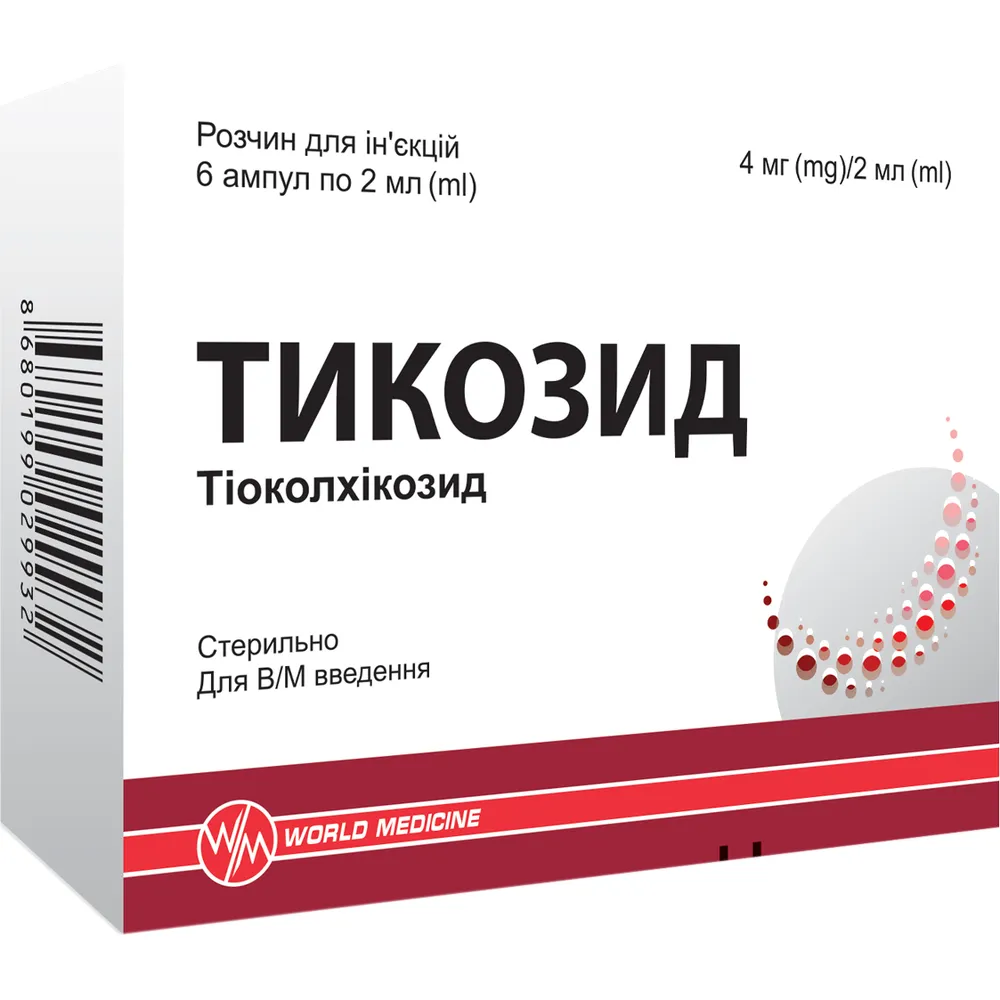
Table of Contents
INSTRUCTIONS FOR MEDICAL USE OF THE MEDICINAL PRODUCT TIKOZID (TIKOZID)
Composition:
Active substance: thiocolchicoside;
Each ampoule contains thiocolchicoside 4 mg;
Excipients: sodium chloride; diluted hydrochloric acid; water for injections.
Pharmaceutical form. Solution for injection.
Main physicochemical properties: clear light-yellow solution.
Pharmacotherapeutic group.
Muscle relaxants with central mechanism of action. ATC code M03BX05.
Pharmacological properties.
Pharmacodynamics.
Thiocolchicoside is a semi-synthetic sulfide derivative of colchicoside with myorelaxant activity.
In vitro studies show that thiocolchicoside binds exclusively to GABA and strychnine-sensitive glycine receptors. Acting as a GABA receptor antagonist, thiocolchicoside produces an effective myorelaxant effect via regulatory complex mechanisms at the supraspinal level; however, its glycinergic mechanism of action cannot be excluded.
The characteristics of thiocolchicoside interaction with GABA receptors are the same as those of its glucuronide derivative, which is the main metabolite (see below).
In vivo studies have demonstrated the myorelaxant properties of thiocolchicoside and its main metabolite in various experimental models.
Electroencephalographic studies have also shown that thiocolchicoside and its major metabolite do not produce a sedative effect.
Pharmacokinetics.
Absorption.
After intramuscular administration, maximum plasma concentration (Cmax) of thiocolchicoside is reached within 30 minutes. Plasma levels of 113 ng/mL are achieved after a 4 mg dose and 175 ng/mL after an 8 mg dose. Corresponding values of the area under the pharmacokinetic curve (AUC) are 283 and 417 ng·h/mL, respectively.
The pharmacologically active metabolite SL18.0740 is also detected at lower concentrations, with a Cmax of 11.7 ng/mL reached 5 hours after administration, and an AUC of 83 ng·h/mL.
Data on the inactive metabolite SL59.0955 are not available.
Distribution.
The apparent volume of distribution of thiocolchicoside is approximately 42.7 L after intramuscular administration of 8 mg. Data on both metabolites are not available.
Elimination.
The elimination half-life of thiocolchicoside is 1.5 hours, and plasma clearance is 19.2 L/h.
Clinical characteristics.
Indications.
Additional therapy for painful muscular contractures in acute spinal disorders in adults and adolescents aged 16 years and older.
Contraindications.
- Hypersensitivity to the active substance or to any of the excipients of the medicinal product;
- flaccid paralysis, muscular hypotonia;
- pregnancy;
- breastfeeding period;
- use in women of childbearing potential who are not using appropriate contraceptive measures during treatment and for one month after completion of treatment;
- use in men who are not using appropriate contraceptive measures during treatment and for three months after completion of treatment.
Interaction with other medicinal products and other types of interactions.
Information on interactions is lacking.
Special precautions for use
Vasovagal syncope has been reported after intramuscular administration of thiocolchicoside; therefore, patients should be monitored after drug administration (see section "Adverse reactions").
Hepatic injury associated with the use of thiocolchicoside has been reported in the post-marketing period. Severe cases (e.g., fulminant hepatitis) of liver injury have been observed in patients who concurrently used nonsteroidal anti-inflammatory drugs (NSAIDs) or paracetamol. If signs of liver injury occur during treatment with the medicinal product, therapy should be discontinued and medical advice sought (see section "Adverse reactions").
Seizures may occur during treatment with thiocolchicoside in patients with epilepsy or other conditions associated with a risk of seizures (see section "Adverse reactions").
The maximum recommended dose of thiocolchicoside (8 mg per day) should not be exceeded. This dose should be divided into two administrations with a 12-hour interval. If a dose is missed, the next dose should be administered at the usual time.
According to preclinical data, one of the metabolites of thiocolchicoside, SL59.0955, causes aneuploidy (a change in chromosome number in dividing cells) at concentrations close to those achieved with 8 mg twice daily orally, which may similarly affect humans.
Aneuploidy is considered a risk factor for teratogenicity, embryotoxicity/fetotoxicity, miscarriage, altered fertility in men, and as a potential risk factor for carcinogenesis. As a precaution, exceeding the recommended dose or prolonged use of the drug should be avoided (see section "Posology and method of administration").
Patients should be adequately informed about potential risks to possible pregnancy and the need to use effective contraceptive methods.
Injection site reactions, including necrosis at the injection site and cutaneous drug embolism, also known as Nicolau syndrome and livedoid dermatitis, have been reported following intramuscular administration of thiocolchicoside (see section "Adverse reactions"). Proper injection technique must be followed when administering thiocolchicoside intramuscularly.
The medicinal product contains less than 1 mmol (23 mg)/dose of sodium, i.e., it is practically sodium-free.
Use during pregnancy or breastfeeding.
Contraception in women and men.
The medicinal product is contraindicated in women of childbearing potential and in men who are not using effective contraception (see section "Contraindications").
Due to the aneugenic potential of thiocolchicoside and its metabolites, women of childbearing potential must use effective contraception during treatment with thiocolchicoside and for one month after completion of treatment.
Men must use effective contraception during treatment with thiocolchicoside and for three months after completion of treatment (see section "Contraindications").
Pregnancy.
Information on the use of thiocolchicoside in pregnant women is limited, so the potential risk to the embryo and fetus is unknown. Animal studies have shown teratogenic effects of thiocolchicoside. The medicinal product is contraindicated during pregnancy (see section "Contraindications").
Breastfeeding.
Thiocolchicoside passes into breast milk. The medicinal product is contraindicated during breastfeeding (see section "Contraindications").
Fertility.
Thiocolchicoside and its metabolites exert an aneugenic effect at various concentration levels, which represents a risk factor for human fertility.
Ability to affect reaction speed when driving or operating machinery.
Studies on the effect of thiocolchicoside on the ability to drive or operate machinery have not been conducted.
Somnolence may occur during treatment with thiocolchicoside, which should be taken into account when driving or operating machinery.
Method of administration and dosing.
The medicinal product is intended for intramuscular injection.
The recommended maximum daily dose is 4 mg every 12 hours (8 mg per day).
Treatment should not exceed 5 consecutive days.
Exceeding the recommended dose or duration of use should be avoided (see section "Special precautions for use").
Children.
The medicinal product is contraindicated for use in children under 16 years of age.
Overdose.
There are no data regarding cases of overdose. In the event of overdose, careful medical monitoring of the patient and symptomatic therapy are recommended.
Adverse Reactions
The adverse reactions listed below are classified according to MedDRA system organ classes and frequency: very common (≥1/10), common (≥1/100, <1/10), uncommon (≥1/1000, <1/100), rare (≥1/10,000, <1/1000), very rare (<1/10,000), not known (frequency cannot be estimated from available data).
Immune system disorders:
Uncommon – pruritus; rare – urticaria; very rare – hypotension; not known – angioedema and anaphylactic reactions, including anaphylactic shock.
Nervous system disorders:
Common – somnolence; rare – excitement or brief confusion; not known – malaise, with or without vasovagal syncope within the first few minutes after intramuscular injection; seizures (see section "Special Warnings and Precautions for Use").
Gastrointestinal disorders:
Common – diarrhea, stomach pain; uncommon – nausea, vomiting; rare – heartburn.
Hepatobiliary disorders:
Frequency not known – liver injury (see section "Special Warnings and Precautions for Use").
Skin and subcutaneous tissue disorders:
Uncommon – allergic skin reactions.
General disorders and administration site conditions:
Not known – injection site reactions, including swelling, erythema, pruritus, pain around the injection site, and Nicolau syndrome ("drug embolism of the skin" and "livedoid dermatitis") following intramuscular injection.
Reporting suspected adverse reactions.
Reporting of suspected adverse reactions after authorization of the medicinal product is important. It allows continued monitoring of the benefit-risk balance of the medicinal product. Healthcare professionals should report any suspected adverse reactions via the national pharmacovigilance system.
Shelf life.
3 years.
Storage conditions.
Store in the original packaging at a temperature not exceeding 25 °C, in a place inaccessible to children.
Packaging.
2 ml in a vial; 6 vials in a blister pack, 1 blister pack in a cardboard box.
Prescription category.
Prescription only.
Manufacturer.
Mefar Ilac San. A.Ş., Turkey /
Mefar Ilac San. A.S., Turkey.
Manufacturer's address and place of business.
Ramazanoglu Mah. Ensar Cad. No: 20, 34906 Kurtkoy – Pendik/Istanbul, Turkey /
Ramazanoglu Mah. Ensar Cad. No: 20, 34906 Kurtkoy – Pendik/Istanbul, Turkey.
Marketing Authorization Holder.
WORLD MEDICINE, LLC, Ukraine.