Tugina
Ukraine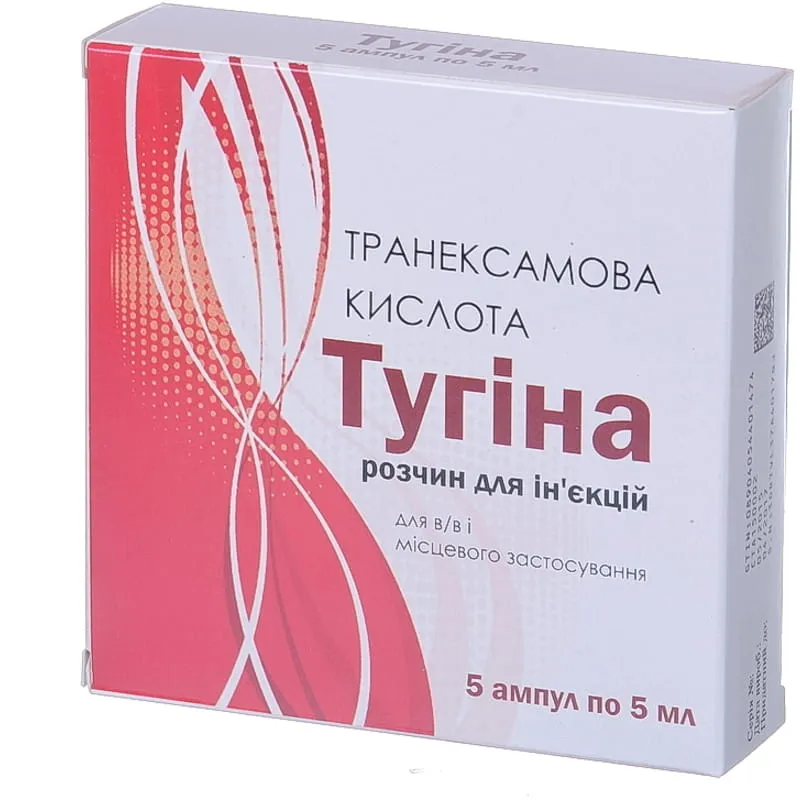
Table of Contents
INSTRUCTION FOR MEDICAL USE OF THE MEDICINAL PRODUCT TUGYNA (TUGYNA)
Composition:
Active substance: tranexamic acid;
1 ml of injection solution contains 100 mg of tranexamic acid;
Excipients: water for injections.
Pharmaceutical form. Injection solution.
Main physicochemical properties: clear, colorless solution.
Pharmacotherapeutic group.
Fibrinolysis inhibitors. ATC code B02A A02.
Pharmacological properties.
Pharmacodynamics. Antifibrinolytic, anti-allergic, anti-inflammatory agent. Competitively inhibits plasminogen activator; at higher concentrations binds plasmin. Prolongs prothrombin time. Inhibits the formation of kinins and other peptides in inflammatory and allergic reactions.
Pharmacokinetics.
After intravenous administration of a 1 g dose, the concentration–time curve shows triexponential kinetics with a mean elimination half-life of approximately 2 hours in the terminal phase. The initial volume of distribution is approximately 9–12 L. It is excreted in urine. Eliminated by the kidneys via glomerular filtration. Total renal excretion is equivalent to total plasma clearance (110–116 mL/min). Over 95% of the administered dose is excreted unchanged in urine. Elimination of tranexamic acid amounts to approximately 90% within 24 hours after intravenous administration of the drug at a dose of 10 mg/kg body weight. Tranexamic acid crosses the placental barrier. The concentration in umbilical cord blood after intravenous administration of the drug at a dose of 10 mg/kg body weight in pregnant women is about 30 mg/L. Tranexamic acid rapidly penetrates into synovial fluid and synovial membrane. In synovial fluid, it reaches the same concentration level as in blood serum. The elimination half-life of tranexamic acid in synovial fluid is about 3 hours. The concentration of tranexamic acid in blood is lower than in other tissues. In breast milk, the concentration is about 1/100 of the peak concentration in blood serum. The concentration of tranexamic acid in cerebrospinal fluid is about 1/10 of the plasma concentration, and in intraocular fluid it is approximately 1/10 of the plasma concentration.
Clinical characteristics.
Indications.
Bleeding or risk of bleeding due to enhanced fibrinolysis, both generalized (bleeding during surgery and in the postoperative period on the prostate gland, hemorrhagic complications of fibrinolytic therapy) and localized (uterine, gastrointestinal bleeding, bleeding after prostatectomy, tonsillectomy, cervical conization, tooth extraction in patients with hemophilia).
Contraindications.
Hypersensitivity to any component of the medicinal product, acute venous or arterial thrombosis, thromboembolic disorders, deep vein thrombosis, tendency to thrombosis and embolism, coagulopathy due to disseminated intravascular coagulation (DIC syndrome) without significant activation of fibrinolysis, color vision disturbances. Subarachnoid hemorrhage, severe renal insufficiency (risk of drug accumulation), hematuria, history of seizures in the patient. Intrathecal and intraventricular injections, intracerebral administration are contraindicated (risk of cerebral edema with subsequent development of seizures).
Interaction with other medicinal products and other forms of interactions.
Due to limited data, highly active prothrombin complex concentrates and other antifibrinolytic agents, anti-inhibitor coagulation complex concentrates should not be used concomitantly with tranexamic acid. Tranexamic acid can be mixed with most solutions (electrolytes, glucose solution, shock-prevention solution).
Heparins may be added during intravenous infusion.
Concomitant therapy with chlorpromazine and tranexamic acid in patients with subarachnoid hemorrhage may lead to cerebral vasospasm and cerebral ischemia, as well as possible reduction in cerebral blood flow.
The drug is incompatible with urokinase, noradrenaline bitartrate, desoxyepinephrine hydrochloride, dipyridamole, diazepam.
Use with caution in patients receiving antifibrinolytic therapy.
Concomitant use with estrogens increases the risk of thrombus formation.
Special precautions for use.
Intravenous injections should be administered slowly. Tranexamic acid should not be administered intramuscularly.
Rapid intravenous administration may cause dizziness and hypotension. To avoid arterial hypotension, the drug should be administered slowly at a rate not exceeding 1 mg per minute.
In renal impairment (depending on the degree of serum creatinine elevation), the dose and frequency of administration should be reduced. The drug is contraindicated in severe renal impairment.
When treating hematuria of renal origin, there is an increased risk of mechanical anuria due to clot formation in the urethra.
Before administering tranexamic acid, risk factors for thromboembolic disorders should be evaluated.
Cases of venous and arterial thrombosis or thromboembolism have been observed in patients receiving the drug. In addition, cases of retinal vessel occlusion and central retinal vein occlusion have been reported. Patients with thromboembolic disease or a history of hereditary thromboembolic disorders are at increased risk of developing venous or arterial thrombosis.
Tranexam should not be used concomitantly with Factor IX complex or antithrombin-coagulation complexes, as this may increase the risk of thrombosis.
Patients with disseminated intravascular coagulation (DIC syndrome) requiring treatment with the drug should be under the supervision of a physician experienced in managing such conditions.
In patients with disseminated intravascular coagulation (DIC), treatment should be limited to cases where fibrinolytic system activation predominates during acute severe bleeding.
In patients at high risk of thromboembolism, tranexamic acid may be used concomitantly with heparin. Tranexamic acid does not interfere with the mechanism of action of heparin.
During prolonged treatment over several days, ophthalmological monitoring is required, including assessment of visual acuity, visual fields, color vision, and fundus examination.
Tranexamic acid should be used with caution in patients taking oral contraceptives, as this may increase the risk of thrombosis.
Seizures have been reported during treatment with tranexamic acid. Most of these cases occurred after intravenous administration of high doses of tranexamic acid during coronary artery bypass grafting (CABG). When recommended low doses of tranexamic acid are used, the incidence of postoperative seizures is similar to that in patients not receiving tranexamic acid.
Use during pregnancy or breastfeeding.
Women of childbearing age should use effective contraceptive methods during treatment.
There are insufficient clinical data on the use of the drug during pregnancy; therefore, the medicinal product should be used only when the pregnant woman's life is at risk.
As a precautionary measure, the use of tranexamic acid is not recommended during the first trimester of pregnancy.
There are only limited clinical data on the use of tranexamic acid in various hemorrhagic conditions during the second and third trimesters of pregnancy, and these data do not indicate any harmful effects on the fetus.
Tranexamic acid passes into breast milk. If treatment is necessary, a decision should be made whether to discontinue breastfeeding.
There are no clinical data on the effect of tranexamic acid on fertility.
Ability to affect reaction speed when driving or operating machinery.
It should be noted that during treatment, dizziness and arterial hypotension may occur in some patients. Therefore, caution should be exercised when driving vehicles or operating other complex machinery.
Method of Administration and Dosage
Administer intravenously (by infusion or bolus injection).
The dosage regimen is individual and depends on the clinical situation.
In generalized fibrinolysis, administer at a single dose of 15 mg/kg body weight every 6–8 hours; the infusion rate should be 1 mL/min.
In local fibrinolysis, the recommended dosage is 200–500 mg 2–3 times daily.
In prostatectomy, administer 1 g intraoperatively, followed by 1 g every 8 hours for 3 days, then switch to oral administration of tranexamic acid tablets until macrohematuria resolves.
If there is a high risk of bleeding or in systemic inflammatory response, it is recommended to administer the drug at a dose of 10–11 mg/kg 20–30 minutes before the procedure.
In patients with coagulopathy, administer the drug at a dose of 10 mg/kg body weight before tooth extraction, followed by oral administration of tranexamic acid tablets after the extraction.
In cases of impaired renal excretory function, dosage adjustment is required:
- At serum creatinine concentration of 120–250 µmol/L: 10 mg/kg twice daily;
- At serum creatinine concentration of 250–500 µmol/L: 10 mg/kg once daily;
- At serum creatinine concentration above 500 µmol/L: 5 mg/kg once daily.
Children.
The maximum single dose for children aged 1 year and older is 10 mg/kg, administered twice daily. The maximum daily dose is 20 mg/kg body weight.
Elderly Patients.
If renal excretory function is not impaired, dosage adjustment is not required.
Children.
Dosage according to age has not been established.
The efficacy, dosing characteristics, and safety of tranexamic acid in children after cardiac surgery have not been fully studied.
Overdose.
In isolated cases, nausea, vomiting, orthostatic symptoms, arterial hypotension, dizziness, headache, seizures, or worsening of other adverse reactions may occur.
Treatment: symptomatic therapy, forced diuresis.
Adverse Reactions.
Gastrointestinal system: nausea, vomiting, diarrhea, stomach and intestinal discomfort.
Nervous system: seizures, dizziness.
Vascular disorders: arterial hypotension (especially after rapid intravenous administration), orthostatic hypotension, thromboembolism, deep vein thrombosis, pulmonary embolism, cerebral vascular thrombosis.
Renal and urinary system: acute cortical necrosis of the kidneys.
Eye disorders: visual disturbances, chromatopsia.
Possible hypersensitivity reactions, including anaphylaxis, skin rashes.
Shelf life. 2 years.
Storage conditions.
Store in the original packaging at a temperature not exceeding 25 °C. Do not freeze. Keep out of reach of children.
Incompatibility.
Pharmaceutically incompatible with blood products; solutions containing penicillin, hypertensive agents (norepinephrine, deoxyepinephrine hydrochloride); tetracyclines; dipyridamole; diazepam.
Incompatible with urokinase, except when used as an antidote following urokinase overdose.
Packaging.
5 ml in a vial made of colorless glass; 5 vials in a PVC blister pack; each blister pack in a cardboard box.
Prescription status. Prescription only.
Manufacturer.
Steril-Gene Life Sciences (P) Ltd.
Manufacturer's address.
No. 45, Mangalam Main Road, Villianur Commune, Puducherry 605110, India
Marketing Authorization Holder.
Tulip Lab Private Limited, India
Address of the Marketing Authorization Holder.
4024, A-Wing, Oberoi Garden Estate, Chandivali, Andheri (East), Mumbai 400 072, India