Cinacalcet-vista
Ukraine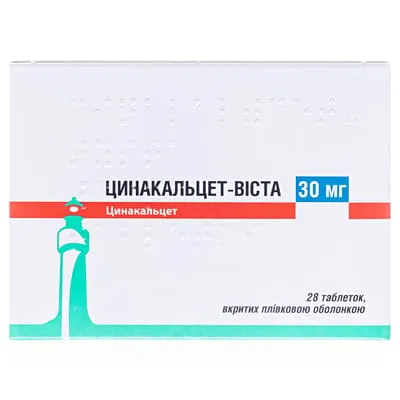
Table of Contents
INSTRUCTION FOR MEDICAL USE OF THE MEDICINAL PRODUCT CINACALCET-VISTA CINACALCET-VISTA
Composition:
Active substance: cinacalcet;
One film-coated tablet contains 30 mg of cinacalcet, equivalent to 33.06 mg of cinacalcet hydrochloride, or 60 mg of cinacalcet, equivalent to 66.12 mg of cinacalcet hydrochloride, or 90 mg of cinacalcet, equivalent to 99.18 mg of cinacalcet hydrochloride;
Excipients: pregelatinized starch, crospovidone (intragranular), povidone, microcrystalline cellulose, colloidal anhydrous silicon dioxide, magnesium stearate;
Coating: partially hydrolyzed polyvinyl alcohol, titanium dioxide (E 171), macrogol, talc, indigocarmine aluminum lake FD&C Blue #2 (E 132), yellow iron oxide (E 172).
Pharmaceutical form. Film-coated tablets.
Main physicochemical properties:
30 mg: oval, biconvex, film-coated tablets, green in color, with "C9CC" engraved on one side and "30" on the other;
60 mg: oval, biconvex, film-coated tablets, green in color, with "C9CC" engraved on one side and "60" on the other;
90 mg: oval, biconvex, film-coated tablets, green in color, with "C9CC" engraved on one side and "90" on the other.
Pharmacotherapeutic group. Hormonal preparations for systemic use (excluding sex hormones and insulin). Agents regulating calcium metabolism. Other anti-parathyroid agents. Cinacalcet. ATC code H05BX01.
Pharmacological properties.
Pharmacodynamics.
Mechanism of action.
Calcium-sensing receptors located on the surface of the parathyroid gland chief cells are the main regulators of parathyroid hormone (PTH) secretion. Cinacalcet exerts a calcimimetic effect by directly reducing PTH levels, increasing the sensitivity of the calcium-sensing receptor to extracellular calcium levels. Reduction in PTH levels is accompanied by a decrease in serum calcium concentration. The reduction in PTH correlates with cinacalcet concentration. After reaching the steady state, serum calcium concentration remains at a constant level throughout the dosing interval.
Pharmacokinetics.
Absorption.
Following oral administration, maximum plasma concentration (Cmax) of cinacalcet is reached approximately within 2–6 hours. Absolute bioavailability of cinacalcet administered under fasting conditions, determined based on comparison of results from different studies, was approximately 20–25%. Administration of cinacalcet with food increases its bioavailability by approximately 50–80%. This increase in plasma cinacalcet concentration is observed independently of the fat content of the meal.
During administration of doses exceeding 200 mg, absorption becomes saturated, likely due to low solubility.
Distribution.
A high volume of distribution (approximately 1000 L) is observed, indicating extensive distribution. Cinacalcet is approximately 97% bound to plasma proteins and distributes minimally into erythrocytes.
After absorption, the decline in cinacalcet concentration occurs in two phases; the initial half-life is approximately 6 hours, and the terminal half-life ranges from 30 to 40 hours. Steady-state levels of cinacalcet are achieved within 7 days with minimal accumulation. The pharmacokinetic properties of cinacalcet do not change over time.
Metabolism.
Cinacalcet is metabolized by multiple enzymes, primarily CYP3A4 and CYP1A2 (the role of CYP1A2 has not been confirmed by clinical methods). The main circulating metabolites are inactive. According to in vitro data, cinacalcet is a potent inhibitor of CYP2D6; however, at concentrations achieved under clinical conditions, cinacalcet is not an inhibitor of other CYP enzymes, including CYP1A2, CYP2C8, CYP2C9, CYP2C19, and CYP3A4, nor is it an inducer of CYP1A2, CYP2C19, or CYP3A4.
Elimination.
After administration of a radiolabeled 75 mg dose to healthy volunteers, cinacalcet underwent rapid and extensive oxidative metabolism followed by conjugation. Elimination of radioactivity occurred primarily via renal excretion of metabolites. Approximately 80% of the administered dose was recovered in urine and 15% in feces.
Linearity/Non-linearity.
The increase in area under the plasma concentration-time curve (AUC) and Cmax is nearly linear over the dose range of 30 mg to 180 mg administered once daily.
Pharmacokinetic/Pharmacodynamic relationship.
Shortly after administration, PTH levels begin to decrease and reach their lowest point approximately 2–6 hours later, corresponding to the time of Cmax of cinacalcet. Thereafter, cinacalcet concentration begins to decline, while PTH levels gradually increase over the 12 hours following dose administration; however, PTH suppression remains approximately at the same level until the end of the 24-hour dosing interval with once-daily dosing. PTH levels were measured at the end of the dosing interval during clinical trials of cinacalcet.
Elderly patients. No clinically significant differences in the pharmacokinetics of cinacalcet related to patient age have been observed.
Renal impairment. The pharmacokinetic profile of cinacalcet in patients with mild, moderate, or severe renal impairment, as well as in patients undergoing hemodialysis or peritoneal dialysis, does not differ significantly from that in healthy volunteers.
Hepatic impairment. Mild hepatic impairment does not result in a noticeable effect on the pharmacokinetics of cinacalcet. Compared to patients with normal liver function, mean AUC values were approximately 2-fold higher in patients with moderate hepatic impairment and approximately 4-fold higher in those with severe hepatic impairment. The mean elimination half-life of cinacalcet is prolonged by 33% and 70%, respectively, in patients with moderate and severe hepatic impairment. Hepatic impairment does not affect the plasma protein binding of cinacalcet. Since dose titration for each patient is based on efficacy and safety parameters, no additional dose adjustment is required for patients with hepatic impairment.
Gender. Clearance of cinacalcet may be lower in females than in males. However, since dose titration is individualized, no additional dose adjustment based on patient gender is required. A population pharmacokinetic analysis was conducted to evaluate the impact of demographic characteristics. This analysis showed no significant influence of gender, race, body surface area, or body weight on the pharmacokinetics of cinacalcet.
Smoking. Clearance of cinacalcet is higher in smokers than in non-smokers, likely due to CYP1A2-mediated enzyme induction. If a patient stops or starts smoking, plasma levels of cinacalcet may change, and dose adjustment may be necessary.
Clinical characteristics.
Indications.
Treatment of secondary hyperparathyroidism (HPT) in adult patients with end-stage renal disease (ESRD) on maintenance hemodialysis. The medicinal product Cinacalcet-Vista may be used as part of a comprehensive treatment regimen including phosphate binders and/or vitamin D sterols, as required (see section "Pharmacological properties").
Parathyroid carcinoma and primary hyperparathyroidism in adults.
Reduction of hypercalcemia in adult patients with:
- parathyroid carcinoma;
- primary HPT, when parathyroidectomy (according to established treatment guidelines) is indicated to reduce serum calcium levels, but is not feasible or contraindicated due to the patient's condition.
Contraindications.
Hypersensitivity to the active substance or to any of the excipients listed in the section "Composition".
Hypocalcemia.
Interaction with other medicinal products and other forms of interactions.
Medicinal products that lower serum calcium levels
Concomitant use of medicinal products that lower serum calcium levels together with cinacalcet may increase the risk of hypocalcemia. Patients receiving cinacalcet should not be prescribed etelcalcetide.
Effect of other medicinal products on cinacalcet
Cinacalcet is metabolized by the enzyme CYP3A4. Concomitant administration of 200 mg ketoconazole, a strong CYP3A4 inhibitor, resulted in an approximately two-fold increase in cinacalcet levels. Dose adjustment of cinacalcet may be necessary when a patient receiving cinacalcet starts or stops treatment with a strong inhibitor (e.g., ketoconazole, itraconazole, telithromycin, voriconazole, ritonavir) or inducer (e.g., rifampicin) of this enzyme.
In vitro data show that cinacalcet is partially metabolized by CYP1A2. Smoking stimulates CYP1A2; plasma levels of cinacalcet observed in smokers were 36–38% higher than in non-smokers. The effect of CYP1A2 inhibitors (e.g., fluvoxamine, ciprofloxacin) on plasma levels of cinacalcet has not been studied. Dose adjustment may be required when a patient starts or stops smoking or when concomitant therapy with a strong CYP1A2 inhibitor is initiated or discontinued.
Calcium carbonate. Concomitant administration of calcium carbonate (single dose of 1500 mg) does not alter the pharmacokinetics of cinacalcet.
Sevelamer. Concomitant administration of sevelamer (2400 mg three times daily) does not affect the pharmacokinetics of cinacalcet.
Pantoprazole. Concomitant administration of pantoprazole (80 mg once daily) does not alter the pharmacokinetics of cinacalcet.
Effect of cinacalcet on other medicinal products
Medicinal products metabolized by cytochrome P450 2D6 (CYP2D6). Cinacalcet is a strong inhibitor of CYP2D6; therefore, dose adjustment may be necessary for concomitant medicinal products with a narrow therapeutic index that are primarily metabolized by CYP2D6 (e.g., flecainide, propafenone, metoprolol, desipramine, nortriptyline, clomipramine).
Desipramine. Concomitant administration of 90 mg cinacalcet once daily with 50 mg desipramine (a tricyclic antidepressant primarily metabolized by CYP2D6) significantly increased the exposure to desipramine by 3.6-fold (90% confidence interval (CI) 3.0) in CYP2D6 extensive metabolizers.
Dextromethorphan. Multiple doses of 50 mg cinacalcet increased the AUC of dextromethorphan by 11-fold (primarily metabolized by CYP2D6).
Warfarin. Repeated oral administration of cinacalcet did not affect the pharmacokinetics and pharmacodynamics of warfarin (as assessed by prothrombin time and factor VII clotting activity).
The lack of effect of cinacalcet on the pharmacokinetics of R- and S-warfarin and the absence of autoinduction in patients with repeated dosing suggest that cinacalcet is not an inducer of CYP3A4, CYP1A2, or CYP2C9 in humans.
Midazolam. Concomitant administration of cinacalcet (90 mg) and oral midazolam (2 mg), a substrate of CYP3A4 and CYP3A5, does not alter the pharmacokinetics of midazolam. These data suggest that cinacalcet does not affect the pharmacokinetics of drugs metabolized by CYP3A4 and CYP3A5, including certain immunosuppressants such as cyclosporine and tacrolimus.
Special precautions for use.
Serum calcium levels.
Cinacalcet should not be initiated in patients with serum calcium levels (corrected for albumin) below the lower limit of the normal range.
Life-threatening events and fatal cases have been reported in adults and children receiving cinacalcet therapy. Potential manifestations of hypocalcemia include paresthesia, muscle pain, muscle spasms, tetany, and seizures. Decreased serum calcium levels may also lead to QT interval prolongation, which may potentially result in ventricular arrhythmias associated with hypocalcemia. Cases of QT interval prolongation and ventricular arrhythmias have been reported in patients receiving cinacalcet therapy (see section "Adverse reactions"). Cinacalcet-Vista should be used with caution in patients with other risk factors for QT interval prolongation, including patients with known congenital long QT syndrome or patients receiving medicinal products known to prolong the QT interval. Since cinacalcet reduces serum calcium levels, patients should be closely monitored for the development of hypocalcemia (see section "Dosage and administration"). Serum calcium levels should be measured within 1 week after initiation or dose adjustment of cinacalcet.
Adults
Cinacalcet therapy should not be initiated in patients with serum calcium levels (corrected for albumin) below the lower limit of normal.
Approximately 30% of dialysis patients with CKD receiving cinacalcet experienced at least one episode of serum calcium concentration below 7.5 mg/dL (1.9 mmol/L).
Non-dialysis CKD patients.
Cinacalcet is not indicated for patients with CKD who are not on dialysis. Clinical studies have shown that adult CKD patients not on dialysis who received cinacalcet had an increased risk of hypocalcemia (serum calcium < 8.4 mg/dL [2.1 mmol/L]) compared to CKD patients on dialysis receiving cinacalcet, which may be related to lower baseline calcium levels and/or residual renal function.
Seizures
Seizures have been reported in patients receiving cinacalcet (see section "Adverse reactions"). The seizure threshold is lowered by significant reductions in serum calcium levels. Therefore, serum calcium levels should be closely monitored in patients receiving Cinacalcet-Vista, particularly in those with a history of seizure disorders.
Arterial hypotension and/or worsening heart failure
During post-marketing pharmacovigilance, isolated cases of arterial hypotension and/or worsening heart failure have been reported in patients with cardiac disease. A causal relationship with cinacalcet use cannot be entirely ruled out, as these events may be related to reduced serum calcium levels.
Concomitant use with other medicinal products
Cinacalcet should be used with caution in patients receiving other medicinal products known to reduce serum calcium levels. Serum calcium levels should also be closely monitored (see section "Interaction with other medicinal products and other forms of interaction").
Etelcalcetide should not be administered to patients receiving cinacalcet. Concomitant use may lead to severe hypocalcemia.
General
Chronic suppression of PTH concentration to levels 1.5 times below the upper limit of normal for iPTH may lead to adynamic bone disease. If PTH levels fall below the recommended range in patients receiving cinacalcet, the dose of Cinacalcet-Vista and/or vitamin D should be reduced or therapy discontinued.
Testosterone levels
Testosterone levels are generally lower than normal in patients with end-stage renal disease. Data from a clinical study in dialysis patients with ESRD showed that free testosterone concentration decreased by an average of 31.3% in patients receiving cinacalcet and by 16.3% in placebo group patients after 6 months of therapy. The open-label extension phase of this study did not show further decline in free and total testosterone concentrations over a 3-year treatment period with cinacalcet. The clinical significance of these reductions in serum testosterone levels is unknown.
Hepatic impairment
Due to the potential for a 2- to 4-fold increase in plasma cinacalcet levels in patients with moderate and severe hepatic impairment (Child-Pugh classification), cinacalcet should be used with caution in these patients, and their condition should be closely monitored (see sections "Pharmacokinetics" and "Dosage and administration").
Use during pregnancy or breastfeeding
Pregnancy
There are no clinical data on the use of cinacalcet in pregnant women. Animal studies do not indicate direct harmful effects on pregnancy, parturition, or postnatal development. No embryotoxic/fetotoxic effects were observed in studies with pregnant animals, except for reduced fetal body weight at doses associated with maternal toxicity. Therefore, cinacalcet should be used during pregnancy only if the expected benefit to the mother outweighs the potential risk to the fetus.
Breastfeeding
It is unknown whether cinacalcet is excreted in human breast milk. Cinacalcet is excreted in the milk of lactating rats, with a high milk-to-plasma concentration ratio. After careful assessment of benefit/risks, a decision should be made whether to discontinue breastfeeding or to discontinue/abstain from cinacalcet therapy.
Fertility
There are no clinical data on the effect of cinacalcet on fertility. No effects on fertility were observed in animal studies.
Ability to affect reaction speed when driving or operating machinery.
Cinacalcet-Vista may have a moderate influence on the ability to drive vehicles and operate machinery, as patients receiving cinacalcet have reported dizziness and seizures (see section "Special precautions for use").
Dosage and Administration
Secondary Hyperparathyroidism
Adults, including elderly patients (> 65 years of age)
The recommended initial dose of the medicinal product Cinacalcet-Vista for adults is 30 mg once daily. Dose titration of cinacalcet should be performed every 2–4 weeks up to the maximum dose of 180 mg once daily, at which the desired parathyroid hormone (PTH) concentration in the range of 150–300 pg/mL (15.9–31.8 pmol/L) is achieved in hemodialysis patients. This concentration is determined by measuring intact PTH (iPTH assay).
Determination of PTH concentration should be performed 1–4 weeks after initiation of therapy or dose adjustment of cinacalcet. PTH levels should be monitored approximately every 1–3 months during medical examinations. The concentration of PTH can be monitored by measuring either iPTH or bio-intact PTH (bio-iPTH). Treatment with cinacalcet does not alter the ratio between iPTH and bio-iPTH.
Dose adjustment based on serum calcium levels
Serum calcium should be measured and monitored prior to administration of the first dose of cinacalcet and should be at the lower limit of the normal range or above. The normal calcium range may vary depending on the methods used in the respective laboratory.
During dose titration, serum calcium levels should be monitored more frequently and no later than 1 week after initiation of treatment or dose adjustment of cinacalcet. After the maintenance dose has been established, serum calcium should be measured approximately monthly. If serum calcium level falls below 8.4 mg/dL (2.1 mmol/L) and/or symptoms of hypocalcemia occur, the following measures are recommended.
Table 1
| Serum calcium level or clinical symptoms of hypocalcemia |
Recommendations |
| < 8.4 mg/dL (2.1 mmol/L) and > 7.5 mg/dL (1.9 mmol/L) or presence of clinical symptoms of hypocalcemia. |
Calcium-containing phosphate binders, vitamin D sterols, and/or adjustment of calcium concentration in dialysate may be used to increase serum calcium levels according to clinical assessment. |
| < 8.4 mg/dL (2.1 mmol/L) and > 7.5 mg/dL (1.9 mmol/L) or persistent symptoms of hypocalcemia despite attempts to increase serum calcium levels. |
Reduce dose or discontinue cinacalcet. |
| ≤ 7.5 mg/dL (1.9 mmol/L) or persistent symptoms of hypocalcemia and inability to increase vitamin D levels. |
Discontinue cinacalcet until serum calcium levels reach 8.0 mg/dL (2.0 mmol/L) and/or hypocalcemia symptoms resolve. Therapy should be resumed at the next lower dose of cinacalcet. |
Transition from etelcalcetide to cinacalcet.
The transition from etelcalcetide to cinacalcet and the corresponding washout period has not been studied in patients. Patients who have discontinued treatment with etelcalcetide should not initiate cinacalcet until at least three subsequent hemodialysis sessions have been completed. Serum calcium levels should then be measured. Before starting cinacalcet, it is necessary to ensure that serum calcium levels are within the normal range.
Parathyroid carcinoma and primary hyperparathyroidism.
Adults, including elderly patients (> 65 years of age).
The recommended initial dose of cinacalcet for adults is 30 mg twice daily. The dose of cinacalcet should be titrated every 2–4 weeks in the following dose escalation sequence: 30 mg twice daily, 60 mg twice daily, 90 mg twice daily, and 90 mg three or four times daily, as needed, to reduce serum calcium concentration to the upper limit of normal or below. The maximum dose used in clinical trials was 90 mg four times daily.
Serum calcium levels should be measured within 1 week after initiating therapy or adjusting the cinacalcet dose. After reaching the maintenance dose, serum calcium should be measured every 2–3 months. Following completion of the dose titration period up to the maximum dose, serum calcium levels should be monitored periodically; if a clinically meaningful reduction in serum calcium is not achieved, discontinuation of cinacalcet therapy should be considered (see section "Pharmacodynamics").
Children.
The safety and efficacy of cinacalcet in children for the treatment of parathyroid carcinoma and primary hyperparathyroidism have not been established. No data are available.
Hepatic impairment.
No initial dose adjustment is required. Cinacalcet should be used with caution in patients with moderate to severe hepatic impairment. Close monitoring of these patients is necessary during dose titration and long-term treatment (see sections "Pharmacodynamics" and "Special precautions for use").
Method of administration.
For oral use. Cinacalcet is recommended to be taken with food or immediately after a meal, as studies have shown that the bioavailability of cinacalcet is increased when administered with food (see section "Pharmacodynamics"). Tablets should be swallowed whole, without splitting or crushing.
Children.
The medicinal product Cinacalcet-Vista is not indicated for use in children. The safety and efficacy of its use in this patient population have not been established.
Overdose.
Doses titrated up to 300 mg once daily have been safely administered to dialysis patients.
Overdose of cinacalcet may lead to hypocalcemia. In the event of overdose, patients should be evaluated for symptoms of hypocalcemia, and treatment should be symptomatic and supportive. Because cinacalcet is highly protein-bound, hemodialysis is not an effective method for treating overdose.
Adverse reactions.
Secondary hyperparathyroidism, parathyroid carcinoma, and primary hyperparathyroidism
Based on available results from placebo-controlled studies involving patients treated with cinacalcet, the most commonly reported adverse reactions were mild to moderate nausea and vomiting, which were mostly transient in nature. Discontinuation of therapy due to adverse reactions was primarily attributed to nausea and vomiting.
Adverse reactions considered to be possibly related to the use of cinacalcet in placebo-controlled and uncontrolled studies are listed below by frequency: very common (≥ 1/10); common (≥ 1/100 to < 1/10); uncommon (≥ 1/1000 to < 1/100); rare (≥ 1/10000 to < 1/1000); very rare (< 1/10,000); frequency not known (cannot be estimated from the available data).
Table 2
| MedDRA System Organ Class |
Frequency |
Adverse Reaction |
| Immune system disorders |
common |
Hypersensitivity reactions |
| Metabolism and nutrition disorders |
common |
anorexia, decreased appetite |
| Nervous system disorders |
common |
convulsions**, dizziness, paraesthesia, headache |
| Cardiac disorders |
frequency unknown* |
worsening of heart failure**, QT interval prolongation and ventricular arrhythmia due to hypocalcemia** |
| common |
hypotension |
|
| Respiratory, thoracic and mediastinal disorders |
common |
upper respiratory tract infections, dyspnea, cough, dyspnea |
| Gastrointestinal disorders |
very common |
nausea, vomiting |
| common |
dyspepsia, diarrhea, abdominal pain, upper abdominal pain, constipation |
|
| Skin and subcutaneous tissue disorders |
common |
rash |
| Musculoskeletal and connective tissue disorders |
common |
myalgia, muscle cramps, back pain |
| General disorders and administration site conditions |
common |
asthenia |
| Investigations |
common |
hypocalcemia**, hyperkalemia, decreased testosterone levels** |
** See section "Special precautions for use".
* See section "Description of selected adverse reactions".
Description of selected adverse reactions.
Hypersensitivity reactions.
Hypersensitivity reactions, including angioedema and urticaria, have been reported during the post-marketing period of cinacalcet use. The frequency of individual adverse reactions, including angioedema and urticaria, cannot be estimated from the available data.
Arterial hypotension and/or worsening of heart failure.
There have been reports of isolated cases of arterial hypotension and/or worsening of heart failure in patients with cardiac dysfunction during the post-marketing period of cinacalcet use; based on the available data, the frequency of such cases cannot be established.
Prolongation of the QT interval and ventricular arrhythmia associated with hypocalcemia. Prolongation of the QT interval and ventricular arrhythmia associated with hypocalcemia have been observed during the post-marketing period of cinacalcet use; their frequency cannot be estimated from the available data (see section "Special precautions for use").
Paediatric population.
Cinacalcet is not intended for use in children. Data on the safety and efficacy of cinacalcet in paediatric patients are lacking. A fatal case was reported in a child with severe hypocalcemia.
Reporting of suspected adverse reactions.
Reporting suspected adverse reactions after medicine authorization is important. It allows continued monitoring of the benefit-risk balance of the medicine. Healthcare professionals are required to report any suspected adverse reactions via the national reporting system.
Shelf life.
36 months.
Storage conditions.
Store in the original packaging at a temperature not exceeding 25 °C. Keep out of reach and sight of children.
Packaging.
14 film-coated tablets in a blister; 2 blisters in a cardboard carton.
Prescription status.
Prescription only.
Manufacturer.
Sínton Hispania, S.L./Synthon Hispania, S.L.
Synthon s.r.o./Synthon, s.r.o.
Manufacturers' addresses and locations of operations.
C/Castello, no1, Sant Boi de Llobregat, Barcelona, 08830, Spain.
Brnenska 32/cp. 597, Blansko, 678 01, Czech Republic.