Cilitin
Ukraine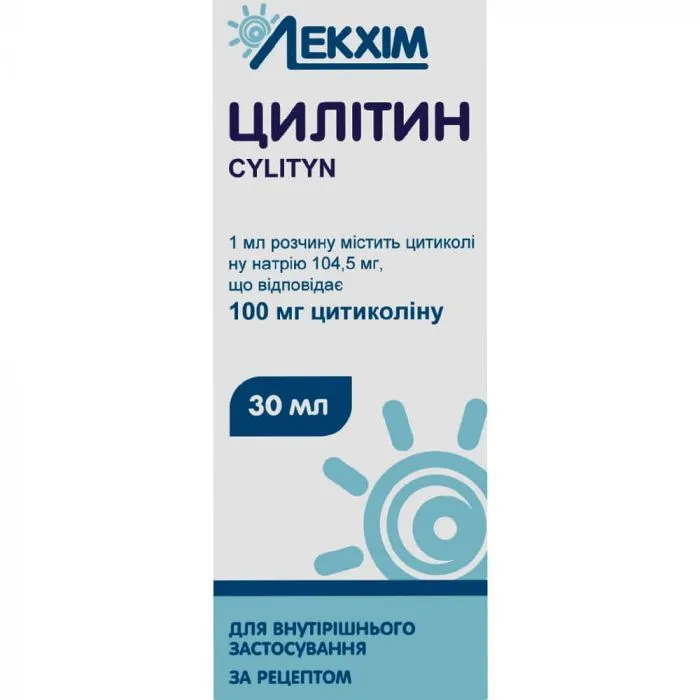
Table of Contents
INSTRUCTIONS FOR MEDICAL USE OF THE MEDICINAL PRODUCT CYLITYN (CILITYN)
Composition:
Active substance: sodium citicoline;
1 ml of solution contains sodium citicoline 104.5 mg, equivalent to 100 mg of citicoline;
Excipients: sorbitol (E 420) 70 % non-crystallizing solution, glycerin, methylparahydroxybenzoate (E 218), propylparahydroxybenzoate (E 216), sodium citrate, sodium saccharin, potassium sorbate, citric acid monohydrate, purified water.
Pharmaceutical form. Oral solution.
Main physicochemical properties: clear, colorless or almost colorless solution.
Pharmacotherapeutic group.
Psychostimulants, drugs used in attention deficit hyperactivity disorder (ADHD), nootropic agents. Other psychostimulant and nootropic agents.
ATC code N06B X06.
Pharmacological properties.
Pharmacodynamics.
Citicoline stimulates the biosynthesis of structural phospholipids in neuronal membranes, as confirmed by magnetic resonance spectroscopy data. Due to this mechanism of action, citicoline improves the functioning of membrane mechanisms such as ion exchange pumps and receptors, the modulation of which is essential for normal nerve impulse conduction.
Thanks to its stabilizing effect on neuronal membranes, citicoline exhibits anti-edematous properties that contribute to a reduction in cerebral edema.
Experimental studies have shown that citicoline inhibits the activation of certain phospholipases (A1, A2, C, and D), reduces the formation of free radicals, prevents the destruction of membrane systems, and preserves antioxidant defense systems such as glutathione.
Citicoline preserves neuronal energy reserves, inhibits apoptosis, and stimulates acetylcholine synthesis.
Experimental evidence has demonstrated that citicoline also exerts a preventive neuroprotective effect in focal cerebral ischemia.
Clinical studies have shown that citicoline significantly enhances functional recovery in patients with acute ischemic stroke, which correlates with a slowing of the growth in volume of ischemic brain damage as observed in neuroimaging.
In patients with traumatic brain injury, citicoline accelerates recovery and reduces the duration and severity of post-traumatic syndrome.
Citicoline improves levels of attention and consciousness, as well as cognitive and neurological disorders associated with cerebral ischemia, and helps reduce symptoms of amnesia.
Pharmacokinetics.
Citicoline is almost completely absorbed after oral administration. After administration, a significant increase in plasma choline levels is observed.
The drug is metabolized in the intestine and liver, forming choline and cytidine.
Following administration, citicoline is widely distributed throughout brain structures, with rapid incorporation of the choline fraction into structural phospholipids and the cytidine fraction into cytidine nucleotides and nucleic acids. In the brain, citicoline integrates into cellular, cytoplasmic, and mitochondrial membranes, becoming incorporated into the phospholipid fraction.
Only a small amount of the dose is excreted in urine and feces (less than 3%). Approximately 12% of the dose is excreted as exhaled CO₂. During excretion in urine, two phases are observed: the first phase lasting 36 hours, during which the elimination rate decreases rapidly, and a second phase, during which elimination decreases much more slowly. The same biphasic pattern is observed in excretion via the respiratory tract. The rate of CO₂ elimination decreases rapidly, approximately within 15 hours, then declines much more slowly.
Clinical characteristics.
Indications.
- Stroke, acute phase of cerebral circulation disorders, and treatment of complications and consequences of cerebral circulation disorders.
- Traumatic brain injury and its neurological consequences.
- Cognitive disorders and behavioral disturbances due to chronic vascular and degenerative cerebral disorders.
Contraindications.
- Hypersensitivity to citicoline or to other components of the drug.
- Increased tone of the parasympathetic nervous system.
Interaction with other medicinal products and other forms of interaction.
Citicoline enhances the effect of levodopa. The drug should not be administered simultaneously with medicinal products containing meclofenoxate.
Special precautions for use.
Cilicin oral solution should not be administered to patients with hereditary fructose intolerance due to the presence of sorbitol (E 420) in the formulation. Methylparahydroxybenzoate and propylparahydroxybenzoate contained in the product may cause allergic reactions (usually of delayed type).
The medicinal product contains sodium compounds (sodium citrate, sodium saccharin) and potassium compounds (potassium sorbate). Caution is advised when administering to patients on sodium- or potassium-restricted diets.
Use during pregnancy or breastfeeding.
Adequate data on the use of citicoline in pregnant women are lacking. Data regarding the excretion of citicoline in breast milk and its effects on the fetus are unknown. The medicinal product should be prescribed during pregnancy or breastfeeding only if the expected therapeutic benefit to the mother outweighs the potential risk to the fetus.
Ability to influence reaction speed when driving or operating machinery.
In individual cases, certain adverse reactions affecting the central nervous system may impair the ability to drive or operate complex machinery.
Dosage and Administration
For oral use. The recommended dose of the medicinal product Cytitin, oral solution,
for adults is from 500 mg (5 ml) to 2000 mg (20 ml) per day, divided into 2–3 doses, depending on the severity of symptoms.
The medicinal product should be administered using the provided dosing syringe as follows:
- Before use, fully depress the plunger of the dosing syringe.
- Pull back the plunger and draw up the required dose, ensuring that the volume of liquid in the syringe corresponds to the prescribed dose.
- The medicinal product may be taken directly or diluted in half a glass of water (120 ml), regardless of food intake.
The dosing syringe must be rinsed with water after each use.
Dosage and duration of treatment depend on the severity of brain lesions and are determined individually by the physician.
Elderly patients do not require dose adjustment.
Children.
Experience with the use of the medicinal product in children is limited.
Overdose.
Cases of overdose have not been reported.
Side effects.
Side effects occur very rarely (<1/10,000), including isolated cases.
Psychiatric disorders: hallucinations.
Central and peripheral nervous system disorders: severe headache, vertigo.
Cardiovascular disorders: arterial hypertension, arterial hypotension.
Respiratory system disorders: dyspnea.
Gastrointestinal disorders: nausea, vomiting, intermittent diarrhea.
Skin and subcutaneous tissue disorders: rash, hyperemia, exanthema, purpura.
General reactions: chills, edema.
Shelf life. 2 years.
Storage conditions.
Store in the original packaging at a temperature not exceeding 25°C.
Keep out of reach of children.
Packaging.
30 ml in a bottle; 1 bottle with a dosing syringe in a cardboard box.
Prescription status. Prescription only.
Manufacturer.
JSC "Tekhnolog".
Manufacturer's address and place of business.
8 Stara Prorizna Street, Uman, Cherkasy region, 20300, Ukraine.