Cyclo 3® fort
Ukraine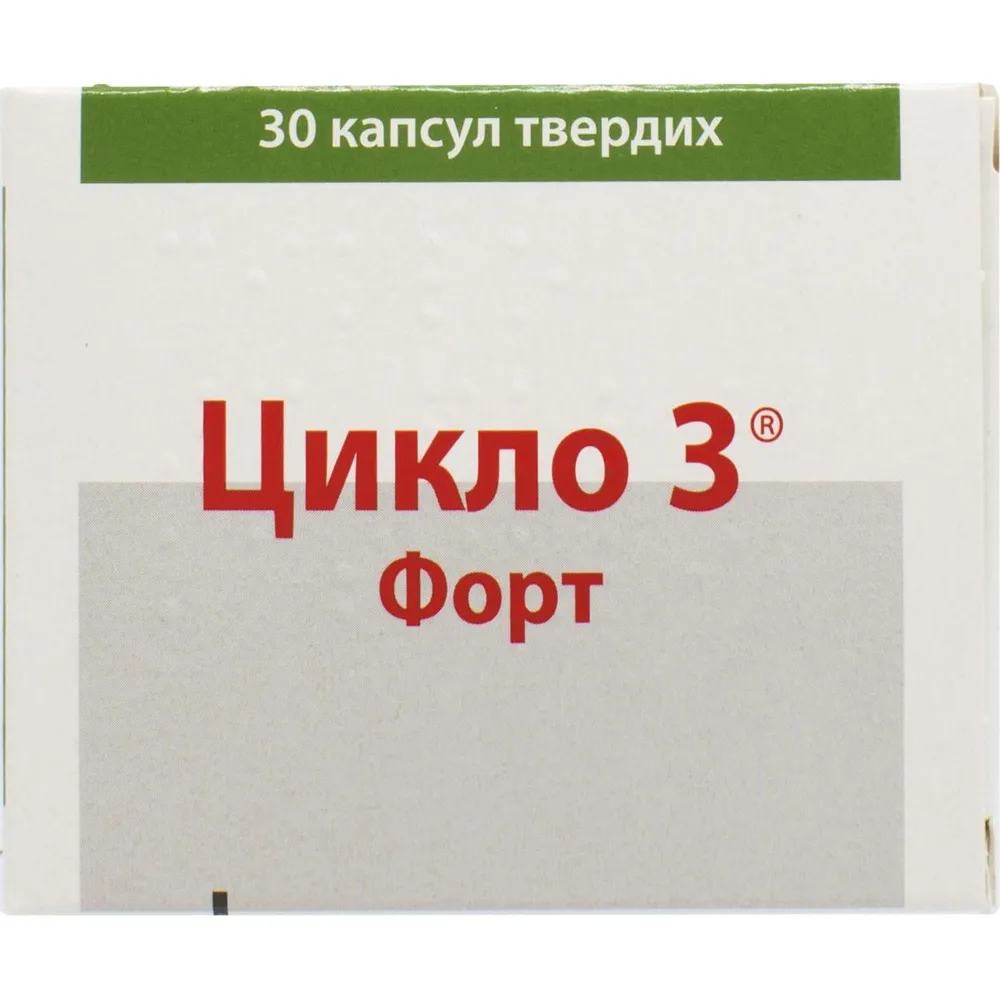
Table of Contents
INSTRUCTION FOR MEDICAL USE OF THE MEDICINAL PRODUCT CYCLO 3® FORT (CYCLO 3® FORT)
Composition:
Active substances: ruscus aculeatus, hesperidin methyl chalcone, ascorbic acid;
1 capsule contains dry extract of butcher's broom (Ruscus aculeatus) with a standardized content of steroidal saponins (150 mg), hesperidin methylchalcone (150 mg), ascorbic acid (100 mg);
Excipients (capsule contents): talc, macrogol 6000, colloidal silicon dioxide (hydrophobic), magnesium stearate;
Excipients (capsule shell): gelatin, colorant yellow "sunset" (E 110), quinoline yellow colorant (E 104), titanium dioxide (E 171).
Pharmaceutical form. Hard capsules.
Main physicochemical properties: size №1 capsule with an opaque yellow body and an opaque orange cap, containing a more or less compacted yellowish powder.
Pharmacotherapeutic group.
Angioprotectors. Capillary-stabilizing agents.
ATC code C05CX.
Pharmacological Properties
Pharmacodynamics
The drug has venotonic, lymphotonic, and angioprotective properties.
Venotonic effect
Demonstrated:
- In in vitro studies on isolated perfused veins, hawthorn extract rapidly (within 5–8 minutes) induced a pronounced, gradual, and sustained contraction of the vessel;
- In in vivo animal studies, hawthorn extract induced an increase in venous perfusion pressure.
The intensity of these effects was comparable in healthy and pathologically altered veins.
Mechanism of venotonic action
The venotonic effect of hawthorn extract is mediated via adrenergic mechanisms at two levels:
- Direct stimulation of postsynaptic alpha-1 and alpha-2 adrenergic receptors in vascular smooth muscle cells;
- Indirect action through the release of norepinephrine from granules of presynaptic nerve endings.
The intensity of hawthorn extract's action is proportional to temperature.
The venotonic effect of the drug on human blood vessels was confirmed by the Ahlqvist method (stereomicroscopic assessment of the tone of dorsal hand veins).
A dose-effect relationship after single-dose administration of the drug has also been established, demonstrating the respective contribution of each component of the medicinal product to venous tone.
Effect on lymphatic circulation
Adrenergic activity has been demonstrated in smooth muscle cells of lymphatic vessels:
- Hawthorn induced contraction of the isolated canine thoracic duct via adrenergic stimulation of the lymphatic collector through mechanisms analogous to its venotonic action;
- Hawthorn enhanced lymph flow in a small lymphatic vessel of the dog’s hind leg, indicating increased contractile capacity of this lymphatic vessel. The duration and intensity of the enhanced lymph flow were dose-dependent.
The combination of hawthorn, methylhydroxychalcone hesperidinate, and vitamin C induced contraction of human lymphatic vessel smooth muscle cells (HLVSMCs) by significantly increasing intracellular Ca2+ concentration in the cytosol. This was measured in native HLVSMCs isolated from lymphatic tissue and confirmed by video-microscopic analysis of fluorescence emitted by a Ca2+-sensitive, specific dye.
Angioprotective effect:
- Reduced capillary permeability in humans was demonstrated using the Landis test.
- In healthy subjects, increased capillary resistance was confirmed by the Kramar method (induction of petechiae on the skin under reduced pressure): a significant increase in capillary resistance was observed within the first hour after drug administration. This effect is primarily attributed to vitamin C.
- Hawthorn and methylhydroxychalcone hesperidinate inhibit hypoxia-induced endothelial cell activation: hawthorn extract prevents hypoxia-induced endothelial cell activation by inhibiting the decrease in adenosine triphosphate (ATP) levels, as demonstrated in human umbilical vein endothelial cells.
- Hawthorn extract binds in vitro to various types of muscarinic receptors and activates them. In vivo, its anti-inflammatory effects are at least partially mediated through muscarinic receptors: following ischemia/reperfusion (I/R), hawthorn extract reduces I/R-related leukocyte-endothelium interactions in a dose-dependent manner, decreasing leukocyte rolling and adhesion, indicating an anti-inflammatory effect.
Pharmacokinetics
Pharmacokinetic studies in animals demonstrated that the heterosides of hawthorn extract (labeled with tritium isotope) and methylhydroxychalcone hesperidinate (labeled with carbon-14 isotope) are rapidly absorbed, with maximum plasma concentration reached approximately 2 hours after administration. The drug components are excreted in urine and feces (the latter related to enterohepatic circulation).
Appropriate pharmacokinetic studies in humans are not feasible; however, pharmacodynamic tests allow indirect assessment of the kinetics of Cyclo 3® Fort.
Venous tone was measured by the Ahlqvist method in healthy subjects after administration of 1 capsule of Cyclo 3® Fort. Maximum venotonic effect was observed 2 hours after drug intake, with return to baseline levels occurring approximately 6 hours later.
Clinical characteristics.
Indications.
- Symptomatic treatment of venous-lymphatic insufficiency (with manifestations such as heaviness in the limbs, pain, tired legs syndrome).
- Acute hemorrhoidal attacks (treatment of functional symptoms).
Contraindications.
Hypersensitivity to any component of the drug; severe renal diseases.
Disorders of iron metabolism (thalassemia, hemochromatosis, sideroblastic anemia) due to the presence of ascorbic acid in the medicinal product.
Interaction with other medicinal products and other forms of interaction.
Specific studies on the interaction of Cyclo 3® Fort with other medicinal products or foodstuffs have not been conducted.
Deferoxamine
When high doses of ascorbic acid are administered intravenously, there is a risk of cardiac dysfunction or development of acute heart failure (usually resolves after discontinuation of vitamin C).
In patients with hemochromatosis, vitamin C should be taken only some time after administration of deferoxamine. When used concomitantly, cardiac function should be monitored.
Deferiprone
Based on extrapolation of data regarding interaction with deferoxamine: caution should be exercised when administering high intravenous doses of ascorbic acid during deferoxamine therapy, as there is a risk of cardiac dysfunction or development of acute heart failure (usually resolves after discontinuation of vitamin C).
Special precautions for use
- In case of diarrhea development, the drug should be discontinued.
- Use in hemorrhoids: treatment should be short-term. This medication cannot replace specific therapy for proctological diseases. If symptoms do not rapidly resolve, a thorough proctological examination of the patient should be performed and treatment reassessed.
Effect on laboratory test results
Ascorbic acid, as a reducing agent, may interfere with laboratory test results, for example, when measuring blood levels of glucose, bilirubin, transaminase activity, lactate, and other parameters.
The medicinal product contains a dye (E110) and may cause allergic reactions.
Use during pregnancy or breastfeeding
Pregnancy
There are limited data on the use of the medicinal product in pregnant women. Animal studies have not shown direct or indirect harmful effects on reproductive function. Preclinical data obtained from conventional studies on pharmacological safety, repeated-dose toxicity, genotoxicity, and reproductive function revealed no specific risk to humans. Carcinogenicity studies have not been conducted (however, in mice receiving only methylchalcone hesperidin, no carcinogenic effect was observed after 96 weeks of oral administration at a 5% diet, i.e., 20 g/kg body weight). As a precautionary measure, it is advisable to avoid using the medicinal product during pregnancy.
Breastfeeding
It is unknown whether metabolites of the medicinal product are excreted in breast milk. Risk to newborns/infants cannot be excluded. As a precautionary measure, the medicinal product should not be used during breastfeeding.
Fertility
Data regarding effects on fertility are lacking.
Ability to influence reaction rate while driving or operating machinery
No specific studies have been conducted.
Administration and Dosage
For venous-lymphatic insufficiency: 2–3 capsules per day. The treatment course usually lasts 1 month. If no positive effect is observed after 2 weeks of regular use, consult a physician.
In proctology: 4–5 capsules per day. The treatment course usually lasts 1 week. If no positive effect is observed after completion of this period, consult a physician.
Capsules should be taken orally with a glass of water.
Children
Due to lack of data, the drug is not recommended for use in children.
Overdose
There are few reports of overdose with this medication. Excessive doses of ascorbic acid may cause hemolytic anemia in patients with glucose-6-phosphate dehydrogenase (G6PD) deficiency. Daily intake of ascorbic acid exceeding 1 g may lead to oxalate lithiasis.
In case of overdose, symptomatic treatment is recommended.
Side effects
Side effects are presented according to the following classification: very common (≥ 1/10), common (≥ 1/100 to < 1/10), uncommon (≥ 1/1000 to < 1/100), rare (≥ 1/10,000 to < 1/1000), very rare (< 1/10,000), and not known (cannot be estimated from the available data).
Nervous system disorders:
- uncommon: insomnia;
- rare: nervousness.
Ear and labyrinth disorders:
- rare: vertigo.
Vascular disorders:
- rare: peripheral coldness, venous pain.
Gastrointestinal disorders:
- common: diarrhea, sometimes severe (associated with risk of weight loss and fluid and electrolyte imbalance if treatment is continued), resolves rapidly after discontinuation of the drug (see section "Special precautions"); abdominal pain;
- uncommon: dyspepsia, nausea;
- rare: gastrointestinal disorders, aphthous stomatitis.
Hepatobiliary disorders:
- rare: increased alanine aminotransferase levels.
Skin and subcutaneous tissue disorders:
- uncommon: erythema, pruritus.
Musculoskeletal and connective tissue disorders:
- uncommon: muscle spasms, limb pain.
Side effects with unknown frequency.
Gastrointestinal disorders:
- reversible, predominantly lymphocytic, microscopic colitis has been identified in some cases (or in some patients);
- stomach pain.
Skin and subcutaneous tissue disorders:
- maculopapular erythema, urticaria.
Laboratory and instrumental investigations:
Frequency not known: impact on laboratory test results.
Reporting of suspected adverse reactions
Reporting of suspected adverse reactions after registration of the medicinal product is important. It allows continued monitoring of the benefit-risk balance of the medicinal product. Medical and pharmaceutical personnel, as well as patients or their legal representatives, should report all cases of suspected adverse reactions and lack of efficacy of the medicinal product via the Automated Pharmacovigilance Information System at the following link: https://aisf.dec.gov.ua.
Shelf life
2 years.
Storage conditions
Store in the original packaging, protected from light, in a place inaccessible to children, at a temperature not exceeding 25 °C.
Packaging
10 capsules in a blister. 3 blisters in a cardboard pack.
Prescription status
Prescription only.
Manufacturer
Pierre Fabre Medicament Production.
Pierre Fabre Medicament Production.
Manufacturer's address and location of manufacturing site
Production site Progipharm, 4 Rue du Lycee, 45500 Gien, France / site Progipharm, Rue du Lycee, 45500 Gien, France.