Cetrorelix® 0.25 mg
Ukraine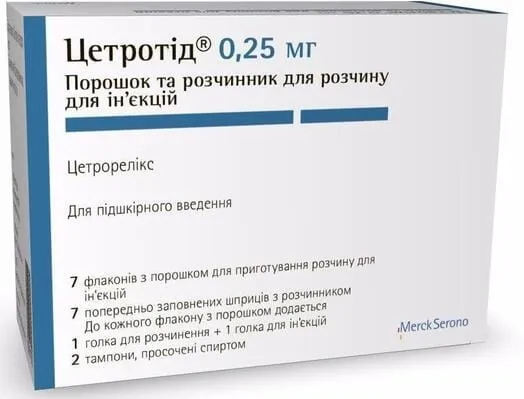
Table of Contents
INSTRUCTIONS FOR MEDICAL USE OF THE MEDICINAL PRODUCT CETROTIDE® 0.25 mg (CETROTIDE® 0.25 mg)
Composition:
Active substance: cetrorelix;
1 vial contains 0.25 mg of cetrorelix (as cetrorelix acetate);
Excipient: mannitol (E 421);
Solvent: 1 pre-filled syringe containing 1 ml of water for injections.
Medicinal form. Powder and solvent for solution for injection.
Main physicochemical properties: the preparation is a white lyophilized powder in the form of a cake; the solvent is a clear, colorless liquid.
Pharmacotherapeutic group. Gonadotropin-releasing hormone antagonists.
ATC code H01C C02.
Pharmacological properties.
Pharmacodynamics.
Cetrorelix is a gonadotropin-releasing hormone antagonist (GnRH antagonist). It binds to membrane receptors of pituitary cells and competes with endogenous GnRH for binding. Through this mechanism of action, cetrorelix controls pituitary secretion of gonadotropins (luteinizing hormone (LH) and follicle-stimulating hormone (FSH)), specifically inhibiting their release in a dose-dependent manner. Suppression begins immediately without an initial stimulatory effect and is maintained during continued administration of the drug.
In women, cetrorelix delays the rapid rise in LH levels and, consequently, ovulation. During ovarian stimulation in women, the duration of action of cetrorelix is dose-dependent. Administration of the drug at a dose of 0.25 mg with 24-hour intervals allows maintaining the effect of cetrorelix. After discontinuation of treatment, the antagonistic hormonal effect of cetrorelix completely disappears.
Pharmacokinetics.
The absolute bioavailability of cetrorelix after subcutaneous administration is approximately 85%.
Total plasma clearance and renal clearance of cetrorelix are 1.2 ml/(min·kg) and 0.1 ml/(min·kg), respectively. The volume of distribution is 1.1 l/kg. The mean terminal half-life after intravenous and subcutaneous administration is approximately 12 and 30 hours, respectively, indicating an absorption process occurring at the injection site. Subcutaneous administration of single doses (0.25 to 3 mg of cetrorelix) and repeated daily administration of the drug for 14 days are characterized by linear pharmacokinetics.
Clinical characteristics.
Indications.
Prevention of premature ovulation in patients undergoing controlled ovarian stimulation followed by oocyte retrieval and application of assisted reproductive technologies.
Contraindications.
- Hypersensitivity to the active substance or to any structural analogs of gonadotropin-releasing hormone (GnRH), exogenous peptide hormones, or excipients of the drug;
- pregnancy and breastfeeding;
- severe renal impairment.
Interaction with other medicinal products and other forms of interaction.
No formal studies of drug interactions with cetrorelix have been conducted. In vitro studies have shown that interaction of cetrorelix with drugs metabolized via the cytochrome P450 system or forming glucuronides or conjugates through other pathways is unlikely. However, the possibility of interactions with gonadotropins and agents inducing histamine release in sensitive individuals cannot be completely ruled out.
Special precautions for use.
Allergic conditions
Cases of allergic/pseudoallergic reactions, including life-threatening anaphylactic reactions, have been reported following administration of the first dose.
Particular attention should be paid to women with signs and symptoms of active allergic disorders or with a known history of allergy. Cetrorelix is not recommended for use in women with severe allergic disorders.
Ovarian hyperstimulation syndrome (OHSS)
Ovarian hyperstimulation syndrome may develop during or after ovarian stimulation and should be considered an inherent risk of gonadotropin stimulation procedures.
Ovarian hyperstimulation syndrome should be treated symptomatically, e.g. with bed rest, intravenous administration of electrolytes/colloids, and heparin therapy.
Luteal phase support should be provided according to the standard practice of the reproductive medicine center.
Repeated ovarian stimulation procedures
Experience with the use of cetrorelix in repeated cycles of ovarian stimulation is limited. Therefore, in repeated treatment cycles, Cetrorelix 0.25 mg should be used only after a careful assessment of the risks and benefits of such use.
Congenital abnormalities
The incidence of congenital abnormalities following assisted reproductive technologies (ART), with or without the use of GnRH antagonists, may be slightly higher than after spontaneous conception, although it is not yet clear whether this is related to the underlying causes of infertility or to ART procedures.
Limited data from post-marketing clinical experience in 316 infants whose mothers received cetrorelix for infertility treatment suggest that cetrorelix does not increase the risk of congenital abnormalities.
Liver function impairment
The use of cetrorelix in patients with impaired liver function has not been studied; therefore, it should be used with caution in such patients.
Renal function impairment
The use of cetrorelix in patients with impaired renal function has not been studied; therefore, it should be used with caution in such patients. Cetrorelix is contraindicated in patients with severe renal impairment.
Use during pregnancy or breastfeeding.
The use of Cetrorelix 0.25 mg is contraindicated during pregnancy and breastfeeding.
Animal studies have shown that cetrorelix affects fertility, reproductive function, and pregnancy in a dose-dependent manner. No teratogenic effects were observed when the drug was administered during critical periods of pregnancy.
Effects on the ability to drive and use machines.
Cetrorelix 0.25 mg has no or negligible influence on the ability of patients to drive a vehicle or operate machinery.
Method of Administration and Dosage.
The medication should only be prescribed by specialists experienced in this field.
The first administration of the medication should be performed under medical supervision and in conditions ensuring immediate treatment in case of possible allergic/pseudoallergic reactions (including life-threatening anaphylactic reactions). Subsequent injections may be self-administered by the patient, provided she does not experience any signs or symptoms indicating the development of hypersensitivity reactions or their consequences, which would require immediate medical intervention.
The contents of one vial (0.25 mg of cetrorelix) should be administered once daily at 24-hour intervals, either in the morning or in the evening. After the first administration of the medication solution, the patient should remain under medical supervision for 30 minutes to ensure the absence of allergic/pseudoallergic reactions to the administration of Cetrotide® 0.25 mg.
Elderly Patients
Cetrotide® 0.25 mg is not indicated for use in elderly patients.
Cetrotide® 0.25 mg is administered subcutaneously into the lower abdominal wall, preferably in the area around the umbilicus. To minimize local reactions at the injection site, it is recommended to rotate the injection site each time, avoid repeated injections at the same site, and use a slow injection technique to ensure gradual absorption of the medication.
Administration in the morning: Administration of Cetrotide® 0.25 mg begins on day 5 or 6 of the ovarian stimulation cycle (approximately 96–120 hours after initiating ovarian stimulation with urinary or recombinant gonadotropins) and continues throughout the gonadotropin treatment period, including on the day of ovulation induction or human chorionic gonadotropin (hCG) administration.
The initial day of Cetrotide® 0.25 mg administration depends on the ovarian response to treatment, i.e., the number and size of growing follicles and/or serum estradiol levels. The initiation of Cetrotide® 0.25 mg administration may be delayed in the absence of follicular growth; however, in clinical practice, treatment is usually started on day 5 or 6 of stimulation.
Administration in the evening: Administration of Cetrotide® 0.25 mg begins on day 5 of the ovarian stimulation cycle (approximately 96–108 hours after initiating ovarian stimulation with urinary or recombinant gonadotropins) and continues throughout the gonadotropin treatment period until the evening before the day of ovulation induction.
The initial day of Cetrotide® 0.25 mg administration depends on the ovarian response to treatment, i.e., the number and size of growing follicles and/or serum estradiol levels. The initiation of Cetrotide® 0.25 mg administration may be delayed in the absence of follicular growth; however, in clinical practice, treatment is usually started on day 5 or 6 of stimulation.
If the patient self-administers Cetrotide® 0.25 mg, she must carefully read and follow the instructions below.
Cetrotide® 0.25 mg must be reconstituted only with the diluent provided in the pre-filled syringe included in the medication package. Do not use the solution if it contains particles or if it is not clear.
Since the medication solution must be at room temperature before injection, the vial and diluent should be removed from the refrigerator 30 minutes prior to use.
- Wash your hands. It is important that hands and all materials to be used are as clean as possible.
- Prepare a clean surface and place on it one vial of medication, one syringe with diluent, one needle for reconstitution (with yellow hub), one fine needle for subcutaneous injections (with grey hub), and two alcohol swabs (not included in the package).
- Remove the plastic cap from the medication vial and wipe the aluminum ring and rubber stopper with an alcohol swab.
- Take the needle (with yellow hub) and remove its cover. Take the syringe with diluent and remove its protective cap. Attach the needle to the syringe and remove its protective cap.
- Pierce the center of the rubber stopper with the needle and slowly inject the diluent into the vial.
- Without removing the needle, gently swirl the vial until the powder is completely dissolved and a clear solution is formed. Avoid vigorous shaking, which may cause foaming.
- Draw the entire solution into the syringe.
- Remove the needle from the syringe and replace it with the subcutaneous injection needle (with grey hub), removing its cover. Attach the needle to the syringe and remove its protective cap.
- Turn the syringe with the needle pointing upward and, pressing the plunger, expel all air bubbles from the syringe. Do not touch the needle and avoid contact with any surface.
- Select an injection site in the lower abdominal wall, preferably around the umbilicus. Take the second alcohol swab and clean the skin at the injection site. Holding the syringe in one hand, use the other hand to gently pinch the skin and insert the needle at a 45º angle.
- Gently pull back the syringe plunger. If blood appears in the syringe, remove the needle from the skin and press the injection site with an alcohol swab. The remaining solution must not be used for further injection and should be discarded. To complete the injection, prepare a new solution of the medication.
- If no blood appears after pulling back the plunger, slowly inject the entire solution subcutaneously by gently pressing the syringe plunger. After injection, slowly withdraw the needle and gently press the injection site with an alcohol swab. Remove the needle at the same angle at which it was inserted.
- The syringe and needles are for single use only. Immediately after completing the injection, they must be discarded (with protective caps placed on the needles to prevent injury).
Children
Cetrotide® 0.25 mg is not indicated for use in pediatric patients.
Overdose.
Overdose may lead to prolonged drug effect, but is unlikely to cause acute toxic effects.
Adverse reactions.
General description of safety profile
The most commonly reported adverse reactions during administration of the drug are local reactions at the injection site, such as erythema, swelling, or pruritus, which are usually transient and mild in severity. In clinical trials following repeated administration of Cetrorelix® 0.25 mg, such reactions were observed with a frequency of 9.4%.
Mild or moderate ovarian hyperstimulation syndrome (OHSS) (Grade I or II according to WHO classification) has been frequently reported and should be considered an inherent risk of the stimulation procedure. In contrast, severe cases of OHSS remain uncommon.
Hypersensitivity reactions, including pseudoallergic/anaphylactoid reactions, have been reported occasionally.
List of adverse reactions
The adverse reactions listed below are classified according to their frequency as follows: very common (≥ 1/10), common (≥ 1/100 to < 1/10), uncommon (≥ 1/1000 to < 1/100), rare (≥ 1/10000 to < 1/1000), very rare (< 1/10000).
Immune system disorders
Uncommon: systemic allergic/pseudoallergic reactions, including life-threatening anaphylactic reactions.
Nervous system disorders
Uncommon: headache.
Gastrointestinal disorders
Uncommon: nausea.
Reproductive system and breast disorders
Common: mild to moderate ovarian hyperstimulation syndrome (Grade I or II according to WHO) may occur, which is an inherent risk of the stimulation procedure.
Uncommon: severe ovarian hyperstimulation syndrome (Grade III according to WHO).
General disorders and administration site conditions
Common: local reactions at the injection site (such as erythema, swelling, and pruritus) have been reported.
Shelf life.
2 years.
The product is intended for immediate and single use after first opening and reconstitution.
Do not use after the expiry date stated on the packaging.
Storage conditions.
Store in a refrigerator (2–8 °C).
Keep in the original packaging to protect from light. Do not freeze and do not place near the cooling element.
The unopened product may be stored in its original packaging for up to 3 months at room temperature (not above 30 °C).
Keep out of reach of children.
Incompatibility.
Since cetrorelix is incompatible with certain substances present in commonly used parenteral solutions, Cetrorelix® 0.25 mg must be reconstituted only with the solvent supplied in the package (water for injections).
Packaging.
1 vial of powder with 1 pre-filled syringe of solvent, 1 reconstitution needle, and 1 injection needle in a blister pack.
7 blister packs in a cardboard box.
Prescription category. Prescription only.
Manufacturers.
Baxter Oncology GmbH;
FAREVA PAU 1/FAREVA PAU 1;
FAREVA PAU 2/FAREVA PAU 2;
Merck Healthcare KGaA.
Manufacturers' addresses.
Kantstrasse 2, 33790 Halle/Westphalia, Germany;
Avenue du Béarn, 64320 Idron, France;
50 chemin de Mazerolles, 64320 Idron, France;
Frankfurter Strasse 250, 64293 Darmstadt, Germany.