Cerebrocurin®
Ukraine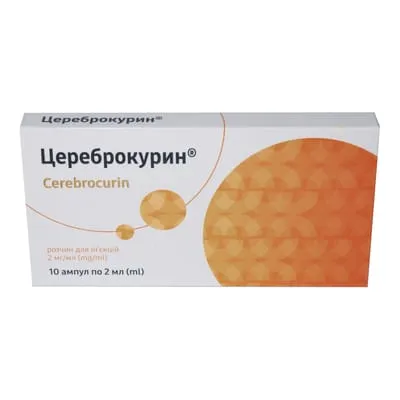
Instructions for Use
INSTRUCTION FOR MEDICAL USE OF THE MEDICINAL PRODUCT CEREBROCURIN® (CEREBROCURIN)
Composition:
Active substance: Cerebrocurin (active neuropeptides obtained from the brain of bovine embryos);
1 ml of solution contains 2 mg of Cerebrocurin;
Excipients: sodium chloride, water for injections, quinocil.
Pharmaceutical form. Injection solution.
Main physicochemical characteristics: clear liquid ranging in color from light yellow to light brown.
Pharmacotherapeutic group. Psychostimulants and nootropics. ATC code N06BX.
Pharmacological properties.
Pharmacodynamics.
The peptide modulator Cerebocurin® affects higher nervous activity by activating energy production and protein synthesis functions of nerve cells, as well as by increasing the activity of the synaptic apparatus of neurons.
Cerebocurin® promotes an increase in mitochondrial diameter, increases their surface area per unit volume, and restores myelin sheaths in brain neurocytes, the mosaic destruction of which occurs during hypoxic damage to neurocytes. The drug exerts a nootropic and vasotropic effect and demonstrates a regulatory influence on the bioelectrical activity of the brain.
Cerebocurin® improves arterial and venous cerebral blood flow. Its nootropic, hypolipidemic, hepatoprotective, and anabolic effects promote restitution of impaired functions of the central nervous system caused by both functional and organic brain lesions, normalize emotional and mnemonic functions, and expand the range of adaptive responses, thus facilitating physical, psychological, and social rehabilitation of patients with neurological and psychiatric disorders.
In hereditary and genetically determined diseases, Cerebocurin® exerts a stabilizing nootropic effect.
Pharmacokinetics.
Pharmacokinetic studies are not feasible because the active neuropeptides contained in the drug are present in the organism as high-molecular-weight precursor proteins, the biosynthesis of which occurs during the postnatal period.
Clinical characteristics.
Indications.
Diseases characterized by impaired function of the central nervous system, in particular various forms of neurocirculatory dystonia, chronic ischemic dyscirculatory and post-traumatic encephalopathies, sequelae of acute cerebrovascular events.
As an adjunctive agent – after neurosurgical reconstructive operations on the major vessels of the head; in Alzheimer's disease, Binswanger's disease (ischemic periventricular arteriolosclerosis), chronic fatigue syndrome and age-related vascular dementia, mixed-type dementia, intellectual and dynamic disorders, psychorganic syndrome with intellectual deficiency; sequelae of encephalitis; Down syndrome, Rett and Martin-Bell syndromes.
In ophthalmological practice – senile macular dystrophy (dry and wet forms), high complicated myopia, conditions following retinal detachment, partial optic nerve atrophy, post-traumatic macular dystrophy, central serous chorioretinopathy, non-proliferative diabetic retinopathy without pronounced macular edema, glaucoma with compensated intraocular pressure.
In pediatric practice – in cases of delayed mental and speech development, congenital alalia and dyslexia, sequelae of stroke with aphasia, cerebral palsy with psychospeech delay (mild degree), apallic (decorticate) syndrome – in the subacute period and its sequelae without frequent epileptic seizures, sequelae of encephalitis or traumatic brain injury with disturbances of intellectual functions and persistent cephalalgia, flaccid paralysis. In the neonatal period – in cases of moderate and severe asphyxia, sequelae of severe chronic hypoxia.
Contraindications.
Hypersensitivity to the components of the drug, pregnancy, lactation.
Interaction with other medicinal products and other forms of interaction.
No interactions have been observed.
Special precautions for use.
Use with caution in patients predisposed to allergies. Cerebrocurin® should be administered under medical supervision in patients with epileptic status or seizures.
Cerebrocurin® is not recommended for use at night in children.
Alcohol consumption should be avoided during treatment with this medication.
Use during pregnancy or breastfeeding.
Cerebrocurin® is not recommended for use in women during pregnancy or breastfeeding.
Ability to affect reaction speed when driving or operating machinery.
Does not affect the ability to drive or operate machinery.
Method of administration and dosage.
Cerebrocurin® is administered intramuscularly.
Adults should receive 2 ml daily. The minimum treatment course is 10 injections. Patients with severe organic brain lesions or Alzheimer's disease may require longer treatment; the course may be extended up to 40 injections, and repeated courses are recommended 2–3 times per year.
In pediatric practice:
- From the first days of life up to the age of 6 months: 0.5 ml every other day, 3–5 injections per course;
- From 6 months to 1 year of age: 0.5 ml every other day, 10 injections per course;
- Children aged 1–3 years: 1–2 ml every other day, 10 injections per course;
- Children aged 3 years and older: 2 ml every other day, 10–20 injections per course. Repeated courses (2–4) are advisable every 1–3 months.
Newborns and children up to 3 years of age should be treated with this drug under hospital conditions.
In ophthalmological practice, Cerebrocurin® is administered intramuscularly: 2 ml daily, or the first five injections intramuscularly, followed by 1 ml peribulbarly and 1 ml intramuscularly. Injections should be performed daily without interruption. The minimum treatment course is 10 injections.
Children.
In pediatric practice, the drug can be used from the first days of life.
Overdose.
No cases of overdose have been reported.
Side effects.
Individual sensitivity to the components of the drug is possible. When using the medicinal product in the treatment of pediatric cerebral palsy with symptomatic epilepsy, the following adverse reactions may be expected: increased frequency of seizures, headache, excessive excitability.
Shelf life.
2 years.
Do not use the medicinal product after the expiry date stated on the packaging.
Storage conditions.
Store in the original packaging, at a temperature from +2 °C to +8 °C, in a place inaccessible to children. Do not freeze!
Packaging.
0.5 ml in an ampoule, 5 ampoules in a cardboard box with a polymer blister insert.
2 ml in an ampoule, 5 or 10 ampoules in a cardboard box with a polymer blister insert.
Prescription status.
By prescription only.
Manufacturer.
LLC "NIR".
Manufacturer's address.
50 Kharkivske Shose, Kyiv, 02155, Ukraine.
Frequently Asked Questions
What is Cerebrocurin® prescribed for?
The drug is used for diseases that impair the function of the central nervous system (e.g., consequences of trauma, strokes, encephalitis), for Alzheimer's disease, visual impairments (macular degeneration, glaucoma), and developmental delays in children. It also helps with chronic fatigue syndrome and certain genetic diseases.
How should Cerebrocurin® be taken correctly?
The drug is administered intramuscularly. For adults, the usual dosage is 2 ml daily; the minimum course is 10 injections. In cases of severe brain damage, the course may be longer — up to 40 injections. For children, the dosage depends on age and must be prescribed by a physician. Treatment for newborns and children under 3 years of age must be conducted in an inpatient setting.
Who should not use this drug?
Contraindications include increased individual sensitivity to the components of the product, pregnancy, and breastfeeding.
What are the possible side effects of Cerebrocurin®?
An individual allergic reaction is possible. In children with cerebral palsy accompanied by epilepsy, seizures may occur more frequently, or headaches or excessive excitement may appear.
Can alcohol be consumed during treatment?
Alcohol should not be consumed during the period of drug use.
Does the drug affect the ability to drive a vehicle?
The drug does not affect the ability to drive vehicles or operate machinery.
Does this product interact with other medicines?
No interactions with other medicinal products have been observed.
Similar Medications
-
Cerebrolysin®
Form: solution for injection
Active substance Dosage Cerebrolysin concentrate (peptide preparation from pig brain) 215.2 mg/ml -
Thiocetam®
Form: solution for injection
Active substance Dosage thiosalicylic acid 16.6 mg/ml piracetam 100 mg/ml Manufacturer: PJSC "Halychpharm"
This page has been machine-translated and may contain inaccuracies. The original data is available in the manufacturing country's language.
Last data check: July 21, 2026 · Data source: Державний реєстр лікарських засобів України