Celestoderm-v®
Ukraine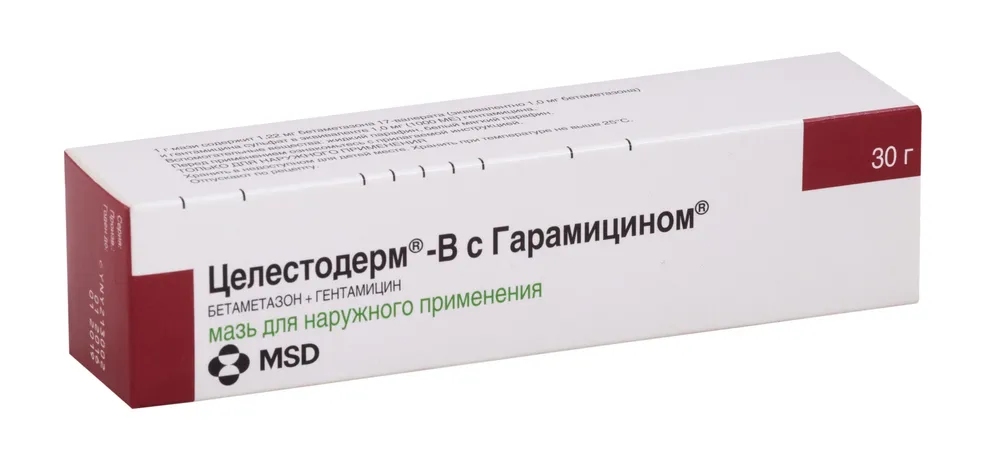
Table of Contents
INSTRUCTIONS FOR MEDICAL USE OF THE MEDICINAL PRODUCT CELESTODERM-V® (CELESTODERM-V®)
Composition:
Active substance: betamethasone;
1 g of ointment contains betamethasone 17-valerate equivalent to 1 mg of betamethasone;
Excipients: white soft paraffin, mineral oil.
Pharmaceutical form. Ointment.
Main physicochemical properties: smooth, homogeneous white ointment without foreign inclusions.
Pharmacotherapeutic group.
Corticosteroids for dermatological use. Potent corticosteroids (group III). Betamethasone. ATC code D07AC01.
Pharmacological properties.
Pharmacodynamics.
The pharmacodynamic activity of Celestoderm-V® is directly proportional to the activity of betamethasone valerate and its derivatives.
Betamethasone 17-α valerate is an ester of betamethasone. Betamethasone is a derivative of cortisol containing a 1,2 double bond, fluorine, and a beta-methyl group. These structural features result in higher glucocorticoid/anti-inflammatory activity and lower mineralocorticoid activity compared to hydrocortisone.
Celestoderm-V® suppresses inflammation, itching, and causes vasoconstriction. The expected mechanism of action of this medicinal product occurs following binding to steroid receptors.
Pharmacokinetics.
Topically applied corticosteroids may be absorbed through intact skin. Absorption increases in the presence of inflammation and/or under other conditions. In particular, absorption of topical corticosteroids is enhanced when an occlusive dressing is used. Therefore, the use of occlusive dressings in resistant dermatoses enhances the therapeutic effect.
Absorption and distribution
The pharmacokinetics of topical corticosteroids absorbed through the skin is similar to that observed after systemic administration.
Corticosteroids bind to plasma proteins to varying degrees.
Biological transformation and elimination
The primary metabolism of corticosteroids occurs in the liver, followed by renal excretion. Some topical corticosteroids and their metabolites are excreted in bile.
Clinical characteristics.
Indications.
Local treatment of dermatitis, especially allergic dermatitis, toxic eczema, atopic dermatitis, and psoriasis.
Contraindications.
- Hypersensitivity to the active substances or to any of the excipients listed in the section "Composition";
- rosacea;
- common acne;
- generalized plaque psoriasis;
- perioral dermatitis;
- viral skin infections such as herpes simplex or varicella;
- skin lesions caused by fungal or bacterial infection, in the absence of appropriate anti-infective therapy.
The use of Celestoderm-V® ointment under occlusive dressings (plaster, etc.) is not recommended.
Celestoderm-V® ointment should not be used during the first trimester of pregnancy (see section "Use during pregnancy or breastfeeding").
Interaction with other medicinal products and other forms of interaction.
There is no information available regarding interactions between Celestoderm-V® ointment and other medicinal products.
Special precautions for use
If irritation or signs of hypersensitivity occur during treatment with Celestoderm-V®, therapy should be discontinued and appropriate treatment initiated.
If concomitant antifungal/antibacterial therapy is prescribed due to the presence of infection and a favorable response is not observed, corticosteroid treatment should be discontinued until signs of infection have resolved.
Adverse reactions, including suppression of adrenal gland function, may occur with systemic corticosteroids. Adverse reactions may also occur with topical corticosteroids, particularly in children and infants.
Systemic absorption of topical corticosteroids increases with the size of the treated body surface area. Therefore, certain precautions should be taken, especially during prolonged treatment and when used in children and infants.
Due to the risk of developing simple glaucoma and subcapsular cataract, Celestoderm-V® is not intended for use in the eye area or application to the eyelids.
Prolonged use of potent topical corticosteroids may lead to atrophic changes, particularly on the face; other body areas are less sensitive. This should be considered during prolonged treatment of conditions such as psoriasis, atopic dermatitis, and severe forms of eczema. Use on the face should never exceed 5 days; occlusive dressings should not be used.
Visual disturbances
Visual disturbances may occur with both systemic and topical corticosteroids, including intranasal, inhaled, and ophthalmic administration. If symptoms such as blurred vision or other visual disturbances occur, the patient should undergo an ophthalmological examination to evaluate possible causes of visual impairment, which may include cataract, glaucoma, or rare conditions such as central serous chorioretinopathy, which has been reported after both systemic and topical corticosteroid use.
Children
Since children have a higher surface area to body weight ratio compared to adults, the degree of hypothalamic-pituitary-adrenal (HPA) axis suppression by topical corticosteroids is greater in children than in adults.
In children treated with corticosteroids, suppression of the hypothalamic-pituitary-adrenal (HPA) axis, Cushing's syndrome, growth retardation, inadequate weight gain, and increased intra-abdominal pressure have been observed. Signs of adrenal cortex suppression in children include low plasma cortisol levels and lack of response to adrenocorticotropic hormone (ACTH) stimulation tests. Bulging fontanelle, headache, and bilateral optic disc swelling are signs of increased intracranial pressure.
Use during pregnancy or breastfeeding
Pregnancy
The use of topical corticosteroids in pregnant women has not been studied. Medicinal products of this class should be used during pregnancy only if the expected benefit outweighs the potential risk to the fetus. These products should not be used in large amounts or for prolonged periods in pregnant women. Celestoderm-V® ointment should not be used during the first trimester of pregnancy.
Breastfeeding
It is unknown whether corticosteroids are absorbed after topical application and their levels in breast milk are also unknown. Therefore, either breastfeeding or the use of the medicinal product should be discontinued, taking into account the importance of the drug for the mother.
Ability to affect reaction speed while driving or operating machinery
Celestoderm-V® has no effect or only a negligible effect on the patient's reaction speed when driving or operating machinery.
Dosage and Administration
Doses
Adult patients, including elderly patients
Apply 1–3 times daily. The frequency of application should be determined according to the severity of the disease. For mild conditions, once-daily application is sufficient, whereas for severe conditions, application three times daily is required.
Patients with renal or hepatic impairment
There are no data on the use of Celestoderm-V® in patients with renal or hepatic impairment.
Administration method
For topical use only. Apply a thin layer to affected areas of the skin.
Children
Celestoderm-V® is not recommended for use in children and adolescents due to lack of clinical data on efficacy and safety in this age group.
Overdose.
Symptoms
Excessive and prolonged use of topical corticosteroids may lead to suppression of pituitary-adrenal function, resulting in secondary adrenal insufficiency, hypercorticism, and Cushing's syndrome.
Treatment
In case of overdose, appropriate symptomatic treatment is indicated. Symptoms of acute hypercorticism are usually reversible. Electrolyte imbalances should be corrected as necessary. In the event of signs of chronic toxic effects, gradual withdrawal of the corticosteroid is recommended.
Adverse reactions.
Adverse reactions are listed by system organ classes and frequency. The frequency of adverse reactions is defined according to the following categories: very common (≥ 1/10); common (≥ 1/100 to < 1/10); uncommon (≥ 1/1000 to < 1/100); rare (≥ 1/10000 to < 1/1000); very rare (< 1/10000); not known (frequency cannot be estimated from the available data).
Local adverse reactions associated with the use of topical corticosteroids, particularly when used under occlusive dressings, may include:
| Frequency |
Adverse Reactions |
| Infections and infestations |
|
| Unknown |
Folliculitis, secondary infection |
| Eye disorders |
|
| Unknown |
Blurred vision (see also section "Special precautions") |
| General disorders and administration site conditions |
|
| Unknown |
Dryness of skin at application site, irritation at application site |
| Skin and subcutaneous tissue disorders |
|
| Unknown |
Pruritus, hypertrichosis, acneiform dermatitis, hypopigmentation of skin, contact dermatitis, perioral dermatitis, skin maceration, skin atrophy, striae of skin, miliaria, burning sensation of skin |
Reporting of suspected adverse reactions
It is important to report suspected adverse reactions after marketing authorization of the medicinal product. This enables ongoing monitoring of the benefit-risk balance of the medicinal product. Healthcare professionals are requested to report all suspected adverse reactions.
Shelf life.
3 years.
Storage conditions.
Keep out of reach and sight of children. Store at a temperature not exceeding 25 °C.
Packaging.
15 g or 30 g in aluminium tubes. 1 tube in a cardboard box.
Prescription status.
Prescription only.
Manufacturer.
Organon Heist bv, Belgium.
Manufacturer's address and location of operations.
Industriepark 30, 2220, Heist-op-den-Berg, Belgium.