Celanid
Ukraine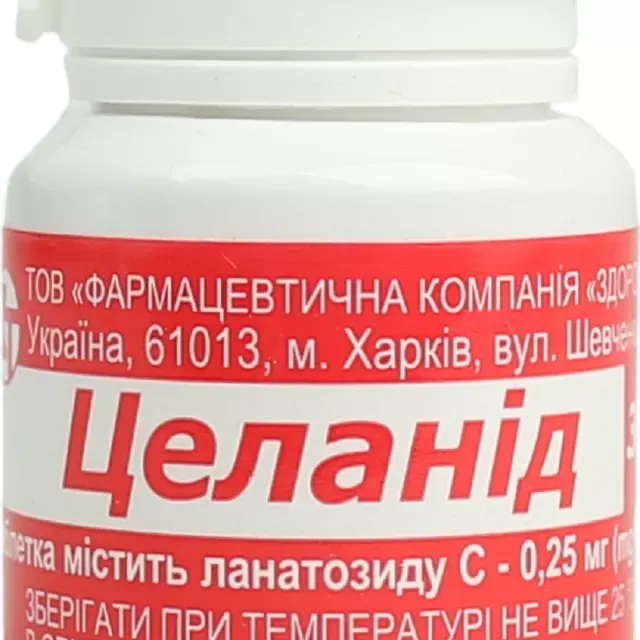
Table of Contents
INSTRUCTIONS FOR MEDICAL USE OF THE MEDICINAL PRODUCT CELANID
Composition:
Active substance: lanatoside C;
One tablet contains lanatoside C 0.25 mg;
Excipients: lactose monohydrate, potato starch, stearic acid, talc.
Pharmaceutical form. Tablets.
Main physicochemical properties: white tablets.
Pharmacotherapeutic group. Cardiovascular agents. Cardiac glycosides. ATC code C01AA06.
Pharmacological properties.
Pharmacodynamics.
Celanid is a glycoside of Digitalis lanata. The biological activity of Celanid is 14,000–16,000 LED or 3,200–3,800 COD per 1 g. The main pharmacodynamic effects of Celanid are positive inotropic, and negative dromotropic and chronotropic effects. Celanid exerts a cardiotonic action (enhances systole, prolongs diastole), slows heart rhythm, decreases cardiac conduction, and increases myocardial excitability. The mechanism of action of the glycoside is based on its influence on the potassium-sodium pump of myocardial cells, calcium ion exchange, and the status of cyclic adenosine monophosphate, which participates in the energy supply of the contractile process in myocardial cells. In patients with chronic heart failure, it produces an indirect vasodilatory effect, reduces venous pressure, increases diuresis, and reduces edema and dyspnea.
Pharmacokinetics.
When administered orally, the drug is well absorbed in the gastrointestinal tract. The bioavailability of the drug ranges from 15% to 45% and varies widely depending on gastric acidity, intestinal motility and its blood supply, and drug interactions (activated charcoal, antacid agents, and astringents reduce the absorption of lanatoside C in the gastrointestinal tract; metoclopramide and proserin enhance intestinal peristalsis, markedly reducing the bioavailability of lanatoside C). Upon entering systemic circulation, 20–25% of the drug binds to plasma proteins. The initial effect of the drug appears within 1.5–3 hours, with maximum effect occurring at 4–6 hours. The elimination half-life is 28–36 hours. The drug is metabolized in the liver and excreted from the body as inactive metabolites in urine and feces.
Clinical Characteristics.
Indications. Acute and chronic circulatory insufficiency of grade II–III (grades II–IV according to NYHA), tachysystolic form of atrial fibrillation, supraventricular paroxysmal tachycardia.
Contraindications. Hypersensitivity to the drug. Glycoside intoxication, atrioventricular block of various degrees, pronounced bradycardia, paroxysmal ventricular tachycardia, Adams-Stokes-Morgagni syndrome, isolated mitral stenosis, unstable angina, acute myocardial infarction, cardiac tamponade, extrasystole, subaortic hypertrophic stenosis, restrictive cardiomyopathy, arrhythmia due to cardiac glycoside intoxication, presence of additional atrioventricular pathways, hypercalcemia, hypokalemia, hypertrophic obstructive cardiomyopathy, ventricular fibrillation.
Interaction with other medicinal products and other types of interactions. When combined with potassium permanganate, ammonia-anise drops, hydrogen peroxide, silver nitrate, raspberry syrup, alkaloid salts, sulfanilamides, and tannin, the glycoside forms a precipitate; with acids and alkalis – inactive products are formed.
When used in combination with barbiturates (especially phenobarbital), enzyme induction in the liver and accelerated metabolism reduce the efficacy of Celanid. Synergism with Celanid is exhibited by calcium preparations; intravenous administration of Celanid together with calcium chloride, pantothenate, or gluconate may lead to increased toxicity and cardiac arrest. Combination of Celanid with chlorpromazine promotes increased blood coagulation. Concurrent use of Celanid with heparin may weaken heparin's effect due to enhanced blood coagulation caused by Celanid. When used simultaneously with lincomycin, pseudomembranous colitis may develop.
Antihypertensive agents reduce Celanid excretion and enhance its toxicity. Similar effects are observed when combined with diuretics (except potassium-sparing diuretics), insulin, amphotericin, and with prolonged use of glucose, corticosteroids, antibiotics, due to hypokalemia and hypomagnesemia.
The risk of glycoside intoxication increases when used concurrently with calcium preparations, catecholamines, and diuretics. Plasma concentration of Celanid increases when used simultaneously with quinidine, verapamil, nifedipine, and spironolactone (to a lesser extent). Antacids reduce drug absorption from the gastrointestinal tract; therefore, the dose of Celanid should be increased. After discontinuation of antacid therapy, the initial lower dose of the drug should be prescribed.
Celanid is recommended to be used concurrently with certain medicinal products. When taken together with anabolic steroids, thiamine chloride, riboflavin, pyridoxine, folic acid, orotic acid, phosphaden, inosine, methionine, unithiol, and methyluracil, its inotropic effect is enhanced.
Activated charcoal and astringents reduce the absorption of lanatoside C in the gastrointestinal tract; metoclopramide and proserine enhance intestinal peristalsis, sharply reducing the bioavailability of lanatoside C.
The concentration of the drug in blood serum may decrease when used concurrently with kaolin-pectin, certain laxatives, cholestyramine, sulfasalazine, neomycin, rifampicin, certain cytostatics, penicillamine, metoclopramide, adrenaline, and salbutamol. Concurrent use of hydrochloride ephedrine, hydrochloride adrenaline, or hydrochloride noradrenaline, as well as selective β-adrenomimetics with cardiac glycosides, may provoke cardiac arrhythmia. The effect of cardiac glycosides is reduced when used concurrently with chlorpromazine and other phenothiazine derivatives. Concurrent use of anticholinesterase agents enhances bradycardia. If necessary, this can be eliminated or alleviated by administration of atropine sulfate. When used concurrently with disodium edetate (ethylene diamine tetraacetic acid disodium salt), reduced efficacy and toxicity of cardiac glycosides are observed. Under the influence of corticotropin, the action of cardiac glycosides may be enhanced. Preparations containing caffeine or theophylline may occasionally provoke cardiac arrhythmia. Sodium adenosine triphosphate should not be administered concurrently with cardiac glycosides. In cases of hypervitaminosis induced by ergocalciferol, enhanced action of cardiac glycosides may occur due to the development of hypercalcemia. The combination of fentanyl and cardiac glycosides may cause arterial hypotension. The clinical significance of interaction with paracetamol has not been sufficiently studied, but there are data indicating reduced renal excretion of cardiac glycosides under its influence.
Special precautions for use.
Patients receiving Celanid must be under medical supervision. The risk of intoxication increases in the presence of hypokalemia, hyponatremia, hypercalcemia, hypernatremia, hypothyroidism, marked ventricular chamber dilation, cor pulmonale, or myocarditis. Monitoring plasma concentration of the drug is one of the methods used to control digitalization levels when administering lanatoside.
The drug should be administered with particular caution in patients with bradycardia and first-degree AV block.
In renal dysfunction, the duration of the drug's effect may be prolonged.
Dosage must be selected very carefully in elderly patients and/or debilitated patients, as well as in patients with impaired renal function or implanted cardiac pacemakers, since toxic effects may occur at doses that are usually well tolerated by other patients.
During treatment with Celanid, intake of hard-to-digest foods and products containing pectins should be limited. Patients with short bowel syndrome or malabsorption syndrome may require higher doses due to impaired drug absorption. Celanid should be administered with particular caution in elderly patients. Given that elimination half-life is prolonged in elderly patients, there is an increased risk of adverse effects and potential overdose.
If a patient has known intolerance to certain sugars, medical advice should be sought before taking this medicinal product.
Use during pregnancy or breastfeeding. The drug is contraindicated.
Ability to affect reaction rate when driving or operating machinery. The drug should be used with caution when driving vehicles or operating machinery.
Dosage and Administration
The dosage and duration of treatment are determined individually by a physician based on the clinical presentation, patient's sensitivity to the drug, and the dynamics of the clinical response.
For therapeutic treatment, administer orally in a daily dose of 0.25–0.5 mg divided into 3–4 doses. For maintenance therapy, starting on day 3–5, administer a daily dose of up to 0.25 mg in 2 divided doses. If necessary, one tablet (0.25 mg) may be taken 1–2 times daily.
Depending on the clinical condition, maintenance therapy may continue for months or years.
In patients with impaired renal excretory function, dosage reduction is required when creatinine clearance is 50–80 mL/min. The average maintenance dose should be 50% of the usual maintenance dose in patients with normal renal function. When creatinine clearance is less than 10 mL/min, the dose should be reduced to 25% of the usual dose. The highest adult oral dose: single dose – 0.5 mg; maximum daily dose – 1 mg.
Children. Do not use.
Overdose.
Symptoms: atrioventricular block, arrhythmia, ventricular fibrillation, bradycardia, extrasystoles, motor disturbances, anorexia, diarrhea, nausea, vomiting, drowsiness, confusion, color vision disturbances, depression, headache, dizziness.
Treatment: reduce the dose or discontinue the drug. To alleviate adverse effects, perform gastric lavage with activated charcoal suspension, administer saline laxatives, unithiol, calcium preparations, and oxygen therapy. In case of rhythm disturbances, use antiarrhythmic agents (phenytoin, lidocaine). For II–III degree AV block, significant sinus bradycardia, or bradyarrhythmia, administer atropine sulfate, use an artificial pacemaker. For ventricular arrhythmias, use lidocaine, phenytoin, or diphenylhydantoin.
Adverse reactions.
In case of increased individual sensitivity to the drug, the following adverse reactions are possible:
Cardiovascular system: polytopic extrasystoles, bigeminy or trigeminy, pronounced bradycardia, atrioventricular block, slowing of atrioventricular conduction;
Gastrointestinal tract: decreased appetite, nausea, vomiting, diarrhea;
Nervous system: drowsiness, confusion, depression, headache, dizziness;
Skin: allergic reactions, urticaria, hyperemia, skin rashes;
Other: reduced diuresis, color vision disturbances; rarely – thrombocytopenia.
In such cases, the dose should be reduced or the drug temporarily discontinued. To reduce or eliminate adverse effects, use unithiol, potassium preparations, and antiarrhythmic agents.
Shelf life. 4 years.
Storage conditions. Store at a temperature not exceeding 25 °C in the original packaging.
Keep out of reach of children.
Packaging. Tablets, 30 in bottles or containers; 10x3 in blisters in a carton.
Prescription status. Prescription only.
Manufacturer.
Limited Liability Company "Research Plant "GNCLC", or
LIMITED LIABILITY COMPANY "CORPORATION "ZDOROV'YA", or
Limited Liability Company "FARMEKS GROUP".
Manufacturer's location and address of business activity.
Ukraine, 61057, Kharkiv region, city of Kharkiv, Vorobiova Street, building 8.
(Limited Liability Company "Research Plant "GNCLC")
Ukraine, 61013, Kharkiv region, city of Kharkiv, Shevchenko Street, building 22.
(LIMITED LIABILITY COMPANY "CORPORATION "ZDOROV'YA")
Ukraine, 08301, Kyiv region, city of Boryspil, Shevchenko Street, building 100.
(Limited Liability Company "FARMEKS GROUP")