Cefodox
Ukraine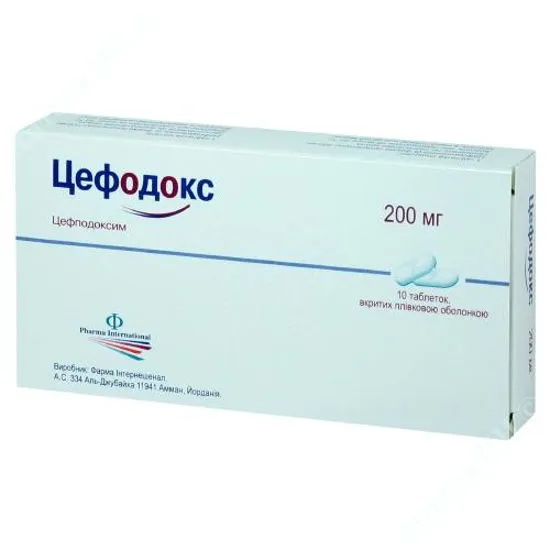
Table of Contents
INSTRUCTIONS FOR MEDICAL USE OF THE MEDICINAL PRODUCT Cefodox (Cefodox)
Composition:
Active substance: cefpodoxime;
1 tablet contains cefpodoxime (in the form of proxetil) 100 mg or 200 mg;
Excipients: microcrystalline silicified cellulose*, sodium croscarmellose, sodium starch glycolate (type A), sodium lauryl sulfate, colloidal anhydrous silicon dioxide, magnesium stearate, Opadry OY-L White 28900 (lactose monohydrate; titanium dioxide (E 171); polyethylene glycol; hydroxypropylmethylcellulose), iron oxide yellow (E 172), polyethylene glycol 6000.
* PROSOLV® SMCC 50; PROSOLV® SMCC 90.
Pharmaceutical form. Film-coated tablets.
Main physicochemical properties:
100 mg tablets: oval, biconvex tablets with a score line, film-coated, cream-white in color, marked with "PhI" on one side and "CF" "1" on the other;
200 mg tablets: oval, biconvex tablets, film-coated, cream-white in color, marked with "PhI" on one side and a score line with markings "CF" "2" on the other.
Pharmacotherapeutic group.
Antibacterials for systemic use. Other beta-lactam antibiotics. Third-generation cephalosporins. ATC code J01D D13.
Pharmacological properties.
Pharmacodynamics.
Cefodox (cefepodoxime in the form of proxetil) is a third-generation beta-lactam antibiotic for oral administration. Its bactericidal effect is due to inhibition of bacterial cell wall synthesis in microorganisms. The drug is active against many Gram-positive, Gram-negative, aerobic, and anaerobic microorganisms.
The spectrum of activity of cefpodoxime includes the following microorganisms:
Susceptible Gram-positive bacteria – Streptococcus pneumoniae, group A streptococci (S. pyogenes), group B (S. agalactiae), groups C, F, and G, as well as S. mitis, S. sanguis, S. salivarius, and Corynebacterium diphtheriae;
Susceptible Gram-negative bacteria – Haemophilus influenzae, Haemophilus parainfluenzae, Moraxella (Branhamella) catarrhalis (both beta-lactamase-producing and non-producing strains), Neisseria meningitidis, Neisseria gonorrhoeae, Escherichia coli, Klebsiella spp. (K. pneumoniae, K. oxytoca), Proteus mirabilis;
Moderately susceptible bacteria – methicillin-susceptible staphylococci, strains producing and not producing penicillinase (S. aureus and S. epidermidis).
Bacteria resistant to cefpodoxime, as well as to other cephalosporins, include: enterococci, methicillin-resistant staphylococci (S. aureus and S. epidermidis), Staphylococcus saprophyticus, Pseudomonas aeruginosa and Pseudomonas spp., Clostridium difficile, Bacteroides fragilis.
Pharmacokinetics.
The active substance of the drug is absorbed in the small intestine and hydrolyzed to the active metabolite cefpodoxime. Peak plasma concentrations are reached within 2–4 hours after a single dose. Cefpodoxime binds to plasma proteins (mainly albumins) in an unsaturated manner. The minimum inhibitory concentration (MIC) of cefpodoxime against most pathogens is achieved in lung parenchyma, bronchial mucosa, pleural fluid, tonsils, interstitial fluid, and prostatic secretions.
It penetrates well into kidney tissues. Within 12 hours after administration of a single dose, MIC90 against most pathogens causing kidney and urinary tract infections is achieved. It is primarily excreted in urine, with a half-life of approximately 2.4 hours.
Clinical characteristics.
Indications.
Infections caused by cefpodoxime-susceptible microorganisms:
- Ear, nose, and throat organs (including sinusitis, tonsillitis, pharyngitis); for the treatment of tonsillitis and pharyngitis, Cefodox should be prescribed in cases of chronic or recurrent infection, as well as in cases of known or suspected resistance of the pathogen to commonly used antibiotics;
- respiratory tract (including acute bronchitis, recurrent or exacerbations of chronic bronchitis, bacterial pneumonia);
- uncomplicated infections of the upper and lower urinary tract (including acute pyelonephritis and cystitis);
- skin and soft tissues (abscesses, cellulitis, infected wounds, furuncles, folliculitis, paronychia, carbuncles, and ulcers);
- uncomplicated gonococcal urethritis.
Contraindications.
Hypersensitivity to cephalosporin drugs, penicillins, or to any component of the medicinal product. Immediate-type or severe hypersensitivity reactions in medical history to penicillin or any other type of beta-lactam drugs.
Rare hereditary intolerance to galactose, lactase deficiency, or glucose-galactose malabsorption syndrome.
Interaction with other medicinal products and other types of interactions.
Concomitant administration of high doses of antacids (sodium bicarbonate and aluminum hydroxide) or histamine H2-receptor blockers leads to a reduction in the extent of absorption by 27–32%, and Cmax by 24–42%. Oral anticholinesterase agents increase Tmax by 47%, but do not affect the extent of absorption. If co-administration with ranitidine is necessary, the medicinal product should be taken 2–3 hours after ranitidine administration.
Cephalosporins potentially enhance the anticoagulant effect of coumarins and reduce the contraceptive effect of estrogens.
During cephalosporin therapy, a positive Coombs' test reaction may occur in individual cases (see section "Special precautions").
Studies have shown that the bioavailability of Cefodox medicinal product decreases by approximately 30% when administered concomitantly with agents that neutralize gastric pH or inhibit gastric secretion.
The bioavailability of Cefodox medicinal product increases when taken with food.
When determining glucose in urine by copper reduction methods (using Benedict's or Fehling's solutions), a false-positive result may be observed; however, cefpodoxime does not affect glucose determination in urine by enzymatic methods.
Concomitant use of the drug with loop diuretics may increase nephrotoxicity. Careful monitoring of renal function is recommended if Cefodox tablets are prescribed simultaneously with drugs exhibiting nephrotoxic effects.
Plasma levels of cefpodoxime increase when the drug is administered with probenecid.
Special precautions for use.
Cross-reactivity between penicillin and cephalosporins occurs in approximately 5–10% of patients with penicillin allergy. Therefore, prior to prescribing cephalosporins, it is essential to determine whether the patient has a history of penicillin allergy and ensure close medical supervision from the first day of cefpodoxime administration. If signs of an anaphylactic reaction occur, the drug must be discontinued immediately.
Cefpodoxime is not recommended for patients with known hypersensitivity to cephalosporin antibiotics. Allergic reactions (especially anaphylaxis) associated with the use of beta-lactam antibiotics may be severe and, in rare cases, fatal.
At the first signs of an allergic reaction during treatment with this drug, administration should be stopped immediately and medical advice should be sought.
Severe cutaneous adverse reactions (SCARs)
Severe cutaneous adverse reactions (SCARs), including Stevens-Johnson syndrome (SJS), toxic epidermal necrolysis (TEN), drug reaction with eosinophilia and systemic symptoms (DRESS), and acute generalized exanthematous pustulosis (AGEP), some of which may be life-threatening or fatal, have been reported at an "unknown" frequency in association with cefpodoxime therapy.
Patients should be informed about the signs and symptoms of these reactions and closely monitored for skin-related adverse effects.
If signs or symptoms suggestive of these reactions occur, cefpodoxime should be discontinued immediately and alternative treatment options should be considered.
If a patient develops a serious reaction such as SJS, TEN, DRESS, or AGEP while receiving cefpodoxime, re-administration of cefpodoxime is absolutely contraindicated.
Discontinue the drug immediately if exudative polymorphic erythema, Stevens-Johnson syndrome, or Lyell's syndrome develops.
Cefpodoxime is not an antibiotic of choice for the treatment of staphylococcal pneumonia. It is also not effective for treating atypical pneumonia caused by Legionella, Mycoplasma, or Chlamydia organisms.
Gastrointestinal adverse reactions, including nausea, vomiting, and abdominal pain, may occur during treatment. Therefore, cefpodoxime should be used with caution in patients with a history of gastrointestinal disorders, particularly colitis. Use of cefpodoxime may lead to diarrhea, antibiotic-associated colitis, and pseudomembranous colitis. These adverse effects, which are more likely to occur in patients receiving high doses of cefpodoxime over a prolonged period, should be considered potentially serious.
Testing for Clostridium difficile should be performed. If colitis develops, cefpodoxime therapy should be discontinued immediately, rectosigmoidoscopy should be performed, and appropriate therapy (e.g., vancomycin) should be initiated if further treatment is required. Constipating foods should be avoided. Although any antibiotic may cause pseudomembranous colitis, the risk is higher with broad-spectrum antibiotics such as cephalosporins.
Neutropenia and agranulocytosis may develop during treatment with beta-lactam antibiotics, particularly with prolonged therapy. If treatment duration exceeds 10 days, blood counts should be monitored, and cefpodoxime therapy should be discontinued if neutropenia develops.
A positive Coombs' test may occur during treatment with cefpodoxime, and hemolytic anemia may develop very rarely. Cross-resistance between cephalosporins and penicillins may occur in such cases.
Renal function changes have been observed when cefpodoxime is used concomitantly with aminoglycosides or potent diuretics; in such cases, monitoring of renal function is required.
Prolonged use of cefpodoxime may result in overgrowth of non-susceptible microorganisms. If superinfection occurs, the patient's condition should be reassessed and appropriate therapy initiated.
This medicinal product contains lactose. If the patient has been diagnosed with intolerance to certain sugars, medical advice should be sought before taking this medicinal product.
Use during pregnancy or breastfeeding.
Data on the safety of cefpodoxime use during pregnancy are lacking. Teratogenic or fetotoxic effects of cefpodoxime were not observed in animal studies. However, cefpodoxime should be used during pregnancy only if the potential benefit to the mother outweighs the potential risk to the fetus, particularly during the first trimester of pregnancy.
Cefpodoxime is excreted in breast milk. Therefore, changes in intestinal flora, including diarrhea and colonization with yeast-like fungi, may occur in breastfed infants. The possibility of sensitization should also be considered. If treatment with cefpodoxime is necessary, breastfeeding should be discontinued.
Ability to affect the reaction rate when operating vehicles or machinery.
Dizziness or hypotension may occur during treatment with cefpodoxime, which may impair the ability to drive or operate machinery.
Method of administration and dosage.
The medicinal product Cefodox, tablets, should be taken orally during meals to enhance absorption.
For adults and children aged 12 years and older with normal renal function, the recommended doses are:
| Infections |
General daily dose |
Dosing regimen |
| ENT infections: sinusitis other infections (including tonsillitis, pharyngitis) |
400 mg 200 mg |
200 mg twice daily 100 mg twice daily |
| Respiratory tract infections (including acute bronchitis, recurrent or exacerbations of chronic bronchitis, bacterial pneumonia) |
200–400 mg (depending on pathogen sensitivity) |
100–200 mg twice daily |
| Uncomplicated urinary tract infections: |
||
| upper (acute pyelonephritis) |
400 mg |
200 mg twice daily |
| lower (cystitis) |
200 mg |
100 mg twice daily |
| Skin and soft tissue infections (abscesses, cellulitis, infected wounds, furuncles, folliculitis, paronychia, carbuncles, and ulcers) |
400 mg |
200 mg twice daily |
| Uncomplicated gonococcal urethritis |
200 mg |
single dose |
The duration of treatment depends on the severity of the disease and is determined individually.
Elderly patients
There is no need to adjust the dose in elderly patients with normal renal function.
Hepatic impairment
There is no need to adjust the dose in patients with hepatic impairment.
Renal impairment
There is no need to adjust the dose of Cefodox if creatinine clearance is > 40 mL/min.
Pharmacokinetic studies indicate an increased half-life and maximum plasma concentration when creatinine clearance is below 40 mL/min; therefore, the dose of the drug should be adjusted.
| Creatinine clearance (ml/min) |
|
| 39–10 |
Single dose1) to be administered every 24 hours (i.e. ½ the usual adult dose) |
| < 10 |
Single dose1) to be administered every 48 hours (i.e. ¼ the usual adult dose) |
| Patients on hemodialysis |
Single dose1) to be administered after each dialysis session |
- Single dose – 100 mg or 200 mg depending on the type of infection.
Children. The medicinal product Cefodox, tablets, is prescribed for children aged 12 years and older.
For children under 12 years of age, Cefodox, powder for oral suspension, is recommended.
Overdose.
Symptoms: nausea, vomiting, abdominal pain, diarrhea. In patients with renal insufficiency, encephalopathy may occur in case of overdose. Cases of encephalopathy are generally reversible with low plasma levels of cefpodoxime.
Treatment: hemodialysis, peritoneal dialysis. Symptomatic therapy.
Side effects.
General disorders: fungal infections, malaise, increased fatigue, asthenia, fever, chest pain (pain may radiate to the back), back pain, chills, generalized pain, abscess, allergic reactions, facial swelling, bacterial infections, localized swelling, localized pain, overgrowth of non-susceptible microorganisms.
Cardiovascular system: congestive heart failure, migraine, palpitations, vasodilation, hematoma, arterial hypertension or hypotension.
Gastrointestinal tract: diarrhea, abdominal pain, bloating, nausea, tenesmus, abdominal distension, vomiting, dyspepsia, decreased appetite, constipation, anorexia, candidal stomatitis, toothache, belching, gastritis, dry mouth, thirst, oral ulcers, pseudomembranous colitis.
Diarrhea with blood may be a symptom of enterocolitis. In case of severe or persistent diarrhea developing during or after treatment, pseudomembranous colitis should be suspected (see section "Special precautions for use").
Hepatobiliary system: cholestatic liver injury.
Blood system: hemolytic anemia, decreased hemoglobin levels, decreased hematocrit, eosinophilia, leukocytosis, leukopenia, lymphocytosis, lymphopenia, agranulocytosis, thrombocytosis, neutropenia, thrombocytopenia, prolonged prothrombin and thrombin time.
Metabolic disorders: dehydration, gout, peripheral edema, weight gain.
Musculoskeletal system: myalgia.
Nervous system: cephalgia, vertigo, dizziness, unsteady gait, headache, hemorrhage, anxiety, nervousness, neurosis, insomnia, sleep disturbances, dream alterations (unusual dreams, nightmares), paresthesia, confusion.
Respiratory system: bronchial asthma, cough, epistaxis, rhinitis, wheezing, sneezing, bronchospasm, dyspnea, pleural effusion, pneumonia.
Skin and subcutaneous tissue: rash, skin hyperemia, urticaria, pruritus, increased sweating, maculopapular and vesiculobullous rashes, fungal dermatitis, epidermal desquamation, dry skin, hair loss, sunburn, Stevens-Johnson syndrome, toxic epidermal necrolysis, erythema multiforme; frequency unknown – acute generalized exanthematous pustulosis (AGEP), drug reaction with eosinophilia and systemic symptoms (DRESS).
Sensory organs: altered or loss of taste, eye irritation, tinnitus.
Immune system: hypersensitivity reactions of all severity grades have been reported (see section "Special precautions for use"), anaphylactic reactions, angioneurotic edema, purpura, serum sickness, arthralgia, fever.
Urinary and reproductive system: hematuria, urinary tract infections, metrorrhagia, vaginal candidiasis, dysuria, frequent urination, proteinuria, elevated urea and creatinine in urine; in isolated cases, renal function disorders have been observed, particularly when cefpodoxime is used concomitantly with aminoglycosides and/or potent diuretics.
Laboratory findings: increased levels in liver function tests – aspartate aminotransferase (AST), alanine aminotransferase (ALT), alkaline phosphatase, bilirubin, urea, and creatinine; false-positive Coombs test.
Biochemical analyses: hyper- or hypoglycemia, hypoalbuminemia, hypoproteinemia, hyperkalemia, hyponatremia.
Reporting of adverse reactions after drug registration is of great importance. It enables continuous monitoring of the benefit-risk balance of the medicinal product. Healthcare professionals, pharmacists, patients, and their legal representatives are encouraged to report all suspected adverse reactions and lack of efficacy via the Automated Pharmacovigilance Information System at the following link: https://aisf.dec.gov.ua.
Shelf life. 3 years.
Storage conditions. Store at a temperature not exceeding 30 °C.
Keep out of reach of children.
Packaging. 10 tablets in a blister; 1 blister per cardboard box.
Prescription status. Prescription only.
Manufacturer/Marketing Authorization Holder. Pharma International Company.
Manufacturer's address and place of business.
Al Castal area, Airport Road, P.O. Box 334, Jubaiha 11941, Amman – Jordan.
Address of the Marketing Authorization Holder. P.O. Box 334 Al-Jubaiha 11941 Amman, Jordan.
Contact details of the manufacturer's/Marketing Authorization Holder's representative in Ukraine – LLC "Megakom":
195-B Klochkivska St., Kharkiv, 61145; phone: +38 (057) 701 37 55.