Cefepime
Ukraine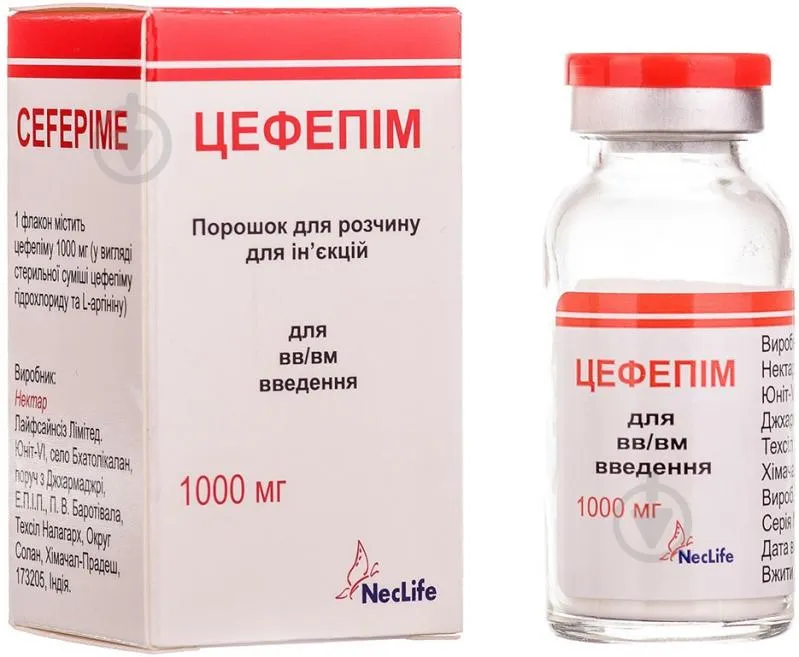
Table of Contents
INSTRUCTION FOR MEDICAL USE OF THE MEDICINAL PRODUCT CEFEPIME
Composition:
Active substance: cefepime;
1 vial contains cefepime hydrochloride equivalent to cefepime 1000 mg (as a sterile mixture of cefepime hydrochloride and L-arginine);
Excipient: L-arginine (in the composition of the sterile mixture with cefepime hydrochloride).
Pharmaceutical form. Powder for solution for injection.
Main physicochemical properties: powder from white to yellowish-white in color.
Pharmacotherapeutic group.
Antibacterial agents for systemic use. Other beta-lactam antibiotics. Fourth-generation cephalosporins. ATC code J01D E01.
Pharmacological properties.
Pharmacodynamics.
Cefepime inhibits the synthesis of bacterial cell wall enzymes and has a broad spectrum of activity against various Gram-positive and Gram-negative bacteria. Cefepime is highly resistant to hydrolysis by most β-lactamases, has low affinity for chromosomally mediated β-lactamases, and rapidly penetrates Gram-negative bacterial cells.
Cefepime is active against the following microorganisms:
Gram-positive aerobes: Staphylococcus aureus and Staphylococcus epidermidis (including β-lactamase-producing strains); other staphylococcal strains, including S. hominis, S. saprophyticus; Streptococcus pyogenes (Group A streptococci); Streptococcus agalactiae (Group B streptococci); Streptococcus pneumoniae (including strains with intermediate resistance to penicillin – MIC from 0.1 to 1 mcg/mL); other β-hemolytic streptococci (Groups C, G, F), S. bovis (Group D), Viridans group streptococci. Most enterococcal strains, e.g., Enterococcus faecalis, and methicillin-resistant staphylococci are resistant to most cephalosporin antibiotics, including cefepime.
Gram-negative aerobes: Pseudomonas spp., including P. aeruginosa, P. putida, P. stutzeri; Escherichia coli; Klebsiella spp., including K. pneumoniae, K. oxytoca, K. ozaenae; Enterobacter spp., including E. cloacae, E. aerogenes, E. sakazakii; Proteus spp., including P. mirabilis, P. vulgaris; Acinetobacter calcoaceticus (subsp. anitratus, lwoffi); Aeromonas hydrophila; Capnocytophaga spp.; Citrobacter spp., including C. diversus, C. freundii; Campylobacter jejuni; Gardnerella vaginalis; Haemophilus ducreyi; H. influenzae (including β-lactamase-producing strains); H. parainfluenzae; Hafnia alvei; Legionella spp.; Morganella morganii; Moraxella catarrhalis (Branhamella catarrhalis) (including β-lactamase-producing strains); Neisseria gonorrhoeae (including β-lactamase-producing strains); N. meningitidis; Pantoea agglomerans (formerly known as Enterobacter agglomerans); Providencia spp. (including P. rettgeri, P. stuartii); Salmonella spp.; Serratia (including S. marcescens, S. liquefaciens); Shigella spp.; Yersinia enterocolitica. Cefepime is inactive against many strains of Xanthomonas maltophilia and Pseudomonas maltophilia.
Anaerobes: Bacteroides spp., including B. melaninogenicus and other oral cavity microorganisms belonging to Bacteroides; Clostridium perfringens; Fusobacterium spp.; Mobiluncus spp.; Peptostreptococcus spp.; Veillonella spp. Cefepime is inactive against Bacteroides fragilis and Clostridium difficile.
Pharmacokinetics.
Mean plasma concentrations of cefepime in healthy adult males at various time points after single intravenous and intramuscular administration are shown in Table 1.
Table 1
Mean plasma concentrations of cefepime (mcg/mL) following intravenous (i.v.)
and intramuscular (i.m.) administration
| Cefepime dose |
0.5 hour |
1 hour |
2 hours |
4 hours |
8 hours |
12 hours |
| 1 g IV |
78.7 |
44.5 |
24.3 |
10.5 |
2.4 |
0.6 |
| 1 g IM |
14.8 |
25.9 |
26.3 |
16 |
4.5 |
1.4 |
Therapeutic concentrations of cefepime are also achieved in urine, bile, peritoneal fluid, bronchial mucous secretion, sputum, prostate, appendix, and gallbladder.
The average elimination half-life of cefepime is approximately 2 hours. In healthy volunteers receiving doses up to 2 g intravenously every 8 hours for 9 days, no drug accumulation was observed.
Cefepime is metabolized to N-methylpyrrolidine, which is rapidly converted to N-methylpyrrolidine oxide. The average total clearance is 120 mL/min. Cefepime is eliminated almost exclusively via renal mechanisms, primarily through glomerular filtration (average renal clearance – 110 mL/min). Approximately 85% of the administered dose is excreted in urine as unchanged cefepime, 1% as N-methylpyrrolidine, approximately 6.8% as N-methylpyrrolidine oxide, and approximately 2.5% as cefepime epimer. Plasma protein binding of cefepime is less than 19% and is independent of drug concentration in serum.
Dose adjustment is not required in patients aged 65 years and older with normal renal function, despite their lower renal clearance compared to younger patients.
Studies conducted in patients with varying degrees of renal impairment have demonstrated an increased elimination half-life. On average, the half-life in patients with severe renal dysfunction requiring dialysis is 13 hours with hemodialysis and 19 hours with peritoneal dialysis.
The pharmacokinetics of cefepime are not altered in patients with hepatic impairment or cystic fibrosis. Dose adjustment is not required in such patients.
Clinical characteristics.
Indications.
Adults
Infections caused by microorganisms sensitive to the drug:
- respiratory tract infections, including pneumonia, bronchitis;
- skin and soft tissue infections;
- intra-abdominal infections, including peritonitis and biliary tract infections;
- urinary tract infections, including pyelonephritis;
- gynecological infections;
- sepsis.
Empirical therapy in patients with febrile neutropenia.
Prophylaxis of postoperative complications in intra-abdominal surgery.
Children
- Pneumonia;
- urinary tract infections, including pyelonephritis;
- skin and soft tissue infections;
- sepsis;
- empirical therapy in patients with febrile neutropenia;
- bacterial meningitis.
Contraindications.
Hypersensitivity to cefepime or arginine, as well as to cephalosporin-class antibiotics, penicillins, or other β-lactam antibiotics.
Special precautions.
Release of the medicinal product into the external environment should be minimized. Avoid contamination of sewage systems or household waste with the medicinal product.
Interaction with other medicinal products and other forms of interaction.
When administering high doses of aminoglycosides concomitantly with cefepime, renal function should be closely monitored due to the potential nephrotoxicity and ototoxicity of aminoglycoside antibiotics. Nephrotoxicity has been reported following concomitant administration of other cephalosporins with diuretics such as furosemide.
Cefepime at concentrations from 1 to 40 mg/mL is compatible with the following parenteral solutions:
0.9% sodium chloride injection solution; 5% and 10% glucose injection solutions; sodium lactate 6M injection solution; 5% glucose and 0.9% sodium chloride injection solution; Ringer's lactate with 5% glucose injection solution.
To avoid potential drug interactions with other agents, cefepime solutions (like most other β-lactam antibiotics) should not be administered simultaneously with metronidazole, vancomycin, gentamicin, tobramycin sulfate, or netilmicin sulfate solutions. If cefepime is prescribed together with any of these agents, each antibiotic should be administered separately.
Effect on laboratory test results
Cefepime administration may result in false-positive glucose in urine tests when using Benedict's reagent. Enzymatic glucose tests based on glucose oxidase reaction are recommended.
Special precautions.
For patients at high risk of severe infections (e.g., patients with a history of bone marrow transplantation, impaired bone marrow function due to severe progressive malignant hemolytic disorders with severe progressive neutropenia), monotherapy may be insufficient; therefore, combination antimicrobial therapy is indicated.
It is essential to determine carefully whether the patient has previously experienced immediate-type hypersensitivity reactions to cefepime, cephalosporins, penicillins, or other β-lactam antibiotics. Antibiotics should be administered cautiously to all patients with any form of allergy, especially drug allergies. If an allergic reaction occurs, the drug should be discontinued. Severe immediate-type hypersensitivity reactions may require treatment with adrenaline and other therapeutic measures.
Cases of pseudomembranous colitis have been reported during treatment with nearly all broad-spectrum antibiotics. Therefore, pseudomembranous colitis must be considered in the differential diagnosis whenever diarrhea occurs during cefepime therapy. The condition may range from mild diarrhea to fatal colitis. Mild cases of colitis were reversible and resolved after discontinuation of cefepime; moderate or severe cases may require specific treatment.
The drug should be used with caution in patients with gastrointestinal disorders, particularly colitis.
During prolonged treatment, regular monitoring of liver, kidney, and hematopoietic system function is necessary.
In patients with impaired renal function (creatinine clearance <60 mL/min), the dose of cefepime should be adjusted to compensate for reduced renal elimination. Since prolonged antibiotic serum concentrations may occur at standard doses in patients with renal impairment or other conditions that may impair renal function, the maintenance dose should be reduced when administering cefepime to such patients. The degree of renal impairment, severity of infection, and susceptibility of the causative organisms should be considered when determining the subsequent dose.
When using cefepime, as with other drugs in this class, serious adverse reactions such as reversible encephalopathy (confusion, including clouding of consciousness), myoclonia, seizures, and/or renal failure have occurred most frequently in patients with renal impairment receiving doses exceeding the recommended dose, and in elderly patients with renal impairment receiving recommended doses of cefepime. Some cases occurred in patients receiving doses adjusted according to renal function. In most cases, symptoms of nephrotoxicity were reversible and resolved after discontinuation of cefepime and/or after hemodialysis.
The pharmacokinetics of cefepime in patients with hepatic impairment is not altered. Dose adjustment is not required in such patients.
The use of antibacterial agents alters the normal flora of the colon and may promote overgrowth of Clostridium. Studies indicate that the toxin produced by Clostridium difficile is the primary cause of antibiotic-associated colitis. After confirmation of the diagnosis of pseudomembranous colitis, appropriate therapeutic measures should be initiated. Mild to moderate pseudomembranous colitis may resolve after discontinuation of the drug. In moderate to severe cases, the need for fluid and electrolyte replacement, protein supplementation, and administration of an antibacterial agent effective against Clostridium difficile should be considered.
Warnings
It is unlikely that prescribing cefepime in the absence of proven or suspected bacterial infection, or for prophylactic use, will be beneficial; however, such use may increase the risk of emergence of resistant bacteria. Prolonged use of cefepime (as with other antibiotics) may lead to superinfection. The patient's condition should be re-evaluated periodically. If superinfection develops, appropriate measures should be taken.
Many cephalosporins, including cefepime, are associated with reduced prothrombin activity. Patients at risk include those with impaired liver or kidney function, those who are poorly nourished, and those receiving prolonged courses of antimicrobial therapy. Prothrombin levels should be monitored in patients at risk, and vitamin K should be administered if necessary.
Positive results in the direct Coombs test may occur during cefepime therapy. When performing hematological or transfusion procedures involving blood grouping by the cross-matching method, or during Coombs test in newborns whose mothers received cephalosporin antibiotics before delivery, a positive Coombs test should be interpreted considering that it may be due to the drug administration.
When lidocaine is used as a solvent for pediatric administration, safety information regarding lidocaine should be taken into account.
It has been demonstrated that L-arginine alters glucose metabolism and simultaneously increases serum potassium levels when administered at doses 33 times higher than the maximum recommended dose of cefepime. Effects at lower doses are still unknown.
Use during pregnancy or breastfeeding.
Adequate and well-controlled studies in pregnant women have not been conducted; therefore,
cefepime should be used during pregnancy only if the potential benefit justifies the potential risk to the fetus.
Cefepime is excreted in breast milk in very small amounts; therefore, breastfeeding should be discontinued during treatment with this drug.
Ability to affect reaction speed when driving or operating machinery.
Since adverse reactions involving the central nervous system may occur during treatment, patients should refrain from driving or operating machinery.
Dosage and Administration
The usual dosage for adults is 1 g, which should be administered intravenously or intramuscularly every 12 hours. The usual duration of treatment is 7–10 days; severe infections may require longer treatment.
However, the dosage and route of administration may vary depending on the susceptibility of the causative microorganisms, the severity of the infection, and the patient's renal function.
Dosage recommendations for adults are provided in Table 2.
Table 2
| Severity of infection |
Dose and route of administration |
Frequency |
| Mild to moderate urinary tract infections |
500 mg – 1 g intravenously or intramuscularly |
every 12 hours |
| Other mild to moderate infections |
1 g intravenously or intramuscularly |
every 12 hours |
| Severe infections |
2 g intravenously |
every 12 hours |
| Very severe and life-threatening infections |
2 g intravenously |
every 8 hours |
Prophylaxis of infections during surgical procedures. 60 minutes before the start of surgery, administer 2 g of the drug intravenously over 30 minutes to adults. After that, additionally administer 500 mg of metronidazole intravenously. Metronidazole solutions should not be administered simultaneously with cefepime. The infusion system should be flushed before administration of metronidazole.
During prolonged surgical procedures (over 12 hours), repeat administration of an equal dose of the drug is recommended 12 hours after the first dose, followed by administration of metronidazole.
Renal function impairment. In patients with impaired renal function (creatinine clearance less than 30 mL/min), the dose of the drug must be adjusted.
Table 3
Recommended doses of cefepime for adults
| Creatinine clearance (mL/min) |
Recommended doses |
|||
| > 50 |
Standard dosing appropriate to the severity of infection (see previous table), dose adjustment not required |
|||
| 2 g every |
2 g every |
1 g every |
500 mg every 12 hours |
|
| 30–50 |
Dose adjustment according to creatinine clearance |
|||
| 2 g every 12 hours |
2 g every |
1 g every 24 hours |
500 mg every 24 hours |
|
| 11–29 |
2 g every 24 hours |
1 g every |
500 mg every 24 hours |
500 mg every 24 hours |
| ≤10 |
1 g every 24 hours |
500 mg every 24 hours |
250 mg every 24 hours |
250 mg every 24 hours |
| Hemodialysis |
500 mg every |
500 mg every 24 hours |
500 mg every 24 hours |
500 mg every 24 hours |
If only serum creatinine concentration is known, creatinine clearance can be calculated using the formula below.
Men:
weight (kg) × (140 - age)
creatinine clearance (mL/min) = --------------------------------------------------- ;
72 × serum creatinine (mg/dL)
Women:
creatinine clearance (mL/min) = the above value × 0.85.
During hemodialysis, approximately 68% of the drug dose is eliminated from the body over 3 hours. After each dialysis session, a supplemental dose equal to the initial dose should be administered. For continuous ambulatory peritoneal dialysis (CAPD), the drug can be administered at the initial standard recommended doses of 500 mg, 1 g, or 2 g, depending on the severity of infection, with a dosing interval of 48 hours.
For children aged 1–2 months, the drug should be administered only for life-threatening indications. Children weighing less than 40 kg who are receiving cefepime should be closely monitored.
For pediatric patients with impaired renal function, dose reduction or extended dosing intervals are recommended.
Calculation of creatinine clearance in children:
0.55 × height (cm)
creatinine clearance (mL/min/1.73 m²) = ---------------------------------------------
serum creatinine (mg/dL)
or
0.52 × height (cm)
creatinine clearance (mL/min/1.73 m²) = ------------------------------------------ – 3.6
serum creatinine (mg/dL)
Children aged 1 to 2 months. Cefepime should be administered only for life-threatening indications at a dose of 30 mg/kg body weight every 12 or 8 hours, depending on the severity of infection.
Children aged 2 months and older. The maximum dose for children should not exceed the recommended adult dose. The usual recommended dose for children weighing less than 40 kg for complicated or uncomplicated urinary tract infections (including pyelonephritis), uncomplicated skin infections, pneumonia, and empirical treatment of febrile neutropenia is 50 mg/kg every 12 hours (for febrile neutropenia and bacterial meningitis – every 8 hours). The usual duration of treatment is 7–10 days; severe infections may require longer treatment.
For children weighing 40 kg or more, cefepime should be administered as in adults.
Administration of the drug. The drug can be administered intravenously or by deep intramuscular injection into a large muscle mass (e.g., the upper outer quadrant of the gluteus maximus).
Intravenous administration. The intravenous route is preferred for patients with severe or life-threatening infections.
For intravenous administration, cefepime should be dissolved in sterile water for injection, 5% dextrose injection solution, or 0.9% sodium chloride injection solution, as specified in the table below. Administer intravenously slowly over 3–5 minutes or via an intravenous infusion system.
Intramuscular administration. The drug can be dissolved in sterile water for injection, 0.9% sodium chloride injection solution, 5% dextrose injection solution, bacteriostatic water for injection with parabens or benzyl alcohol, or 0.5% or 1% lidocaine hydrochloride solution, at the concentrations specified in Table 4.
Table 4
| Route of administration |
Volume of solvent for dilution (ml) |
Approximate volume of resulting solution (ml) |
| Intravenous administration: 1 g/vial |
10 |
11.4 |
| Intramuscular administration: |
3 |
4.4 |
As with other parenterally administered medicinal products, prepared solutions of the drug should be inspected for the presence of particulate matter prior to administration.
Appropriate microbiological studies should be performed to identify the causative microorganism(s) and to determine its (their) susceptibility to cefepime. However, cefepime may be used as monotherapy before identification of the causative microorganism due to its broad spectrum of antibacterial activity against both gram-positive and gram-negative microorganisms. In patients at risk of mixed aerobic/anaerobic (including Bacteroides fragilis) infections, treatment with cefepime in combination with an agent active against anaerobes may be initiated before identification of the causative pathogen.
Children.
May be administered to children aged 1 month and older.
Overdose.
Symptoms. In case of a significant overdose, especially in patients with impaired renal function, adverse reactions may intensify. Symptoms of overdose include encephalopathy accompanied by hallucinations, impaired consciousness, stupor, coma; myoclonus; epileptiform seizures; neuromuscular excitability.
Treatment. Administration of the drug should be discontinued and symptomatic therapy initiated. Hemodialysis accelerates the elimination of cefepime from the body; peritoneal dialysis is poorly effective. Severe immediate-type allergic reactions require administration of epinephrine and other forms of intensive therapy.
Adverse reactions.
Immune system disorders: hypersensitivity reactions, including anaphylaxis, anaphylactic shock, angioedema;
Respiratory system disorders: cough, sore throat, dyspnea, respiratory disorders;
Cardiovascular system disorders: tachycardia, vasodilation;
Gastrointestinal disorders: nausea, vomiting, dyspepsia, oral candidiasis, altered taste sensation, diarrhea, colitis (including pseudomembranous colitis), abdominal pain, constipation;
Nervous system disorders: headache, insomnia, restlessness, convulsions, dizziness, paresthesia, epileptiform seizures;
Hepatobiliary disorders: hepatitis, cholestatic jaundice;
Skin and subcutaneous tissue disorders: rash, pruritus, urticaria;
Reproductive system disorders: genital pruritus, candidiasis;
Other: asthenia, increased sweating, fever, vaginitis, erythema, chest pain, back pain, peripheral edema.
Local reactions at the site of administration:
Intravenous administration – phlebitis and inflammation;
Intramuscular administration – pain, inflammation.
Post-marketing studies:
- encephalopathy (loss of consciousness, hallucinations, stupor, coma), epileptiform seizures, myoclonia, renal failure;
- anaphylaxis, including anaphylactic shock, transient leukopenia, neutropenia, agranulocytosis, and thrombocytopenia.
Laboratory findings: increased levels of alanine aminotransferase, aspartate aminotransferase, alkaline phosphatase, total bilirubin; anemia, eosinophilia, prolonged prothrombin time or partial thromboplastin time (PTT), and positive Coombs test without hemolysis. Transient increases in blood urea nitrogen and/or serum creatinine and transient thrombocytopenia were observed in less than 0.5% of patients. Transient leukopenia and neutropenia were also reported.
Possible adverse reactions typical for cephalosporin antibiotics: Stevens-Johnson syndrome, erythema multiforme, toxic epidermal necrolysis, toxic nephropathy, aplastic anemia, hemolytic anemia, bleeding, liver function disorders, cholestasis, pancytopenia.
Shelf life. 2 years.
Do not use after the expiry date stated on the packaging.
Storage conditions.
Store out of reach of children.
Store in the original packaging at a temperature not exceeding 25 °C.
After reconstitution, the solution should be used immediately or stored for no more than 24 hours at a temperature not exceeding 25 °C or for up to 7 days at a temperature between 2 and 8 °C.
Color change does not affect the drug's activity provided the product is stored properly as recommended by the manufacturer.
Incompatibility.
Do not mix with other medicinal products in the same container. Use only the solvents specified in the section "Administration and dosage."
Packaging.
1000 mg of powder for solution for injection in a vial No. 1 in a cardboard box.
Prescription category. Prescription only.
Manufacturer.
Ananta Medicare Limited.
Manufacturer's address.
Chak 17 ML, Agro Food Park Road, RIICO Industrial Area, Udaipur Vihar, Sri Ganganagar-335002 (Rajasthan), India.
Marketing Authorization Holder.
Ananta Medicare Ltd.
Address of the Marketing Authorization Holder and/or its representative.
Suite 1, 2 Station Court, Imperial Wharf, Townmead Road, Fulham, London, United Kingdom.