Trivalumen
Ukraine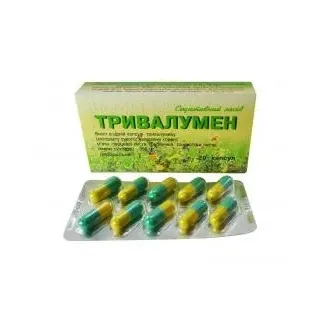
Table of Contents
INSTRUCTIONS FOR MEDICAL USE OF THE MEDICINAL PRODUCT TRIVALUMEN (TRIVALUMEN)
Composition:
Active substance: trivalumen;
1 capsule contains trivalumen (dry extract (extraction agent – water) of a mixture of valerian roots (Radices Valerianae), peppermint leaves (Folia Menthae piperitae), yellow centaury leaves (Folia Menyanthidis trifoliatae), and hop strobiles (Strobili lupuli) in a ratio of (1:2:2:1)), calculated as dry substance – 356 mg;
Excipients: lactose monohydrate, magnesium stearate.
Hard gelatin capsule size № 0: quinoline yellow (E 104), yellow FCF (E 110), patent blue V (E 131), diamond black BN (black PN) (E 151), titanium dioxide (E 171), gelatin.
Pharmaceutical form. Capsules.
Main physicochemical properties: hard gelatin capsules with a green cap and yellow body. The capsule contents are a light brown to dark brown powder, granules, or compacted mass with a fragrant odor.
Pharmacological properties.
Pharmacodynamics.
Trivalmen is a combined herbal preparation, whose action is determined by the synergistic properties of its components. The complex esters of borneol and isovaleric acid present in valerian reduce the excitability of the central nervous system, decrease tension and irritability during mental overload, exhibit sedative, hypnotic, and spasmolytic effects, exert a choleretic action, enhance secretory activity of the gastrointestinal mucosal glands, slow heart rate, and dilate coronary vessels of the heart. The activity of hops cones is due to their essential oil and bitter resins, which contain bitter substances (humulone, lupulone, and aliphatic terpene alcohols), phytoncides, vitamins of group B and C, tocopherols, and substances with estrogenic activity. These components stimulate appetite, improve bile secretion, exert diuretic effects, produce calming effects in states of excitement and insomnia, exhibit anti-inflammatory activity, and provide analgesic properties.
The pharmacological effect of peppermint is primarily associated with menthol, as well as terpenes, tannins, bitter substances, and organic acids. The components of peppermint exhibit analgesic, astringent, and anti-inflammatory effects; reduce nausea, mildly stimulate secretion of gastrointestinal and liver glands, enhance appetite, and normalize intestinal motility.
Thanks to bitter glycosidic compounds and flavonoids, black horehound enhances gastrointestinal secretion, improves digestion, stimulates appetite, normalizes intestinal motility, and exerts anti-hypoxic and antioxidant effects.
The drug does not cause dependence, does not suppress psychomotor function, and does not impair work capacity.
Pharmacokinetics.
Not studied.
Clinical characteristics.
Indications.
Insomnia due to nervous and mental fatigue; neurocirculatory dystonia with tachycardia, cardialgia, and arterial hypertension; decreased appetite.
Contraindications.
- Hypersensitivity to any component of the drug;
- arterial hypotension;
- depressive state, drowsiness;
- cholelithiasis, cholangitis, pronounced liver function disorders.
Interaction with other medicinal products and other forms of interaction.
The drug may potentiate the effects of sedatives, spasmolytics, centrally-acting antihypertensives, tranquilizers, neuroleptics, alcohol, nootropic agents, analgesics, anesthetics, curare-like muscle relaxants. Concomitant use with synthetic sedative drugs is not recommended.
Special precautions for use.
Do not exceed the recommended doses of the drug.
The drug should be used with caution in patients who have had severe liver function impairment or a history of severe liver disease.
Since the drug contains peppermint, its use should be avoided in patients with gastroesophageal reflux, achlorhydria, or hiatal hernia of the esophageal opening of the diaphragm due to the possible exacerbation of disease symptoms. Use with caution in patients with bronchial asthma.
Valerian, an ingredient of the drug, may produce a moderate depressant effect; therefore, concomitant use of Trivalumen with hypnotics, other sedatives, or alcohol is not recommended due to potential potentiation of effect.
The capsules contain lactose; therefore, the drug should not be used in patients with rare hereditary forms of galactose intolerance, lactase deficiency, or glucose-galactose malabsorption syndrome.
The drug contains the colorant Sunset Yellow FCF (E 110), which may cause allergic reactions, including bronchial asthma. The risk of allergy is higher in patients with hypersensitivity to acetylsalicylic acid.
Use during pregnancy or breastfeeding.
The drug is contraindicated during pregnancy.
If use of the drug is necessary in women, breastfeeding should be discontinued during the treatment period.
Ability to affect reaction rate when driving or operating machinery.
When using the drug, patients should refrain from driving or operating potentially hazardous machinery.
Dosage and Administration.
For adults and children aged 12 years and older: 1 capsule 2–3 times daily; for initial forms of insomnia – 1 capsule 1–1.5 hours before bedtime.
The duration of treatment is 7–15 days. The treatment course may be repeated after 10 days (following consultation with a physician).
Children.
The drug must not be used in children under 12 years of age.
Overdose.
Symptoms: headache, drowsiness, weakness, lethargy, sluggishness, dizziness, increased fatigue, reduced attention span, enhanced sedative effect, depressed state, abdominal spasms, stomach pain, nausea, mydriasis, decreased hearing and visual acuity, limb tremor, chest tightness, tachycardia/bradycardia, reduced arterial blood pressure. If any of these reactions occur, the drug must be discontinued immediately.
Treatment: symptomatic.
Adverse Reactions.
Nervous system: headache, dizziness, lethargy, somnolence, emotional blunting, depression, general weakness, reduced work capacity, difficulty concentrating; in individual cases – psychic excitation, anxiety, insomnia.
Cardiovascular system: arterial hypotension, chest tightness, chest pain, cardiac arrhythmias (including bradycardia, tachycardia), flushing.
Gastrointestinal system: heartburn, nausea, abdominal cramps, dyspeptic symptoms, impaired digestion, diarrhea.
Hepatobiliary system: possible signs of hepatotoxicity.
Immune system: allergic reactions, including skin rashes, itching, urticaria, hyperemia, swelling, dyspnea, bronchial asthma.
Adverse reactions occur very rarely, are reversible, and usually develop during prolonged use or significant exceeding of recommended doses.
If any adverse events occur, the patient must discontinue the drug and consult a physician immediately.
Shelf life. 2 years.
Do not use the medication after the expiry date stated on the packaging.
Storage conditions. In the original packaging at a temperature not exceeding 25 °C.
Keep out of reach of children.
Packaging. 10 capsules per blister, 2 blisters per carton.
Availability. Over-the-counter.
Manufacturer.
Public Joint-Stock Company "Scientific-Production Center "Borshchagov Chemical and Pharmaceutical Plant".
Manufacturer's address and place of business.
17 Myru Street, Kyiv, 03134, Ukraine.