Triazofam
Ukraine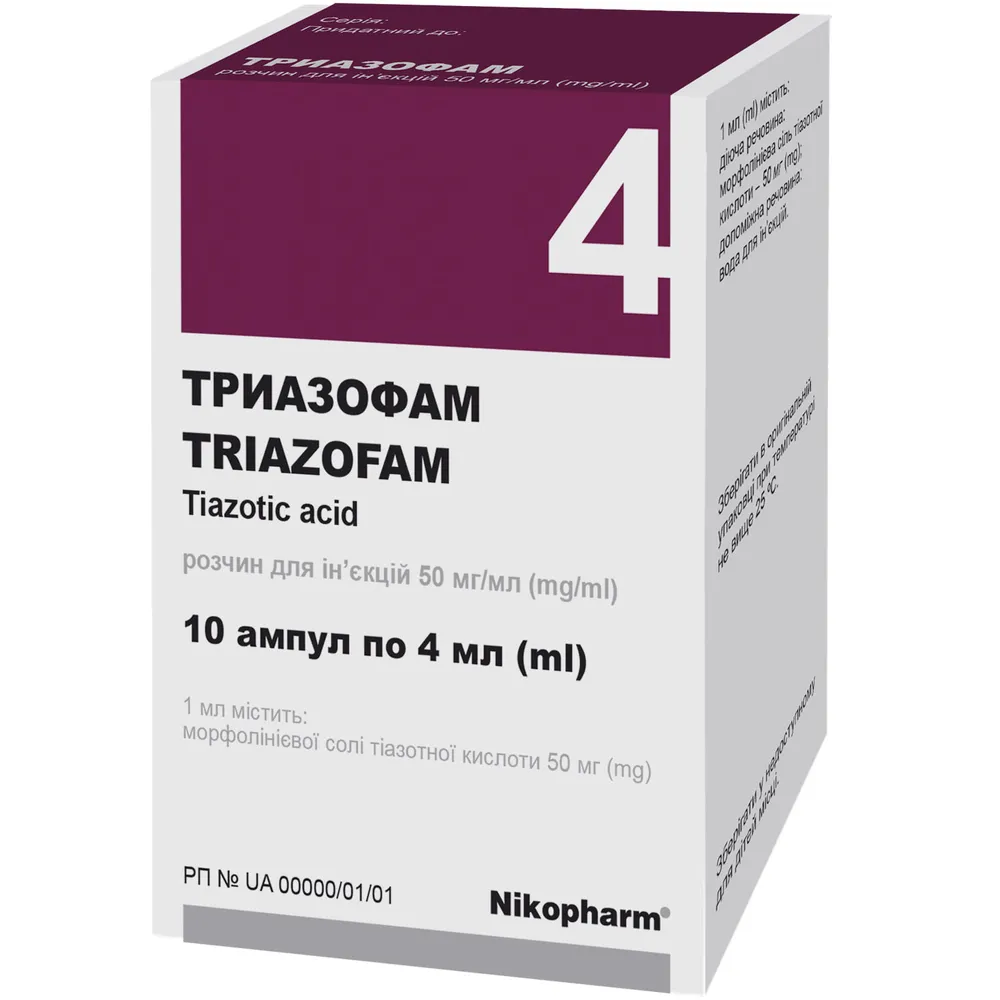
Table of Contents
INSTRUCTIONS FOR MEDICAL USE OF THE MEDICINAL PRODUCT TRIAZOFAM (TRIAZOFAM)
Composition:
Active substance: thiatic acid;
1 ml of solution contains 25 mg of morpholine salt of thiatic acid, recalculated to 100% substance, equivalent to 16.6 mg of thiatic acid;
Excipients: water for injections.
Pharmaceutical form. Solution for injection.
Main physicochemical properties: clear colorless liquid or with a slight yellowish tint.
Pharmacotherapeutic group.
Cardiological drugs. Other cardiological drugs. Thiatic acid. ATC code C01EB23.
Pharmacological Properties.
Pharmacodynamics.
The pharmacological effect of thiotropic acid is due to its anti-ischemic, membrane-stabilizing, antioxidant, and immunomodulatory actions.
The drug's effect is achieved by enhancing compensatory activation of anaerobic glycolysis and stimulating oxidation processes in the Krebs cycle, thus preserving intracellular ATP pools. The presence of a thiol sulfur in the molecular structure of thiotropic acid—exhibiting redox properties—and a tertiary nitrogen that binds excess hydrogen ions contribute to activation of the antioxidant system. The strong reducing properties of the thiol group lead to reactions with reactive oxygen species and lipid radicals. Reactivation of antiradical enzymes—superoxide dismutase, catalase, and glutathione peroxidase—prevents initiation of reactive oxygen species.
The action of thiotropic acid results in inhibition of lipid peroxidation in ischemic areas of the myocardium, reduced myocardial sensitivity to catecholamines, prevention of progressive suppression of cardiac contractile function, and stabilization—along with a corresponding reduction—of myocardial necrosis and ischemic areas. Improvement of blood rheological properties occurs via activation of the fibrinolytic system. Enhanced myocardial metabolism, increased contractile capacity, and support of cardiac rhythm normalization make thiotropic acid suitable for treatment of patients with various forms of ischemic heart disease.
In addition to its use in cardiology, thiotropic acid is also applied in the treatment of liver and other internal organ diseases, due to its pronounced hepatoprotective properties. The drug prevents hepatocyte destruction, reduces fatty infiltration and the spread of centrilobular liver necroses, promotes reparative regeneration of hepatocytes, and normalizes protein, carbohydrate, lipid, and pigment metabolism within them. It increases the rate of bile synthesis and excretion and normalizes its chemical composition.
Pharmacokinetics.
Maximum plasma concentration of thiotropic acid is achieved within 0.84 hours after intramuscular administration and within 0.1 hours after intravenous administration. Plasma protein binding does not exceed 10%. Thiotropic acid accumulates predominantly in the kidneys (31%). Significant accumulation also occurs in the colon, heart, and spleen, while minimal accumulation is observed in the small intestine and lungs (1–2%).
Clinical characteristics.
Indications.
In the complex treatment of ischemic heart disease: angina pectoris, myocardial infarction, postinfarction cardiosclerosis; as an additional agent in the therapy of cardiac arrhythmia.
In the complex treatment of chronic hepatitis, alcoholic hepatitis, fibrosis and liver cirrhosis.
Contraindications.
Hypersensitivity to thiotropic acid, acute renal failure.
Interaction with other medicinal products and other types of interactions.
Thiotropic acid, as a cardioprotective agent, can be used in combination with basic therapies for ischemic heart disease. As a hepatoprotective agent, it may be combined with standard treatments for hepatitis of corresponding etiology.
Special precautions.
None.
Use during pregnancy or breastfeeding.
There is insufficient experience with the use of the drug during pregnancy or breastfeeding.
Ability to affect reaction speed when driving vehicles or operating other machinery.
Caution should be exercised when driving vehicles or operating other complex machinery in case of adverse reactions affecting the central or peripheral nervous system.
Method of Administration and Dosage
In myocardial infarction and unstable angina, administer the drug intravenously slowly at a rate of 2 ml/min: 4 ml of 25 mg/ml solution (100 mg); or by intravenous infusion at a rate of 20–30 drops per minute (dilute 4 ml of 25 mg/ml solution in 150–250 ml of 0.9% sodium chloride solution); or intramuscularly, 4 ml of 25 mg/ml solution (100 mg) 2–3 times daily. Treatment course – 14 days.
In effort-induced angina, administer intramuscularly 4 ml of 25 mg/ml solution twice daily (daily dose – 200 mg). Treatment course – 14 days.
In rest angina and post-infarction cardiosclerosis, administer Triazopham intramuscularly 2 ml 3 times daily. Treatment course – 20–30 days.
In chronic hepatitis with marked disease activity, administer Triazopham intramuscularly 2 ml (50 mg) 2–3 times daily for the first 5 days; or intravenously slowly at a rate of 2 ml/min: 4 ml of 25 mg/ml solution (100 mg) once daily; or by intravenous infusion at a rate of 20–30 drops per minute (dilute 2 ampoules of 25 mg/ml solution in 150–250 ml of 0.9% sodium chloride solution). From day 5 to day 20 of therapy, switch to oral tablets (100 mg three times daily).
In chronic hepatitis of minimal or moderate activity, administer intramuscularly 2 ml of 25 mg/ml solution 3 times daily. Treatment course – 20–30 days.
In liver cirrhosis, treatment course is 60 days. Begin therapy with intramuscular administration of 2 ml of 25 mg/ml solution (50 mg) 3 times daily for 5 days, then continue treatment with tablets (100 mg three times daily).
Children.
Experience with use of the drug in children is insufficient.
Overdose.
In case of overdose, concentration of sodium and potassium in urine increases. In such cases, the drug should be discontinued. Treatment is symptomatic.
Adverse reactions.
The drug is usually well tolerated. In patients with increased individual sensitivity, the following may occur:
Skin and subcutaneous tissue disorders: itching, skin hyperemia, rash, cases of urticaria;
Immune system disorders: angioneurotic edema, anaphylactic shock have been reported in patients taking other drugs;
Other: fever, chills, and injection site reactions.
In patients (mainly elderly) taking other medications, the following may occur:
Central and peripheral nervous system disorders: general weakness, dizziness, tinnitus, headache;
Cardiovascular system disorders: tachycardia, arterial hypertension, cases of decreased blood pressure;
Gastrointestinal disorders: dyspeptic symptoms including dry mouth, nausea, bloating, vomiting;
Respiratory system disorders: dyspnea, asthma.
Reporting suspected adverse reactions
Reporting suspected adverse reactions after drug registration is of great importance. It enables ongoing monitoring of the benefit-risk balance of the medicinal product. Healthcare and pharmaceutical professionals, as well as patients or their legal representatives, should report all suspected adverse reactions and lack of drug efficacy via the Automated Pharmacovigilance Information System at: https://aisf.dec.gov.ua.
**Shelf life. **2 years.
Storage conditions.
Store in the original packaging at a temperature not exceeding 25 °C. Keep out of reach and sight of children.
Packaging. 2 ml or 4 ml in an ampoule, 10 ampoules per cardboard pack.
Prescription status. Prescription only.
Manufacturer. LLC "FARMASEL".
Manufacturer's address and location of business activity.
3, Prorizna Street, Kvitneve, Brovary District, Kyiv Oblast, 07408, Ukraine.