Tropisetron
Ukraine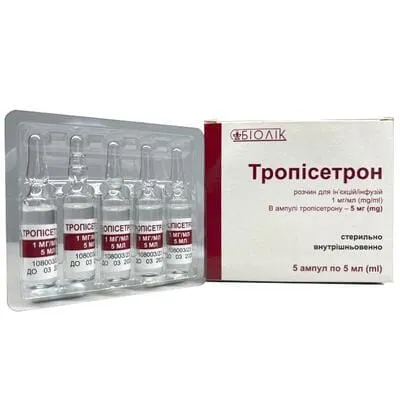
Table of Contents
INSTRUCTIONS FOR MEDICAL USE OF THE MEDICINAL PRODUCT TROPISERTRON (TROPISETRON)
Composition:
Active substance: tropisetron hydrochloride;
1 ml of solution contains 1.128 mg of tropisetron hydrochloride calculated as 1 mg of tropisetron;
Excipients: hydrochloric acid concentrated, sodium chloride, sodium acetate trihydrate, glacial acetic acid, water for injections.
Pharmaceutical form. Solution for injection/infusion.
Main physicochemical properties: clear, colorless liquid.
Pharmacotherapeutic group. Antiemetics and drugs used to relieve nausea. ATC code A04A A03.
Pharmacological Properties
Pharmacodynamics
Tropisetron is a potent and highly selective competitive antagonist of 5-HT₃ receptors— a subclass of serotonin receptors located on peripheral neurons and in the CNS. Surgical interventions and treatments involving certain agents, including some chemotherapeutic drugs, may promote the release of serotonin (5-HT) from enterochromaffin-like cells in the gastrointestinal mucosa. This triggers the vomiting reflex and associated nausea. Tropisetron selectively blocks the stimulation of presynaptic 5-HT₃ receptors on peripheral neurons involved in initiating the vomiting reflex. It may also exert an additional direct effect on 5-HT₃ receptors located in the CNS, which mediate the influence of the vagus nerve on the area postrema. This action is believed to underlie the antiemetic mechanism of tropisetron.
The duration of action of the drug is 24 hours, allowing for once-daily administration. In studies where the drug was used across multiple cycles of chemotherapy, its efficacy was maintained.
Tropisetron prevents nausea and vomiting induced by surgery or antineoplastic chemotherapy, with no extrapyramidal side effects observed.
Pharmacokinetics
Absorption
Tropisetron is almost completely absorbed from the gastrointestinal tract (over 95%). The half-absorption time averages approximately 20 minutes.
Distribution
Non-specific binding of tropisetron to plasma proteins (mainly to alpha₁-glycoproteins) is 71%. The volume of distribution in adults ranges from 400 to 600 L; in children aged 3 to 6 years, it is approximately 145 L, and in children aged 7 to 15 years, approximately 265 L.
Metabolism
Maximum plasma concentration is reached within 3 hours. Bioavailability depends on the dose: following a 5 mg dose, it is approximately 60%, increasing (up to 100%) after a 45 mg dose. Bioavailability and terminal half-life values in children are similar to those observed in healthy volunteers.
Tropisetron is metabolized via hydroxylation at the 5-, 6-, or 7-position of the indole ring, followed by conjugation reactions forming glucuronide or sulfate metabolites, which are excreted in urine or bile (the ratio of metabolites in urine to feces is 5:1). The metabolites of tropisetron exhibit significantly reduced activity at 5-HT₃ receptors and do not contribute to the drug's pharmacological effect. Tropisetron metabolism is associated with genetically determined polymorphism of the sparteine/debrisoquine metabolic pathway. It is known that nearly 8% of individuals of Caucasian ethnicity are poor metabolizers of sparteine/debrisoquine.
Repeated administration of tropisetron at doses exceeding 10 mg twice daily may saturate the hepatic enzyme system involved in tropisetron metabolism, potentially leading to dose-dependent increases in plasma tropisetron levels. However, even in individuals with reduced tropisetron metabolism, administration of such doses does not result in plasma concentrations exceeding tolerable levels. Therefore, it is expected that when the recommended dose (5 mg once daily) is used for 6 days to prevent nausea and vomiting during antineoplastic chemotherapy, accumulation of tropisetron will not be clinically significant.
Elimination
In individuals with rapid tropisetron metabolism, the elimination half-life (beta-phase) is approximately 8 hours; in patients with reduced metabolism, this value may increase up to 45 hours.
Total clearance of tropisetron is approximately 1 L/min, with renal clearance accounting for nearly 10% of this value. In patients with reduced tropisetron metabolism, total clearance decreases to 0.1–0.2 L/min, while renal clearance remains unchanged. Reduced extra-renal clearance leads to approximately a 4- to 5-fold prolongation of the elimination half-life and a 5- to 7-fold increase in the area under the concentration-time curve (AUC). Maximum concentration (Cₘₐₓ) and volume of distribution in these patients do not differ from those in rapid metabolizers. In patients with low tropisetron metabolism, the fraction of unchanged drug excreted in urine is higher than in patients with rapid tropisetron metabolism.
Clinical characteristics.
Indications.
- Prevention of nausea and vomiting associated with anti-cancer chemotherapy;
- prevention and treatment of postoperative nausea and vomiting;
- prevention of nausea and vomiting following gynecological intra-abdominal surgical procedures. To achieve the optimal benefit/risk ratio, the drug should be administered to patients with a history of postoperative nausea and vomiting.
Contraindications.
Hypersensitivity to tropisetron, to other 5-HT3 receptor antagonists, or to any of the excipients of the drug.
Interaction with other medicinal products and other forms of interaction.
Concomitant administration of the drug with medicinal products that induce hepatic enzyme systems (e.g., phenobarbital) leads to reduced plasma concentrations of tropisetron. Therefore, dose adjustments (increases) may be necessary in patients with rapid tropisetron metabolism (patients with slow metabolism do not require such adjustments). The effect of cytochrome P450 enzyme system inhibitors (such as cimetidine) on tropisetron plasma levels is negligible; dosage adjustments are not required in such cases. Interactions between tropisetron and anesthetic agents have not been studied.
Prolongation of the QTc interval has been observed in several patients receiving tropisetron who were also taking other medicinal products known to cause this effect. In clinical studies with tropisetron alone at therapeutic doses, QTc prolongation has not been reported. Nevertheless, caution should be exercised when administering the drug concomitantly with other medicinal products that may increase the QTc interval.
Special precautions for use.
Use in patients with reduced metabolism of sparteine/debrisoquine.
In patients belonging to this group (approximately 8% of the Caucasian population), the elimination half-life of tropisetron is prolonged (4 to 5 times longer compared to extensive metabolizers of sparteine/debrisoquine). However, administration of intravenous tropisetron at doses up to 40 mg twice daily for 7 days in healthy volunteers who are poor metabolizers of sparteine/debrisoquine did not result in any serious adverse events. These observations indicate that when treating poor metabolizers of sparteine/debrisoquine for 6-day treatment courses, there is no need to reduce the standard daily dose of 5 mg.
Use in patients with hepatic or renal impairment.
No changes in tropisetron pharmacokinetics have been observed in patients with acute hepatitis or fatty liver disease. In contrast, in patients with liver cirrhosis or impaired renal function, plasma concentrations of tropisetron may exceed those observed in healthy extensive metabolizers by up to 50%. However, when tropisetron is administered according to the recommended 6-day regimens at a dose of 5 mg/day, dose reduction is not required.
Use in patients with arterial hypertension.
Tropisetron should be used with caution in patients with uncontrolled arterial hypertension, and daily doses exceeding 10 mg should be avoided, as this may lead to a further increase in blood pressure.
Use in patients with heart disease.
Caution should be exercised when administering tropisetron to patients with cardiac rhythm or conduction disorders, as well as in patients receiving antiarrhythmic drugs or beta-blockers, due to limited experience with concomitant use of tropisetron and anesthetic agents in such cases.
Use in elderly patients.
There are no data indicating that dosage adjustment is required in elderly patients (compared to younger patients) or that different adverse reactions may occur in this population.
This medicinal product, when used at the maximum dose of 5 mg/day, contains less than 1 mmol (23 mg)/dose of sodium, i.e., is practically sodium-free.
Tropisetron must not be stored in opened ampoules; it should be used immediately after opening.
Use during pregnancy or breastfeeding.
Tropisetron should not be administered during pregnancy.
It is unknown whether tropisetron is excreted in breast milk; therefore, breastfeeding should be discontinued during treatment.
Ability to affect reaction speed when driving or operating machinery.
There are no data available on the effect of the drug on the ability to drive or operate machinery.
Patients experiencing adverse effects such as dizziness or increased fatigue should refrain from driving or operating machinery.
Method of Administration and Dosage
Prevention of nausea and vomiting associated with anti-tumor chemotherapy.
Children
For children aged 2 years and older, the recommended dose of the drug is 0.2 mg/kg (0.2 mL/kg); the maximum daily dose is 5 mg. On the first day, shortly before the administration of anti-tumor chemotherapy, the drug should be administered intravenously either as an infusion (after dilution with commonly used infusion solutions such as 0.9% sodium chloride solution, Ringer's solution, or 5% glucose solution) or as a slow injection (over not less than 1 minute). Then, from day 2 to day 6, the drug should be administered orally as a solution. Immediately after dilution with orange juice, the appropriate amount of tropisetron contained in the ampoule should be taken in the morning, 1 hour before eating.
Adults
For adults, tropisetron is recommended as a 6-day course at a dose of 5 mg/day. On the first day, it should be administered intravenously shortly before anti-tumor chemotherapy either as an infusion (after prior dilution) or as a slow injection (over not less than 1 minute). Then, from day 2 to day 6, the drug should be administered orally in the form of capsules.
If tropisetron alone provides insufficient antiemetic effect, the therapeutic effect can be enhanced by adding dexamethasone.
Management of nausea and vomiting occurring in the postoperative period.
Adults
It is recommended to administer tropisetron intravenously as a single dose of 2 mg either as an infusion (after prior dilution in 40 mL of solution) or as a slow injection (over not less than 30 seconds). To prevent postoperative nausea and vomiting, the drug should be administered shortly before induction of anesthesia.
Instructions for use.
The ampoules contain 1 mg/1 mL of aqueous solution. The solution contained in the ampoules is compatible with the following injection solutions (1 mg of tropisetron is diluted in 20 mL): 5% glucose solution, 10% mannitol, Ringer's solution, 0.9% sodium chloride solution, and 0.3% potassium chloride solution. The solution in the ampoules is also not inactivated in standard infusion containers (made of glass or PVC) and with standard infusion sets. Further diluted solutions are physically and chemically stable for at least 24 hours. From a microbiological standpoint, the drug should be used immediately. Otherwise, the storage time and conditions remain the responsibility of the user and should not exceed 24 hours at a temperature of 2–8 °C.
Children. The drug is indicated for use in children aged 2 years and older.
Overdose.
Symptoms. In cases of repeated administration of very high doses, visual hallucinations have been observed; in patients with pre-existing arterial hypertension, increased blood pressure has occurred.
Treatment. Symptomatic treatment under continuous monitoring of vital functions and the patient's general condition is indicated.
Adverse reactions.
When the drug is used at recommended doses, adverse effects are transient. Headache was the most commonly reported adverse effect with the 2 mg dose. Constipation was observed with the 5 mg dose; dizziness, increased fatigue, and gastrointestinal disturbances such as abdominal pain and diarrhea occurred less frequently.
As with other 5-HT3 receptor antagonists, hypersensitivity reactions ("Type I reactions") have been observed, characterized by one or more of the following symptoms: flushing and/or generalized urticaria, chest discomfort, dyspnea, arterial hypotension.
Immune system disorders: hypersensitivity; anaphylactic reactions/shock were observed very rarely.
Nervous system disorders: headache, drowsiness, dizziness, syncope.
Cardiac disorders: cardiac arrest and circulatory arrest have been reported very rarely.
Vascular disorders: arterial hypotension or hypertension, flushing; collapse has been reported very rarely.
Respiratory, thoracic and mediastinal disorders: dyspnea, chest discomfort, shortness of breath; bronchospasm has been reported very rarely.
Gastrointestinal disorders: constipation, diarrhea, abdominal pain.
Metabolism and nutrition disorders: anorexia.
Skin and subcutaneous tissue disorders: generalized urticaria; rash and erythema were observed very rarely.
General disorders and administration site conditions: increased fatigue.
Some of these symptoms may be caused by concomitant therapy or the underlying disease.
Shelf life. 3 years.
Storage conditions.
Store protected from light at a temperature between 2 °C and 8 °C. Do not freeze! Keep out of reach of children.
Incompatibilities.
Do not use solvents not specified in the section "Dosage and administration".
Packaging.
5 ml in an ampoule; 5 ampoules in a pack; 5 ampoules in a blister, 1 blister in a pack.
Prescription category. Prescription only.
Manufacturer.
LLC "BIOLIK PHARMA".
Manufacturer's location and address of place of business.
Legal entity location:
Pomirky, 70, Kharkiv, Kharkiv region, 61070, Ukraine.
Place of business address:
Pomirky-70, building without number, Kharkiv, Kharkiv region, 61070, Ukraine.